S.Prasanth Kumar, Bioinformatician Drug Design Pharmacophore Identification S.Prasanth Kumar, Bioinformatician S.Prasanth Kumar   Dept. of Bioinformatics  Applied Botany Centre (ABC)  Gujarat University, Ahmedabad, INDIA www.facebook.com/Prasanth Sivakumar FOLLOW ME ON  ACCESS MY RESOURCES IN SLIDESHARE prasanthperceptron CONTACT ME [email_address]
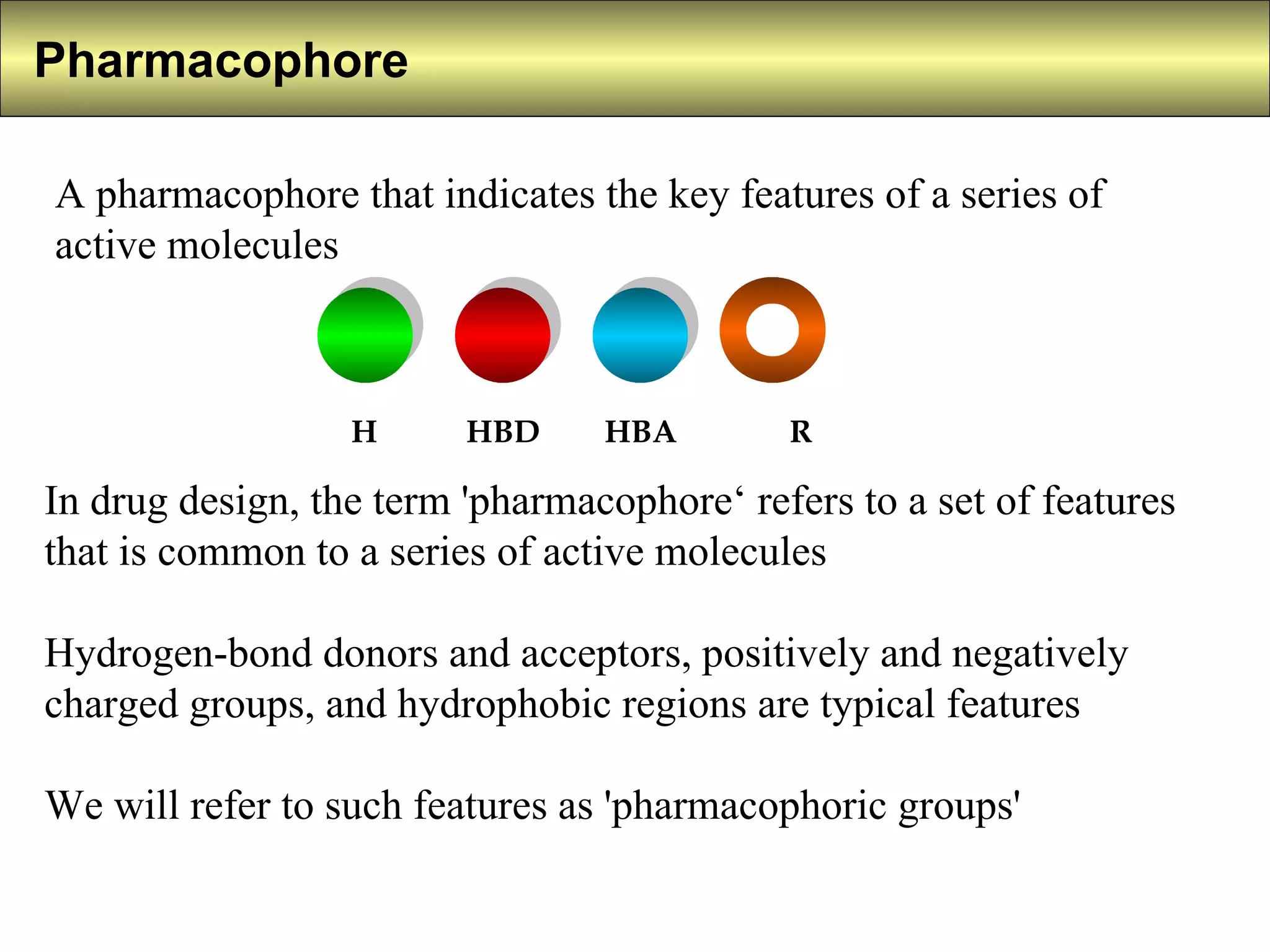
Pharmacophore  A pharmacophore that indicates the key features of a series of active molecules  In drug design, the term 'pharmacophore‘ refers to a set of features that is common to a series of active molecules Hydrogen-bond donors and acceptors, positively and negatively charged groups, and hydrophobic regions are typical features We will refer to such features as 'pharmacophoric groups'  H  HBD  HBA  R
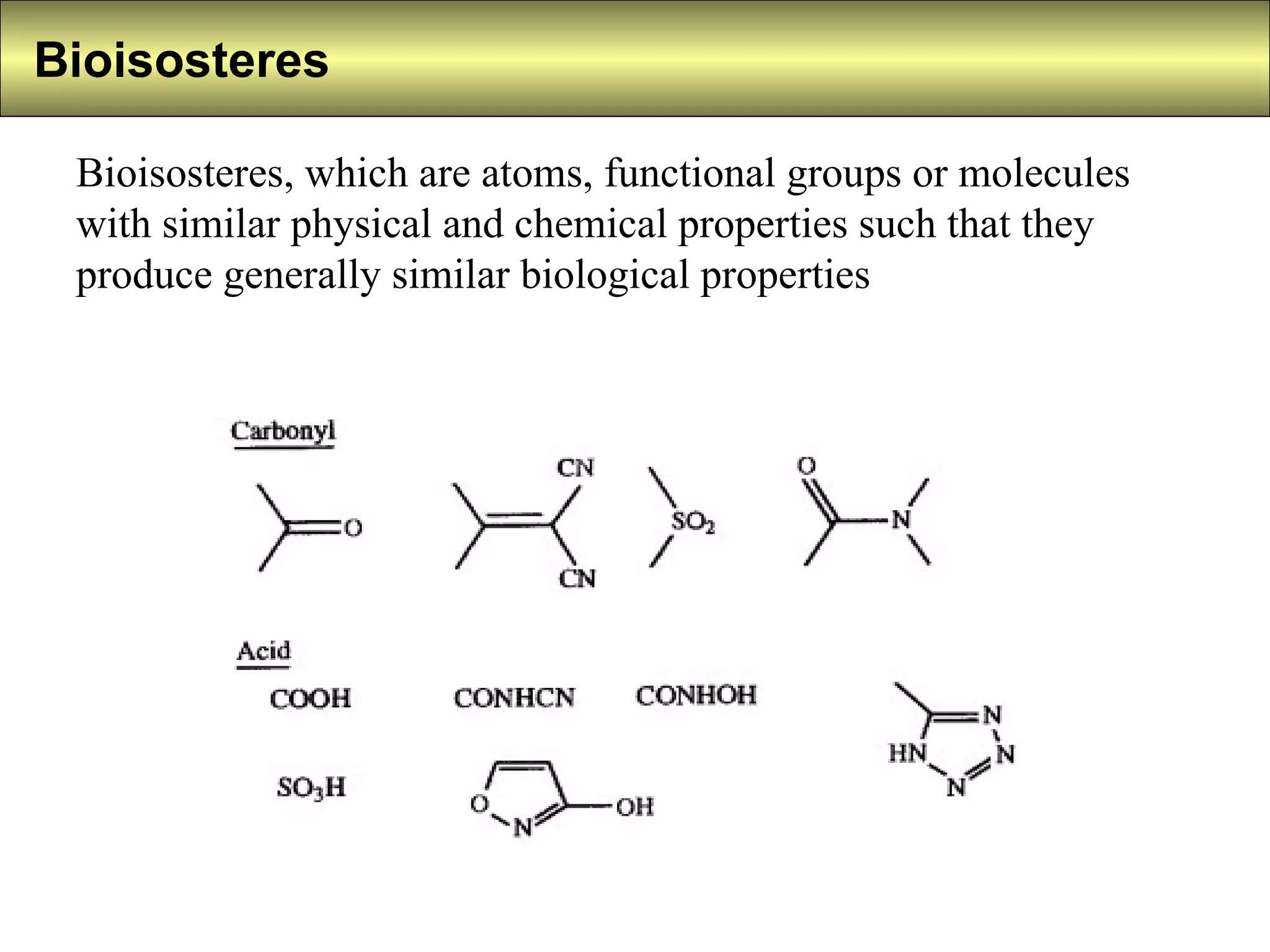
Bioisosteres Bioisosteres, which are atoms, functional groups or molecules with similar physical and chemical properties such that they produce generally similar biological properties
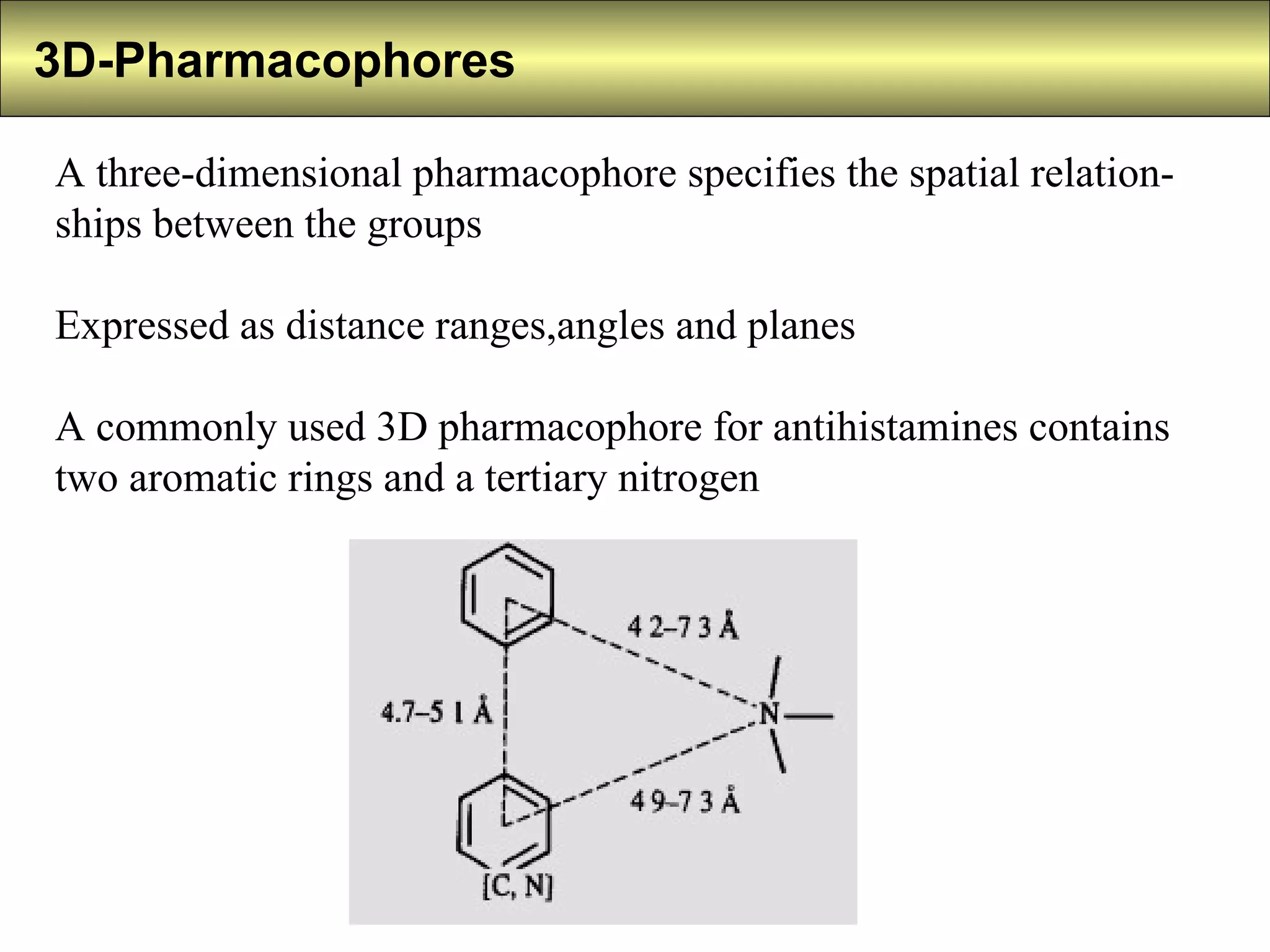
3D-Pharmacophores A three-dimensional pharmacophore specifies the spatial relation-  ships between the groups Expressed as distance ranges,angles and planes A commonly used 3D pharmacophore for antihistamines contains two aromatic rings and a tertiary nitrogen
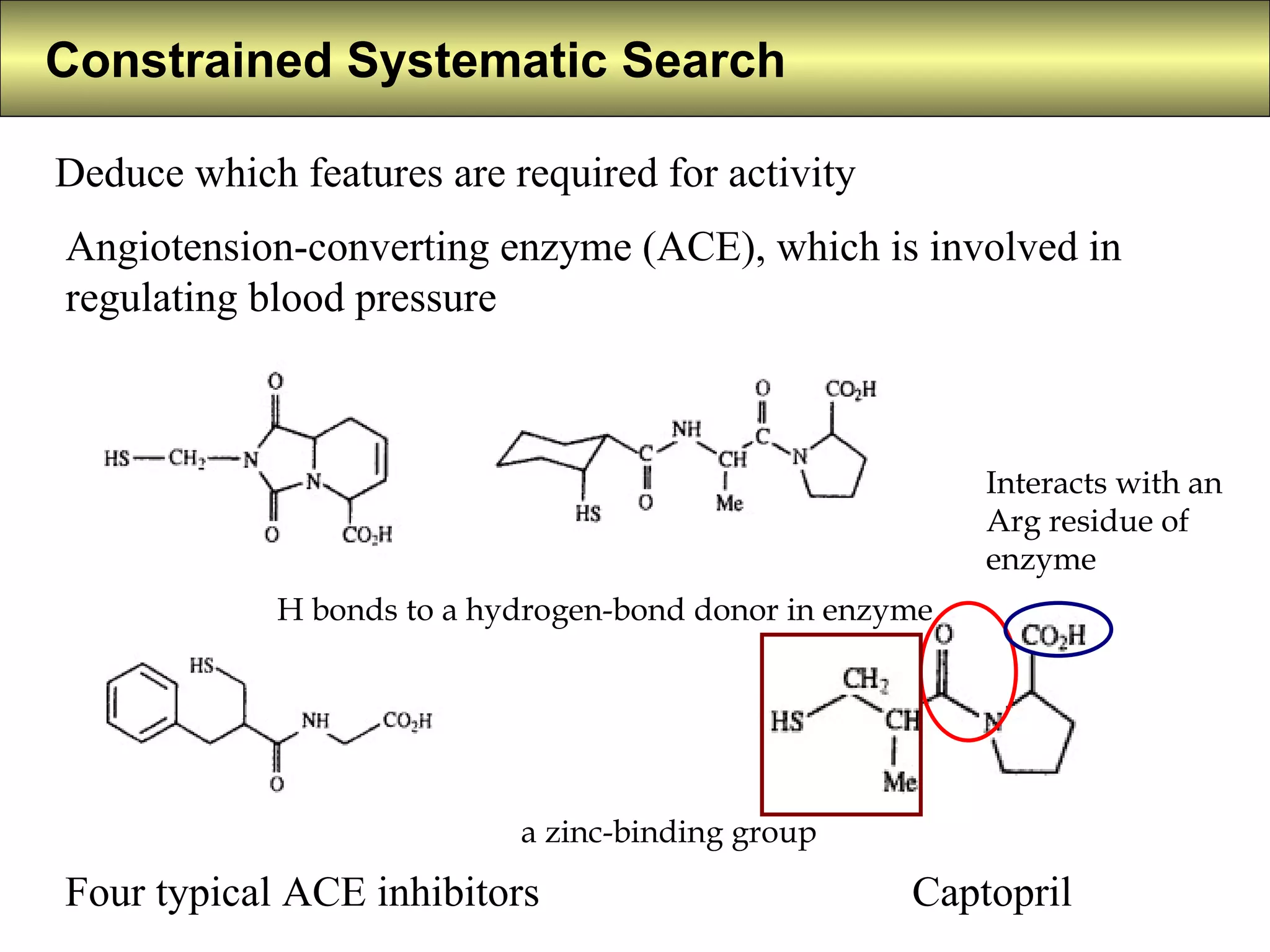
Constrained Systematic Search   Deduce which features are required for activity  Angiotension-converting enzyme (ACE), which is involved in regulating blood pressure  Four typical ACE inhibitors  Captopril  Interacts with an Arg residue of enzyme a zinc-binding group H bonds to a hydrogen-bond donor in enzyme
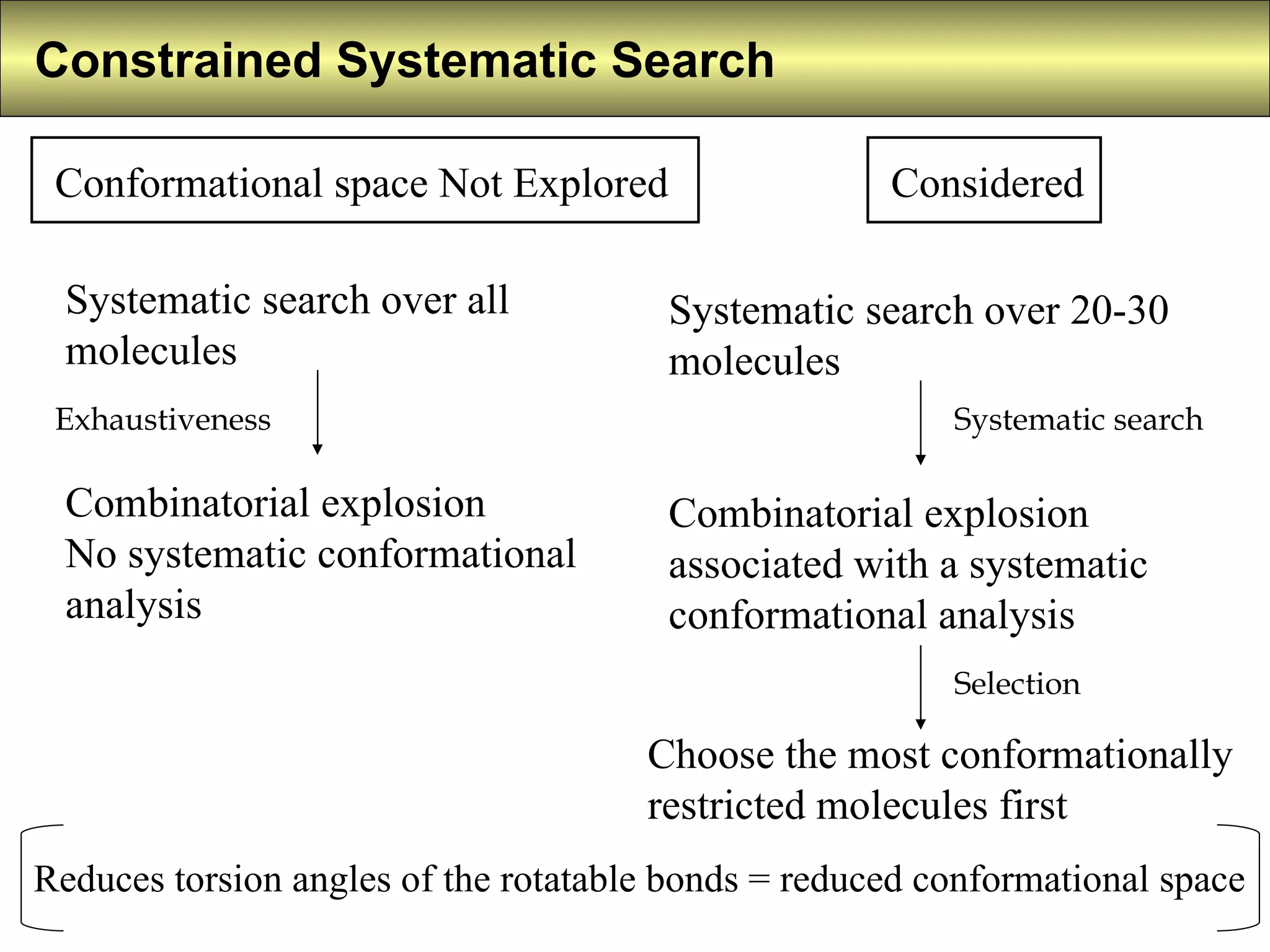
Constrained Systematic Search   Systematic search over all molecules  Combinatorial explosion No systematic conformational analysis Considered  Reduces torsion angles of the rotatable bonds = reduced conformational space Conformational space Not Explored Systematic search over 20-30 molecules  Combinatorial explosion associated with a systematic conformational analysis Exhaustiveness  Systematic search Choose the most conformationally restricted molecules first Selection
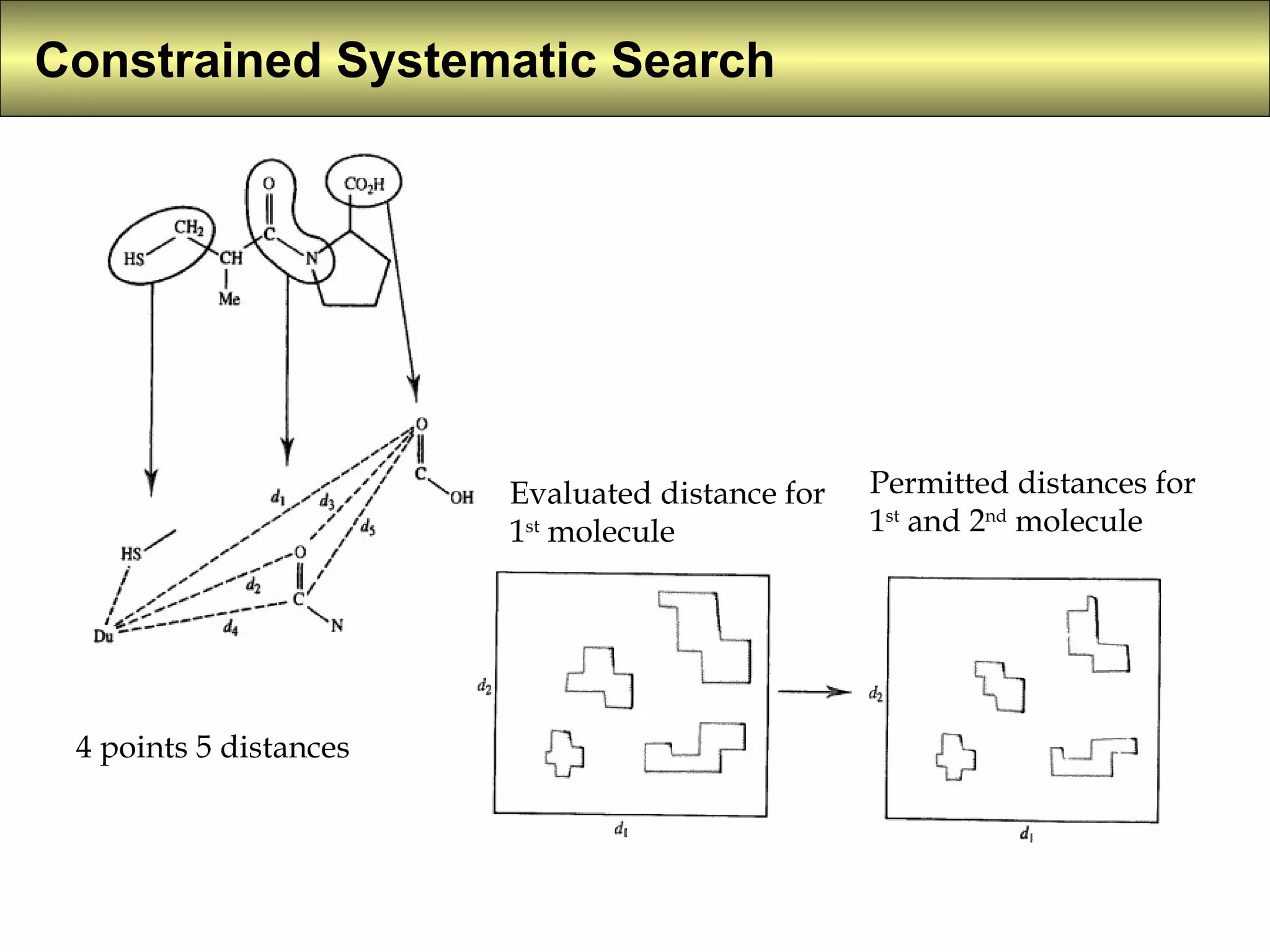
Constrained Systematic Search   Evaluated distance for 1 st  molecule Permitted distances for 1 st  and 2 nd  molecule 4 points 5 distances
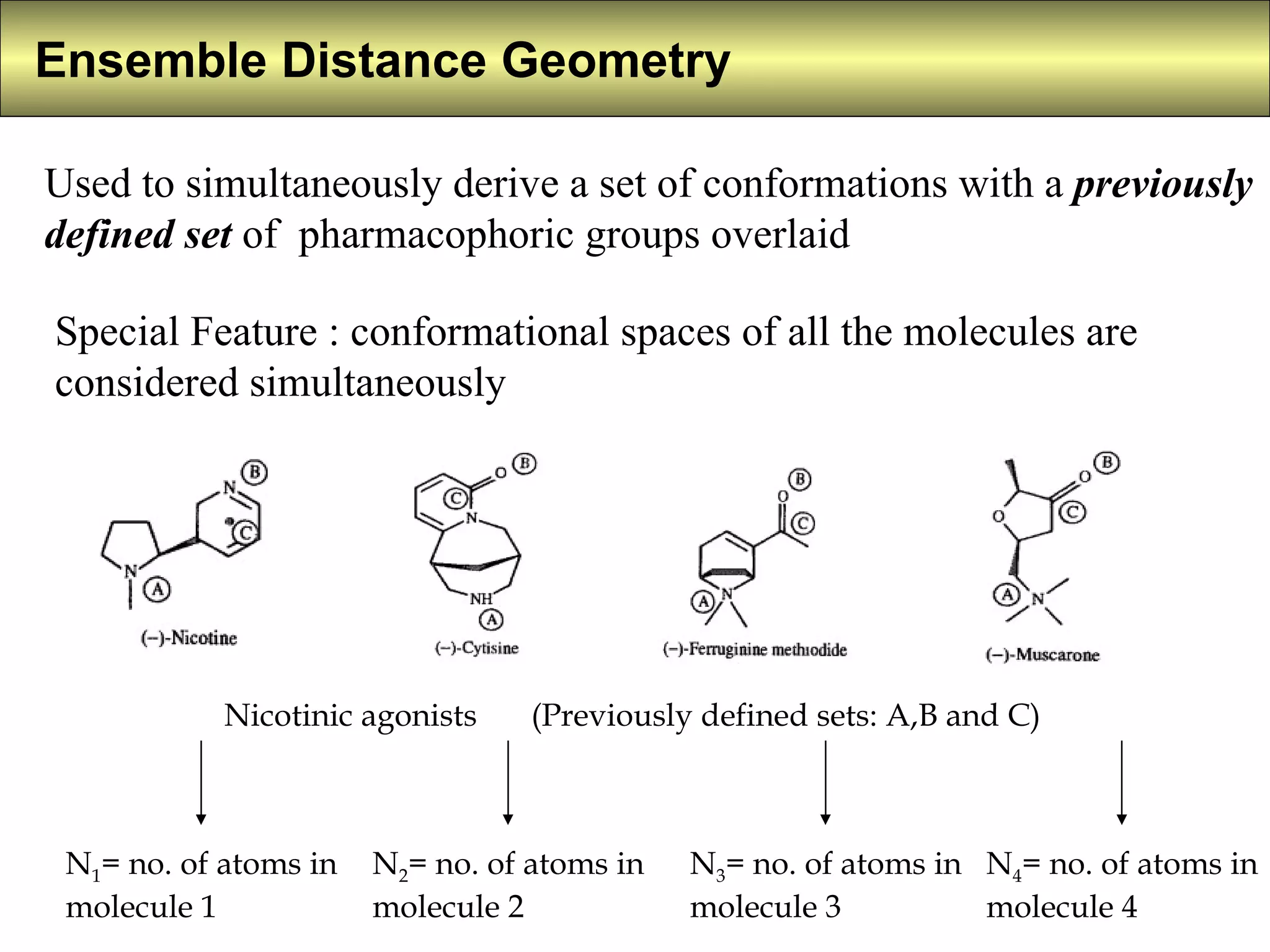
Ensemble Distance Geometry  Used to simultaneously derive a set of conformations with a  previously defined set  of  pharmacophoric groups overlaid  Special Feature : conformational spaces of all the molecules are considered simultaneously Nicotinic agonists  (Previously defined sets: A,B and C) N 1 = no. of atoms in molecule 1 N 2 = no. of atoms in molecule 2 N 3 = no. of atoms in molecule 3 N 4 = no. of atoms in molecule 4
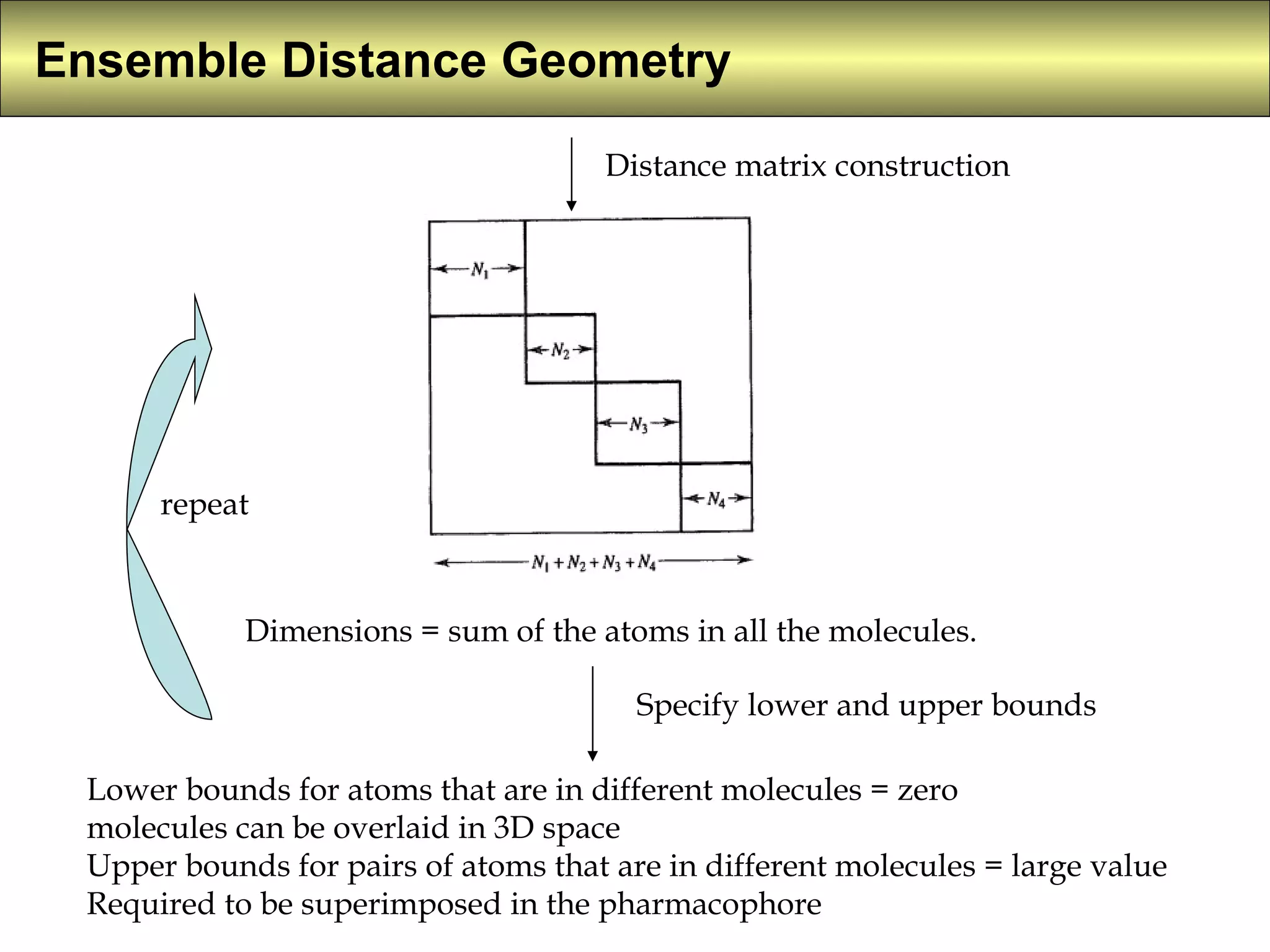
Ensemble Distance Geometry  Distance matrix construction Dimensions = sum of the atoms in all the molecules.  Specify lower and upper bounds Lower bounds for atoms that are in different molecules = zero molecules can be overlaid in 3D space Upper bounds for pairs of atoms that are in different molecules = large value Required to be superimposed in the pharmacophore repeat
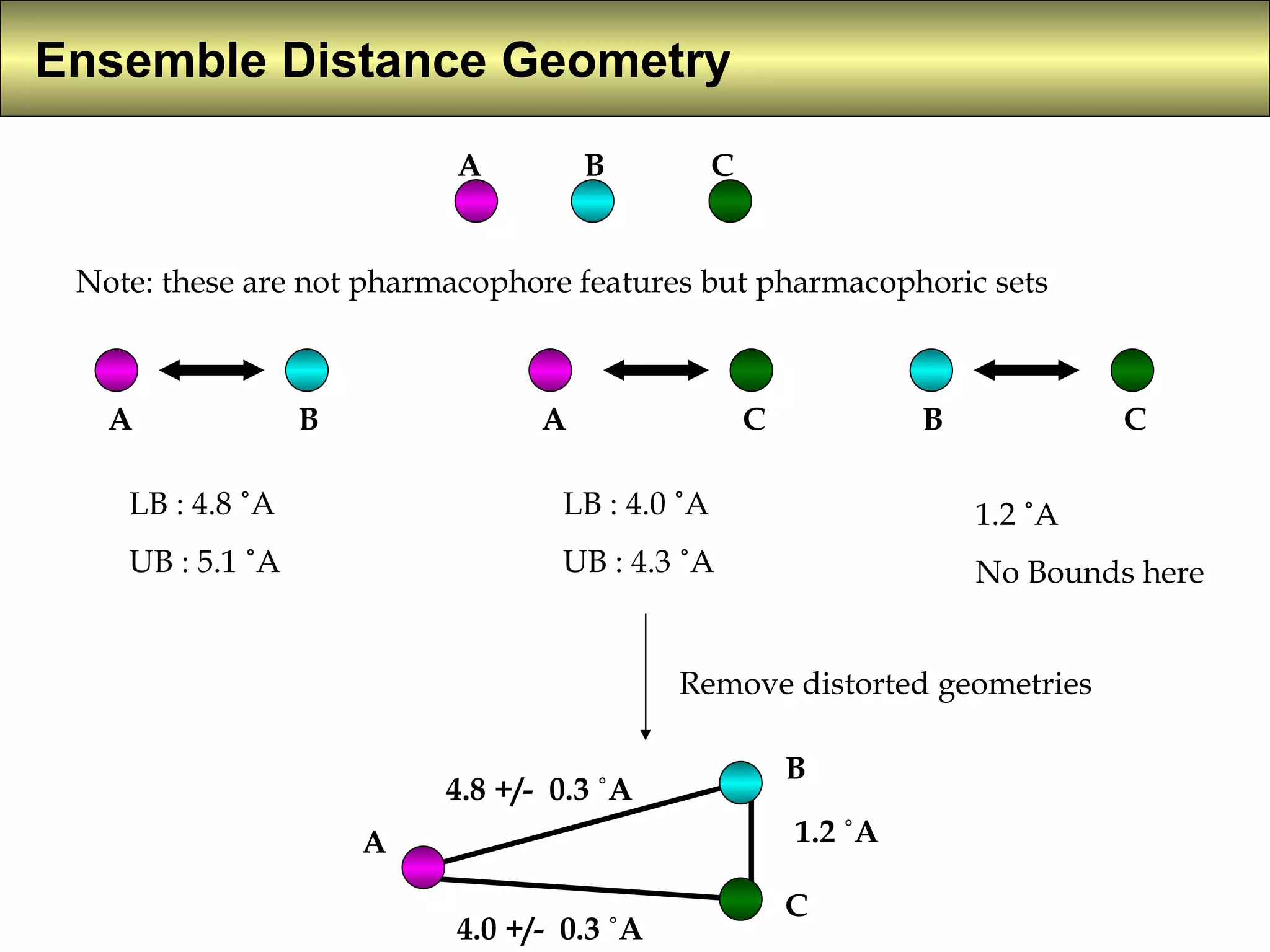
Ensemble Distance Geometry  A B C Note: these are not pharmacophore features but pharmacophoric sets A A B B C C LB : 4.8 ˚A UB : 5.1 ˚A LB : 4.0 ˚A UB : 4.3 ˚A 1.2 ˚A No Bounds here Remove distorted geometries A B C 4.8 +/-  0.3 ˚A 1.2 ˚A 4.0 +/-  0.3 ˚A
Clique Detection Methods   When many pharmacophoric groups are present in the molecule it may be very difficult to identify all possible combinations of the functional groups  Clique is defined as a 'maximal completely connected subgraph'  Clique detection algorithms can be applied to a set of pre-calculated conformations of the molecules Cliques are based upon the graph-theoretical approach to molecular structure
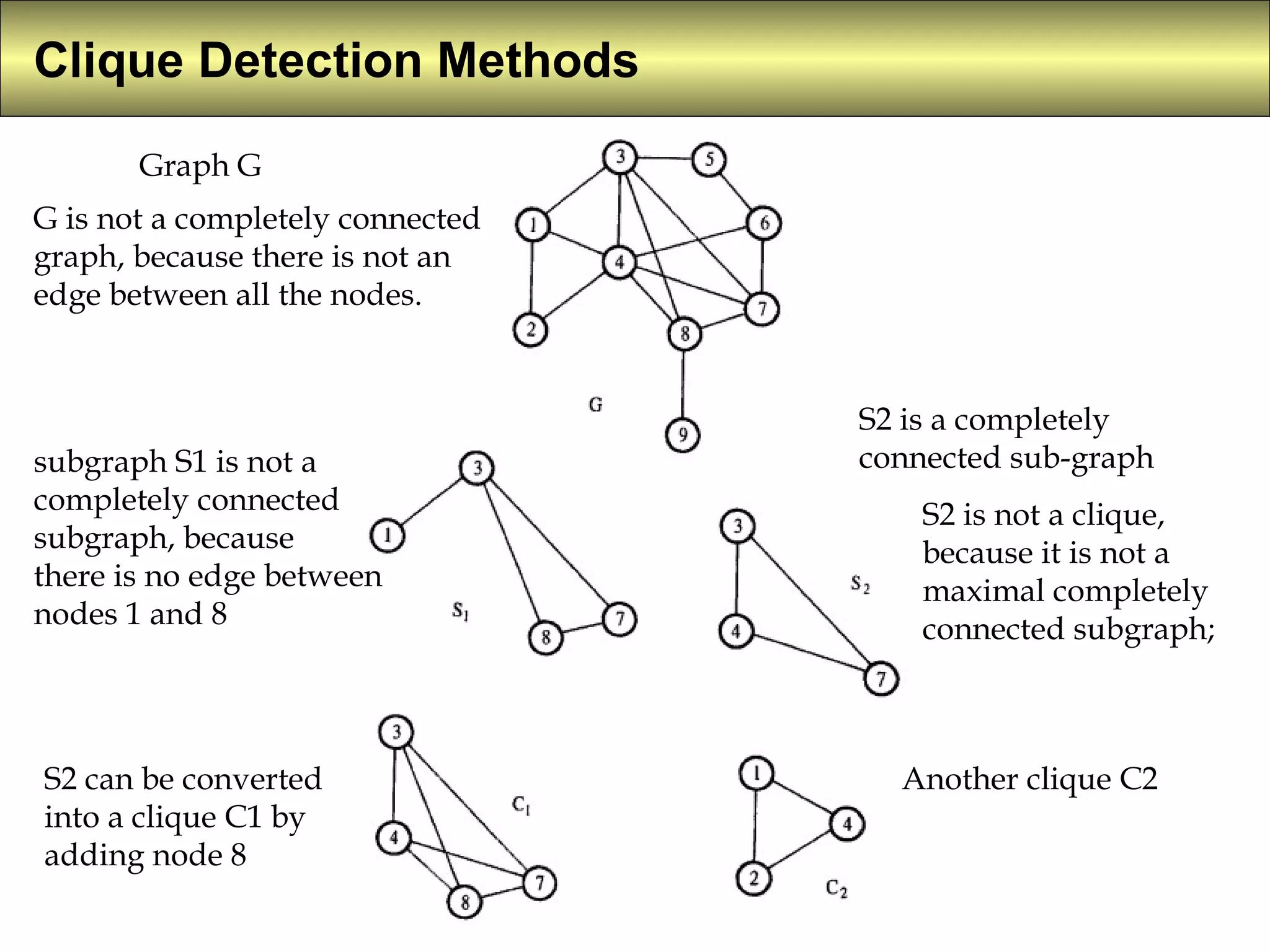
Clique Detection Methods   Graph G G is not a completely connected graph, because there is not an edge between all the nodes.  subgraph S1 is not a completely connected subgraph, because  there is no edge between nodes 1 and 8 S2 is a completely connected sub-graph S2 is not a clique, because it is not a maximal completely connected subgraph;  S2 can be converted into a clique C1 by adding node 8 Another clique C2
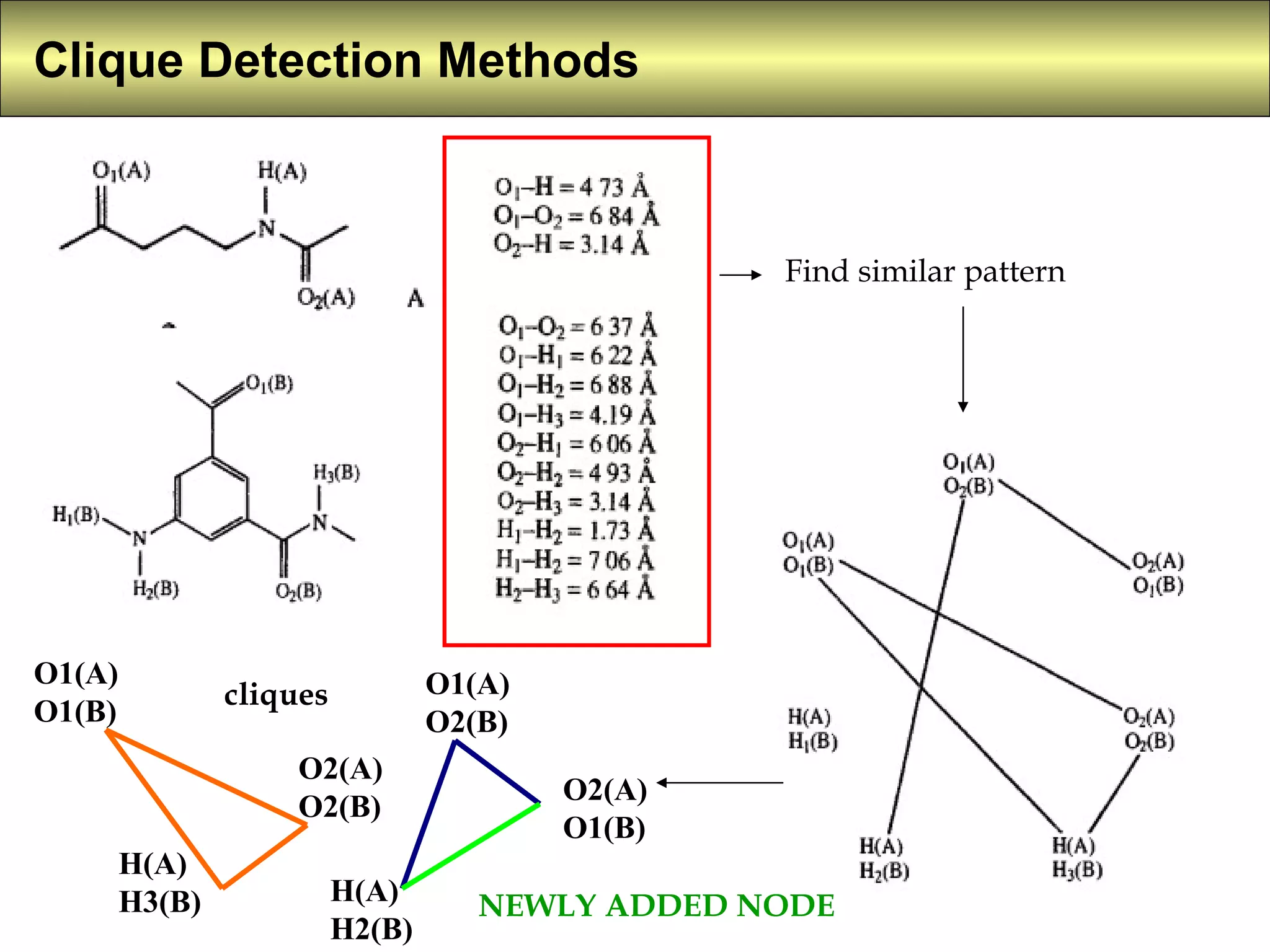
Clique Detection Methods   Find similar pattern cliques O1(A) O2(B) O2(A) O1(B) H(A) H2(B) O1(A) O1(B) O2(A) O2(B) H(A) H3(B) NEWLY ADDED NODE
Thank You For Your Attention !!!

Pharmacophore identification

  • 1.
    S.Prasanth Kumar, BioinformaticianDrug Design Pharmacophore Identification S.Prasanth Kumar, Bioinformatician S.Prasanth Kumar Dept. of Bioinformatics Applied Botany Centre (ABC) Gujarat University, Ahmedabad, INDIA www.facebook.com/Prasanth Sivakumar FOLLOW ME ON ACCESS MY RESOURCES IN SLIDESHARE prasanthperceptron CONTACT ME [email_address]
  • 2.
    Pharmacophore Apharmacophore that indicates the key features of a series of active molecules In drug design, the term 'pharmacophore‘ refers to a set of features that is common to a series of active molecules Hydrogen-bond donors and acceptors, positively and negatively charged groups, and hydrophobic regions are typical features We will refer to such features as 'pharmacophoric groups' H HBD HBA R
  • 3.
    Bioisosteres Bioisosteres, whichare atoms, functional groups or molecules with similar physical and chemical properties such that they produce generally similar biological properties
  • 4.
    3D-Pharmacophores A three-dimensionalpharmacophore specifies the spatial relation- ships between the groups Expressed as distance ranges,angles and planes A commonly used 3D pharmacophore for antihistamines contains two aromatic rings and a tertiary nitrogen
  • 5.
    Constrained Systematic Search Deduce which features are required for activity Angiotension-converting enzyme (ACE), which is involved in regulating blood pressure Four typical ACE inhibitors Captopril Interacts with an Arg residue of enzyme a zinc-binding group H bonds to a hydrogen-bond donor in enzyme
  • 6.
    Constrained Systematic Search Systematic search over all molecules Combinatorial explosion No systematic conformational analysis Considered Reduces torsion angles of the rotatable bonds = reduced conformational space Conformational space Not Explored Systematic search over 20-30 molecules Combinatorial explosion associated with a systematic conformational analysis Exhaustiveness Systematic search Choose the most conformationally restricted molecules first Selection
  • 7.
    Constrained Systematic Search Evaluated distance for 1 st molecule Permitted distances for 1 st and 2 nd molecule 4 points 5 distances
  • 8.
    Ensemble Distance Geometry Used to simultaneously derive a set of conformations with a previously defined set of pharmacophoric groups overlaid Special Feature : conformational spaces of all the molecules are considered simultaneously Nicotinic agonists (Previously defined sets: A,B and C) N 1 = no. of atoms in molecule 1 N 2 = no. of atoms in molecule 2 N 3 = no. of atoms in molecule 3 N 4 = no. of atoms in molecule 4
  • 9.
    Ensemble Distance Geometry Distance matrix construction Dimensions = sum of the atoms in all the molecules. Specify lower and upper bounds Lower bounds for atoms that are in different molecules = zero molecules can be overlaid in 3D space Upper bounds for pairs of atoms that are in different molecules = large value Required to be superimposed in the pharmacophore repeat
  • 10.
    Ensemble Distance Geometry A B C Note: these are not pharmacophore features but pharmacophoric sets A A B B C C LB : 4.8 ˚A UB : 5.1 ˚A LB : 4.0 ˚A UB : 4.3 ˚A 1.2 ˚A No Bounds here Remove distorted geometries A B C 4.8 +/- 0.3 ˚A 1.2 ˚A 4.0 +/- 0.3 ˚A
  • 11.
    Clique Detection Methods When many pharmacophoric groups are present in the molecule it may be very difficult to identify all possible combinations of the functional groups Clique is defined as a 'maximal completely connected subgraph' Clique detection algorithms can be applied to a set of pre-calculated conformations of the molecules Cliques are based upon the graph-theoretical approach to molecular structure
  • 12.
    Clique Detection Methods Graph G G is not a completely connected graph, because there is not an edge between all the nodes. subgraph S1 is not a completely connected subgraph, because there is no edge between nodes 1 and 8 S2 is a completely connected sub-graph S2 is not a clique, because it is not a maximal completely connected subgraph; S2 can be converted into a clique C1 by adding node 8 Another clique C2
  • 13.
    Clique Detection Methods Find similar pattern cliques O1(A) O2(B) O2(A) O1(B) H(A) H2(B) O1(A) O1(B) O2(A) O2(B) H(A) H3(B) NEWLY ADDED NODE
  • 14.
    Thank You ForYour Attention !!!