S.Prasanth Kumar, Bioinformatician Proteomics 2D-PAGE & Proteome Databases S.Prasanth Kumar   Dept. of Bioinformatics  Applied Botany Centre (ABC)  Gujarat University, Ahmedabad, INDIA www.facebook.com/Prasanth Sivakumar FOLLOW ME ON  ACCESS MY RESOURCES IN SLIDESHARE prasanthperceptron CONTACT ME [email_address]
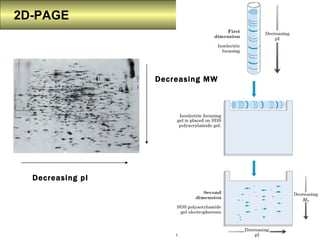
2D-PAGE Decreasing pI Decreasing MW
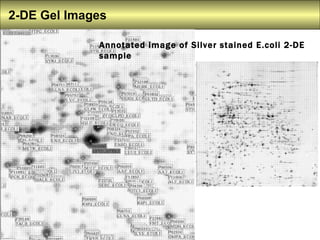
2-DE Gel Images Annotated image of Silver stained E.coli 2-DE sample
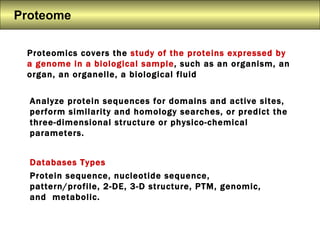
Proteome Proteomics covers the  study of the proteins expressed by a genome in a biological sample , such as an organism, an organ, an organelle, a biological fluid  Analyze protein sequences for domains and active sites, perform similarity and homology searches, or predict the three-dimensional structure or physico-chemical parameters.  Protein sequence, nucleotide sequence, pattern/profile, 2-DE, 3-D structure, PTM, genomic, and  metabolic.  Databases Types
Protein sequence databases  SWISS-PROT  an  annotated  universal sequence database, TrEMBL   an  automatically generated  sequence database with    repository character, which supplements SWISS-PROT.  SWISS-PROT [http://www.expasy.org/sprot/]  a curated protein  sequence database which provides a high level of annotation Types of Annotations:   Description of a protein's function, its domain structure, PTMs, conflicts  between literature references and variants.  It also provides a  minimal level of redundancy ,  a high level of integration with other bio molecular  databases , and an extensive external documentation. (Created in 1986:Main Host-ExPaSy)
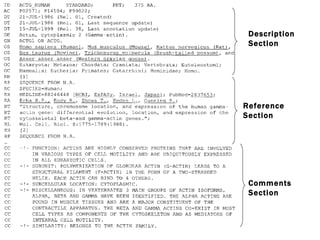
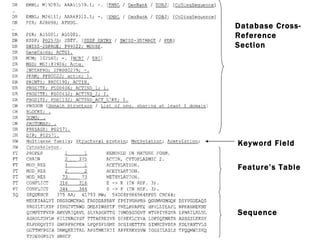
SWISSPROT format  Description Section Reference Section Comments Section
Database Cross-Reference Section Keyword Field Feature’s Table Sequence
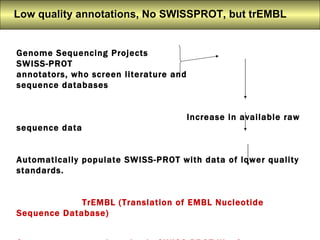
Low quality annotations, No SWISSPROT, but trEMBL Genome Sequencing Projects  SWISS-PROT annotators, who screen literature and  sequence databases  Increase in available raw sequence data Automatically populate SWISS-PROT with data of lower quality standards.  TrEMBL (Translation of EMBL Nucleotide Sequence Database) Computer-annotated entries in SWISS-PROT-like format .  It is populated by protein sequences translated from the coding sequences  (CDS) in EMBL and is a supplement to SWISS-PROT
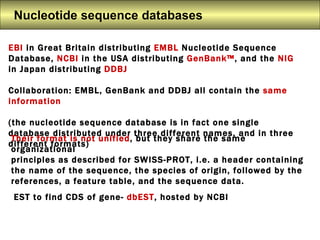
Nucleotide sequence databases EBI  in Great Britain distributing  EMBL  Nucleotide Sequence Database,  NCBI  in the USA distributing  GenBank™ , and the  NIG  in Japan distributing  DDBJ Collaboration: EMBL, GenBank and DDBJ all contain the  same information (the nucleotide sequence database is in fact one single database distributed under three different names, and in three different formats) Their format is not unified , but they share the same organizational  principles as described for SWISS-PROT, i.e. a header containing the name of the sequence, the species of origin, followed by the references, a feature table, and the sequence data.  EST to find CDS of gene-  dbEST , hosted by NCBI
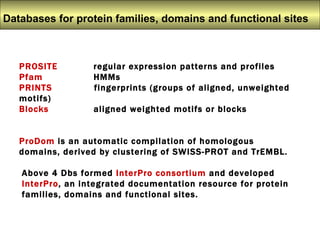
PROSITE   regular expression patterns and profiles Pfam   HMMs PRINTS   fingerprints (groups of aligned, unweighted motifs) Blocks  aligned weighted motifs or blocks ProDom  is an automatic compilation of homologous domains, derived by clustering of SWISS-PROT and TrEMBL.  Databases for protein families, domains and functional sites  Above 4 Dbs formed  InterPro consortium  and developed  InterPro , an integrated documentation resource for protein families, domains and functional sites.
2-DE databases   Information on proteins identified on 2-DE and consist of two major components:  image data and textual information .  An image is the representation of a stained gel scanned optically. Apparent spots represent the position of focused protein forms and are linked to the textual information component of the database.  Textual information includes,  Data on apparent  pI  and  Mw  of the spots, the name and description of  the protein, the identification method, bibliographical references, and cross- references to SWISS-PROT and other databases.
SWISS-2DPAGE The SWISS-2DPAGE database was created and is maintained at  the SIB in collaboration with the University Hospital of Geneva.  In March 2000, it contained 26 reference maps from human, mouse, Saccharomyces cerevisiae, Escherichia coii and Dictyostellum  Discoideum It includes specific fields, such as  the type of master gel from which the protein spot has been identified, the list of gel images associated with the entry, as well as other 2-DE specific data, such as the mapping procedure, the spot identifier, the experimental pi and Mw, the peptide mass fingerprint and the amino-acid composition - if experimentally determined.
Post-translational modification databases  RESID   a general database of protein structure modifications  (http://www-nbrfgeorgetown.edu/pirwww/dbinfo/resid.html), maintained  by the NBRF in the USA and the PIR group The database contains descriptive, chemical, structural, and ibliographical information on 283 (Release 22.1, July 2000) types of modified amino-acid residues.  GlycoSuiteDB  (http://www.glycosuite.com) is an annotated database of glycan structures. The database is provided by Proteomesystems Ltd and contains information about most published O- and N-linked glycans.
O-GLYCBASE , a database of O-glycosylated proteins (http://www.cbs.dtu.dk/databases/OGLYCBASE/),  PhosphoBase , a database of phosphorylation sites in proteins and  peptides (http://www.cbs.dtu.dk/databases/PhosphoBase/) Both databases are maintained by the Center for Biological Sequence Analysis ( CBS ) in Denmark, which also provides prediction servers for both types of modifications ( NetOGlyc and NetPhos ).  Post-translational modification databases
Thank You For Your Attention !!!

Proteome databases

  • 1.
    S.Prasanth Kumar, BioinformaticianProteomics 2D-PAGE & Proteome Databases S.Prasanth Kumar Dept. of Bioinformatics Applied Botany Centre (ABC) Gujarat University, Ahmedabad, INDIA www.facebook.com/Prasanth Sivakumar FOLLOW ME ON ACCESS MY RESOURCES IN SLIDESHARE prasanthperceptron CONTACT ME [email_address]
  • 2.
    2D-PAGE Decreasing pIDecreasing MW
  • 3.
    2-DE Gel ImagesAnnotated image of Silver stained E.coli 2-DE sample
  • 4.
    Proteome Proteomics coversthe study of the proteins expressed by a genome in a biological sample , such as an organism, an organ, an organelle, a biological fluid Analyze protein sequences for domains and active sites, perform similarity and homology searches, or predict the three-dimensional structure or physico-chemical parameters. Protein sequence, nucleotide sequence, pattern/profile, 2-DE, 3-D structure, PTM, genomic, and metabolic. Databases Types
  • 5.
    Protein sequence databases SWISS-PROT an annotated universal sequence database, TrEMBL an automatically generated sequence database with repository character, which supplements SWISS-PROT. SWISS-PROT [http://www.expasy.org/sprot/] a curated protein sequence database which provides a high level of annotation Types of Annotations: Description of a protein's function, its domain structure, PTMs, conflicts between literature references and variants. It also provides a minimal level of redundancy , a high level of integration with other bio molecular databases , and an extensive external documentation. (Created in 1986:Main Host-ExPaSy)
  • 6.
    SWISSPROT format Description Section Reference Section Comments Section
  • 7.
    Database Cross-Reference SectionKeyword Field Feature’s Table Sequence
  • 8.
    Low quality annotations,No SWISSPROT, but trEMBL Genome Sequencing Projects SWISS-PROT annotators, who screen literature and sequence databases Increase in available raw sequence data Automatically populate SWISS-PROT with data of lower quality standards. TrEMBL (Translation of EMBL Nucleotide Sequence Database) Computer-annotated entries in SWISS-PROT-like format . It is populated by protein sequences translated from the coding sequences (CDS) in EMBL and is a supplement to SWISS-PROT
  • 9.
    Nucleotide sequence databasesEBI in Great Britain distributing EMBL Nucleotide Sequence Database, NCBI in the USA distributing GenBank™ , and the NIG in Japan distributing DDBJ Collaboration: EMBL, GenBank and DDBJ all contain the same information (the nucleotide sequence database is in fact one single database distributed under three different names, and in three different formats) Their format is not unified , but they share the same organizational principles as described for SWISS-PROT, i.e. a header containing the name of the sequence, the species of origin, followed by the references, a feature table, and the sequence data. EST to find CDS of gene- dbEST , hosted by NCBI
  • 10.
    PROSITE regular expression patterns and profiles Pfam HMMs PRINTS fingerprints (groups of aligned, unweighted motifs) Blocks aligned weighted motifs or blocks ProDom is an automatic compilation of homologous domains, derived by clustering of SWISS-PROT and TrEMBL. Databases for protein families, domains and functional sites Above 4 Dbs formed InterPro consortium and developed InterPro , an integrated documentation resource for protein families, domains and functional sites.
  • 11.
    2-DE databases Information on proteins identified on 2-DE and consist of two major components: image data and textual information . An image is the representation of a stained gel scanned optically. Apparent spots represent the position of focused protein forms and are linked to the textual information component of the database. Textual information includes, Data on apparent pI and Mw of the spots, the name and description of the protein, the identification method, bibliographical references, and cross- references to SWISS-PROT and other databases.
  • 12.
    SWISS-2DPAGE The SWISS-2DPAGEdatabase was created and is maintained at the SIB in collaboration with the University Hospital of Geneva. In March 2000, it contained 26 reference maps from human, mouse, Saccharomyces cerevisiae, Escherichia coii and Dictyostellum Discoideum It includes specific fields, such as the type of master gel from which the protein spot has been identified, the list of gel images associated with the entry, as well as other 2-DE specific data, such as the mapping procedure, the spot identifier, the experimental pi and Mw, the peptide mass fingerprint and the amino-acid composition - if experimentally determined.
  • 13.
    Post-translational modification databases RESID a general database of protein structure modifications (http://www-nbrfgeorgetown.edu/pirwww/dbinfo/resid.html), maintained by the NBRF in the USA and the PIR group The database contains descriptive, chemical, structural, and ibliographical information on 283 (Release 22.1, July 2000) types of modified amino-acid residues. GlycoSuiteDB (http://www.glycosuite.com) is an annotated database of glycan structures. The database is provided by Proteomesystems Ltd and contains information about most published O- and N-linked glycans.
  • 14.
    O-GLYCBASE , adatabase of O-glycosylated proteins (http://www.cbs.dtu.dk/databases/OGLYCBASE/), PhosphoBase , a database of phosphorylation sites in proteins and peptides (http://www.cbs.dtu.dk/databases/PhosphoBase/) Both databases are maintained by the Center for Biological Sequence Analysis ( CBS ) in Denmark, which also provides prediction servers for both types of modifications ( NetOGlyc and NetPhos ). Post-translational modification databases
  • 15.
    Thank You ForYour Attention !!!