Nucleic Acid
Database
Database Utilities
• Provides structural references in the form
of base pair annotation for DNA, RNA, and
some proteins
• Contains search engine to find data on
many DNA and RNA strcuctures
• Depicts these structures through
systematic design based on biological data
• Includes innovative methods of examining
DNA structures
NDB Tools
• RNA Viewer
• Base Pair Viewer
•Given NDB files
•Files uploaded in
PDB format
•Results are 2-D
structure or 3-D
structure (RASMOL)
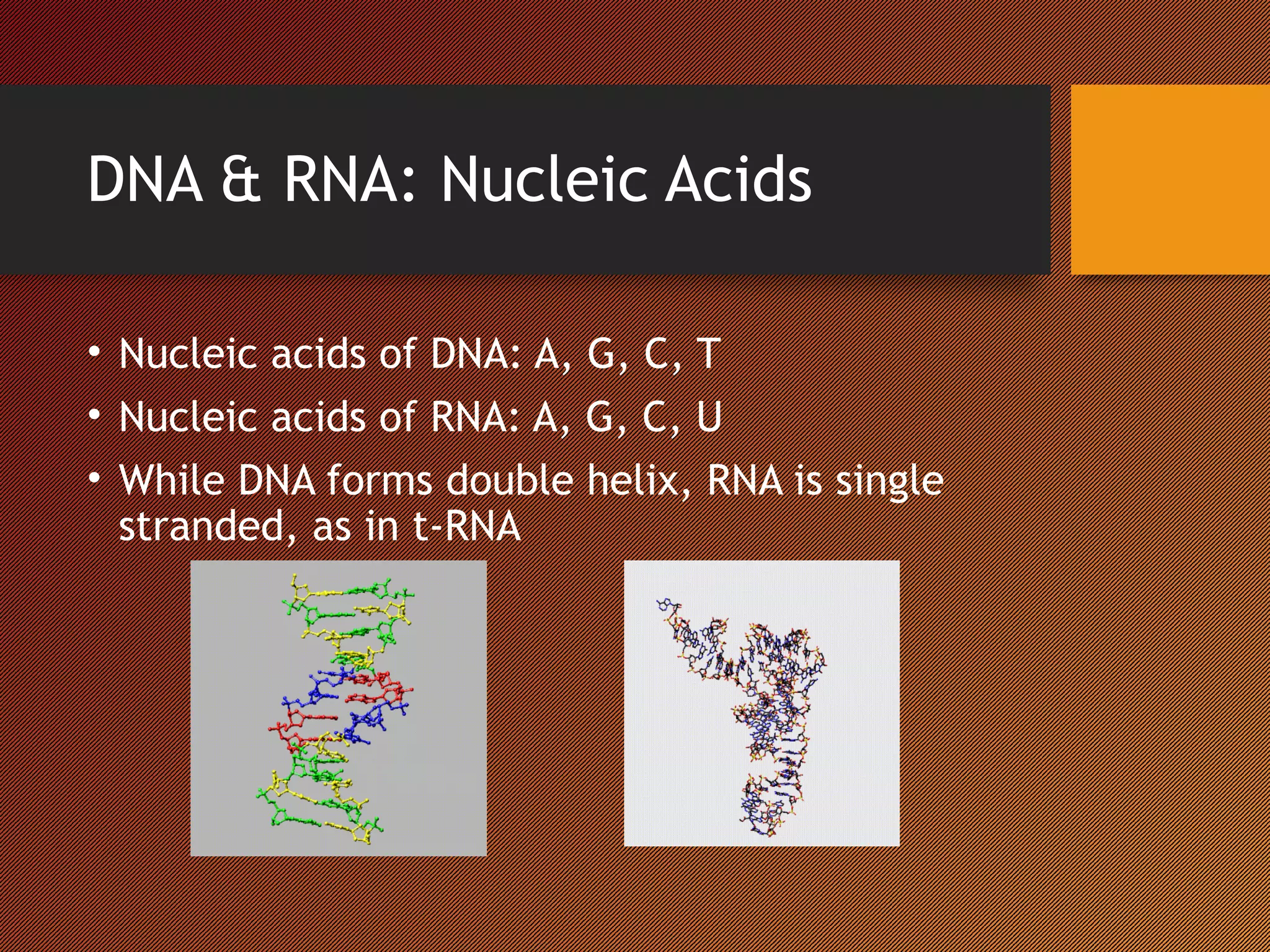
DNA & RNA: Nucleic Acids
• Nucleic acids of DNA: A, G, C, T
• Nucleic acids of RNA: A, G, C, U
• While DNA forms double helix, RNA is single
stranded, as in t-RNA
Ideal Geometries Defined by
Parameters
adenine
cytosine
guanine
thymine
uracil
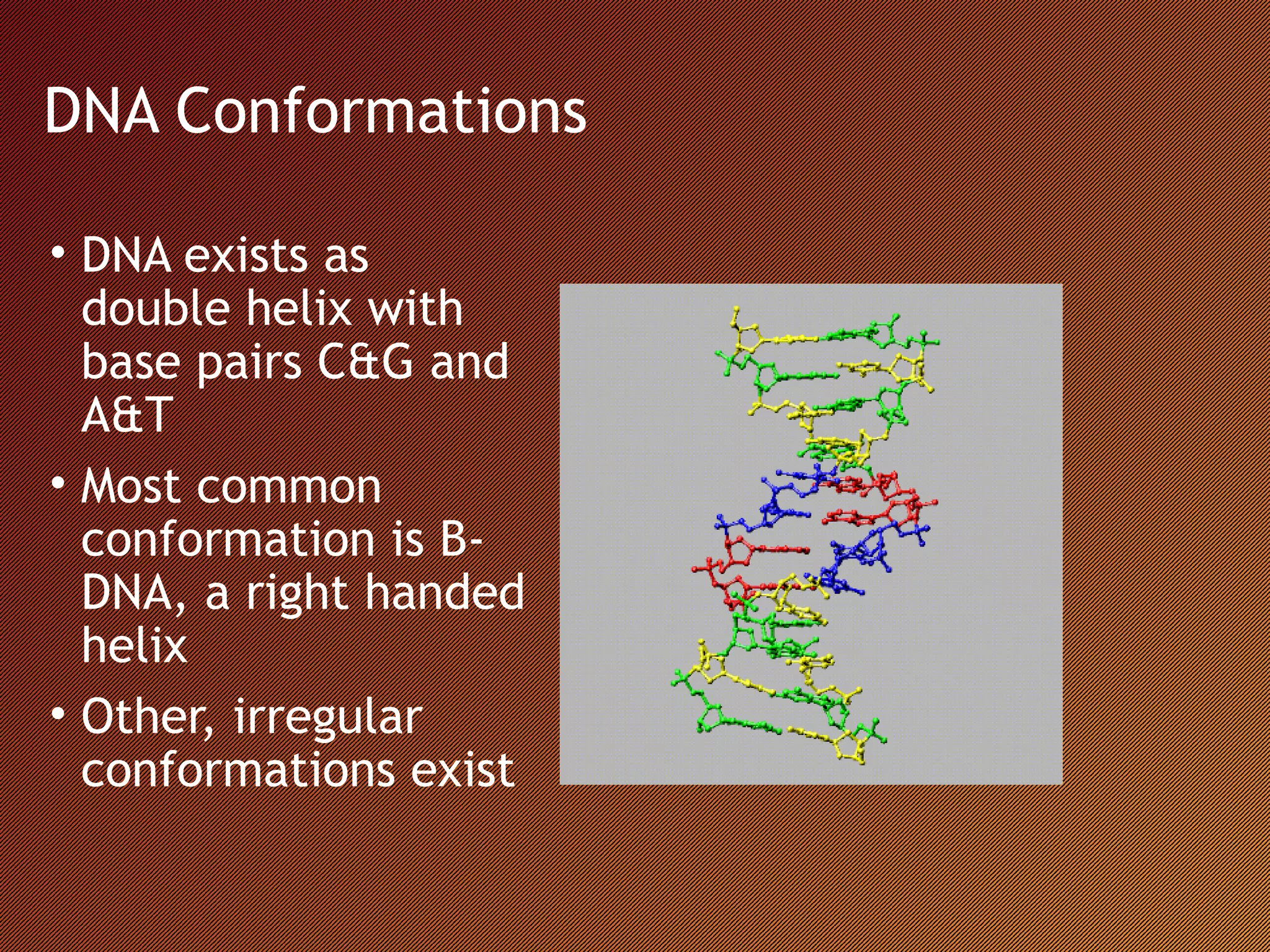
DNA Conformations
• DNA exists as
double helix with
base pairs C&G and
A&T
• Most common
conformation is B-
DNA, a right handed
helix
• Other, irregular
conformations exist
Other DNA Conformations
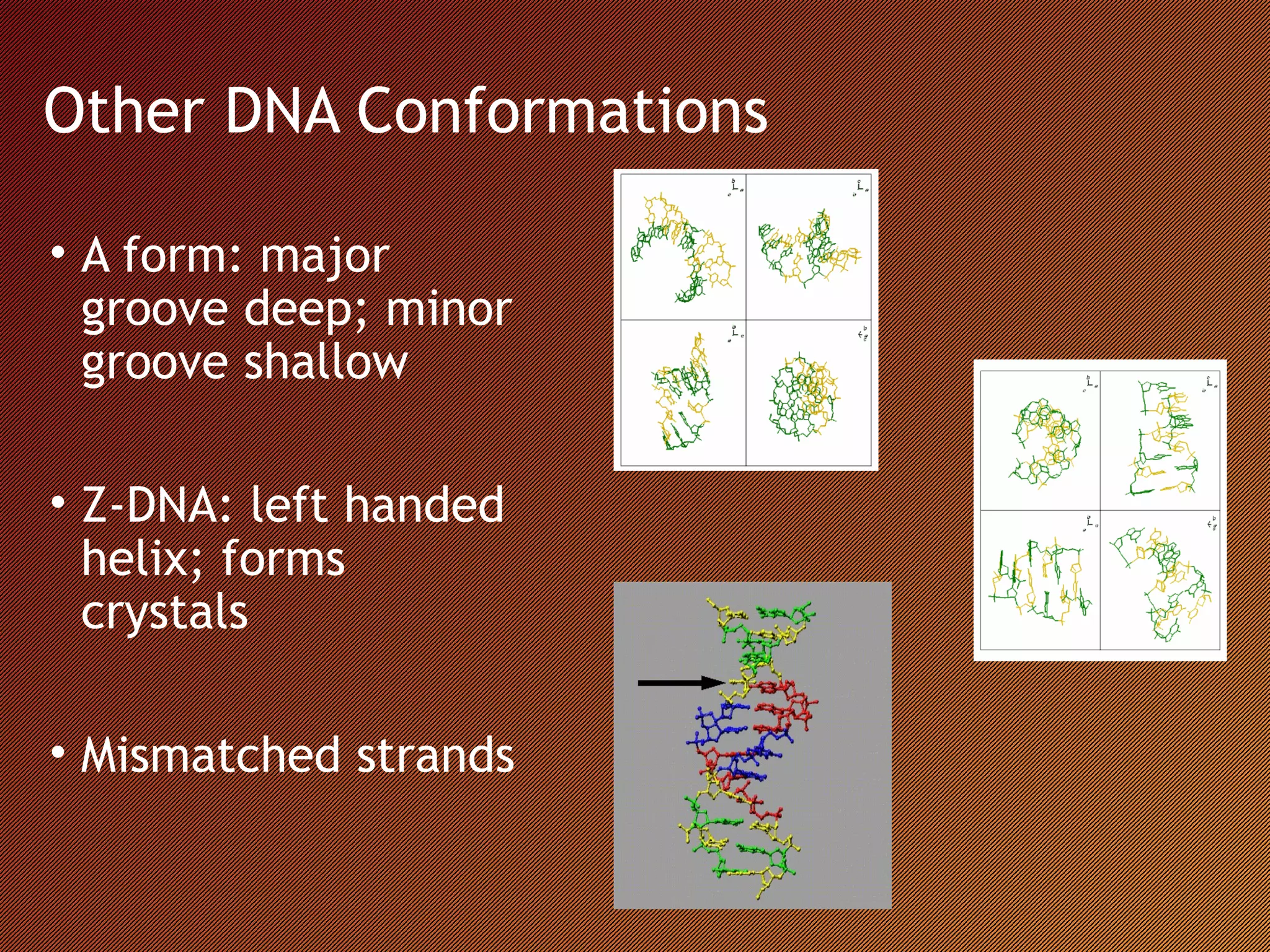
• A form: major
groove deep; minor
groove shallow
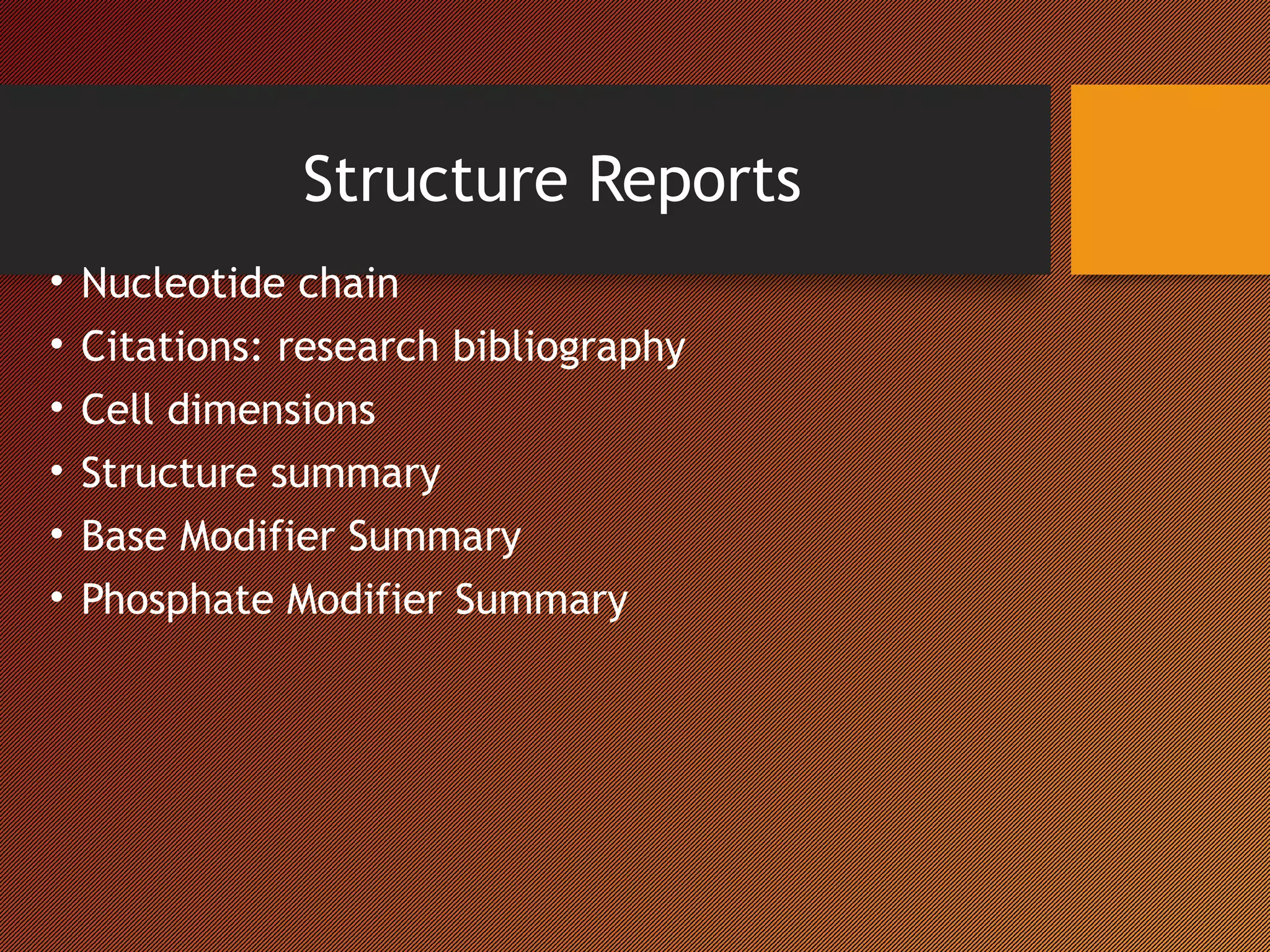
• Z-DNA: left handed
helix; forms
crystals
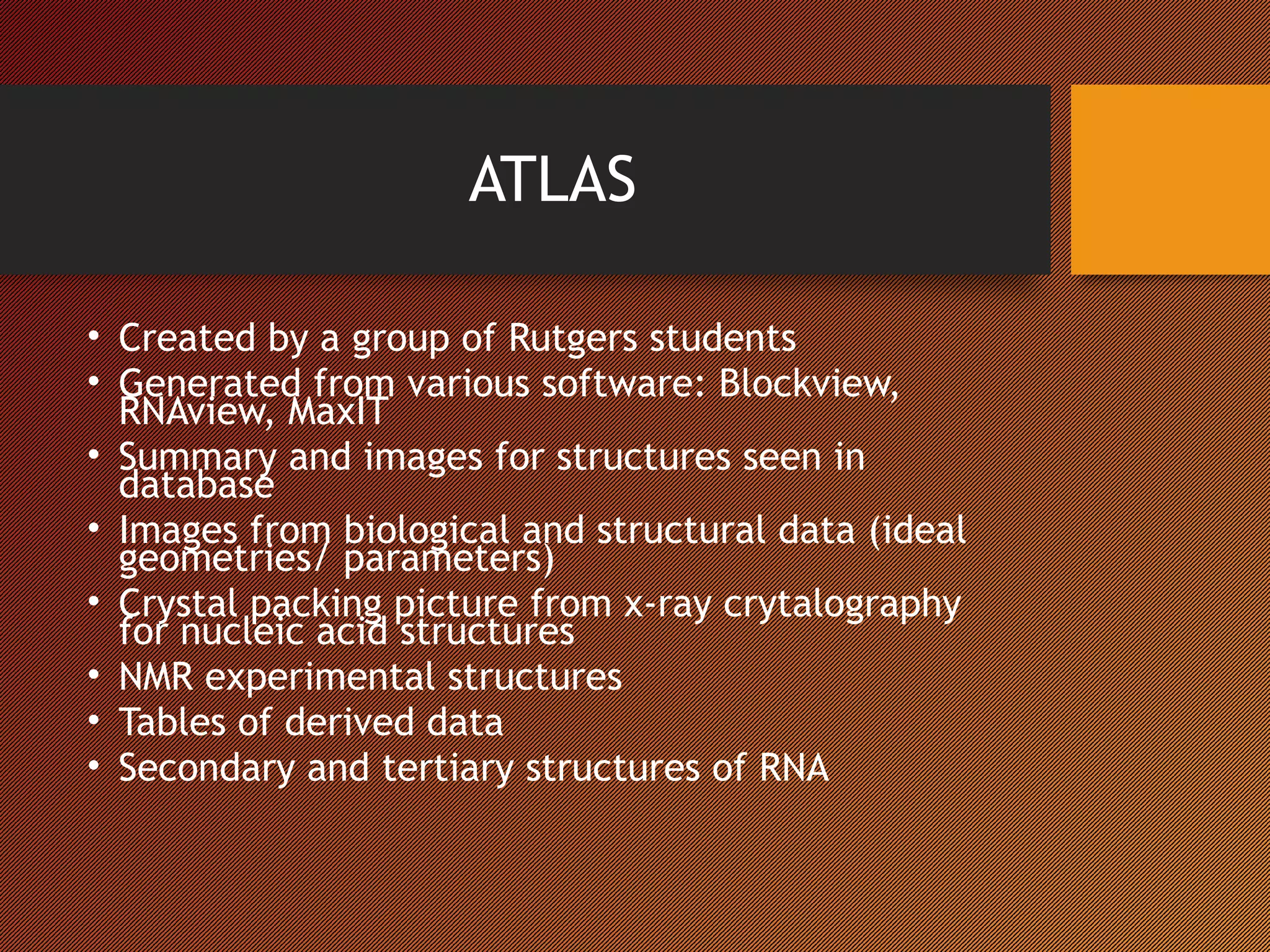
• Mismatched strands
Base Pair List Instructions
• Column 1, 2, 3 are Chain ID, residue sequence number,
and residue name.
• The standard Watson-Crick pairs are annotated as -/-
(AU,AT) or +/+ (GC).
• The three base edges: W (Watson-Crick edge); H
(Hoogsteen edge); S (sugar edge).
• Glycosidic bond orientation is annotated as (cis or
trans).
• For each nucleic acid, syn sugar-base conformation is
annotated as (syn).
• Stacked base pairs are annotated as (stack).
• Non-identified edges are annotated as (.) or (?) or (X).
• Tertiary interactions are marked by (!) in the line.
Nucleic Acid Database: Search
Engine
• Author
• Title
• Year
• Publication
• Volume
• Page
• Citation
Complex NDB Search
Structure Reports
• Nucleotide chain
• Citations: research bibliography
• Cell dimensions
• Structure summary
• Base Modifier Summary
• Phosphate Modifier Summary
Other Database Functions
• NDB Integrated Search An alternate NDB
search application which provides more
flexible searching and report generation.
• NDB Status Search Provides a report on
the processing status of crystal structures.
• Tutorials Instructional aid for the various
search capabilities.
• Download Data
• Deposit Data
ATLAS
• Created by a group of Rutgers students
• Generated from various software: Blockview,
RNAview, MaxIT
• Summary and images for structures seen in
database
• Images from biological and structural data (ideal
geometries/ parameters)
• Crystal packing picture from x-ray crytalography
for nucleic acid structures
• NMR experimental structures
• Tables of derived data
• Secondary and tertiary structures of RNA
Atlas
• X-Ray Atlas
Gallery Index
Index Listing 
• NMR Atlas
Gallery Index
Index Listing 
• Sorted Galleries
• Musical Atlas
Musical Atlas
• Different musical algorithms to view DNA
structures in an innovative manner,
through instrumental song
A-DNA
A-DNA with mismatches
B-DNA
B-DNA with mismatches
Z-DNA
Project 1 of Musical ATLAS
• In each melody, each base in the sequence is played for
one beat. If there are four adenines in a row, the note A
will be played four (separated) times. If there is only
one cytosine, it will be played for one beat, etc. The
sequence for each structure is played once.
• Melody is derived from sequence of molecules (repeated
4 times in a sequence
• Bass line is the complimentary sequence to the initial
sequence
Project 2 of Musical ATLAS
• Each piece of DNA music consists of 15 measures.
• Measure length is determined by the number of
bases in the DNA strand. (Each base is equal to one
beat.) For example, a strand which is 10 base pairs
long will have 10-beat measures, while a 4 base
pair strand will be represented by 4 beats per
measure, and so on.
• In the time signature there are (# of nitrogenous
bases) beats per measure with the eighth note
getting the beat. The eighth note was arbitrarily
chosen.
• The sequence is repeated in each measure.
Database Utilities- Conclusion
• Provides structural references in the form
of base pair annotation for DNA, RNA, and
some proteins- RNA Viewer & Base Pair
Viewer
• Contains search engine to find data on
many DNA and RNA strcuctures- Search
Engine
• Depicts these structures through
systematic design based on biological data-
ATLAS
• Includes innovative methods of examining
DNA structures- Musical Atlas

Nucleic acid database

  • 1.
  • 2.
    Database Utilities • Providesstructural references in the form of base pair annotation for DNA, RNA, and some proteins • Contains search engine to find data on many DNA and RNA strcuctures • Depicts these structures through systematic design based on biological data • Includes innovative methods of examining DNA structures
  • 3.
    NDB Tools • RNAViewer • Base Pair Viewer •Given NDB files •Files uploaded in PDB format •Results are 2-D structure or 3-D structure (RASMOL)
  • 4.
    DNA & RNA:Nucleic Acids • Nucleic acids of DNA: A, G, C, T • Nucleic acids of RNA: A, G, C, U • While DNA forms double helix, RNA is single stranded, as in t-RNA
  • 5.
    Ideal Geometries Definedby Parameters adenine cytosine guanine thymine uracil
  • 6.
    DNA Conformations • DNAexists as double helix with base pairs C&G and A&T • Most common conformation is B- DNA, a right handed helix • Other, irregular conformations exist
  • 7.
    Other DNA Conformations •A form: major groove deep; minor groove shallow • Z-DNA: left handed helix; forms crystals • Mismatched strands
  • 8.
    Base Pair ListInstructions • Column 1, 2, 3 are Chain ID, residue sequence number, and residue name. • The standard Watson-Crick pairs are annotated as -/- (AU,AT) or +/+ (GC). • The three base edges: W (Watson-Crick edge); H (Hoogsteen edge); S (sugar edge). • Glycosidic bond orientation is annotated as (cis or trans). • For each nucleic acid, syn sugar-base conformation is annotated as (syn). • Stacked base pairs are annotated as (stack). • Non-identified edges are annotated as (.) or (?) or (X). • Tertiary interactions are marked by (!) in the line.
  • 9.
    Nucleic Acid Database:Search Engine • Author • Title • Year • Publication • Volume • Page • Citation Complex NDB Search
  • 10.
    Structure Reports • Nucleotidechain • Citations: research bibliography • Cell dimensions • Structure summary • Base Modifier Summary • Phosphate Modifier Summary
  • 11.
    Other Database Functions •NDB Integrated Search An alternate NDB search application which provides more flexible searching and report generation. • NDB Status Search Provides a report on the processing status of crystal structures. • Tutorials Instructional aid for the various search capabilities. • Download Data • Deposit Data
  • 12.
    ATLAS • Created bya group of Rutgers students • Generated from various software: Blockview, RNAview, MaxIT • Summary and images for structures seen in database • Images from biological and structural data (ideal geometries/ parameters) • Crystal packing picture from x-ray crytalography for nucleic acid structures • NMR experimental structures • Tables of derived data • Secondary and tertiary structures of RNA
  • 13.
    Atlas • X-Ray Atlas Gallery Index Index Listing  •NMR Atlas Gallery Index Index Listing  • Sorted Galleries • Musical Atlas
  • 14.
    Musical Atlas • Differentmusical algorithms to view DNA structures in an innovative manner, through instrumental song A-DNA A-DNA with mismatches B-DNA B-DNA with mismatches Z-DNA
  • 15.
    Project 1 ofMusical ATLAS • In each melody, each base in the sequence is played for one beat. If there are four adenines in a row, the note A will be played four (separated) times. If there is only one cytosine, it will be played for one beat, etc. The sequence for each structure is played once. • Melody is derived from sequence of molecules (repeated 4 times in a sequence • Bass line is the complimentary sequence to the initial sequence
  • 16.
    Project 2 ofMusical ATLAS • Each piece of DNA music consists of 15 measures. • Measure length is determined by the number of bases in the DNA strand. (Each base is equal to one beat.) For example, a strand which is 10 base pairs long will have 10-beat measures, while a 4 base pair strand will be represented by 4 beats per measure, and so on. • In the time signature there are (# of nitrogenous bases) beats per measure with the eighth note getting the beat. The eighth note was arbitrarily chosen. • The sequence is repeated in each measure.
  • 17.
    Database Utilities- Conclusion •Provides structural references in the form of base pair annotation for DNA, RNA, and some proteins- RNA Viewer & Base Pair Viewer • Contains search engine to find data on many DNA and RNA strcuctures- Search Engine • Depicts these structures through systematic design based on biological data- ATLAS • Includes innovative methods of examining DNA structures- Musical Atlas