S.PRASANTH KUMAR   prasanthvirtualbioinfolab.blogspot.com  Bioinformatics Laboratory  Department of Botany  Gujarat University   © Prasanth Virtual Bioinfo Lab, 2011 Distributed under Creative Common Rights Protein Structure Determination- Part I Special Attention to X-ray Crystallography
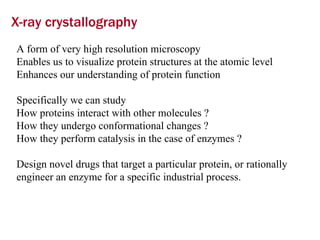
X-ray crystallography A form of very high resolution microscopy  Enables us to visualize protein structures at the atomic level  Enhances our understanding of protein function Specifically we can study  How proteins interact with other molecules ? How they undergo conformational changes ? How they perform catalysis in the case of enzymes ? Design novel drugs that target a particular protein, or rationally engineer an enzyme for a specific industrial process.
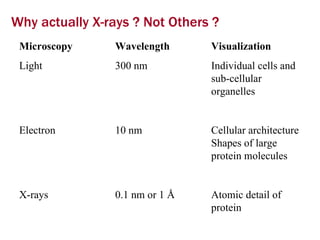
Why actually X-rays ? Not Others ? Microscopy Wavelength  Visualization Light  300 nm  Individual cells and  sub-cellular  organelles Electron 10 nm Cellular architecture  Shapes of large  protein molecules X-rays 0.1 nm or 1 Å Atomic detail of  protein
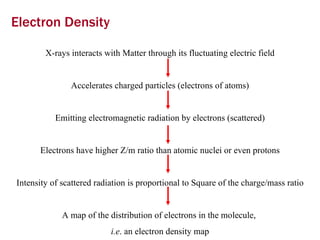
Electron Density  X-rays interacts with Matter through its fluctuating electric field Accelerates charged particles (electrons of atoms) Emitting electromagnetic radiation by electrons (scattered) Electrons have higher Z/m ratio than atomic nuclei or even protons Intensity of scattered radiation is proportional to Square of the charge/mass ratio A map of the distribution of electrons in the molecule,  i.e . an electron density map
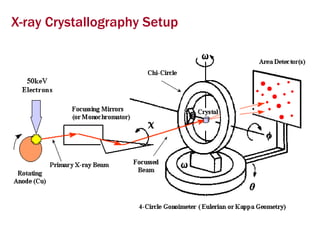
X-ray Crystallography Setup
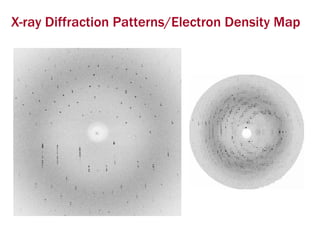
X-ray Diffraction Patterns/Electron Density Map
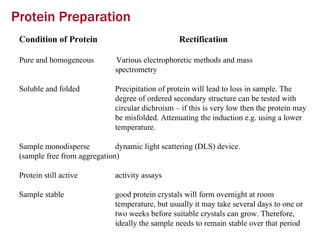
Protein Preparation Condition of Protein  Rectification Pure and homogeneous  Various electrophoretic methods and mass  spectrometry  Soluble and folded  Precipitation of protein will lead to loss in sample. The  degree of ordered secondary structure can be tested with  circular dichroism – if this is very low then the protein may  be misfolded. Attenuating the induction e.g. using a lower  temperature.  Sample monodisperse  dynamic light scattering (DLS) device.  (sample free from aggregation) Protein still active  activity assays  Sample stable good protein crystals will form overnight at room  temperature, but usually it may take several days to one or  two weeks before suitable crystals can grow. Therefore,  ideally the sample needs to remain stable over that period
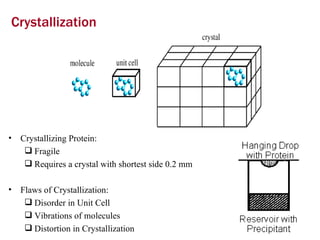
Crystallization Crystallizing Protein: Fragile Requires a crystal with shortest side 0.2 mm Flaws of Crystallization: Disorder in Unit Cell Vibrations of molecules Distortion in Crystallization
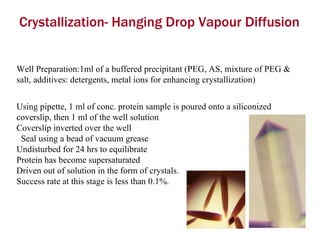
Crystallization- Hanging Drop Vapour Diffusion Well Preparation:1ml of a buffered precipitant (PEG, AS, mixture of PEG & salt, additives: detergents, metal ions for enhancing crystallization) Using pipette, 1 ml of conc. protein sample is poured onto a siliconized coverslip, then 1 ml of the well solution   Coverslip inverted over the well  Seal using a bead of vacuum grease  Undisturbed for 24 hrs to equilibrate  Protein has become supersaturated  Driven out of solution in the form of crystals.  Success rate at this stage is less than 0.1%.
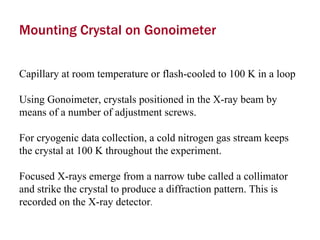
Mounting Crystal on Gonoimeter Capillary at room temperature or flash-cooled to 100 K in a loop  Using Gonoimeter, crystals positioned in the X-ray beam by means of a number of adjustment screws.  For cryogenic data collection, a cold nitrogen gas stream keeps the crystal at 100 K throughout the experiment.  Focused X-rays emerge from a narrow tube called a collimator and strike the crystal to produce a diffraction pattern. This is recorded on the X-ray detector .
X-ray data collection Rotate crystal through 1 degree  Record XRD pattern If XRD pattern is very crowded, reduce the degree of rotation Repeat until 30 degrees were obtained Sometimes 180 degrees depending on crystal symmetry Lower the symmetry= More data are required For high resolution, use Synchrotron
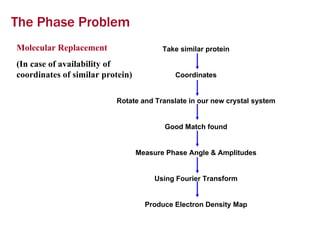
The Phase Problem Molecular Replacement  (In case of availability of coordinates of similar protein) Take similar protein Coordinates Rotate and Translate in our new crystal system Good Match found Measure Phase Angle & Amplitudes Using Fourier Transform Produce Electron Density Map
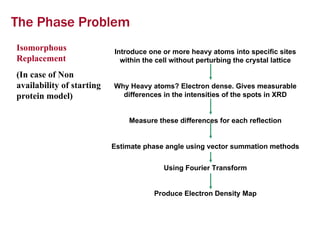
The Phase Problem Isomorphous Replacement (In case of Non availability of starting protein model) Introduce one or more heavy atoms into specific sites within the cell without perturbing the crystal lattice Why Heavy atoms? Electron dense. Gives measurable differences in the intensities of the spots in XRD Measure these differences for each reflection Estimate phase angle using vector summation methods Using Fourier Transform Produce Electron Density Map
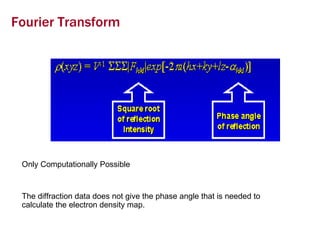
Fourier Transform Only Computationally Possible The diffraction data does not give the phase angle that is needed to calculate the electron density map.
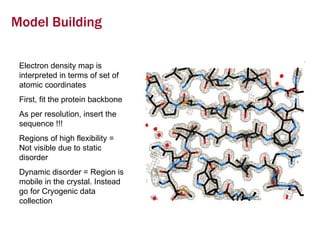
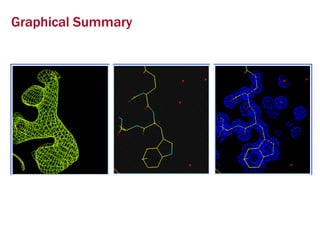
Model Building Electron density map is interpreted in terms of set of atomic coordinates First, fit the protein backbone As per resolution, insert the sequence !!! Regions of high flexibility = Not visible due to static disorder Dynamic disorder = Region is mobile in the crystal. Instead go for Cryogenic data collection
Graphical Summary
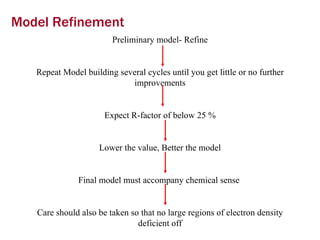
Model Refinement Preliminary model- Refine Repeat Model building several cycles until you get little or no further improvements Expect R-factor of below 25 % Lower the value, Better the model Final model must accompany chemical sense  Care should also be taken so that no large regions of electron density deficient off
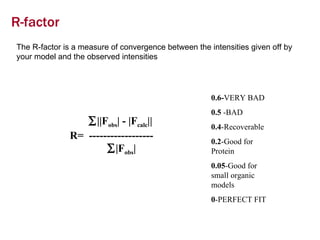
R-factor The R-factor is a measure of convergence between the intensities given off by your model and the observed intensities  ||F obs | - |F calc || R=  ------------------    |F obs | 0.6- VERY BAD 0.5  -BAD 0.4 -Recoverable 0.2 -Good for Protein 0.05 -Good for small organic models 0 -PERFECT FIT
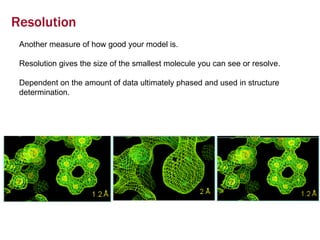
Resolution Another measure of how good your model is. Resolution gives the size of the smallest molecule you can see or resolve.  Dependent on the amount of data ultimately phased and used in structure determination.
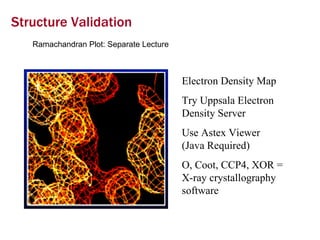
Structure Validation Ramachandran Plot: Separate Lecture Electron Density Map Try Uppsala Electron Density Server Use Astex Viewer  (Java Required) O, Coot, CCP4, XOR = X-ray crystallography software
Thank You for Your Attention !

Structure determination

  • 1.
    S.PRASANTH KUMAR prasanthvirtualbioinfolab.blogspot.com Bioinformatics Laboratory Department of Botany Gujarat University © Prasanth Virtual Bioinfo Lab, 2011 Distributed under Creative Common Rights Protein Structure Determination- Part I Special Attention to X-ray Crystallography
  • 2.
    X-ray crystallography Aform of very high resolution microscopy Enables us to visualize protein structures at the atomic level Enhances our understanding of protein function Specifically we can study How proteins interact with other molecules ? How they undergo conformational changes ? How they perform catalysis in the case of enzymes ? Design novel drugs that target a particular protein, or rationally engineer an enzyme for a specific industrial process.
  • 3.
    Why actually X-rays? Not Others ? Microscopy Wavelength Visualization Light 300 nm Individual cells and sub-cellular organelles Electron 10 nm Cellular architecture Shapes of large protein molecules X-rays 0.1 nm or 1 Å Atomic detail of protein
  • 4.
    Electron Density X-rays interacts with Matter through its fluctuating electric field Accelerates charged particles (electrons of atoms) Emitting electromagnetic radiation by electrons (scattered) Electrons have higher Z/m ratio than atomic nuclei or even protons Intensity of scattered radiation is proportional to Square of the charge/mass ratio A map of the distribution of electrons in the molecule, i.e . an electron density map
  • 5.
  • 6.
  • 7.
    Protein Preparation Conditionof Protein Rectification Pure and homogeneous Various electrophoretic methods and mass spectrometry Soluble and folded Precipitation of protein will lead to loss in sample. The degree of ordered secondary structure can be tested with circular dichroism – if this is very low then the protein may be misfolded. Attenuating the induction e.g. using a lower temperature. Sample monodisperse dynamic light scattering (DLS) device. (sample free from aggregation) Protein still active activity assays Sample stable good protein crystals will form overnight at room temperature, but usually it may take several days to one or two weeks before suitable crystals can grow. Therefore, ideally the sample needs to remain stable over that period
  • 8.
    Crystallization Crystallizing Protein:Fragile Requires a crystal with shortest side 0.2 mm Flaws of Crystallization: Disorder in Unit Cell Vibrations of molecules Distortion in Crystallization
  • 9.
    Crystallization- Hanging DropVapour Diffusion Well Preparation:1ml of a buffered precipitant (PEG, AS, mixture of PEG & salt, additives: detergents, metal ions for enhancing crystallization) Using pipette, 1 ml of conc. protein sample is poured onto a siliconized coverslip, then 1 ml of the well solution Coverslip inverted over the well Seal using a bead of vacuum grease Undisturbed for 24 hrs to equilibrate Protein has become supersaturated Driven out of solution in the form of crystals. Success rate at this stage is less than 0.1%.
  • 10.
    Mounting Crystal onGonoimeter Capillary at room temperature or flash-cooled to 100 K in a loop Using Gonoimeter, crystals positioned in the X-ray beam by means of a number of adjustment screws. For cryogenic data collection, a cold nitrogen gas stream keeps the crystal at 100 K throughout the experiment. Focused X-rays emerge from a narrow tube called a collimator and strike the crystal to produce a diffraction pattern. This is recorded on the X-ray detector .
  • 11.
    X-ray data collectionRotate crystal through 1 degree Record XRD pattern If XRD pattern is very crowded, reduce the degree of rotation Repeat until 30 degrees were obtained Sometimes 180 degrees depending on crystal symmetry Lower the symmetry= More data are required For high resolution, use Synchrotron
  • 12.
    The Phase ProblemMolecular Replacement (In case of availability of coordinates of similar protein) Take similar protein Coordinates Rotate and Translate in our new crystal system Good Match found Measure Phase Angle & Amplitudes Using Fourier Transform Produce Electron Density Map
  • 13.
    The Phase ProblemIsomorphous Replacement (In case of Non availability of starting protein model) Introduce one or more heavy atoms into specific sites within the cell without perturbing the crystal lattice Why Heavy atoms? Electron dense. Gives measurable differences in the intensities of the spots in XRD Measure these differences for each reflection Estimate phase angle using vector summation methods Using Fourier Transform Produce Electron Density Map
  • 14.
    Fourier Transform OnlyComputationally Possible The diffraction data does not give the phase angle that is needed to calculate the electron density map.
  • 15.
    Model Building Electrondensity map is interpreted in terms of set of atomic coordinates First, fit the protein backbone As per resolution, insert the sequence !!! Regions of high flexibility = Not visible due to static disorder Dynamic disorder = Region is mobile in the crystal. Instead go for Cryogenic data collection
  • 16.
  • 17.
    Model Refinement Preliminarymodel- Refine Repeat Model building several cycles until you get little or no further improvements Expect R-factor of below 25 % Lower the value, Better the model Final model must accompany chemical sense Care should also be taken so that no large regions of electron density deficient off
  • 18.
    R-factor The R-factoris a measure of convergence between the intensities given off by your model and the observed intensities  ||F obs | - |F calc || R= ------------------  |F obs | 0.6- VERY BAD 0.5 -BAD 0.4 -Recoverable 0.2 -Good for Protein 0.05 -Good for small organic models 0 -PERFECT FIT
  • 19.
    Resolution Another measureof how good your model is. Resolution gives the size of the smallest molecule you can see or resolve. Dependent on the amount of data ultimately phased and used in structure determination.
  • 20.
    Structure Validation RamachandranPlot: Separate Lecture Electron Density Map Try Uppsala Electron Density Server Use Astex Viewer (Java Required) O, Coot, CCP4, XOR = X-ray crystallography software
  • 21.
    Thank You forYour Attention !