For the students of Gulf Medical University, Ajman,
MBBS

Dr. Seyed Morteza Mahmoudi,
MBBS
Gulf Medical University, Ajman
Contents
 Surgical Anatomy
 Relations
 Coverings
 Lobes
 Arteries and veins
 Lymphatic and nerves
 Prostate Surgeries
 Complications
 Injuries
 Urinary incontinence
 Erection and Ejaculation
 http://vimeo.com/55246215
Shape and Location
Relations
Capsules
Relations











Anteriorly
1)Symphysis pubis
2)Retropubic space (cave of Retzius)
3) Puboprostatic ligaments
4) Santorini venous plexus
Posteriorly
1)Rectal ampula
2)Denonvilliers fascia
3) Dorsal venous plexus
4)Prostatic nervous plexus
Relations











Laterally
1)Levator ani muscle (levator prostatae)
2)Parietal and visceral layers of pelvic peritoneum
3) Neurovascular triangle
Superiorly
1)Neck of the bladder
2)Sphincter vesicea (internal urethral sphincter)
Inferiorly
1)Urogenital diaphragm
2) Sphincter urethrea (External urethral sphincter)
•Lies between the neck of the bladder and the
urogenital diaphragm
•Lies anterior to the rectum through which it
normally can be palpated
•Surrounds the first part
of the male urethra &
ejaculatory ducts
•cone-shaped with its
base directed toward the
bladder
•apex resting on the
superior fascia of the
urogenital diaphragm
Capsules
Surrounded by connective tissue true capsule
and condensation of pelvic fascia (false
capsule), -separated by the prostatic venous

plexus

In prostatectomy-both capsules with the
venous plexus are retained and the gland is
enucleated.
Arterial Blood supply
 Inferior vesical A
 Middle rectal A
 Internal pudendal A
Venous Blood supply
 Prostatic plexus >> vesical plexus>>internal iliac V
 Communication with Batson’s plexus of paravertebral

veins>>vertebral venous plexus may be responsible for
spread of cancer metastasis into vertebral bodies or
intracranial invasion.
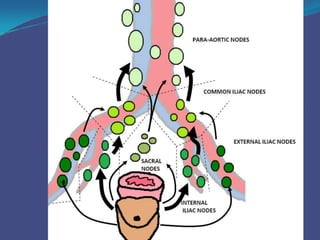
Lymphatic Drainage
 The lymphatic drainage of the prostate primarily

drains to the obturator and the internal iliac lymphatic
channels. There is also lymphatic communication with
the external iliac, presacral, and the para-aortic lymph
nodes.
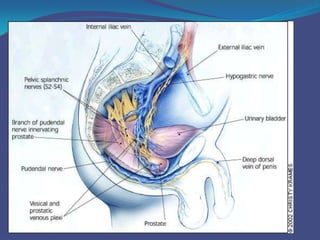
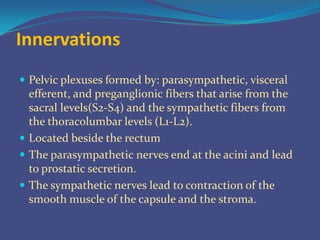
Innervations
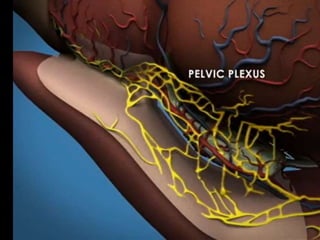
 Pelvic plexuses formed by: parasympathetic, visceral

efferent, and preganglionic fibers that arise from the
sacral levels(S2-S4) and the sympathetic fibers from
the thoracolumbar levels (L1-L2).
 Located beside the rectum
 The parasympathetic nerves end at the acini and lead
to prostatic secretion.
 The sympathetic nerves lead to contraction of the
smooth muscle of the capsule and the stroma.
Inferior hypogastric plexus
(also called the pelvic plexus)
Contributions from:
•Sympathetic
•Sacral splanchnic nerves -post ganglionic
•Lumbar splanchnic nerves
•Parasympathetic
• Pelvic splanchnic nerves
•Sensory
•Visceral afferent fibers
•Vesical, prostatic, rectal,
Supplies1-pelvic organs
Parasympathetic – efferent visceral branches
Pelvic splanchnic nerves
• Are also known as nervi erigentes

• Are visceral branches of the ventral rami of the S2, S3, S4 spinal nerves
• Comprise the

sacral parasympathetic outflow

• Mediate the parasympathetic influences on defecation, micturition, and
erection
• Join the inferior hypogastric (pelvic) plexus
• Only parasympathetics to ascend in pelvic mesocolon & reach the inferior
mesenteric plexus - distributed to the descending and sigmoid colon (caudal to the left
colic flexure)
Sacral sympathetic trunk
• Is continuous with the lumbar sympathetic trunk over
the sacral promontory posterior to the common iliac
vessels
Lobes
1. Anterior
2.Lateral
3.Posterior
4.Median
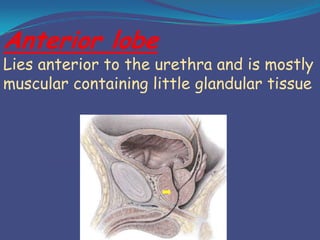
Anterior lobe

Lies anterior to the urethra and is mostly
muscular containing little glandular tissue
Posterior lobe
Lies posterior to the urethra and
inferior to the plane of the ejaculatory
ducts.
Paired lateral lobes

between the anterior and posterior lobes
lateral to the urethra and form the bulk
of the gland
Middle lobe (median lobe)
Lies posterior to the urethra and superior to the
plane of the ejaculatory ducts
when enlarged results in obstruction of the urethra
at the neck of the bladder
Opens by 25 to 30 ducts into the prostatic sinus, a
recess in the prostatic urethra alongside the
colliculus seminalis
Internal features of the prostatic
urethra

Prostatic sinus
The urethral crest is the longitudinal ridge in
the posterior wall of the prostatic urethra.

The colliculus seminalis is a smooth
enlargement of the urethral crest.
— It receives the openings of the paired
ejaculatory ducts & prostatic utricle.
— It is also called the verumontanum.
The prostatic sinus - depression on each side
of the colliculus seminalis - receives the

openings of the prostatic ducts.

The prostatic utricle -a blind pouch that opens
at the apex of the colliculus seminalis.
It is thought to be the remnant of the

fused paramesonephric ducts

- the male homologue of the uterus and upper
vagina.
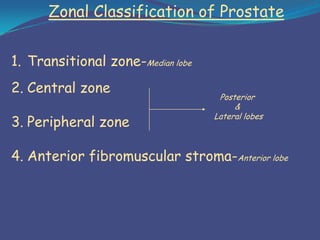
Zonal Classification of Prostate
1. Transitional zone-Median lobe

2. Central zone
3. Peripheral zone

Posterior
&
Lateral lobes

4. Anterior fibromuscular stroma-Anterior lobe
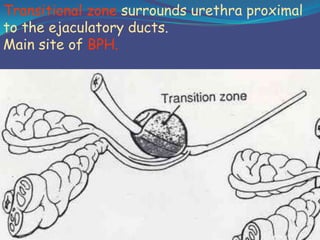
Transitional zone surrounds urethra proximal
to the ejaculatory ducts.
Main site of BPH.
Central zone surrounds ejaculatory ducts and
projects under the bladder base
narrows as it approaches the opening of the
ejaculatory ducts into the verumontanum.

Site of origin of about 10% of carcinomas.
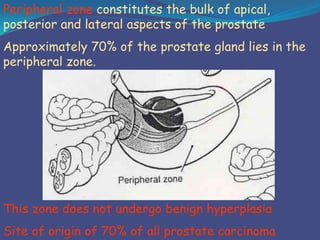
Peripheral zone constitutes the bulk of apical,
posterior and lateral aspects of the prostate
Approximately 70% of the prostate gland lies in the
peripheral zone.

This zone does not undergo benign hyperplasia
Site of origin of 70% of all prostate carcinoma
Anterior fibromuscular stroma- nonglandular regionlocated in the anteromedial portion of the gland
extends from bladder neck to striated urethral
sphincter.
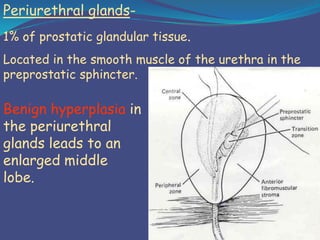
Periurethral glands1% of prostatic glandular tissue.
Located in the smooth muscle of the urethra in the
preprostatic sphincter.

Benign hyperplasia in
the periurethral
glands leads to an
enlarged middle
lobe.
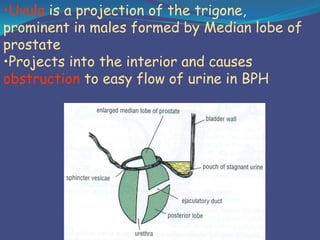
•Uvula is a projection of the trigone,
prominent in males formed by Median lobe of
prostate
•Projects into the interior and causes
obstruction to easy flow of urine in BPH
PR Structures felt
 Anteriorly
 Terminal phalanx:
 Rectovesical pouch
 Posterior surface of bladder
 Seminal vesicles
 Vasa defrentia
 Middle phalenx:
 Rectoprostatic fascia
 Prostate
 Proximal phalanx:
 Perineal body
 Urogenital diaphragm
 Bulb of the penis
 Laterally
 Ischiorectal fossa and ischial spines
Routs of Prostate Cancer Spread
 Local Spread:
 Seminal vesicle
 Trigone of bladder
 Distal urethral sphincter
 Rectal wall
 Blood stream
 Pelvic bone and lower lumbar vertebrae
 Intracranial cavity
 Lymphatic
 Retroperitonial lymph nodes
 Mediastinal lymph nodes
 Supraclavicular lymph nodes
BPH Surgeries
 TURP
 Open Prostatectomy
 Retropubic Prostatectomy
 Perineal Prostatectomy
 Transvesical Prostatectomy
 Laparoscopic Prostatectomy
 Robotic Laparoscopic Prostatectomy
 Intraurethral stents
 Newer treatments
 Laser treatment –
 Transurethral microwave therapy (TUMT)
 Transurethral needle ablation of the prostate (TUNA)
 High-intensity ultrasonographic energy therapy - Currently in the
clinical trial stage
 http://www.youtube.com/watch?v=B1bAvN_esiI
 http://www.youtube.com/watch?v=JWFf8CDw0m0
 http://www.youtube.com/watch?v=5Exd86dbT68
Complications
 General complications of surgery
 Local injuries
 Bladder, rectum, sphincters,
 Incontinence

 Retrograde ejaculation
 Urethral stricture
 Bladder neck stenosis

 Erectile dysfunction (impotance)
 Sterility
Surgical Anatomy of Prostate

Surgical Anatomy of Prostate

  • 2.
    For the studentsof Gulf Medical University, Ajman, MBBS Dr. Seyed Morteza Mahmoudi, MBBS Gulf Medical University, Ajman
  • 7.
    Contents  Surgical Anatomy Relations  Coverings  Lobes  Arteries and veins  Lymphatic and nerves  Prostate Surgeries  Complications  Injuries  Urinary incontinence  Erection and Ejaculation
  • 8.
  • 9.
  • 10.
  • 16.
  • 19.
    Relations           Anteriorly 1)Symphysis pubis 2)Retropubic space(cave of Retzius) 3) Puboprostatic ligaments 4) Santorini venous plexus Posteriorly 1)Rectal ampula 2)Denonvilliers fascia 3) Dorsal venous plexus 4)Prostatic nervous plexus
  • 20.
    Relations           Laterally 1)Levator ani muscle(levator prostatae) 2)Parietal and visceral layers of pelvic peritoneum 3) Neurovascular triangle Superiorly 1)Neck of the bladder 2)Sphincter vesicea (internal urethral sphincter) Inferiorly 1)Urogenital diaphragm 2) Sphincter urethrea (External urethral sphincter)
  • 21.
    •Lies between theneck of the bladder and the urogenital diaphragm •Lies anterior to the rectum through which it normally can be palpated
  • 22.
    •Surrounds the firstpart of the male urethra & ejaculatory ducts •cone-shaped with its base directed toward the bladder •apex resting on the superior fascia of the urogenital diaphragm
  • 23.
    Capsules Surrounded by connectivetissue true capsule and condensation of pelvic fascia (false capsule), -separated by the prostatic venous plexus In prostatectomy-both capsules with the venous plexus are retained and the gland is enucleated.
  • 27.
    Arterial Blood supply Inferior vesical A  Middle rectal A  Internal pudendal A
  • 28.
    Venous Blood supply Prostatic plexus >> vesical plexus>>internal iliac V  Communication with Batson’s plexus of paravertebral veins>>vertebral venous plexus may be responsible for spread of cancer metastasis into vertebral bodies or intracranial invasion.
  • 30.
    Lymphatic Drainage  Thelymphatic drainage of the prostate primarily drains to the obturator and the internal iliac lymphatic channels. There is also lymphatic communication with the external iliac, presacral, and the para-aortic lymph nodes.
  • 32.
    Innervations  Pelvic plexusesformed by: parasympathetic, visceral efferent, and preganglionic fibers that arise from the sacral levels(S2-S4) and the sympathetic fibers from the thoracolumbar levels (L1-L2).  Located beside the rectum  The parasympathetic nerves end at the acini and lead to prostatic secretion.  The sympathetic nerves lead to contraction of the smooth muscle of the capsule and the stroma.
  • 33.
    Inferior hypogastric plexus (alsocalled the pelvic plexus) Contributions from: •Sympathetic •Sacral splanchnic nerves -post ganglionic •Lumbar splanchnic nerves •Parasympathetic • Pelvic splanchnic nerves •Sensory •Visceral afferent fibers •Vesical, prostatic, rectal, Supplies1-pelvic organs
  • 34.
    Parasympathetic – efferentvisceral branches Pelvic splanchnic nerves • Are also known as nervi erigentes • Are visceral branches of the ventral rami of the S2, S3, S4 spinal nerves • Comprise the sacral parasympathetic outflow • Mediate the parasympathetic influences on defecation, micturition, and erection • Join the inferior hypogastric (pelvic) plexus • Only parasympathetics to ascend in pelvic mesocolon & reach the inferior mesenteric plexus - distributed to the descending and sigmoid colon (caudal to the left colic flexure)
  • 35.
    Sacral sympathetic trunk •Is continuous with the lumbar sympathetic trunk over the sacral promontory posterior to the common iliac vessels
  • 38.
  • 39.
    Anterior lobe Lies anteriorto the urethra and is mostly muscular containing little glandular tissue
  • 40.
    Posterior lobe Lies posteriorto the urethra and inferior to the plane of the ejaculatory ducts.
  • 41.
    Paired lateral lobes betweenthe anterior and posterior lobes lateral to the urethra and form the bulk of the gland
  • 42.
    Middle lobe (medianlobe) Lies posterior to the urethra and superior to the plane of the ejaculatory ducts when enlarged results in obstruction of the urethra at the neck of the bladder
  • 43.
    Opens by 25to 30 ducts into the prostatic sinus, a recess in the prostatic urethra alongside the colliculus seminalis
  • 44.
    Internal features ofthe prostatic urethra Prostatic sinus
  • 46.
    The urethral crestis the longitudinal ridge in the posterior wall of the prostatic urethra. The colliculus seminalis is a smooth enlargement of the urethral crest. — It receives the openings of the paired ejaculatory ducts & prostatic utricle. — It is also called the verumontanum.
  • 47.
    The prostatic sinus- depression on each side of the colliculus seminalis - receives the openings of the prostatic ducts. The prostatic utricle -a blind pouch that opens at the apex of the colliculus seminalis. It is thought to be the remnant of the fused paramesonephric ducts - the male homologue of the uterus and upper vagina.
  • 48.
    Zonal Classification ofProstate 1. Transitional zone-Median lobe 2. Central zone 3. Peripheral zone Posterior & Lateral lobes 4. Anterior fibromuscular stroma-Anterior lobe
  • 50.
    Transitional zone surroundsurethra proximal to the ejaculatory ducts. Main site of BPH.
  • 51.
    Central zone surroundsejaculatory ducts and projects under the bladder base narrows as it approaches the opening of the ejaculatory ducts into the verumontanum. Site of origin of about 10% of carcinomas.
  • 52.
    Peripheral zone constitutesthe bulk of apical, posterior and lateral aspects of the prostate Approximately 70% of the prostate gland lies in the peripheral zone. This zone does not undergo benign hyperplasia Site of origin of 70% of all prostate carcinoma
  • 53.
    Anterior fibromuscular stroma-nonglandular regionlocated in the anteromedial portion of the gland extends from bladder neck to striated urethral sphincter.
  • 54.
    Periurethral glands1% ofprostatic glandular tissue. Located in the smooth muscle of the urethra in the preprostatic sphincter. Benign hyperplasia in the periurethral glands leads to an enlarged middle lobe.
  • 56.
    •Uvula is aprojection of the trigone, prominent in males formed by Median lobe of prostate •Projects into the interior and causes obstruction to easy flow of urine in BPH
  • 58.
    PR Structures felt Anteriorly  Terminal phalanx:  Rectovesical pouch  Posterior surface of bladder  Seminal vesicles  Vasa defrentia  Middle phalenx:  Rectoprostatic fascia  Prostate  Proximal phalanx:  Perineal body  Urogenital diaphragm  Bulb of the penis  Laterally  Ischiorectal fossa and ischial spines
  • 62.
    Routs of ProstateCancer Spread
  • 63.
    Routs of ProstateCancer Spread  Local Spread:  Seminal vesicle  Trigone of bladder  Distal urethral sphincter  Rectal wall  Blood stream  Pelvic bone and lower lumbar vertebrae  Intracranial cavity  Lymphatic  Retroperitonial lymph nodes  Mediastinal lymph nodes  Supraclavicular lymph nodes
  • 64.
    BPH Surgeries  TURP Open Prostatectomy  Retropubic Prostatectomy  Perineal Prostatectomy  Transvesical Prostatectomy  Laparoscopic Prostatectomy  Robotic Laparoscopic Prostatectomy  Intraurethral stents  Newer treatments  Laser treatment –  Transurethral microwave therapy (TUMT)  Transurethral needle ablation of the prostate (TUNA)  High-intensity ultrasonographic energy therapy - Currently in the clinical trial stage
  • 65.
  • 67.
  • 68.
  • 69.
    Complications  General complicationsof surgery  Local injuries  Bladder, rectum, sphincters,  Incontinence  Retrograde ejaculation  Urethral stricture  Bladder neck stenosis  Erectile dysfunction (impotance)  Sterility

Editor's Notes

  • #5 EXPLANATION: Knowledge of the anatomic division of the prostate is important in understanding the locations of the major pathologic diseases of the prostate. Most adenocarcinomas of the prostate originate in the peripheral zone, while hyperplastic nodules originate in the transition zone. This anatomic differentiation is the result of the physiologic fact that the transition zone is particularly estrogen-sensitive, while the peripheral zone is particularly androgen-sensitive. Dihydrotestosterone (DHT), which is formed from testosterone by the action of 5-α-reductase, is responsible for the development of the prostate during fetal growth and also at the time of puberty. With aging, DHT levels are increased in the prostate, where DHT binds to nuclear DNA and causes prostatic hyperplasia. This hyperplastic effect by DHT is augmented by estrogen, which appears to function by induction of androgen receptors, and therefore this hyperplasia occurs in the portion of the prostate that is particularly estrogen-sensitive.
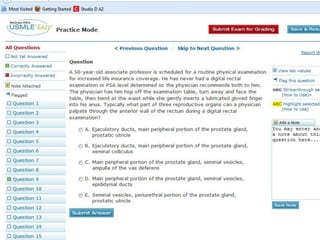
  • #7 EXPLANATION: In most males, during a digital rectal examination, one can palpate the main peripheral portion of the prostate gland, then just a little more cranially, both the seminal vesicles and ampulla of the vas (ductus) deferens if one has a long enough finger. The main goal of the digital rectal examination is to palpate the backside of the prostate gland which is the main peripheral portion of the gland; the site of most prostate cancer growth. An additional screening tool is the PSA level within blood. Generally the PSA level should be below 2.5 ng/mL. Elevated levels of PSA, however, can also indicate inflammation of the prostate in addition to cancerous growth. Both the prostatic utricle (answers a and e) and seminal colliculus(answer b) are internal structures found deep within the prostate gland, a blind outpocketing from the prostatic urethra, and thus cannot be palpated. The epididymal ducts (answer d) are in the scrotum, thus cannot be palpated during a digital rectal examination.
  • #10 A normal prostate gland is approximately 20 g in volume, 3 cm in length, 4 cm wide, and 2 cm in depth. As men get older, the prostate gland is variable in size secondary to benign prostatic hyperplasia. cone-shaped with its base directed toward the bladderapex resting on the superior fascia of the urogenital diaphragm
  • #17 Layers of fascia enveloping prostatic capsule, demonstrating the planes of dissection for differing grades (1–4) of nerve sparing. LPF = lateral pelvic fascia; LF = levator fascia; LA = levatorani. (From [13] and [14].)
  • #18 The endopelvic part of the pelvic fascia is continued over the various pelvic viscera to form for the fibrous coverings.It is attached to the diaphragmatic part of the pelvic fascia along the tendinous arch, and has been subdivided in accordance with the viscera to which it is related:Thus its anterior part, known as the vesical layer, forms the anterior and lateral ligaments of the bladder.In males, its middle lamina crosses the floor of the pelvis between the rectum and vesiculæseminales as the rectovesical septum; in the female this is perforated by the cervix and is named the transverse cervical ligament.Its posterior portion passes to the side of the rectum; it forms a loose sheath for the rectum, but is firmly attached around the anal canal; this portion is known as the rectal layer.
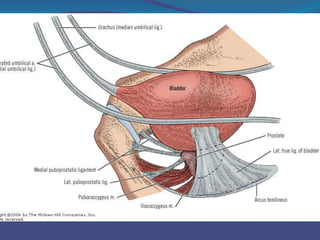
  • #22 The gland is located posterior to the pubic symphysis, superior to the perineal membrane, inferior to the bladder, and anterior to the rectum (see the image below). The base of the prostate is in continuity with the bladder and the prostate ends at the apex before becoming the striated external urethral sphincter. The sphincter is a vertically oriented tubular sheath that surrounds the membranous urethra and prostate.
  • #23 The prostate is enclosed by a capsule composed of collagen, elastin and large amounts of smooth muscle. The prostate is covered by 3 distinct layers of fascia on the anterior, lateral, and posterior aspects. The anterior and anterolateral fascia is in direct continuity of the true capsule; this is the location of the deep dorsal vein of the penis and its tributaries. Laterally, the fascia fuses with the levator fascia. The outer longitudinal fibers of the detrusor muscle fuse and blend with the fibromuscular tissue of the capsule. The posterior aspect is covered by the rectovesical (Denonvilliers) fascia. The rectovesical fascia is a connective tissue that is located between the anterior wall of the rectum and posterior aspect of the prostate. This fascial layer covers the prostate and seminal vesicles posteriorly and extends caudally to terminate as a fibrous plate just below the urethra at the level of the external urethral sphincter. This is described as a median fibrous raphe which has a distal extension to the level of the central tendon of the perineum. The gland is supported anteriorly by the puboprostatic ligaments and inferiorly by the external urethral sphincter and perineal membrane. The puboprostatic ligaments are actually pubovesical ligaments; however, with the growth of the prostate from puberty, these ligaments have the appearance of terminating into the prostate. The prostate is surrounded by the puborectal portion of the levatorani. The seminal vesicles lie superior to the prostate under the base of the bladder and are approximately 6 cm in length. Each seminal vesicle joins its corresponding ductus deferens to form the ejaculatory duct before entering the prostate.
  • #24 Santorini plexus1. venous plexus on ventral and lateral prostatic surfaces.
  • #25 The arterial supply to the prostate is primarily from the inferior vesical artery, which originates from the anterior division of the internal iliac (hypogastric) artery. The inferior vesical artery then branches into 2 main arterial branches to feed the prostate. The prostatic vessels and the autonomic innervations run between the layers of the lateral prostatic fascia and the prostate. The inferior vesical artery supplies the base of the bladder, the distal ureters, and the prostate.The first arterial branch is the urethral artery that enters the prostatovesical junction posterolaterally and travels inward perpendicular to the urethra toward the bladder neck at approximately the 5 o'clock and 7 o'clock meridian. The urethral artery then turns caudally and parallel to the urethra to supply the transition zone. This artery is the main arterial supply for the adenomas in benign prostatic hyperplasia. The capsular artery is the second main branch of the prostate. It runs posterolateral to the prostate with the cavernous nerves. This artery enters the prostate at right angles to supply the glandular tissue. The arterial blood supply to the seminal vessels and ductus deferens comes from the deferential artery or artery of the ductus, a branch from the superior vesical artery.The venous drainage of the prostate starts with the deep dorsal vein, which leaves the penis under the deep penile (Buck) fascia between the corpora cavernosa and then under the pubic arch. This vein then passes anterosuperior to the perineal membrane and divides into 3 major branches, the superficial branch and the right and left branches. The superficial branch travels between the puboprostatic ligaments and lies on top of the prostate and bladder neck. The superficial branch is outside the anterior prostatic fascia in the retropubic fat and pierces the fascia to drain into the dorsal venous complex. The common trunk of the dorsal venous complex and the lateral venous plexuses are covered by the anterior prostatic fascia and the endopelvic fascia. The lateral plexuses travel posterolaterally and communicate with the pudendal, obturator, and vesical plexus. These veins then communicate with the internal iliac vein.
  • #30 Lymphatic drainageThe lymphatic drainage of the prostate primarily drains to the obturator and the internal iliac lymphatic channels. There is also lymphatic communication with the external iliac, presacral, and the para-aortic lymph nodes.
  • #65 Transurethral Resection of the ProstateTURP is considered the criterion standard for relieving BOO secondary to BPH. The indications to proceed with a surgical intervention include the following: AUR Failed voiding trials Recurrent gross hematuria Urinary tract infection Renal insufficiency secondary to obstructionAdditional indications for surgical intervention include failure of medical therapy, a desire to terminate medical therapy, and/or financial constraints associated with medical therapy. However, TURP carries a significant risk of morbidity (18%) and mortality risk (0.23%).TURP is performed with regional or general anesthesia and involves the placement of a working sheath in the urethra through which a hand-held device with an attached wire loop is placed. High-energy electrical cutting current is run through the loop so that the loop can be used to shave away prostatic tissue. The entire device is usually attached to a video camera to provide vision for the surgeon.Although TURP is often successful, it has some drawbacks. When prostatic tissue is cut away, significant bleeding may occur, possibly resulting in termination of the procedure, blood transfusion, and a prolonged hospital stay. Patients are usually monitored overnight and discharged the following morning, with or without a catheter.Irrigating fluid may also be absorbed in significant quantities through veins that are cut open, with possible serious sequelae termed transurethral resection syndrome (TUR syndrome). However, this is very rare and does not occur with saline irrigation used in bipolar devices. A urinary catheter must be left in place until the bleeding has mostly cleared.The large working sheath combined with the use of electrical energy may also result in stricturing of the urethra.The cutting of the prostate may also result in a partial resection of the urinary sphincteric mechanism, causing the muscle along the bladder outlet to become weak or incompetent. As a result, when the patient ejaculates, this sphincteric mechanism cannot keep the bladder adequately closed. The ejaculate consequently goes backwards into the bladder (ie, retrograde ejaculation), rather than out the penis. Additionally, if the urinary sphincter is damaged, urinary incontinence may result.The nerves associated with erection run along the outer rim of the prostate, and the high-energy current and/or heat generated by such may damage these nerves, resulting in impotence.Open ProstatectomyThis procedure is now reserved for patients with very large prostates (>75 g), patients with concomitant bladder stones or bladder diverticula, and patients who cannot be positioned for transurethral surgery.Open prostatectomy requires hospitalization and involves the use of general/regional anesthesia and a lower abdominal incision. The inner core of the prostate (adenoma), which represents the transition zone, is shelled out, thus leaving the peripheral zone behind. This procedure may involve significant blood loss, resulting in transfusion. Open prostatectomy usually has an excellent outcome in terms of improvement of urinary flow and urinary symptoms.More recently, laparoscopic simple prostatectomy has been performed at a number of institutions and appears to be feasible. However, prostatectomy performed in this fashion still appears to be associated with risk for significant blood loss. Experience to date with this procedure is limited.[28]Minimally Invasive TreatmentThere is considerable interest in the development of other therapies to decrease the amount of obstructing prostate tissue while avoiding the above-mentioned adverse effects associated with TURP. These therapies are collectively called minimally invasive therapies.Most minimally invasive therapies rely on heat to destroy prostatic tissue. This heat is delivered in a limited and controlled fashion, in the hope of avoiding the complications associated with TURP. They also allow for the use of milder forms of anesthesia, which translates into less anesthetic risk for the patient.Heat may be delivered in the form of laser energy, microwaves, radiofrequency energy, high-intensity ultrasound waves, and high-voltage electrical energy. As in TURP, delivery devices are usually passed through a working sheath placed in the urethra, although they are usually of a smaller size than that needed for TURP. Devices may also simply be attached or incorporated into a urinary catheter or passed through the rectum, from which the prostate may also be accessed.Keep in mind that many of these minimally invasive therapies are undergoing constant improvements and refinements, resulting in increased efficacy and safety. Ask urologists about the specifics of the minimally invasive therapies that they use and what results they have experienced.Transurethral Incision of the ProstateTransurethral incision of the prostate (TUIP) has been in use for many years and, for a long time, was the only alternative to TURP. It may be performed with local anesthesia and sedation. TUIP is suitable for patients with small prostates and for patients unlikely to tolerate TURP well because of other medical conditions. TUIP is associated with less bleeding and fluid absorption than TURP. It is also associated with a lower incidence of retrograde ejaculation and impotence than TURP.LasersLasers deliver heat to the prostate in various ways. Lasers heat prostate tissue, causing tissue death by coagulative necrosis, with subsequent tissue contraction; however, laser coagulation of the prostate in this specific sense has met with limited results.Lasers have also been used to directly evaporate, or to melt away, prostate tissue, which is more effective than laser coagulation. Photoselective vaporization of the prostate produces a beam that does not directly come into contact with the prostate; rather, it delivers heat energy into the prostate, resulting in destruction/ablation of the prostate tissue.Potassium-titanyl-phosphate (KTP) and holmium lasers are used to cut and/or enucleate the prostate, similar to the TURP technique. These are widely used laser techniques.Transurethral vaporization/ablation with the KTP or holmium laser can be performed with general or spinal anesthesia and can be performed in an outpatient setting. Catheter time usually lasts less than 24 hours. Studies suggest that photoselective vaporization of the prostate can significantly improve and sustain symptomatic and urodynamic outcomes.This procedure has been quite useful in patients who require anticoagulation for various medical conditions, since anticoagulation does not need to be interrupted for this procedure, thus further decreasing patient risk.[29, 30]Lasers may be used in a knifelike fashion to directly cut away prostate tissue (ie, holmium laser enucleation of the prostate), similar to a TURP procedure. The holmium laser allows for simultaneous cutting and coagulation, making it quite useful for prostate resection. Laser enucleation of the prostate has proved to be safe and effective for treatment of symptomatic BPH, regardless of prostate size, with low morbidity and short hospital stay.TUR syndrome is not seen with this technique, because iso-osmotic saline is used for irrigation. Additionally, removed prostatic tissue is available for histologic evaluation, whereas vaporization/ablation technique does not provide tissue for evaluation. Holmium laser enucleation of the prostate may prove to be the new criterion standard for surgical management of BPH.[30, 31]Laser treatment usually results in decreased bleeding, fluid absorption, and length of hospital stay, as well as decreased incidence of impotence and retrograde ejaculation when compared with standard TURP. However, healing from laser treatment does not occur until after a period when dead cells slough; thus, patients may experience urinary urgency or irritation, resulting in frequent or uncomfortable urination for a few weeks.The results of laser therapy vary from one another because not all wavelengths yield the same tissue effects. For example, interstitial lasers (eg, indigo lasers) are designed to heat tissue within the confines of the prostate gland and spread radiant energy at relatively low energy levels. They do not directly involve the urethral portion; thus, irritative symptoms following the procedure are potentially reduced.Contact lasers such as KTP or holmium, on the other hand, are designed to cut and vaporize at extremely high temperatures They usually bring about more relief of urinary symptoms than treatment with medicines, but not always as much as is provided with TURP. However, KTP laser vaporization and holmium laser enucleation yield results that rival those of TURP.Transurethral Microwave TherapyThe use of microwave energy, termed transurethral microwave therapy (TUMT), delivers heat to the prostate via a urethral catheter or a transrectal route. The surface closest to the probe (the rectal or urethral surface) is cooled to prevent injury. The heat causes cell death, with subsequent tissue contraction, thereby decreasing prostatic volume.TUMT can be performed in the outpatient setting with local anesthesia. Microwave treatment appears to be associated with significant prostatic swelling; a considerable number of patients require a urinary catheter until the swelling subsides. In terms of efficacy, TUMT places between medical therapy and TURP. The 2010 AUA guidelines state TUMT is an effective option for partially relieving symptoms that may be considered in patients with moderate or severe LUTS secondary to BPH.[32]Transurethral Needle Ablation of the ProstateTransurethral needle ablation of the prostate (TUNA) involves using high-frequency radio waves to produce heat, resulting in a similar process of thermal injury to the prostate as previously described. A specially designed transurethral device with needles is used to deliver the energy.TUNA can be performed under local anesthesia, allowing the patient to go home the same day. Similar to microwave treatment, radiofrequency treatment is quite popular, and a number of urologists have experience with its use. Radiofrequency treatment appears to reliably result in significant relief of symptoms and better urine flow, although not quite to the extent achieved with TURP. The 2010 AUA guideline update considers TURP an appropriate and effective treatment option for moderate or severe LUTS.[2]High-Intensity Ultrasound Energy TherapyHigh-intensity ultrasound energy therapy delivers heat to prostate tissue, with the subsequent process of thermal injury. High-intensity ultrasound waves may be delivered rectally or extracorporeally and can be used with the patient on intravenous sedation. Urinary retention appears to be common with its use.High-intensity ultrasound energy also produces moderate results in terms of improvement of the urinary flow rate and urinary symptoms, although its use is now relatively limited compared with the more popular TUNA and TUMT.High-intensity ultrasound is considered investigational at this time and should not be offered outside of clinical trials.Mechanical ApproachesMechanical approaches are used less commonly and are usually reserved for patients who cannot have a formal surgical procedure. Mechanical approaches do not involve the use of energy to treat the prostate.Prostatic stents are flexible devices that can expand when put in place to improve the flow of urine past the prostate. Their use has been associated with encrustation, pain, incontinence, and overgrowth of tissue through the stent, possibly making their removal quite difficult. To date, their full role and long-term effects are not fully known.DietData from the Prostate Cancer Prevention Trial revealed that a diet low in fat and red meat and high in protein and vegetables may reduce the risk of symptomatic BPH. Additionally, regular alcohol consumption was associated with a reduced risk of symptomatic BPH, but this is to be interpreted cautiously given the untoward effects of excessive alcohol consumption.[33]