The Prostate:A Vital Gland
 The prostate gland is a small, walnut-shaped gland that
plays a crucial role in the male reproductive system.
 Located just below the bladder and in front of the rectum, it
surrounds the urethra.
 The prostate gland is responsible for producing a milky
fluid that makes up a significant portion of semen, which
nourishes and protects sperm.
by Dr.Umar khan
Shape, Size, and Weight of the Prostate
Shape
The prostate resembles a
walnut in shape, with a
slightly rounded base and a
pointed apex.
Size
The prostate's size is
variable, but in adults, it
typically measures about 3
centimeters in width, 4
centimeters in length, and 2
centimeters in height.
Weight
The average weight of the
prostate in adult males
ranges from 15 to 20 grams.
This weight can fluctuate
depending on factors like
age, health conditions, and
hormonal levels.
Relations of the Prostate
Superiorly
The base of the prostate is continuous with the neck of the bladder . The urethra enters the center of the base of the prostate
Inferiorly:
The apex of the prostate lies on the upper surface of the urogenital diaphragm. The urethra leaves the prostate just above the
apex on the anterior surface
Anteriorly:
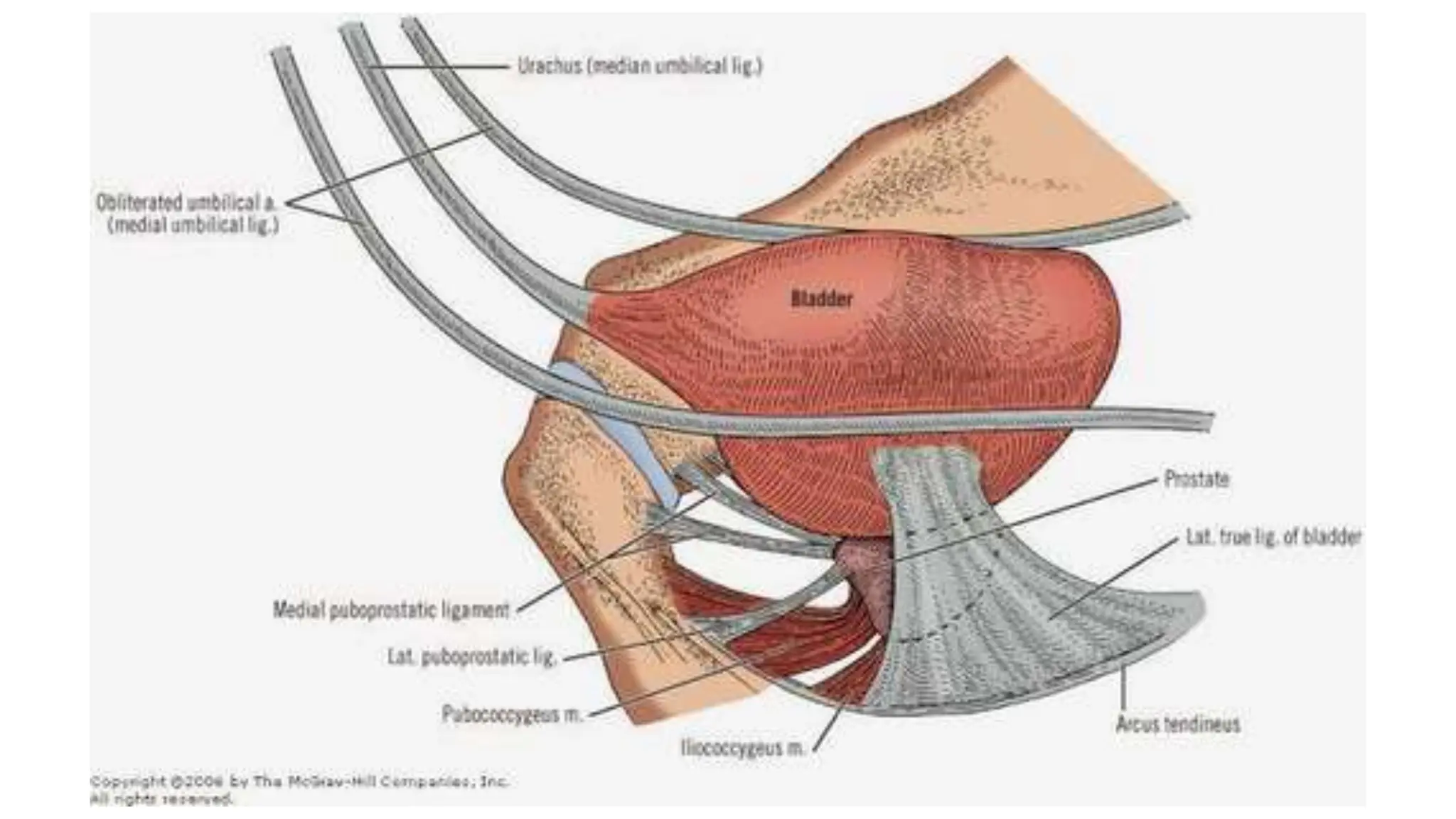
The prostate is related to the symphysis pubis, separated from it by the extraperitoneal fat in the retropubic space (cave of
Retzius). The prostate is connected to the posterior aspect of the pubic bones by the fascial puboprostatic ligaments
Posteriorly:
The prostate is closely related to the anterior surface of the rectal ampulla and is separated from it by the rectovesical
septum (fascia of Denonvilliers).
Laterally:
The prostate is embraced by the anterior fibers of the levator ani as they run posteriorly from the pubis
Gross Features of the Prostate
Base
The base of the prostate is the broadest part,
facing the bladder. It's connected to the bladder
by the prostatic urethra, which forms a
continuation of the bladder neck.
Apex
The apex of the prostate is the pointed lower
end, facing the membranous urethra. This
section of the urethra lies within the urogenital
diaphragm, a muscular structure in the pelvic
floor.
Lateral Surfaces
The lateral surfaces of the prostate are smooth
and convex, gently curving towards the sides.
They are covered by a thin layer of fibrous tissue
called the prostatic capsule.
Posterior Surface
The posterior surface of the prostate is slightly
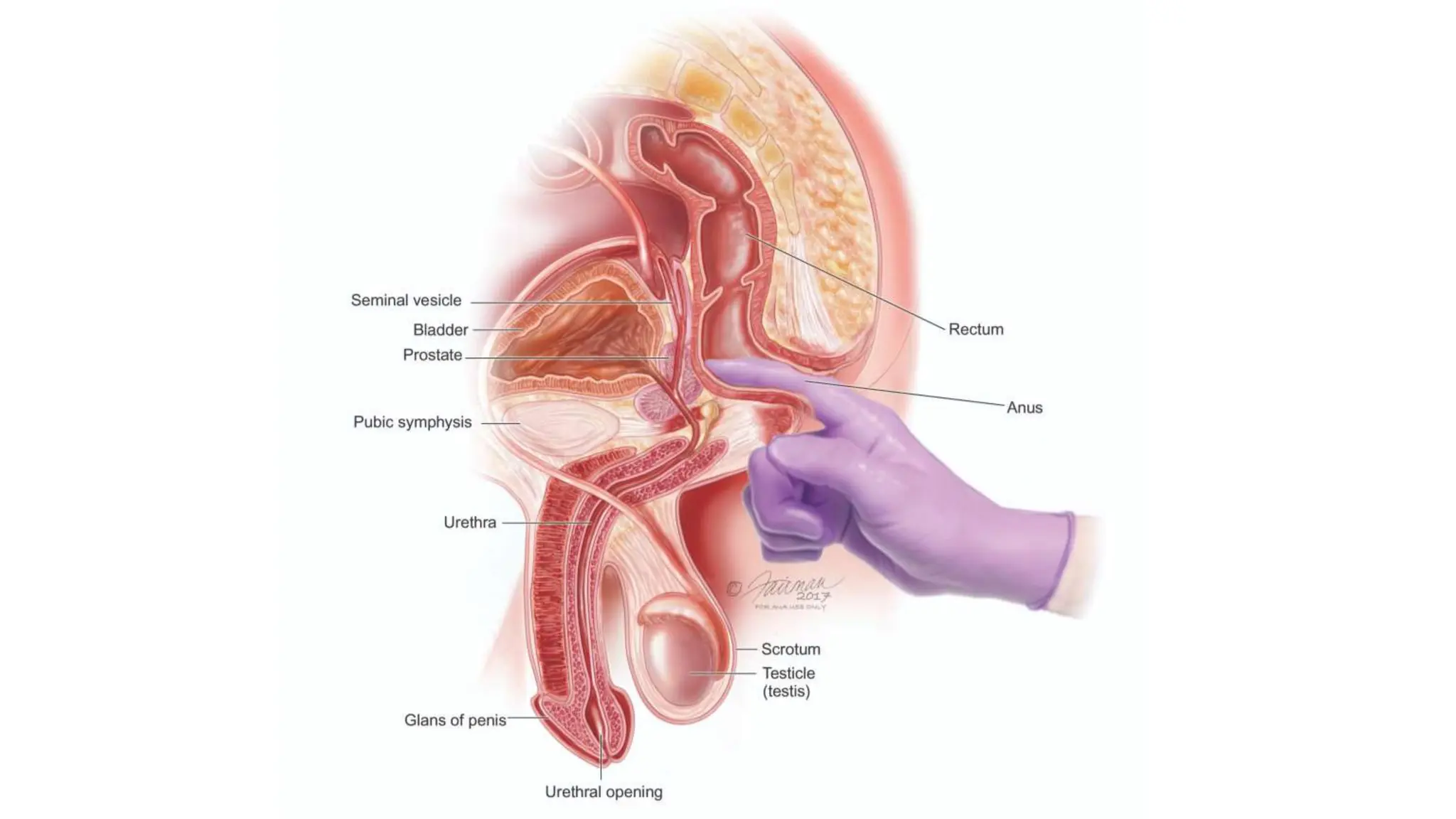
flattened and faces the rectum. This proximity is
important for rectal examination and allows
doctors to assess the prostate's size and
consistency.
Zones of the Prostate
1 Transitional Zone ( 5%)
 This zone is located in the central region of the
prostate and surrounds the prostatic urethra.
 It's primarily responsible for the development
of benign prostatic hyperplasia (BPH) and
contains the periurethral glands.
2 Central Zone (25%)
 The central zone is situated around the
ejaculatory ducts and extends from the
base to the apex of the prostate.
 It's relatively small and contains the
seminal vesicles and prostatic utricle.
3 Peripheral Zone (70%)
 This zone makes up the majority of the
prostate, surrounding the central zone.
 It's most commonly affected by prostate cancer,
and it contains the main portion of the gland's
secretory tissue.
4 Anterior Fibromuscular Stroma
This non-glandular region lies in the front of
the prostate and plays a structural role,
providing support and contributing to its
overall shape.
Sphincters Related to the
Prostate
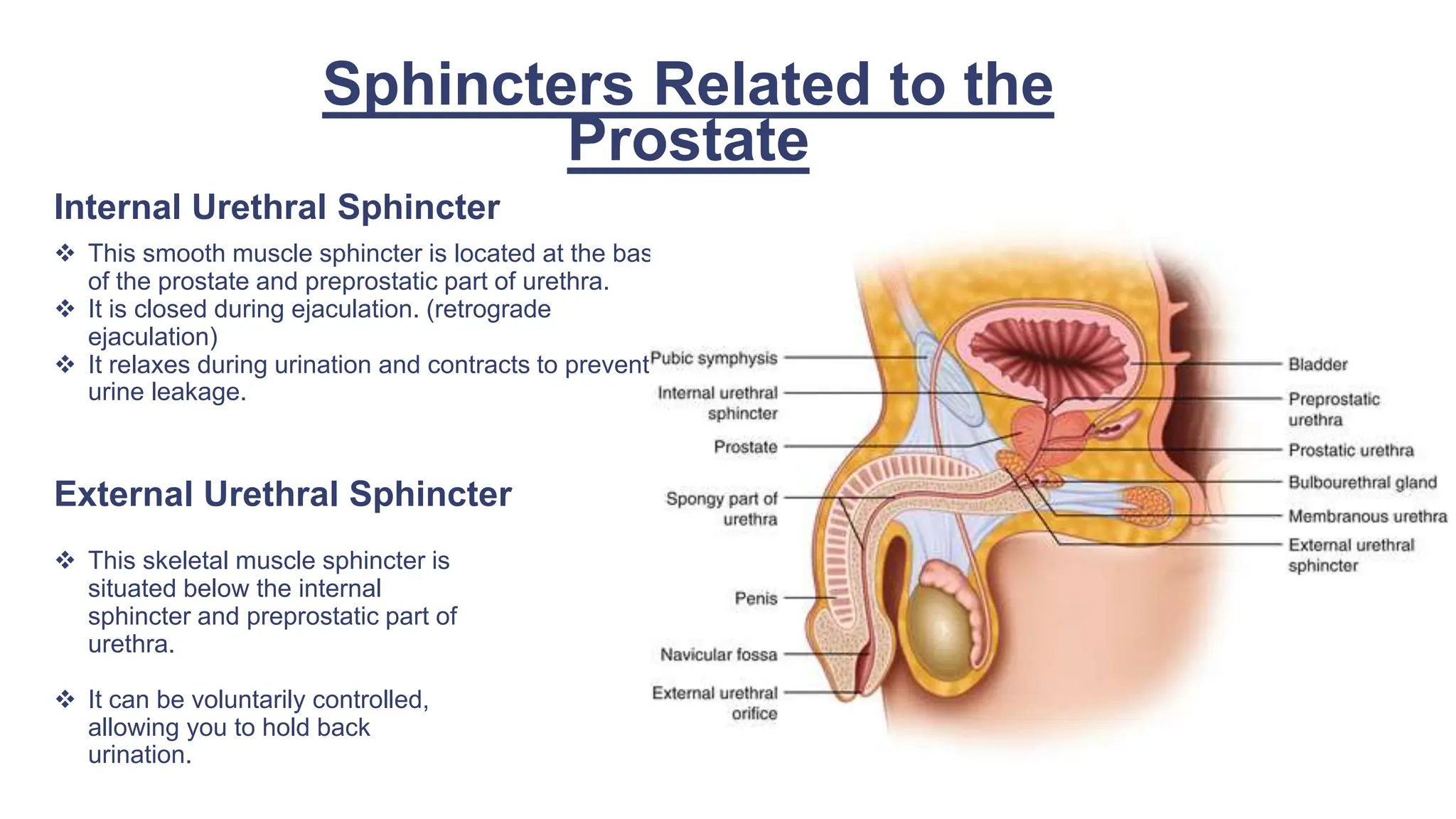
Internal Urethral Sphincter
 This smooth muscle sphincter is located at the base
of the prostate and preprostatic part of urethra.
 It is closed during ejaculation. (retrograde
ejaculation)
 It relaxes during urination and contracts to prevent
urine leakage.
External Urethral Sphincter
 This skeletal muscle sphincter is
situated below the internal
sphincter and preprostatic part of
urethra.
 It can be voluntarily controlled,
allowing you to hold back
urination.
Lobes of the Prostate
The prostate is incompletely divided into five lobes
The anterior lobe lies in front of the urethra and is devoid of glandular tissue.
tissue.
The median, or middle lobe is the wedge of gland situated between the urethra and the ejaculatory
urethra and the ejaculatory ducts. Its upper surface is related to the trigone of the bladder it is rich in glands.
The posterior lobe is situated behind the urethra and below the ejaculatory ducts and also contains
ducts and also contains glandular tissue.
The right and left lateral lobes lie on either side of the urethra and are separated from one
separated from one another by a shallow vertical groove on the posterior surface of the prostate. The lateral
lobes contain many glands
Capsules and Ligaments of the Prostate
True Capsule
• It is fibromuscular in structure and is continuous with stroma of the gland.
• The venous plexus lies between true and false capsules
False Capsule
It lies outside the true capsule and is derived from the endopelvic fascia.
 A pair of puboprostatic ligaments extend from the false capsule to the back of pubic
Structures within the Prostate
Prostatic Acini
 These small, sac-like structures are the functional units of the prostate gland.
 They are lined with epithelial cells that produce prostatic fluid, a milky substance that comprises a
significant portion of semen.
Prostatic Ducts
 These ducts connect the prostatic acini to the prostatic urethra, carrying the prostatic fluid into the
urethra.
Prostatic Urethra
 The prostatic urethra is about 1.25 in. (3 cm) long and begins at the neck of the bladder.
 The prostatic urethra is the widest and most dilatable portion of the entire urethra.
 On the posterior wall is a longitudinal ridge called the urethral crest (verumontanum)
 On each side of this ridge is a groove called the prostatic sinus; the prostatic glands open into these
grooves.
 On the summit of the urethral crest is a depression, the prostatic utricle .
 On the edge of the mouth of the utricle are the openings of the two ejaculatory ducts.
Blood Supply and Venous Drainage of the
Prostate
1 Arterial Supply
The prostate receives its blood supply from branches of the internal iliac artery
• the inferior vesical artery
• the middle rectal artery
• Internal pudendal artery
2 Venous Drainage
The veins form the prostatic venous plexus, which lies outside the capsule of the prostate
The prostatic plexus receives blood from following veins and drains into the internal iliac veins.
• the deep dorsal vein of the penis
• numerous vesical veins
 Valveless communications exist between the prostatic and vertebral venous plexuses through which
prostatic carcinoma can spread to the vertebral column and to the skull
3 Lymphatic Drainage
The lymphatic vessels of the prostate drain into the internal iliac nodes
Clinicals :
• Benign hypertrophy of the prostate (BHP)
• Carcinoma of prostate
• Prostatitis
The Prostate - anatomy lecture about human gland

The Prostate - anatomy lecture about human gland

  • 1.
    The Prostate:A VitalGland  The prostate gland is a small, walnut-shaped gland that plays a crucial role in the male reproductive system.  Located just below the bladder and in front of the rectum, it surrounds the urethra.  The prostate gland is responsible for producing a milky fluid that makes up a significant portion of semen, which nourishes and protects sperm. by Dr.Umar khan
  • 2.
    Shape, Size, andWeight of the Prostate Shape The prostate resembles a walnut in shape, with a slightly rounded base and a pointed apex. Size The prostate's size is variable, but in adults, it typically measures about 3 centimeters in width, 4 centimeters in length, and 2 centimeters in height. Weight The average weight of the prostate in adult males ranges from 15 to 20 grams. This weight can fluctuate depending on factors like age, health conditions, and hormonal levels.
  • 3.
    Relations of theProstate Superiorly The base of the prostate is continuous with the neck of the bladder . The urethra enters the center of the base of the prostate Inferiorly: The apex of the prostate lies on the upper surface of the urogenital diaphragm. The urethra leaves the prostate just above the apex on the anterior surface Anteriorly: The prostate is related to the symphysis pubis, separated from it by the extraperitoneal fat in the retropubic space (cave of Retzius). The prostate is connected to the posterior aspect of the pubic bones by the fascial puboprostatic ligaments Posteriorly: The prostate is closely related to the anterior surface of the rectal ampulla and is separated from it by the rectovesical septum (fascia of Denonvilliers). Laterally: The prostate is embraced by the anterior fibers of the levator ani as they run posteriorly from the pubis
  • 6.
    Gross Features ofthe Prostate Base The base of the prostate is the broadest part, facing the bladder. It's connected to the bladder by the prostatic urethra, which forms a continuation of the bladder neck. Apex The apex of the prostate is the pointed lower end, facing the membranous urethra. This section of the urethra lies within the urogenital diaphragm, a muscular structure in the pelvic floor. Lateral Surfaces The lateral surfaces of the prostate are smooth and convex, gently curving towards the sides. They are covered by a thin layer of fibrous tissue called the prostatic capsule. Posterior Surface The posterior surface of the prostate is slightly flattened and faces the rectum. This proximity is important for rectal examination and allows doctors to assess the prostate's size and consistency.
  • 7.
    Zones of theProstate 1 Transitional Zone ( 5%)  This zone is located in the central region of the prostate and surrounds the prostatic urethra.  It's primarily responsible for the development of benign prostatic hyperplasia (BPH) and contains the periurethral glands. 2 Central Zone (25%)  The central zone is situated around the ejaculatory ducts and extends from the base to the apex of the prostate.  It's relatively small and contains the seminal vesicles and prostatic utricle. 3 Peripheral Zone (70%)  This zone makes up the majority of the prostate, surrounding the central zone.  It's most commonly affected by prostate cancer, and it contains the main portion of the gland's secretory tissue. 4 Anterior Fibromuscular Stroma This non-glandular region lies in the front of the prostate and plays a structural role, providing support and contributing to its overall shape.
  • 9.
    Sphincters Related tothe Prostate Internal Urethral Sphincter  This smooth muscle sphincter is located at the base of the prostate and preprostatic part of urethra.  It is closed during ejaculation. (retrograde ejaculation)  It relaxes during urination and contracts to prevent urine leakage. External Urethral Sphincter  This skeletal muscle sphincter is situated below the internal sphincter and preprostatic part of urethra.  It can be voluntarily controlled, allowing you to hold back urination.
  • 10.
    Lobes of theProstate The prostate is incompletely divided into five lobes The anterior lobe lies in front of the urethra and is devoid of glandular tissue. tissue. The median, or middle lobe is the wedge of gland situated between the urethra and the ejaculatory urethra and the ejaculatory ducts. Its upper surface is related to the trigone of the bladder it is rich in glands. The posterior lobe is situated behind the urethra and below the ejaculatory ducts and also contains ducts and also contains glandular tissue. The right and left lateral lobes lie on either side of the urethra and are separated from one separated from one another by a shallow vertical groove on the posterior surface of the prostate. The lateral lobes contain many glands
  • 12.
    Capsules and Ligamentsof the Prostate True Capsule • It is fibromuscular in structure and is continuous with stroma of the gland. • The venous plexus lies between true and false capsules False Capsule It lies outside the true capsule and is derived from the endopelvic fascia.  A pair of puboprostatic ligaments extend from the false capsule to the back of pubic
  • 14.
    Structures within theProstate Prostatic Acini  These small, sac-like structures are the functional units of the prostate gland.  They are lined with epithelial cells that produce prostatic fluid, a milky substance that comprises a significant portion of semen. Prostatic Ducts  These ducts connect the prostatic acini to the prostatic urethra, carrying the prostatic fluid into the urethra. Prostatic Urethra  The prostatic urethra is about 1.25 in. (3 cm) long and begins at the neck of the bladder.  The prostatic urethra is the widest and most dilatable portion of the entire urethra.  On the posterior wall is a longitudinal ridge called the urethral crest (verumontanum)  On each side of this ridge is a groove called the prostatic sinus; the prostatic glands open into these grooves.  On the summit of the urethral crest is a depression, the prostatic utricle .  On the edge of the mouth of the utricle are the openings of the two ejaculatory ducts.
  • 17.
    Blood Supply andVenous Drainage of the Prostate 1 Arterial Supply The prostate receives its blood supply from branches of the internal iliac artery • the inferior vesical artery • the middle rectal artery • Internal pudendal artery 2 Venous Drainage The veins form the prostatic venous plexus, which lies outside the capsule of the prostate The prostatic plexus receives blood from following veins and drains into the internal iliac veins. • the deep dorsal vein of the penis • numerous vesical veins  Valveless communications exist between the prostatic and vertebral venous plexuses through which prostatic carcinoma can spread to the vertebral column and to the skull 3 Lymphatic Drainage The lymphatic vessels of the prostate drain into the internal iliac nodes
  • 20.
    Clinicals : • Benignhypertrophy of the prostate (BHP) • Carcinoma of prostate • Prostatitis