Tips on using my ppt.
1. You can freely download, edit, modify and put your
name etc.
2. Don’t be concerned about number of slides. Half the
slides are blanks except for the title.
3. First show the blank slides (eg. Aetiology ) > Ask
students what they already know about ethology of
today's topic. > Then show next slide which enumerates
aetiologies.
4. At the end rerun the show – show blank> ask questions >
show next slide.
5. This will be an ACTIVE LEARNING SESSION x
three revisions.
6. Good for self study also.
7. See notes for bibliography.
Objectives
Objectives
• What do we study in Anatomy
Objectives
• Embryology
• Parts
• Size and Weight
• Surfaces
• Borders
• Relations
• Arterial Supply
• Venous Drainage
• Lymphatic Drainage
• Nerve Supply
• Attachments/Supports
• Surface Marking
• Microscopic Anatomy
• Applied Anatomy
• Physiology
• Congenital Anomalies
Parts of Urogenital System
•
Parts of Urogenital System
• Kidneys
• Ureters
• Urinary Bladder
• Prostate and Seminal Vesicles
• Penis and male Urethra
• Testis and Scrotum
• Vulva and Female Urethra
• Uterus and Ovary.
Parts of Urinary tract
• Upper Urinary tract- Kidneys and Ureters
• Lower urinary tract (bladder, prostate and
urethra)
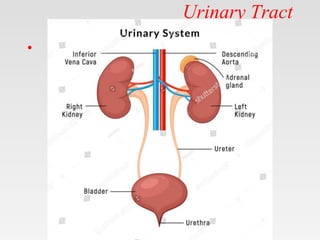
Urinary Tract
•
Kidneys
Kidneys
• The two kidneys lie retroperitoneally on the
posterior abdominal wall.
• Anteriorly, the right kidney is covered by
the liver, the second part of the duodenum
and the ascending colon.
• The spleen, stomach, tail of pancreas, left
colon and small bowel overlie the left
kidney.
• The renal hilum lies medially and transmits
from front to back the renal vein, renal
artery and renal pelvis.
Kidneys
• The parenchyma of each kidney usually drains
into seven calyces, three upper, two middle and
two lower calyces.
• Each of the three segments represents an
anatomically distinct unit with its own blood
supply.
• One or more renal arteries are present as
physiological end arteries that provide the sole
blood supply to the tissue they serve.
• The renal veins are commonly multiple, variable
and richly anastomotic.
Ureters
Ureters
• Stones formed in kidney are painless they
produce very severe pain when get stuck in
ureter.
• It has three anatomic sites of narrowing at
which kidney stones typically become
lodged:
1. The ureteropelvic junction (UPJ),
2. Pelvic brim
3. Ureterovesical junction (UVJ).
Ureters
• In the female, it lies close to the lateral
fornix of the vagina and is crossed by the
uterine vessels, where it is vulnerable to
damage during hysterectomy.
Urinary Bladder
Urinary Bladder
• It is lined by transitional epithelium (aka.
Urothelium) covering the connective tissue lamina
propria, which contains a rich plexus of vessels
and lymphatics.
• When the detrusor muscle hypertrophies, the inner
layer,covered by urothelium, stands out, resulting
in the appearance of trabeculation.
• Over the trigone is a thin layer of smooth muscle
to which the epithelium is closely adherent and
which extends as a sheath around the lower ureters
and into the proximal urethra.
Urinary Bladder
• Around the male bladder neck is the smooth
muscle internal sphincter innervated by adrenergic
fibres, which prevents retrograde ejaculation.
• The distal urethral sphincter is a horseshoe-shaped
mass of striated muscle that lies anterior and distal
to the prostate, or in the proximal two-thirds of the
female urethra. It is distinct from the pelvic floor
and is supplied by S2–S4 fibres via the pudendal
nerve and by somatic fibres passing through the
inferior hypogastric plexus.
Urinary Bladder
• At the posterolateral bladder neck, condensations
of fascia pass forward medially and laterally to the
ureter to join with the prostatic fascia; this fascia
needs to be divided during cystectomy.
• The puboprostatic ligaments are well-
defined condensations of the anterior
endopelvic fascia; they stretch from the
front of the prostate to the periosteum of the
pubis and lie lateral to the dorsal vein
complex.
Urinary Bladder
• The urachus and obliterated hypogastric arteries,
together with the folds of peritoneum overlying
them, are called the median and lateral umbilical
ligaments.
• Condensations of fascia also occur around the
superior and inferior vascular pedicles.
Arteries
• The superior and inferior vesical arteries from the
internal iliac artery.
• Branches from the obturator and inferior gluteal
arteries (and from the uterine and vaginal arteries
in females) also supply the bladder.
Urinary Bladder
Veins
• The veins form a plexus on the lateral and inferior
surfaces of the bladder.
• In the male, the prostatic plexus is continuous with
the vesical plexus, which drains into the internal
iliac vein.
• In the female, similar large veins are continuous
with the vaginal plexus.
Urinary Bladder
• Lymphatics
• These accompany the veins and drain to nodes
along the internal iliac vessels and then to the
obturator and external iliac chains.
Urinary Bladder
INNERVATION
The parasympathetic input
• This is derived from the anterior primary divisions
of the second, third and fourth sacral segments
(mainly S2 and S3).
• Fibres pass through the pelvic splanchnic nerves
to the inferior hypogastric plexus, from where they
are distributed to the bladder.
• The pelvic plexus can be damaged during deep
pelvic operations.
Urinary Bladder
INNERVATION
The sympathetic input
• This arises in the 11th thoracic to the second
lumbar segments. fibres pass via the presacral
hypogastric nerve (rather than via the sympathetic
chains) to the inferior hypogastric plexus.
Urinary Bladder
INNERVATION
Somatic innervation
• Somatic innervation passes to the distal sphincter
mechanism via the pudendal nerves and also via
fibres that pass through the inferior hypogastric
plexus.
• In relationship to the posterolateral aspect of the
prostatic capsule and are at risk of damage during
radical cystoprostatectomy or radical
prostatectomy; inadvertent diathermy in the region
of these nerves may be the cause of uncommon
erectile impotence after transurethral
prostatectomy.
THE MALE URETHRA
THE MALE URETHRA
• It has four components which are named (from
proximal to distal),
1. Prostatic
2. Membranous
3. Bulbar
4. Penile urethra.
THE MALE URETHRA
• The prostatic urethra extends from the bladder
neck to the verumontanum an important landmark
for urologists performing transurethral resection of
the prostate.
• The membranous urethra lies just distal to the
verumontanum and is located where the urethra
penetrates the pelvic floor and it is the usual site of
urethral rupture at the time of a pelvic fracture.
• It is the primary location of continence as a
consequence of the surrounding pelvic floor
musculature and external urethral sphincter
THE MALE URETHRA
• The bulbar urethra extends from the membranous
urethra to the penoscrotal junction and is
anteriorly located within the corpus spongiosum.
•
THE FEMALE URETHRA
THE FEMALE URETHRA
• The female urethra is around 2–3 cm long,
extending from the bladder neck to the external
urethral meatus.
• Continence is maintained by the external striated
urethral sphincter, which in women extends for
almost the whole length of the urethra.
• There is extra support from the surrounding pelvic
floor musculature.
• In contrast to men, the female bladder neck has
little role in the maintenance of continence.
Colles’fascia
•
Colles’fascia
• Aka The membranous layer of the superficial fascia of
perineum.
• Continues as Scarpa’’s fascia in abdomen
• In bulbar urethral injury Extravasation of urine is common
if the urine is not diverted and the extravasated urine is
confined in front of the mid-perineal point and collects in
the scrotum and penis and beneath the deep layer of
superficial fascia in the abdominal wall.
• Extravasated urine is confined in front of the mid-perineal
point by the attachment of Colles’ fascia to the triangular
ligament and by the attachment of Scarpa’s fascia just
below the inguinal ligament. The external spermatic fascia
stops it getting into the inguinal canals.
Penis
•
Penis
•
Male reproductive system
Penis
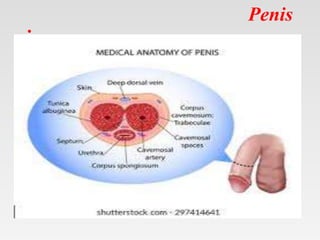
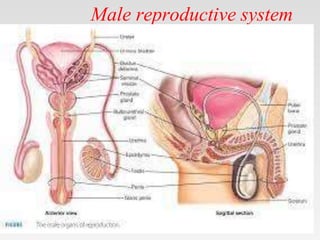
• The penis is composed of three tubular structures.
The Dors altwo structures, which are apposed to
each other, are called the corpora cavernosa and
are anchored posteriorly onto the pubic rami.
• They provide the erectile function.
• The third tubular structure is the corpus
spongiosum, which contains the urethra and it
expands distally to form the glans penis.
• The corpora cavernosa have an outer covering of
tunica albuginea which is relatively inelastic and
which also forms the septum between them.
• The central arterial blood supply (the central
penile artery) is a branch of the internal pudendal
Testis & Epididymis
Testis & Epididymis
• The anatomy of the adult testis reflects its
embryonic development.
• The testicular arteries originate high up in the
retroperitoneum from the abdominal aorta, just
below the renal arteries.
• The testicular veins drain into the renal vein on the
left and the inferior vena cava on the right.
• The epididymis lies on the posterior aspect of the
testis and is palpable as a separate structure, with a
head, a body and a tail.
• The vas curves up behind the testis and can be felt
above the testis as a firm tubular structure entering
the external inguinal ring.
The prostate and seminal vesicles
•
The prostate and seminal vesicles
•
The prostate and seminal vesicles
•
The prostate and seminal vesicles
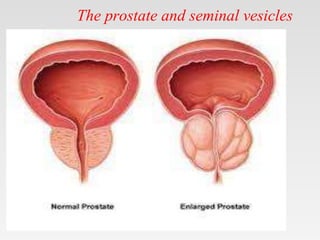
• Prostate is divided into the peripheral zone (PZ),
which lies mainly posteriorly and from which
most carcinomas arise, and a central zone (CZ),
which lies posterior to the urethral lumen and
above the ejaculatory ducts as they pass through
the prostate;
• There is also a periurethral transitional zone (TZ),
from which most benign prostatic hyperplasia
(BPH) arises.
•
The prostate and seminal vesicles
• Smooth muscle cells are found throughout the
prostate but,
• in the upper part of the prostate and bladder neck,
there is a separate sphincter muscle that subserves
a sexual function, closing during ejaculation.
• Resection of this tissue during prostatectomy is
responsible for retrograde ejaculation.
The prostate and seminal vesicles
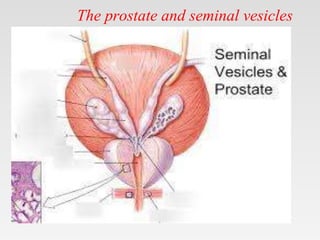
• The seminal glands are a pair of 5cm long tubular
glands. They are located between
the bladder fundus and the rectum
• Their most important anatomical relation is with
the vas deferens, which combine with the duct of
the seminal vesicles to form the ejaculatory duct,
which subsequently drains into the prostatic
urethra.
Get this ppt in mobile
1. Download Microsoft
PowerPoint from play
store.
2. Open Google assistant
3. Open Google lens.
4. Scan qr code from
next slide.
Get this ppt in mobile
1. Download Microsoft
PowerPoint from play
store.
2. Open Google assistant
3. Open Google lens.
4. Scan qr code from
next slide.
Get my ppt collection
• https://www.slideshare.net/drpradeeppande/
edit_my_uploads
• https://www.dropbox.com/sh/x600md3cvj8
5woy/AACVMHuQtvHvl_K8ehc3ltkEa?dl
=0
• https://www.facebook.com/doctorpradeeppa
nde/?ref=pages_you_manage

Genitourinary system surgical antomy.pptx

  • 1.
    Tips on usingmy ppt. 1. You can freely download, edit, modify and put your name etc. 2. Don’t be concerned about number of slides. Half the slides are blanks except for the title. 3. First show the blank slides (eg. Aetiology ) > Ask students what they already know about ethology of today's topic. > Then show next slide which enumerates aetiologies. 4. At the end rerun the show – show blank> ask questions > show next slide. 5. This will be an ACTIVE LEARNING SESSION x three revisions. 6. Good for self study also. 7. See notes for bibliography.
  • 2.
  • 3.
    Objectives • What dowe study in Anatomy
  • 4.
    Objectives • Embryology • Parts •Size and Weight • Surfaces • Borders • Relations • Arterial Supply • Venous Drainage • Lymphatic Drainage • Nerve Supply • Attachments/Supports • Surface Marking • Microscopic Anatomy • Applied Anatomy • Physiology • Congenital Anomalies
  • 5.
  • 6.
    Parts of UrogenitalSystem • Kidneys • Ureters • Urinary Bladder • Prostate and Seminal Vesicles • Penis and male Urethra • Testis and Scrotum • Vulva and Female Urethra • Uterus and Ovary.
  • 7.
    Parts of Urinarytract • Upper Urinary tract- Kidneys and Ureters • Lower urinary tract (bladder, prostate and urethra)
  • 8.
  • 9.
  • 10.
    Kidneys • The twokidneys lie retroperitoneally on the posterior abdominal wall. • Anteriorly, the right kidney is covered by the liver, the second part of the duodenum and the ascending colon. • The spleen, stomach, tail of pancreas, left colon and small bowel overlie the left kidney. • The renal hilum lies medially and transmits from front to back the renal vein, renal artery and renal pelvis.
  • 11.
    Kidneys • The parenchymaof each kidney usually drains into seven calyces, three upper, two middle and two lower calyces. • Each of the three segments represents an anatomically distinct unit with its own blood supply. • One or more renal arteries are present as physiological end arteries that provide the sole blood supply to the tissue they serve. • The renal veins are commonly multiple, variable and richly anastomotic.
  • 12.
  • 13.
    Ureters • Stones formedin kidney are painless they produce very severe pain when get stuck in ureter. • It has three anatomic sites of narrowing at which kidney stones typically become lodged: 1. The ureteropelvic junction (UPJ), 2. Pelvic brim 3. Ureterovesical junction (UVJ).
  • 14.
    Ureters • In thefemale, it lies close to the lateral fornix of the vagina and is crossed by the uterine vessels, where it is vulnerable to damage during hysterectomy.
  • 15.
  • 16.
    Urinary Bladder • Itis lined by transitional epithelium (aka. Urothelium) covering the connective tissue lamina propria, which contains a rich plexus of vessels and lymphatics. • When the detrusor muscle hypertrophies, the inner layer,covered by urothelium, stands out, resulting in the appearance of trabeculation. • Over the trigone is a thin layer of smooth muscle to which the epithelium is closely adherent and which extends as a sheath around the lower ureters and into the proximal urethra.
  • 17.
    Urinary Bladder • Aroundthe male bladder neck is the smooth muscle internal sphincter innervated by adrenergic fibres, which prevents retrograde ejaculation. • The distal urethral sphincter is a horseshoe-shaped mass of striated muscle that lies anterior and distal to the prostate, or in the proximal two-thirds of the female urethra. It is distinct from the pelvic floor and is supplied by S2–S4 fibres via the pudendal nerve and by somatic fibres passing through the inferior hypogastric plexus.
  • 18.
    Urinary Bladder • Atthe posterolateral bladder neck, condensations of fascia pass forward medially and laterally to the ureter to join with the prostatic fascia; this fascia needs to be divided during cystectomy. • The puboprostatic ligaments are well- defined condensations of the anterior endopelvic fascia; they stretch from the front of the prostate to the periosteum of the pubis and lie lateral to the dorsal vein complex.
  • 19.
    Urinary Bladder • Theurachus and obliterated hypogastric arteries, together with the folds of peritoneum overlying them, are called the median and lateral umbilical ligaments. • Condensations of fascia also occur around the superior and inferior vascular pedicles. Arteries • The superior and inferior vesical arteries from the internal iliac artery. • Branches from the obturator and inferior gluteal arteries (and from the uterine and vaginal arteries in females) also supply the bladder.
  • 20.
    Urinary Bladder Veins • Theveins form a plexus on the lateral and inferior surfaces of the bladder. • In the male, the prostatic plexus is continuous with the vesical plexus, which drains into the internal iliac vein. • In the female, similar large veins are continuous with the vaginal plexus.
  • 21.
    Urinary Bladder • Lymphatics •These accompany the veins and drain to nodes along the internal iliac vessels and then to the obturator and external iliac chains.
  • 22.
    Urinary Bladder INNERVATION The parasympatheticinput • This is derived from the anterior primary divisions of the second, third and fourth sacral segments (mainly S2 and S3). • Fibres pass through the pelvic splanchnic nerves to the inferior hypogastric plexus, from where they are distributed to the bladder. • The pelvic plexus can be damaged during deep pelvic operations.
  • 23.
    Urinary Bladder INNERVATION The sympatheticinput • This arises in the 11th thoracic to the second lumbar segments. fibres pass via the presacral hypogastric nerve (rather than via the sympathetic chains) to the inferior hypogastric plexus.
  • 24.
    Urinary Bladder INNERVATION Somatic innervation •Somatic innervation passes to the distal sphincter mechanism via the pudendal nerves and also via fibres that pass through the inferior hypogastric plexus. • In relationship to the posterolateral aspect of the prostatic capsule and are at risk of damage during radical cystoprostatectomy or radical prostatectomy; inadvertent diathermy in the region of these nerves may be the cause of uncommon erectile impotence after transurethral prostatectomy.
  • 25.
  • 26.
    THE MALE URETHRA •It has four components which are named (from proximal to distal), 1. Prostatic 2. Membranous 3. Bulbar 4. Penile urethra.
  • 27.
    THE MALE URETHRA •The prostatic urethra extends from the bladder neck to the verumontanum an important landmark for urologists performing transurethral resection of the prostate. • The membranous urethra lies just distal to the verumontanum and is located where the urethra penetrates the pelvic floor and it is the usual site of urethral rupture at the time of a pelvic fracture. • It is the primary location of continence as a consequence of the surrounding pelvic floor musculature and external urethral sphincter
  • 28.
    THE MALE URETHRA •The bulbar urethra extends from the membranous urethra to the penoscrotal junction and is anteriorly located within the corpus spongiosum. •
  • 29.
  • 30.
    THE FEMALE URETHRA •The female urethra is around 2–3 cm long, extending from the bladder neck to the external urethral meatus. • Continence is maintained by the external striated urethral sphincter, which in women extends for almost the whole length of the urethra. • There is extra support from the surrounding pelvic floor musculature. • In contrast to men, the female bladder neck has little role in the maintenance of continence.
  • 31.
  • 32.
    Colles’fascia • Aka Themembranous layer of the superficial fascia of perineum. • Continues as Scarpa’’s fascia in abdomen • In bulbar urethral injury Extravasation of urine is common if the urine is not diverted and the extravasated urine is confined in front of the mid-perineal point and collects in the scrotum and penis and beneath the deep layer of superficial fascia in the abdominal wall. • Extravasated urine is confined in front of the mid-perineal point by the attachment of Colles’ fascia to the triangular ligament and by the attachment of Scarpa’s fascia just below the inguinal ligament. The external spermatic fascia stops it getting into the inguinal canals.
  • 33.
  • 34.
  • 35.
  • 36.
    Penis • The penisis composed of three tubular structures. The Dors altwo structures, which are apposed to each other, are called the corpora cavernosa and are anchored posteriorly onto the pubic rami. • They provide the erectile function. • The third tubular structure is the corpus spongiosum, which contains the urethra and it expands distally to form the glans penis. • The corpora cavernosa have an outer covering of tunica albuginea which is relatively inelastic and which also forms the septum between them. • The central arterial blood supply (the central penile artery) is a branch of the internal pudendal
  • 37.
  • 38.
    Testis & Epididymis •The anatomy of the adult testis reflects its embryonic development. • The testicular arteries originate high up in the retroperitoneum from the abdominal aorta, just below the renal arteries. • The testicular veins drain into the renal vein on the left and the inferior vena cava on the right. • The epididymis lies on the posterior aspect of the testis and is palpable as a separate structure, with a head, a body and a tail. • The vas curves up behind the testis and can be felt above the testis as a firm tubular structure entering the external inguinal ring.
  • 39.
    The prostate andseminal vesicles •
  • 40.
    The prostate andseminal vesicles •
  • 41.
    The prostate andseminal vesicles •
  • 42.
    The prostate andseminal vesicles • Prostate is divided into the peripheral zone (PZ), which lies mainly posteriorly and from which most carcinomas arise, and a central zone (CZ), which lies posterior to the urethral lumen and above the ejaculatory ducts as they pass through the prostate; • There is also a periurethral transitional zone (TZ), from which most benign prostatic hyperplasia (BPH) arises. •
  • 43.
    The prostate andseminal vesicles • Smooth muscle cells are found throughout the prostate but, • in the upper part of the prostate and bladder neck, there is a separate sphincter muscle that subserves a sexual function, closing during ejaculation. • Resection of this tissue during prostatectomy is responsible for retrograde ejaculation.
  • 44.
    The prostate andseminal vesicles • The seminal glands are a pair of 5cm long tubular glands. They are located between the bladder fundus and the rectum • Their most important anatomical relation is with the vas deferens, which combine with the duct of the seminal vesicles to form the ejaculatory duct, which subsequently drains into the prostatic urethra.
  • 45.
    Get this pptin mobile 1. Download Microsoft PowerPoint from play store. 2. Open Google assistant 3. Open Google lens. 4. Scan qr code from next slide.
  • 47.
    Get this pptin mobile 1. Download Microsoft PowerPoint from play store. 2. Open Google assistant 3. Open Google lens. 4. Scan qr code from next slide.
  • 50.
    Get my pptcollection • https://www.slideshare.net/drpradeeppande/ edit_my_uploads • https://www.dropbox.com/sh/x600md3cvj8 5woy/AACVMHuQtvHvl_K8ehc3ltkEa?dl =0 • https://www.facebook.com/doctorpradeeppa nde/?ref=pages_you_manage

Editor's Notes

  • #26 In bulbar urethral injury Extravasation of urine is common if the urine is not diverted and the extravasated urine is confined in front of the mid-perineal point by the attachment of Colles’ fascia to the triangular ligament and by the attachment of Scarpa’s fascia just below the inguinal ligament. The external spermatic fascia stops it getting into the inguinal canals. Extravasated urine collects in the scrotum and penis and beneath the deep layer of superficial fascia in the abdominal wall.
  • #27 In bulbar urethral injury Extravasation of urine is common if the urine is not diverted and the extravasated urine is confined in front of the mid-perineal point by the attachment of Colles’ fascia to the triangular ligament and by the attachment of Scarpa’s fascia just below the inguinal ligament. The external spermatic fascia stops it getting into the inguinal canals. Extravasated urine collects in the scrotum and penis and beneath the deep layer of superficial fascia in the abdominal wall.
  • #32 The attachment of Colles’ fascia to the triangular ligament and by the attachment of Scarpa’s fascia just below the inguinal ligament. The external spermatic fascia stops it getting into the inguinal canals.
  • #33 The attachment of Colles’ fascia to the triangular ligament and by the attachment of Scarpa’s fascia just below the inguinal ligament. The external spermatic fascia stops it getting into the inguinal canals.
  • #50 drpradeeppande@gmail.com 7697305442