PROSTATE ANATOMY
WHAT DO YOU WANT TO KNOW ?
Mohammed ALMoaiqel
King Abdulazizi Medical City
Riyadh
Saudi Arabia
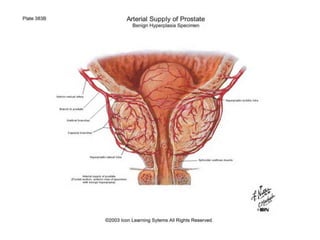
Prostate gland is a pyramid organ,
20 gm weight approx. 3X4X2 cm
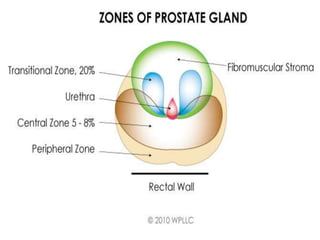
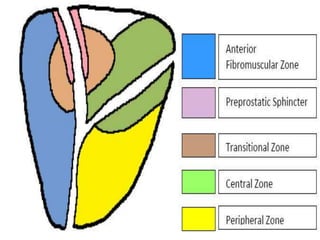
• Peripheral zone 70%
• Central zone 25%
• Transitional zone 5-10%
• Anterior fibromuscular
• Prostate CA in PZ
• BPH in TZ
• Chronic Prostatitis in PZ
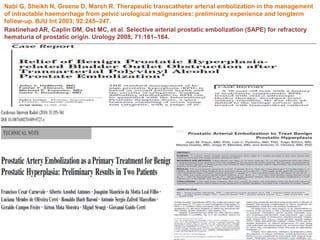
Rastinehad AR, Caplin DM, Ost MC, et al. Selective arterial prostatic embolization (SAPE) for refractory
hematuria of prostatic origin. Urology 2008; 71:181–184.
Nabi G, Sheikh N, Greene D, Marsh R. Therapeutic transcatheter arterial embolization in the management
of intractable haemorrhage from pelvic urological malignancies: preliminary experience and longterm
follow-up. BJU Int 2003; 92:245–247.
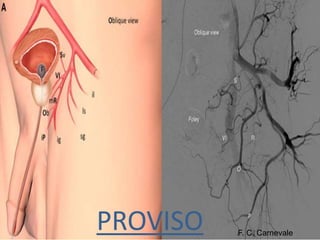
PROVISO F. C. Carnevale
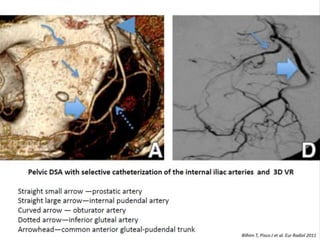
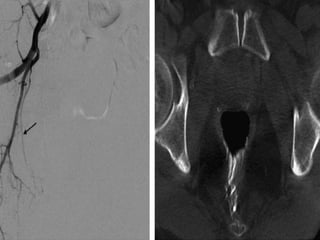
CT ANGIOGRAPHY WITH MIP & VR
25-55 ispilateral oblique vies with
10-20 caudal angulation
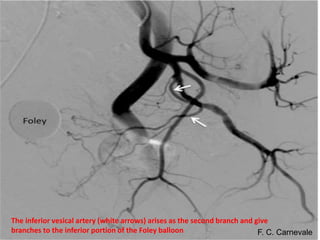
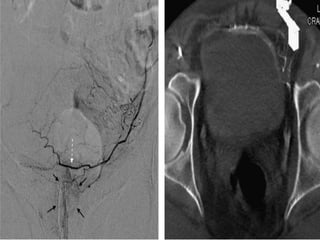
Foley catheter
The inferior vesical artery (white arrows) arises as the second branch and give
branches to the inferior portion of the Foley balloon F. C. Carnevale
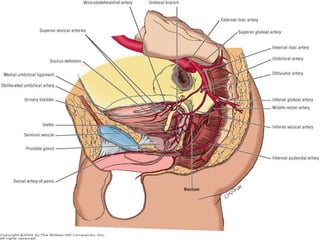
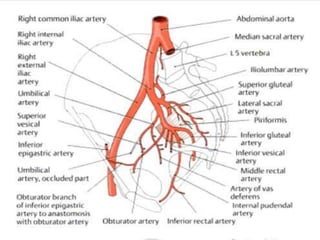
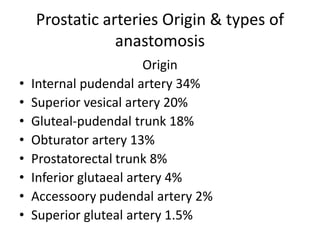
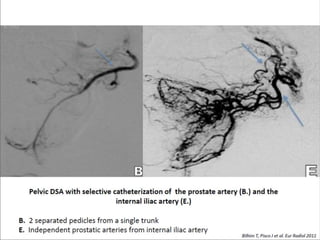
Prostatic arteries Origin & types of
anastomosis
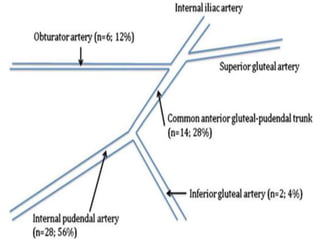
Origin
• Internal pudendal artery 34%
• Superior vesical artery 20%
• Gluteal-pudendal trunk 18%
• Obturator artery 13%
• Prostatorectal trunk 8%
• Inferior glutaeal artery 4%
• Accessoory pudendal artery 2%
• Superior gluteal artery 1.5%
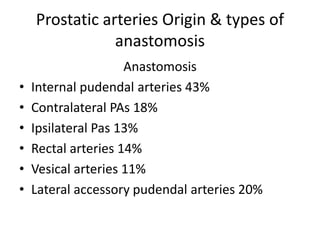
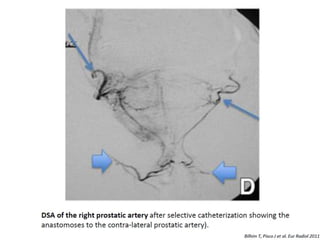
Anastomosis
• Internal pudendal arteries 43%
• Contralateral PAs 18%
• Ipsilateral Pas 13%
• Rectal arteries 14%
• Vesical arteries 11%
• Lateral accessory pudendal arteries 20%
Prostatic arteries Origin & types of
anastomosis
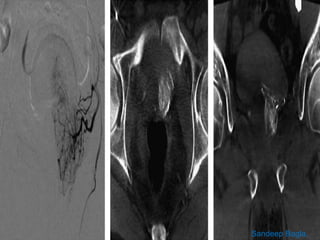
Sandeep Bagla,
CONCLUSION
Detailed angiographic arterial prostatic supply
are mandatory to be known by the
interventionlist before and during PAE
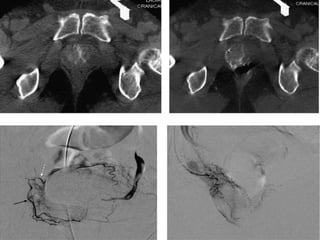
CT Angio before, ipsilateral view, Foly catheter
and CONE BEAM CT all are useful tools during
PAE

Prostate anatomy

  • 1.
    PROSTATE ANATOMY WHAT DOYOU WANT TO KNOW ? Mohammed ALMoaiqel King Abdulazizi Medical City Riyadh Saudi Arabia
  • 2.
    Prostate gland isa pyramid organ, 20 gm weight approx. 3X4X2 cm
  • 3.
    • Peripheral zone70% • Central zone 25% • Transitional zone 5-10% • Anterior fibromuscular
  • 4.
    • Prostate CAin PZ • BPH in TZ • Chronic Prostatitis in PZ
  • 7.
    Rastinehad AR, CaplinDM, Ost MC, et al. Selective arterial prostatic embolization (SAPE) for refractory hematuria of prostatic origin. Urology 2008; 71:181–184. Nabi G, Sheikh N, Greene D, Marsh R. Therapeutic transcatheter arterial embolization in the management of intractable haemorrhage from pelvic urological malignancies: preliminary experience and longterm follow-up. BJU Int 2003; 92:245–247.
  • 12.
    PROVISO F. C.Carnevale
  • 13.
  • 14.
    25-55 ispilateral obliquevies with 10-20 caudal angulation
  • 15.
  • 16.
    The inferior vesicalartery (white arrows) arises as the second branch and give branches to the inferior portion of the Foley balloon F. C. Carnevale
  • 17.
    Prostatic arteries Origin& types of anastomosis Origin • Internal pudendal artery 34% • Superior vesical artery 20% • Gluteal-pudendal trunk 18% • Obturator artery 13% • Prostatorectal trunk 8% • Inferior glutaeal artery 4% • Accessoory pudendal artery 2% • Superior gluteal artery 1.5%
  • 18.
    Anastomosis • Internal pudendalarteries 43% • Contralateral PAs 18% • Ipsilateral Pas 13% • Rectal arteries 14% • Vesical arteries 11% • Lateral accessory pudendal arteries 20% Prostatic arteries Origin & types of anastomosis
  • 23.
  • 27.
    CONCLUSION Detailed angiographic arterialprostatic supply are mandatory to be known by the interventionlist before and during PAE CT Angio before, ipsilateral view, Foly catheter and CONE BEAM CT all are useful tools during PAE