Urological symptoms  Urology Department Undergraduate courses
History Taking The medical history is the cornerstone of the evaluation of the urologic patient.  A complete history can be divided into:  The chief complaint  History of the present illness The patient's past medical and surgical history Family history.  Magdy Fath-Alla, 2009
Complaint Urological complaint(s) can be categorized into one or more of: Pain Changes in the act of micturition Changes in gross appearance of urine Changes in function and/or appearance of male genitalia. Systemic symptoms Magdy Fath-Alla, 2009
Pain Pain arising from the GU tract may be quite severe and is usually associated with  Obstruction: Ureteric stone.  Urinary retention. Inflammation   parenchymatous organs inflamm. produces severe pain (pyelonephritis, prostatitis, and epididymitis) Inflammation of the mucosa of a hollow viscus such as the bladder or urethra usually produces discomfort. Tumors of  GU tract usually do not cause pain unless they  produce obstruction or extend to adjacent nerves. Magdy Fath-Alla, 2009
Renal Pain   Site: ipsilateral  costovertebral angle  just lateral to the sacrospinalis muscle and beneath the 12th rib.  Pain due to inflammation is usually steady ( dull ache ) due to acute distention of the renal capsule,  Pain due to obstruction fluctuates in intensity ( colicky) .  may be associated with gastrointestinal symptoms  because of reflex stimulation of the celiac ganglion. Radiation: across the flank anteriorly toward the upper abdomen and umbilicus and may be  to  the testis or labium. Magdy Fath-Alla, 2009
Differential Diagnosis of Renal Pain 1) Pain of intraperitoneal origin  (perforated duodenal ulcer or pancreatitis) has the following characters: Radiates into the back, but the site of greatest pain and tenderness is in the epigastrium.  Radiates into the shoulder because of irritation of the diaphragm and phrenic nerve.  2) Renal pain may also be confused with pain resulting from irritation of the costal nerves (radicular pain), most commonly T10-T12.  However, the pain is not colicky in nature. Magdy Fath-Alla, 2009
Ureteral Pain   usually acute and secondary to obstruction.   Distribution of the pain according to site:  In upper ureteral obstruction, the pain may be referred to the scrotum in the male or the labium in the female.  Midureter obstruction: on the right side is referred to the right lower quadrant (McBurney's point) and simulate appendicitis; on the left side to left lower quadrant.  Lower ureteral obstruction causes bladder irritability (frequency, urgency, and suprapubic discomfort). Magdy Fath-Alla, 2009
Vesical and Prostatic pain   Vesical pain due to retention or inflammation.  Constant suprapubic pain that is unrelated to urinary retention is seldom of urologic origin.   Inflammatory conditions of the bladder usually produce  intermittent suprapubic discomfort.   Prostatic pain  due to inflammation with secondary edema and distention of the prostatic capsule.   poorly localized to lower abdominal, inguinal, perineal, lumbosacral, and/or rectal pain.  Magdy Fath-Alla, 2009
Penile and Testicular Pain   Penile pain Pain in the flaccid penis is referred pain from bladder or urethra and maximally at the urethral meatus.  Pain in the erect penis is usually due to Peyronie's disease or priapism. Scrotal pain  Primary pain arises from within the scrotum: Acute epididymitis or torsion of the testis.  Chronic scrotal pain (dull, heavy) due to hydrocele or  varicocele. Referred: from kidneys or retroperitoneum or from inguinal hernia. Magdy Fath-Alla, 2009
Irritative Symptoms   Frequency The normal adult voids five or six times per day, with a volume of approximately 300 mL with each void.  Urinary frequency is due either to increased urinary output (polyuria), detrusor instability or to decreased bladder capacity.  Magdy Fath-Alla, 2009
Irritative Symptoms   Nocturia  is nocturnal frequency.  Normally, adults arise no more than twice at night to void (decrease urine concentration with age).  Nocturia occur in the patient with congestive heart failure and peripheral edema, old aged and drinking fluids at night. Dysuria  is painful urination commonly referred to the urethral meatus.  at the start of urination indicate urethral pathology. at the end (strangury) indicate bladder origin. Dysuria is frequently accompanied by frequency & urgency. Urgency  the sudden intense desire to void that the patient can not defer. Magdy Fath-Alla, 2009
Obstructive Symptoms   Urinary hesitancy  delayed start of urination. Decreased force and caliber of urinary stream   is due to bladder outlet obstruction and commonly results from benign prostatic hyperplasia (BPH) or a urethral stricture.  Straining   refers to the use of abdominal musculature to urinate.  Intermittency  means interrupted stream. Postvoid dribbling   refers to the release of few drops of urine after micturition.  Magdy Fath-Alla, 2009
Incontinence Urinary incontinence is the involuntary loss of urine  Continuous Incontinence  most commonly due to: urinary tract fistula (as vesico-vaginal fistula usually due to gynecologic surgery, radiation, or obstetric trauma.  ectopic ureter that opens either at the urethra or the female genital tract.  Stress Incontinence  is sudden leakage of urine with coughing, sneezing, exercise (increase intra-abdominal pressure).  most common in women after childbearing or menopause and men after prostatic surgery and injury to the external urethral sphincter.    Magdy Fath-Alla, 2009
Incontinence Urge Incontinence  loss of urine preceded by a strong urge t o void.  Due to: cystitis, neurogenic bladder. Overflow Urinary Incontinence  Due to advanced urinary retention and high residual urine volumes.  Urine dribble due to bladder overflow.  Enuresis   micturition that occurs during sleep.  It occurs normally in children up to 3 years old. Magdy Fath-Alla, 2009
Changes in the gross appearance of urine Hematuria   the presence of blood in the urine > 3 RBCs per high-power microscopic field (HPF).  painless hematuria in adults, should be regarded as a symptom of urologic malignancy until proved otherwise. In evaluating hematuria: gross or microscopic.  Initial, terminal or allthrough. Painful or not. Associated with clots or not and shape of clots.   Magdy Fath-Alla, 2009
Changes in the gross appearance of urine Cloudy Urine Pyuria   Pyuria is a urinary tract infection in which large quantities of white blood cells cause urine to have a cloudy appearance.  Microscopic examination of the urine will demonstrate pus cells. Phosphaturia   due to precipitation of phosphates in alkaline urine.  Acidification of urine with acetic acid at the time of urine analysis causes clearing of the specimen. Magdy Fath-Alla, 2009
Abnormal appearance and/or function of the male external genitalia Male sexual dysfunction and impotence impotence is the inability to achieve and maintain an erection adequate for intercourse.  Other male sexual disorders, including loss of libido, absence of emission, absence of orgasm & premature ejaculation.  Bloody ejaculate (Hematospermia) refers to the presence of blood in the seminal fluid. It almost always results from nonspecific inflammation of the prostate and/or seminal vesicles.  Magdy Fath-Alla, 2009
Abnormal appearance and/or function of the male external genitalia Penile complaints Cutaneous lesions. Penile curvature. Urethral discharge  most common symptom of venereal infection.  purulent thick, profuse, and yellow to gray discharge is typical of gonococcal urethritis. scanty and watery discharge is due to nonspecific urethritis. bloody discharge suggests carcinoma of the urethra. Scrotal complaints Cutaneous lesions. Absent or retractile testis. Scrotal swellings or masses. Magdy Fath-Alla, 2009
Systemic symptoms Fever and chills occur with infection anywhere in the GU tract but most common with pyelonephritis, prostatitis, or epididymitis.  Fever, weight loss, and malaise are nonspecific systemic manifestations of: acute and chronic inflammation, renal failure, and genito-urinary malignancy with or without metastases. Magdy Fath-Alla, 2009
Genito-Urinary Examination Urology Department Undergraduate courses
General Examination Apperance:  distressed due to pain or does appear unwell suggesting systemic illness and possibly renal failure.  Complexion:  Pallor is evidence of anemia (due to hematuria).  Vital data:  blood pressure. Signs of dehydration:  dry mouth and tongue may indicate renal failure or polyuria of diabetes.  Cervical lymph nodes enlargment  due to metastatic spread from any urological cancer.  Magdy Fath-Alla, 2009
Abdominal Examination Inspection  scars (specially round umbilicus for laparoscopy scars) Distension, prominent veins, local swelling and hernia, pulsation, visible peristalsis, skin lesions. Exclude lesions of abdominal wall: Patient raises head, patient does straight leg-raising, "blowing test" or Valsalva.  Check for inguinal node enlargement. Magdy Fath-Alla, 2009
Abdominal Examination General Palpation Use warm hands. Examine the tender areas last.  Light palpation then deep.  Check for guarding, rigidly and rebound tenderness.  Determine for any mass: site, tenderness, size and shape, surface (irregular or smooth), edge (regular or irregular), consistency (soft or hard), mobility, whether pulsatile or ballotable. Differential diagnosis of abdominal masses.  Magdy Fath-Alla, 2009
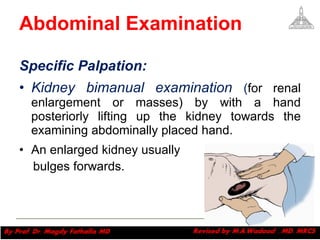
Abdominal Examination Specific Palpation: Kidney bimanual examination  ( for renal enlargement or masses) by with a hand posteriorly lifting up the kidney towards the examining abdominally placed hand.  An enlarged kidney usually  bulges forwards.  Magdy Fath-Alla, 2009
Abdominal Examination Tenderness over the kidney should be tested by gentle pressure over the renal angle.  Bladder palpation:  felt in retention (acute or chronic.  Percussion  for ascites (shifting dullness) or enlarged bladder. Auscultation  for a renal bruit in renal artery stenosis  (above umbilicus, 2cm to left or right of the midline and also in both flanks with the patient sitting up). Magdy Fath-Alla, 2009
Scrotum and Genitalia examination Penis examination :  inspection and palpation of: Prepuce to exclude phimosis and hypospadias. Glans. Skin (looking for ulcers, rashes) and Urethral discharge. Examine the scrotum : Inspect scrotal skin  Palpate testes, epididymis and vas  Identify scrotal swellings: scrotal or inguinoscrotal. Magdy Fath-Alla, 2009
Is it possible to get above the swelling?  Is the swelling solid or cystic?  Is there a hydrocele, varicocele or epididymal cyst?  Testing for translucency with a torch will determine whether the mass is cystic or a solid mass.  Magdy Fath-Alla, 2009 Scrotum and Genitalia examination
Differential diagnosis (common   swellings) A) Attached to the testis :  Solid (non-translucent): testicular tumor.  Cystic (translucent): hydrocele.  B) Separate from the testis :  Solid (non-translucent): chronic epididymitis.  Cystic (translucent): epididymal cyst.  Scrotum and Genitalia examination Magdy Fath-Alla, 2009
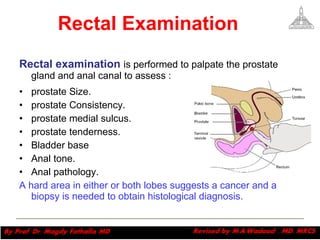
Rectal Examination Rectal examination   is performed to palpate the prostate gland and anal canal to assess : prostate Size.  prostate Consistency.  prostate medial sulcus.  prostate tenderness.  Bladder base  Anal tone. Anal pathology. A hard area in either or both lobes suggests a cancer and a biopsy is needed to obtain histological diagnosis.  Magdy Fath-Alla, 2009
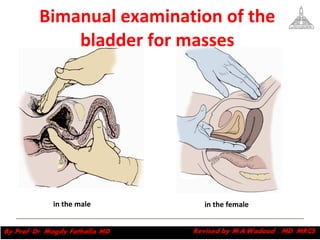
Bimanual examination of the bladder for masses in the male in the female
Thank You

Urologic symptoms and examination

  • 1.
    Urological symptoms Urology Department Undergraduate courses
  • 2.
    History Taking Themedical history is the cornerstone of the evaluation of the urologic patient. A complete history can be divided into: The chief complaint History of the present illness The patient's past medical and surgical history Family history. Magdy Fath-Alla, 2009
  • 3.
    Complaint Urological complaint(s)can be categorized into one or more of: Pain Changes in the act of micturition Changes in gross appearance of urine Changes in function and/or appearance of male genitalia. Systemic symptoms Magdy Fath-Alla, 2009
  • 4.
    Pain Pain arisingfrom the GU tract may be quite severe and is usually associated with Obstruction: Ureteric stone. Urinary retention. Inflammation parenchymatous organs inflamm. produces severe pain (pyelonephritis, prostatitis, and epididymitis) Inflammation of the mucosa of a hollow viscus such as the bladder or urethra usually produces discomfort. Tumors of GU tract usually do not cause pain unless they produce obstruction or extend to adjacent nerves. Magdy Fath-Alla, 2009
  • 5.
    Renal Pain Site: ipsilateral costovertebral angle just lateral to the sacrospinalis muscle and beneath the 12th rib. Pain due to inflammation is usually steady ( dull ache ) due to acute distention of the renal capsule, Pain due to obstruction fluctuates in intensity ( colicky) . may be associated with gastrointestinal symptoms because of reflex stimulation of the celiac ganglion. Radiation: across the flank anteriorly toward the upper abdomen and umbilicus and may be to the testis or labium. Magdy Fath-Alla, 2009
  • 6.
    Differential Diagnosis ofRenal Pain 1) Pain of intraperitoneal origin (perforated duodenal ulcer or pancreatitis) has the following characters: Radiates into the back, but the site of greatest pain and tenderness is in the epigastrium. Radiates into the shoulder because of irritation of the diaphragm and phrenic nerve. 2) Renal pain may also be confused with pain resulting from irritation of the costal nerves (radicular pain), most commonly T10-T12. However, the pain is not colicky in nature. Magdy Fath-Alla, 2009
  • 7.
    Ureteral Pain usually acute and secondary to obstruction. Distribution of the pain according to site: In upper ureteral obstruction, the pain may be referred to the scrotum in the male or the labium in the female. Midureter obstruction: on the right side is referred to the right lower quadrant (McBurney's point) and simulate appendicitis; on the left side to left lower quadrant. Lower ureteral obstruction causes bladder irritability (frequency, urgency, and suprapubic discomfort). Magdy Fath-Alla, 2009
  • 8.
    Vesical and Prostaticpain Vesical pain due to retention or inflammation. Constant suprapubic pain that is unrelated to urinary retention is seldom of urologic origin. Inflammatory conditions of the bladder usually produce intermittent suprapubic discomfort. Prostatic pain due to inflammation with secondary edema and distention of the prostatic capsule. poorly localized to lower abdominal, inguinal, perineal, lumbosacral, and/or rectal pain. Magdy Fath-Alla, 2009
  • 9.
    Penile and TesticularPain Penile pain Pain in the flaccid penis is referred pain from bladder or urethra and maximally at the urethral meatus. Pain in the erect penis is usually due to Peyronie's disease or priapism. Scrotal pain Primary pain arises from within the scrotum: Acute epididymitis or torsion of the testis. Chronic scrotal pain (dull, heavy) due to hydrocele or varicocele. Referred: from kidneys or retroperitoneum or from inguinal hernia. Magdy Fath-Alla, 2009
  • 10.
    Irritative Symptoms Frequency The normal adult voids five or six times per day, with a volume of approximately 300 mL with each void. Urinary frequency is due either to increased urinary output (polyuria), detrusor instability or to decreased bladder capacity. Magdy Fath-Alla, 2009
  • 11.
    Irritative Symptoms Nocturia is nocturnal frequency. Normally, adults arise no more than twice at night to void (decrease urine concentration with age). Nocturia occur in the patient with congestive heart failure and peripheral edema, old aged and drinking fluids at night. Dysuria is painful urination commonly referred to the urethral meatus. at the start of urination indicate urethral pathology. at the end (strangury) indicate bladder origin. Dysuria is frequently accompanied by frequency & urgency. Urgency the sudden intense desire to void that the patient can not defer. Magdy Fath-Alla, 2009
  • 12.
    Obstructive Symptoms Urinary hesitancy delayed start of urination. Decreased force and caliber of urinary stream is due to bladder outlet obstruction and commonly results from benign prostatic hyperplasia (BPH) or a urethral stricture. Straining refers to the use of abdominal musculature to urinate. Intermittency means interrupted stream. Postvoid dribbling refers to the release of few drops of urine after micturition. Magdy Fath-Alla, 2009
  • 13.
    Incontinence Urinary incontinenceis the involuntary loss of urine Continuous Incontinence most commonly due to: urinary tract fistula (as vesico-vaginal fistula usually due to gynecologic surgery, radiation, or obstetric trauma. ectopic ureter that opens either at the urethra or the female genital tract. Stress Incontinence is sudden leakage of urine with coughing, sneezing, exercise (increase intra-abdominal pressure). most common in women after childbearing or menopause and men after prostatic surgery and injury to the external urethral sphincter.   Magdy Fath-Alla, 2009
  • 14.
    Incontinence Urge Incontinence loss of urine preceded by a strong urge t o void. Due to: cystitis, neurogenic bladder. Overflow Urinary Incontinence Due to advanced urinary retention and high residual urine volumes. Urine dribble due to bladder overflow. Enuresis micturition that occurs during sleep. It occurs normally in children up to 3 years old. Magdy Fath-Alla, 2009
  • 15.
    Changes in thegross appearance of urine Hematuria the presence of blood in the urine > 3 RBCs per high-power microscopic field (HPF). painless hematuria in adults, should be regarded as a symptom of urologic malignancy until proved otherwise. In evaluating hematuria: gross or microscopic. Initial, terminal or allthrough. Painful or not. Associated with clots or not and shape of clots.   Magdy Fath-Alla, 2009
  • 16.
    Changes in thegross appearance of urine Cloudy Urine Pyuria Pyuria is a urinary tract infection in which large quantities of white blood cells cause urine to have a cloudy appearance. Microscopic examination of the urine will demonstrate pus cells. Phosphaturia due to precipitation of phosphates in alkaline urine. Acidification of urine with acetic acid at the time of urine analysis causes clearing of the specimen. Magdy Fath-Alla, 2009
  • 17.
    Abnormal appearance and/orfunction of the male external genitalia Male sexual dysfunction and impotence impotence is the inability to achieve and maintain an erection adequate for intercourse. Other male sexual disorders, including loss of libido, absence of emission, absence of orgasm & premature ejaculation. Bloody ejaculate (Hematospermia) refers to the presence of blood in the seminal fluid. It almost always results from nonspecific inflammation of the prostate and/or seminal vesicles. Magdy Fath-Alla, 2009
  • 18.
    Abnormal appearance and/orfunction of the male external genitalia Penile complaints Cutaneous lesions. Penile curvature. Urethral discharge most common symptom of venereal infection. purulent thick, profuse, and yellow to gray discharge is typical of gonococcal urethritis. scanty and watery discharge is due to nonspecific urethritis. bloody discharge suggests carcinoma of the urethra. Scrotal complaints Cutaneous lesions. Absent or retractile testis. Scrotal swellings or masses. Magdy Fath-Alla, 2009
  • 19.
    Systemic symptoms Feverand chills occur with infection anywhere in the GU tract but most common with pyelonephritis, prostatitis, or epididymitis. Fever, weight loss, and malaise are nonspecific systemic manifestations of: acute and chronic inflammation, renal failure, and genito-urinary malignancy with or without metastases. Magdy Fath-Alla, 2009
  • 20.
    Genito-Urinary Examination UrologyDepartment Undergraduate courses
  • 21.
    General Examination Apperance: distressed due to pain or does appear unwell suggesting systemic illness and possibly renal failure. Complexion: Pallor is evidence of anemia (due to hematuria). Vital data: blood pressure. Signs of dehydration: dry mouth and tongue may indicate renal failure or polyuria of diabetes. Cervical lymph nodes enlargment due to metastatic spread from any urological cancer. Magdy Fath-Alla, 2009
  • 22.
    Abdominal Examination Inspection scars (specially round umbilicus for laparoscopy scars) Distension, prominent veins, local swelling and hernia, pulsation, visible peristalsis, skin lesions. Exclude lesions of abdominal wall: Patient raises head, patient does straight leg-raising, "blowing test" or Valsalva. Check for inguinal node enlargement. Magdy Fath-Alla, 2009
  • 23.
    Abdominal Examination GeneralPalpation Use warm hands. Examine the tender areas last. Light palpation then deep. Check for guarding, rigidly and rebound tenderness. Determine for any mass: site, tenderness, size and shape, surface (irregular or smooth), edge (regular or irregular), consistency (soft or hard), mobility, whether pulsatile or ballotable. Differential diagnosis of abdominal masses. Magdy Fath-Alla, 2009
  • 24.
    Abdominal Examination SpecificPalpation: Kidney bimanual examination ( for renal enlargement or masses) by with a hand posteriorly lifting up the kidney towards the examining abdominally placed hand. An enlarged kidney usually bulges forwards. Magdy Fath-Alla, 2009
  • 25.
    Abdominal Examination Tendernessover the kidney should be tested by gentle pressure over the renal angle. Bladder palpation: felt in retention (acute or chronic. Percussion for ascites (shifting dullness) or enlarged bladder. Auscultation for a renal bruit in renal artery stenosis (above umbilicus, 2cm to left or right of the midline and also in both flanks with the patient sitting up). Magdy Fath-Alla, 2009
  • 26.
    Scrotum and Genitaliaexamination Penis examination : inspection and palpation of: Prepuce to exclude phimosis and hypospadias. Glans. Skin (looking for ulcers, rashes) and Urethral discharge. Examine the scrotum : Inspect scrotal skin Palpate testes, epididymis and vas Identify scrotal swellings: scrotal or inguinoscrotal. Magdy Fath-Alla, 2009
  • 27.
    Is it possibleto get above the swelling? Is the swelling solid or cystic? Is there a hydrocele, varicocele or epididymal cyst? Testing for translucency with a torch will determine whether the mass is cystic or a solid mass. Magdy Fath-Alla, 2009 Scrotum and Genitalia examination
  • 28.
    Differential diagnosis (common swellings) A) Attached to the testis : Solid (non-translucent): testicular tumor. Cystic (translucent): hydrocele. B) Separate from the testis : Solid (non-translucent): chronic epididymitis. Cystic (translucent): epididymal cyst. Scrotum and Genitalia examination Magdy Fath-Alla, 2009
  • 29.
    Rectal Examination Rectalexamination is performed to palpate the prostate gland and anal canal to assess : prostate Size. prostate Consistency. prostate medial sulcus. prostate tenderness. Bladder base Anal tone. Anal pathology. A hard area in either or both lobes suggests a cancer and a biopsy is needed to obtain histological diagnosis. Magdy Fath-Alla, 2009
  • 30.
    Bimanual examination ofthe bladder for masses in the male in the female
  • 31.