ANATOMY OF
URINARY BLADDER
Dept of Urology
Govt Royapettah Hospital and Kilpauk Medical College
Chennai
Moderators:
Professors:
• Prof. Dr. G. Sivasankar, M.S., M.Ch.,
• Prof. Dr. A. Senthilvel, M.S., M.Ch.,
Asst Professors:
• Dr. J. Sivabalan, M.S., M.Ch.,
• Dr. R. Bhargavi, M.S., M.Ch.,
• Dr. S. Raju, M.S., M.Ch.,
• Dr. K. Muthurathinam, M.S., M.Ch.,
• Dr. D. Tamilselvan, M.S., M.Ch.,
• Dr. K. Senthilkumar, M.S., M.Ch.
Dept of Urology, GRH and KMC, Chennai. 2
3
Dept of Urology, GRH and KMC, Chennai.
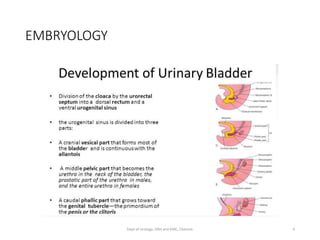
EMBRYOLOGY
4
Dept of Urology, GRH and KMC, Chennai.
5
Dept of Urology, GRH and KMC, Chennai.
6
Dept of Urology, GRH and KMC, Chennai.
7
Dept of Urology, GRH and KMC, Chennai.
8
Dept of Urology, GRH and KMC, Chennai.
GROSS ANATOMY
• Extraperitoneal hollow organ in
anterior pelvis
• When filled, the bladder has a
capacity of about 500 mL - ovoid
shape.
• The empty bladder is tetrahedral
• a superiorsurface with an apex at
the urachus
• two inferolateralsurfaces
• a posteroinferior surface or base
with the bladder neck at the lowest
point
9
Dept of Urology, GRH and KMC, Chennai.
10
Dept of Urology, GRH and KMC, Chennai.
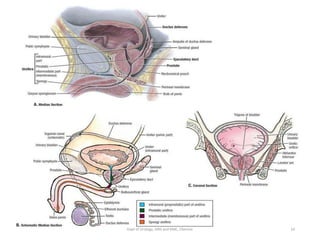
• Retzius Space – retro pubic
prevesical space
• Contains loose areolar tissue
• Cushion for anteriorbladder
• Enteredby dividing the
transversalis fascia
• As far posteriorlyas iliac vessels
and distal ureter
• For open prostatectomy, anterior
bladder and pelvic fractures.
11
Dept of Urology, GRH and KMC, Chennai.
12
Dept of Urology, GRH and KMC, Chennai.
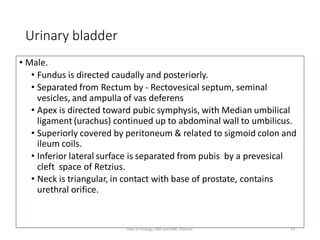
Urinary bladder
• Male.
• Fundus is directed caudally and posteriorly.
• Separated from Rectum by - Rectovesical septum, seminal
vesicles, and ampulla of vas deferens
• Apex is directed toward pubic symphysis, with Median umbilical
ligament (urachus) continued up to abdominal wall to umbilicus.
• Superiorly covered by peritoneum & related to sigmoid colon and
ileum coils.
• Inferior lateral surface is separated from pubis by a prevesical
cleft space of Retzius.
• Neck is triangular, in contact with base of prostate, contains
urethral orifice.
13
Dept of Urology, GRH and KMC, Chennai.
14
Dept of Urology, GRH and KMC, Chennai.
15
Dept of Urology, GRH and KMC, Chennai.
Urinary bladder
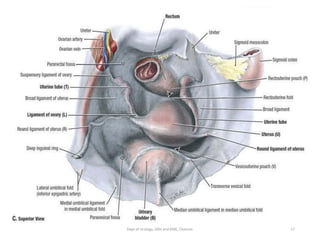
• Female
• Fundus is separated from
anterior surface of uterus
by VesicoUterine pouch.
• Below, is related to cervix
and upper vaginal wall.
• Superior surface, when
bladder is empty, uterus
rest on this.
• Inferior surface, rest on
pelvic and urogenital
diaphragm.
16
Dept of Urology, GRH and KMC, Chennai.
17
Dept of Urology, GRH and KMC, Chennai.
• Body (or dome) and Fundus :
- supple, mobile and highly
distensible -
capable of expanding into
abdomen
• Base of bladder not so
distensible holds orifices (ureters
and urethra) in place
18
Dept of Urology, GRH and KMC, Chennai.
Peritoneal Reflection
• Superior surface
• Ant – Sweeps onto the ant abd wall
• Post – passes to level of SV
• On distension,it sweeps off the ant
abd wall superiorly
19
Dept of Urology, GRH and KMC, Chennai.
20
Dept of Urology, GRH and KMC, Chennai.
21
Dept of Urology, GRH and KMC, Chennai.
22
Dept of Urology, GRH and KMC, Chennai.
23
Dept of Urology, GRH and KMC, Chennai.
24
Dept of Urology, GRH and KMC, Chennai.
HISTOLOGY
• 7 layers of urothelium
• GAG coat
• Thin BM
• Thick Lamina Propria with blood
vessels
• Smooth muscle layer
• inner longitudinal,
• middle circular
• outer longitudinal layers
25
Dept of Urology, GRH and KMC, Chennai.
26
Dept of Urology, GRH and KMC, Chennai.
27
Dept of Urology, GRH and KMC, Chennai.
28
Dept of Urology, GRH and KMC, Chennai.
Male Bladder Neck
• The large-diameter muscle fascicles replaced by much finer fibers
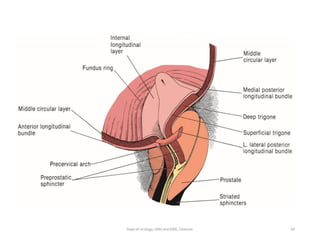
• bladder neck  the detrusor muscle - three layers
• Radially oriented inner longitudinal fibers pass through the internal
meatus to become continuous with the inner longitudinal layer of
smooth muscle in the urethra.
• The middle layer forms a circular preprostatic sphincter
that is responsible for continence at the level of the bladder neck
• The outer longitudinal fibers are thickest posteriorly
at the bladder base and attached to the apex of trigone and prostate
Bladder neck plays important role in antegrade ejaculation.
29
Dept of Urology, GRH and KMC, Chennai.
30
Dept of Urology, GRH and KMC, Chennai.
Female neck
• At the female bladder neck, the inner longitudinal fibers converge
radially to pass downward as the inner longitudinal layer of the
urethra.
• Middle layer not so robust
• Little adnergic innervation and is weak
31
Dept of Urology, GRH and KMC, Chennai.
UV junction
• 2 to 3 cm from the bladder,
Waldeyer fibromuscular
sheath extends longitudinally
over the ureter and follows it
to the trigone.
• Intramural 1.5-2 cm
• The intravesical portion lies
immediately beneath the
bladder urothelium  pliant
• backed by a strong plate of
detrusor muscle
32
Dept of Urology, GRH and KMC, Chennai.
• Intramural ureter is a common site in which ureteral stones are
impacted.
• Pliant intravesical ureter backed by a strong plate of detrusor results
in passive occlusion of ureter like a flap valve ,VUR is thought to
result from insufficient submucosal length of ureter and poor
detrusor backing.
• Chronic increasing intravesical pressure due to BOO cause herniation
of bladder mucosa through weakest point of hiatus above the ureter
and produce a Hutch diverticulum and reflux.
33
Dept of Urology, GRH and KMC, Chennai.
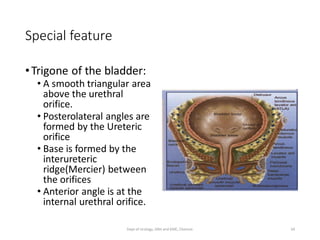
Special feature
•Trigone of the bladder:
• A smooth triangular area
above the urethral
orifice.
• Posterolateral angles are
formed by the Ureteric
orifice
• Base is formed by the
interureteric
ridge(Mercier) between
the orifices
• Anterior angle is at the
internal urethral orifice.
34
Dept of Urology, GRH and KMC, Chennai.
Trigone
• The muscle of trigone forms three distinct layers:
(1)a superficial layer, derived from the longitudinal muscle of the
ureter, which extends down the urethra to insert at the
verumontanum;
(2) a deep layer, which continues from Waldeyer sheath and inserts
at the bladder neck;
(3) a detrusor layer, formed by the outer longitudinal and middle
circular smooth muscle layers of the bladder wall.
35
Dept of Urology, GRH and KMC, Chennai.
36
Dept of Urology, GRH and KMC, Chennai.
• Superficial trigonal muscle anchors the ureter to the bladder.
• During ureteral reimplantation, this muscle is tented up and divided
in order to gain access to the space between Waldeyer sheath and
the ureter
• The urothelium overlying the muscular trigone is usually only three
cells thick  adheres strongly to the underlying muscle by a dense
lamina propria.
• During filling and emptying of the bladder, this mucosal surface
remains smooth.
• Trigone relaxes during Micturition phase
37
Dept of Urology, GRH and KMC, Chennai.
NEUROVASCULAR SUPPLY
•Arteries: superior and inferior vesical, middle rectal
•Veins: vesical plexus  vesical veins internal iliac
vein (communicates with prostatic plexus)
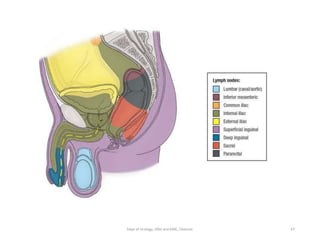
•Lymphatics: External(Bulk), internal, sacral, and
common iliac nodes,obturator nodes.
•Nerves: Inferior epigastric and vesical plexus
38
Dept of Urology, GRH and KMC, Chennai.
1.Superior vesical artery :
-supplies the superior part of bladder
2.Inferior vesical artery:
-supplies the lower ureter ,bladder base , prostate
and the seminal vesical in male
-in female supply the ureter ,bladder base and
vagina
3.Trigone is mainly supplied by
-vesiculo-deferential artery in male
-uterine artery in female
4.Additional supply is derived from
-obturator
-inferior gluteal
-in females-uterine and vaginal arteries 39
Dept of Urology, GRH and KMC, Chennai.
40
Dept of Urology, GRH and KMC, Chennai.
VASCULATURE OF BLADDER :
Vesical blood supply is through two pedicles
1. Lateral pedicle 2. Posterior pedicle
1. LATERAL PEDICLE:
- formed mainly by lateral vesical ligament in male
cardinal ligament in
female
(approached from rectovesical space it lies lateral to ureter
2. POSTERIOR PEDICLE:
- formed by posterior vesical ligament in male,
uterosacral ligament in female (posteromedial to ureter)
41
Dept of Urology, GRH and KMC, Chennai.
42
Dept of Urology, GRH and KMC, Chennai.
VENOUS DRAINAGE:
* the dorsal vein of penis passes between the
inferior pubic arch and the striated urinary
sphincter to reach the pelvis
* it trifurcates into
1. central superficial branch
2. 2 lateral plexuses (plexus of santorini)
[During retropubic prostatectomy the dorsal
vein complex is best divided distally before its
ramification to minimise blood loss.]
43
Dept of Urology, GRH and KMC, Chennai.
* The superficial branch pierces the visceral endopelvic
fascia between the puboprostatic ligaments draining
1. retropubic fat
2. anterior bladder
3. anterior prostate
* Lateral plexuses swifts down the side of the prostate
receiving drainage from prostate & rectum
*communicates with vesical plexuses on the lower
part of bladder
*3-5 inferior vesical veins emerge from vesical plexuses
and drains into internal iliac veins
44
Dept of Urology, GRH and KMC, Chennai.
45
Dept of Urology, GRH and KMC, Chennai.
LYMPHATIC DRAINAGE
46
Dept of Urology, GRH and KMC, Chennai.
47
Dept of Urology, GRH and KMC, Chennai.
Neurogenic control
• Brain:
- Master control
- Conscious social control
- Frontal lobe
- Tonically inhibitory signals to detrusor.
- [Stroke,dementia,cancer, CP, parkinson, shy drager syndrome…. ]
48
Dept of Urology, GRH and KMC, Chennai.
• Brain stem:
- Pons- PMC – Barington’s nucleus
- Inborn excitatory nature.
- As a relay switch in the voiding pathway.
- Coordinates the urethral sphincter relaxation and detrusor contraction
to facilitate urination.
- Affected by emotions.
- Brain takes over the control of the pons at age 3-4 years.
- The stretch receptors of the detrusor muscle send a signal to the pons,
which in turn notifies the brain.
49
Dept of Urology, GRH and KMC, Chennai.
• Sacral spinal cord:
- Primitive voiding center – Sacral reflex center – bladder contractions.
- Important intermediary between the pons and the sacral cord.
- Spinal injury: urinary frequency, urgency and urge incontinence and are
unable to empty bladder. [Detrusor sphincter dyssynergia with detrusor
hyperreflexia (DSD-DH)].
( EX … multiple sclerosis).
- Or Detrusor areflexia. (Herniated disc/ tumor)
50
Dept of Urology, GRH and KMC, Chennai.
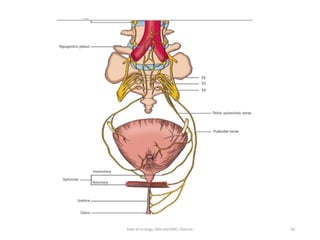
• Peripheral nerves:
- Sympathetic: constantly active. [T10-L2].
1. Bladder to increase its capacity without increasing detrusor resting
pressure (accommodation) and stimulates the internal urinary sphincter to
remain tightly closed.
2.Sympathetic activity also inhibits para sympathetic stimulation [S2-4]
(opposite action).
51
Dept of Urology, GRH and KMC, Chennai.
52
Dept of Urology, GRH and KMC, Chennai.
53
Dept of Urology, GRH and KMC, Chennai.
• Somatic nervous system:
- External urinary sphincter and the pelvic diaphragm.
- Pudendal nerve [S2-3] originates from the nucleus of Onuf and regulates
the voluntary actions of the external urinary sphincter and the pelvic
diaphragm.
- Shy- Drager synd : Lesion in Onuf nucleus.
- Neuropraxia : after delivery- Stress incontinence.
- Suprasacral- infrapontine spinal cord trauma can cause overstimulation of
the pudendal nerve - urinary retention. SPINAL SHOCK
54
Dept of Urology, GRH and KMC, Chennai.
55
Dept of Urology, GRH and KMC, Chennai.
56
Dept of Urology, GRH and KMC, Chennai.
57
Dept of Urology, GRH and KMC, Chennai.
58
Dept of Urology, GRH and KMC, Chennai.
Bladder Afferent Fiber - Type Location
• Aδ (finely myelinated axons) (Smooth muscle) Sense bladder
fullness (wall tension) Increase discharge at lower pressure
threshold
• C fiber (unmyelinated axons) (Mucosa) Respond to stretch
(bladder volume sensors) Increase discharge at lower threshold
• C fiber (unmyelinated axons) (Mucosa muscle)
Nociception to overdistention -Sensitive to irritants
• Silent afferent
• Becomes mechanosensitive and unmasks new afferentpathway during
inflammation
59
Dept of Urology, GRH and KMC, Chennai.
60
Dept of Urology, GRH and KMC, Chennai.
Storage & voiding reflexes
61
Dept of Urology, GRH and KMC, Chennai.
SURGICAL ANATOMY
62
Dept of Urology, GRH and KMC, Chennai.
63
Dept of Urology, GRH and KMC, Chennai.
To prevent impotence
following radical
cystectomy, the surgeon
should preserve the
autonomic plexus at the
pelvic side walls by staying
close to the seminal
vesicles.
Injury to the nerves
innervating the corpora
can be prevented by
locating the NV bundle
between the lateral pelvic
fascia and Denonvilliers'
fascia . 64
Dept of Urology, GRH and KMC, Chennai.
65
Dept of Urology, GRH and KMC, Chennai.
THANK YOU...:)
66
Dept of Urology, GRH and KMC, Chennai.

Urinary Bladder anatomy 1

  • 1.
    ANATOMY OF URINARY BLADDER Deptof Urology Govt Royapettah Hospital and Kilpauk Medical College Chennai
  • 2.
    Moderators: Professors: • Prof. Dr.G. Sivasankar, M.S., M.Ch., • Prof. Dr. A. Senthilvel, M.S., M.Ch., Asst Professors: • Dr. J. Sivabalan, M.S., M.Ch., • Dr. R. Bhargavi, M.S., M.Ch., • Dr. S. Raju, M.S., M.Ch., • Dr. K. Muthurathinam, M.S., M.Ch., • Dr. D. Tamilselvan, M.S., M.Ch., • Dr. K. Senthilkumar, M.S., M.Ch. Dept of Urology, GRH and KMC, Chennai. 2
  • 3.
    3 Dept of Urology,GRH and KMC, Chennai.
  • 4.
    EMBRYOLOGY 4 Dept of Urology,GRH and KMC, Chennai.
  • 5.
    5 Dept of Urology,GRH and KMC, Chennai.
  • 6.
    6 Dept of Urology,GRH and KMC, Chennai.
  • 7.
    7 Dept of Urology,GRH and KMC, Chennai.
  • 8.
    8 Dept of Urology,GRH and KMC, Chennai.
  • 9.
    GROSS ANATOMY • Extraperitonealhollow organ in anterior pelvis • When filled, the bladder has a capacity of about 500 mL - ovoid shape. • The empty bladder is tetrahedral • a superiorsurface with an apex at the urachus • two inferolateralsurfaces • a posteroinferior surface or base with the bladder neck at the lowest point 9 Dept of Urology, GRH and KMC, Chennai.
  • 10.
    10 Dept of Urology,GRH and KMC, Chennai.
  • 11.
    • Retzius Space– retro pubic prevesical space • Contains loose areolar tissue • Cushion for anteriorbladder • Enteredby dividing the transversalis fascia • As far posteriorlyas iliac vessels and distal ureter • For open prostatectomy, anterior bladder and pelvic fractures. 11 Dept of Urology, GRH and KMC, Chennai.
  • 12.
    12 Dept of Urology,GRH and KMC, Chennai.
  • 13.
    Urinary bladder • Male. •Fundus is directed caudally and posteriorly. • Separated from Rectum by - Rectovesical septum, seminal vesicles, and ampulla of vas deferens • Apex is directed toward pubic symphysis, with Median umbilical ligament (urachus) continued up to abdominal wall to umbilicus. • Superiorly covered by peritoneum & related to sigmoid colon and ileum coils. • Inferior lateral surface is separated from pubis by a prevesical cleft space of Retzius. • Neck is triangular, in contact with base of prostate, contains urethral orifice. 13 Dept of Urology, GRH and KMC, Chennai.
  • 14.
    14 Dept of Urology,GRH and KMC, Chennai.
  • 15.
    15 Dept of Urology,GRH and KMC, Chennai.
  • 16.
    Urinary bladder • Female •Fundus is separated from anterior surface of uterus by VesicoUterine pouch. • Below, is related to cervix and upper vaginal wall. • Superior surface, when bladder is empty, uterus rest on this. • Inferior surface, rest on pelvic and urogenital diaphragm. 16 Dept of Urology, GRH and KMC, Chennai.
  • 17.
    17 Dept of Urology,GRH and KMC, Chennai.
  • 18.
    • Body (ordome) and Fundus : - supple, mobile and highly distensible - capable of expanding into abdomen • Base of bladder not so distensible holds orifices (ureters and urethra) in place 18 Dept of Urology, GRH and KMC, Chennai.
  • 19.
    Peritoneal Reflection • Superiorsurface • Ant – Sweeps onto the ant abd wall • Post – passes to level of SV • On distension,it sweeps off the ant abd wall superiorly 19 Dept of Urology, GRH and KMC, Chennai.
  • 20.
    20 Dept of Urology,GRH and KMC, Chennai.
  • 21.
    21 Dept of Urology,GRH and KMC, Chennai.
  • 22.
    22 Dept of Urology,GRH and KMC, Chennai.
  • 23.
    23 Dept of Urology,GRH and KMC, Chennai.
  • 24.
    24 Dept of Urology,GRH and KMC, Chennai.
  • 25.
    HISTOLOGY • 7 layersof urothelium • GAG coat • Thin BM • Thick Lamina Propria with blood vessels • Smooth muscle layer • inner longitudinal, • middle circular • outer longitudinal layers 25 Dept of Urology, GRH and KMC, Chennai.
  • 26.
    26 Dept of Urology,GRH and KMC, Chennai.
  • 27.
    27 Dept of Urology,GRH and KMC, Chennai.
  • 28.
    28 Dept of Urology,GRH and KMC, Chennai.
  • 29.
    Male Bladder Neck •The large-diameter muscle fascicles replaced by much finer fibers • bladder neck  the detrusor muscle - three layers • Radially oriented inner longitudinal fibers pass through the internal meatus to become continuous with the inner longitudinal layer of smooth muscle in the urethra. • The middle layer forms a circular preprostatic sphincter that is responsible for continence at the level of the bladder neck • The outer longitudinal fibers are thickest posteriorly at the bladder base and attached to the apex of trigone and prostate Bladder neck plays important role in antegrade ejaculation. 29 Dept of Urology, GRH and KMC, Chennai.
  • 30.
    30 Dept of Urology,GRH and KMC, Chennai.
  • 31.
    Female neck • Atthe female bladder neck, the inner longitudinal fibers converge radially to pass downward as the inner longitudinal layer of the urethra. • Middle layer not so robust • Little adnergic innervation and is weak 31 Dept of Urology, GRH and KMC, Chennai.
  • 32.
    UV junction • 2to 3 cm from the bladder, Waldeyer fibromuscular sheath extends longitudinally over the ureter and follows it to the trigone. • Intramural 1.5-2 cm • The intravesical portion lies immediately beneath the bladder urothelium  pliant • backed by a strong plate of detrusor muscle 32 Dept of Urology, GRH and KMC, Chennai.
  • 33.
    • Intramural ureteris a common site in which ureteral stones are impacted. • Pliant intravesical ureter backed by a strong plate of detrusor results in passive occlusion of ureter like a flap valve ,VUR is thought to result from insufficient submucosal length of ureter and poor detrusor backing. • Chronic increasing intravesical pressure due to BOO cause herniation of bladder mucosa through weakest point of hiatus above the ureter and produce a Hutch diverticulum and reflux. 33 Dept of Urology, GRH and KMC, Chennai.
  • 34.
    Special feature •Trigone ofthe bladder: • A smooth triangular area above the urethral orifice. • Posterolateral angles are formed by the Ureteric orifice • Base is formed by the interureteric ridge(Mercier) between the orifices • Anterior angle is at the internal urethral orifice. 34 Dept of Urology, GRH and KMC, Chennai.
  • 35.
    Trigone • The muscleof trigone forms three distinct layers: (1)a superficial layer, derived from the longitudinal muscle of the ureter, which extends down the urethra to insert at the verumontanum; (2) a deep layer, which continues from Waldeyer sheath and inserts at the bladder neck; (3) a detrusor layer, formed by the outer longitudinal and middle circular smooth muscle layers of the bladder wall. 35 Dept of Urology, GRH and KMC, Chennai.
  • 36.
    36 Dept of Urology,GRH and KMC, Chennai.
  • 37.
    • Superficial trigonalmuscle anchors the ureter to the bladder. • During ureteral reimplantation, this muscle is tented up and divided in order to gain access to the space between Waldeyer sheath and the ureter • The urothelium overlying the muscular trigone is usually only three cells thick  adheres strongly to the underlying muscle by a dense lamina propria. • During filling and emptying of the bladder, this mucosal surface remains smooth. • Trigone relaxes during Micturition phase 37 Dept of Urology, GRH and KMC, Chennai.
  • 38.
    NEUROVASCULAR SUPPLY •Arteries: superiorand inferior vesical, middle rectal •Veins: vesical plexus  vesical veins internal iliac vein (communicates with prostatic plexus) •Lymphatics: External(Bulk), internal, sacral, and common iliac nodes,obturator nodes. •Nerves: Inferior epigastric and vesical plexus 38 Dept of Urology, GRH and KMC, Chennai.
  • 39.
    1.Superior vesical artery: -supplies the superior part of bladder 2.Inferior vesical artery: -supplies the lower ureter ,bladder base , prostate and the seminal vesical in male -in female supply the ureter ,bladder base and vagina 3.Trigone is mainly supplied by -vesiculo-deferential artery in male -uterine artery in female 4.Additional supply is derived from -obturator -inferior gluteal -in females-uterine and vaginal arteries 39 Dept of Urology, GRH and KMC, Chennai.
  • 40.
    40 Dept of Urology,GRH and KMC, Chennai.
  • 41.
    VASCULATURE OF BLADDER: Vesical blood supply is through two pedicles 1. Lateral pedicle 2. Posterior pedicle 1. LATERAL PEDICLE: - formed mainly by lateral vesical ligament in male cardinal ligament in female (approached from rectovesical space it lies lateral to ureter 2. POSTERIOR PEDICLE: - formed by posterior vesical ligament in male, uterosacral ligament in female (posteromedial to ureter) 41 Dept of Urology, GRH and KMC, Chennai.
  • 42.
    42 Dept of Urology,GRH and KMC, Chennai.
  • 43.
    VENOUS DRAINAGE: * thedorsal vein of penis passes between the inferior pubic arch and the striated urinary sphincter to reach the pelvis * it trifurcates into 1. central superficial branch 2. 2 lateral plexuses (plexus of santorini) [During retropubic prostatectomy the dorsal vein complex is best divided distally before its ramification to minimise blood loss.] 43 Dept of Urology, GRH and KMC, Chennai.
  • 44.
    * The superficialbranch pierces the visceral endopelvic fascia between the puboprostatic ligaments draining 1. retropubic fat 2. anterior bladder 3. anterior prostate * Lateral plexuses swifts down the side of the prostate receiving drainage from prostate & rectum *communicates with vesical plexuses on the lower part of bladder *3-5 inferior vesical veins emerge from vesical plexuses and drains into internal iliac veins 44 Dept of Urology, GRH and KMC, Chennai.
  • 45.
    45 Dept of Urology,GRH and KMC, Chennai.
  • 46.
    LYMPHATIC DRAINAGE 46 Dept ofUrology, GRH and KMC, Chennai.
  • 47.
    47 Dept of Urology,GRH and KMC, Chennai.
  • 48.
    Neurogenic control • Brain: -Master control - Conscious social control - Frontal lobe - Tonically inhibitory signals to detrusor. - [Stroke,dementia,cancer, CP, parkinson, shy drager syndrome…. ] 48 Dept of Urology, GRH and KMC, Chennai.
  • 49.
    • Brain stem: -Pons- PMC – Barington’s nucleus - Inborn excitatory nature. - As a relay switch in the voiding pathway. - Coordinates the urethral sphincter relaxation and detrusor contraction to facilitate urination. - Affected by emotions. - Brain takes over the control of the pons at age 3-4 years. - The stretch receptors of the detrusor muscle send a signal to the pons, which in turn notifies the brain. 49 Dept of Urology, GRH and KMC, Chennai.
  • 50.
    • Sacral spinalcord: - Primitive voiding center – Sacral reflex center – bladder contractions. - Important intermediary between the pons and the sacral cord. - Spinal injury: urinary frequency, urgency and urge incontinence and are unable to empty bladder. [Detrusor sphincter dyssynergia with detrusor hyperreflexia (DSD-DH)]. ( EX … multiple sclerosis). - Or Detrusor areflexia. (Herniated disc/ tumor) 50 Dept of Urology, GRH and KMC, Chennai.
  • 51.
    • Peripheral nerves: -Sympathetic: constantly active. [T10-L2]. 1. Bladder to increase its capacity without increasing detrusor resting pressure (accommodation) and stimulates the internal urinary sphincter to remain tightly closed. 2.Sympathetic activity also inhibits para sympathetic stimulation [S2-4] (opposite action). 51 Dept of Urology, GRH and KMC, Chennai.
  • 52.
    52 Dept of Urology,GRH and KMC, Chennai.
  • 53.
    53 Dept of Urology,GRH and KMC, Chennai.
  • 54.
    • Somatic nervoussystem: - External urinary sphincter and the pelvic diaphragm. - Pudendal nerve [S2-3] originates from the nucleus of Onuf and regulates the voluntary actions of the external urinary sphincter and the pelvic diaphragm. - Shy- Drager synd : Lesion in Onuf nucleus. - Neuropraxia : after delivery- Stress incontinence. - Suprasacral- infrapontine spinal cord trauma can cause overstimulation of the pudendal nerve - urinary retention. SPINAL SHOCK 54 Dept of Urology, GRH and KMC, Chennai.
  • 55.
    55 Dept of Urology,GRH and KMC, Chennai.
  • 56.
    56 Dept of Urology,GRH and KMC, Chennai.
  • 57.
    57 Dept of Urology,GRH and KMC, Chennai.
  • 58.
    58 Dept of Urology,GRH and KMC, Chennai.
  • 59.
    Bladder Afferent Fiber- Type Location • Aδ (finely myelinated axons) (Smooth muscle) Sense bladder fullness (wall tension) Increase discharge at lower pressure threshold • C fiber (unmyelinated axons) (Mucosa) Respond to stretch (bladder volume sensors) Increase discharge at lower threshold • C fiber (unmyelinated axons) (Mucosa muscle) Nociception to overdistention -Sensitive to irritants • Silent afferent • Becomes mechanosensitive and unmasks new afferentpathway during inflammation 59 Dept of Urology, GRH and KMC, Chennai.
  • 60.
    60 Dept of Urology,GRH and KMC, Chennai.
  • 61.
    Storage & voidingreflexes 61 Dept of Urology, GRH and KMC, Chennai.
  • 62.
    SURGICAL ANATOMY 62 Dept ofUrology, GRH and KMC, Chennai.
  • 63.
    63 Dept of Urology,GRH and KMC, Chennai.
  • 64.
    To prevent impotence followingradical cystectomy, the surgeon should preserve the autonomic plexus at the pelvic side walls by staying close to the seminal vesicles. Injury to the nerves innervating the corpora can be prevented by locating the NV bundle between the lateral pelvic fascia and Denonvilliers' fascia . 64 Dept of Urology, GRH and KMC, Chennai.
  • 65.
    65 Dept of Urology,GRH and KMC, Chennai.
  • 66.
    THANK YOU...:) 66 Dept ofUrology, GRH and KMC, Chennai.