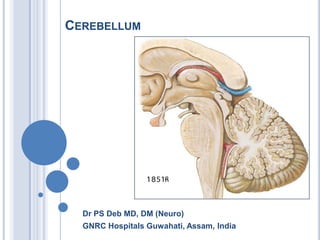
CEREBELLUM
Dr PS Deb MD, DM (Neuro)
GNRC Hospitals Guwahati, Assam, India
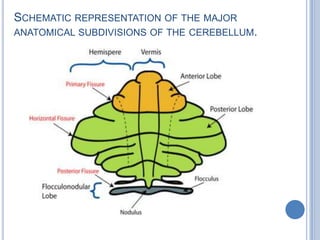
SCHEMATIC REPRESENTATION OF THE MAJOR
ANATOMICAL SUBDIVISIONS OF THE CEREBELLUM.
PHYLOGENETIC ORGANIZATION
Spinocerebellum
Pontocerebellum
Vestibulocerebellum
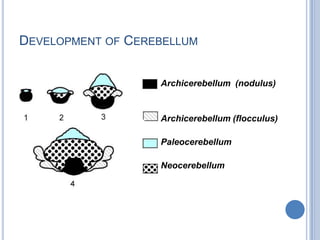
DEVELOPMENT OF CEREBELLUM
Archicerebellum (nodulus)
Archicerebellum (flocculus)
Paleocerebellum
Neocerebellum
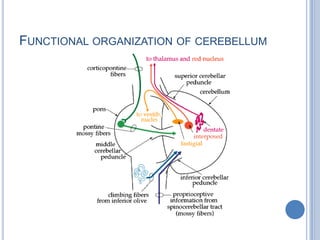
FUNCTIONAL ORGANIZATION OF CEREBELLUM
FUNCTIONAL AND PHYLOGENETIC ROLE
Phylogenetic
denomination
Anatomical parts Role
Vestibulocerebellu
m (Archicerebellum)
Flocculonodular lobe
(+ adjacent vermis)
Regulates balance and eye
movements.
Spinocerebellum
(Paleocerebellum)
Vermis and
intermediate parts of
the hemispheres
("paravermis")
regulates body & limb
movements.
The spino cerebellum is able to
elaborate proprioceptive input
in order to anticipate the future
position of a body part during the
course of a movement.
Cerebrocerebellum
(Neocerebellum)
Middle portion of the
vermis & Lateral
parts of the
hemispheres
involved in planning & initiation of
movement.It has purely cognitive
functions as well.
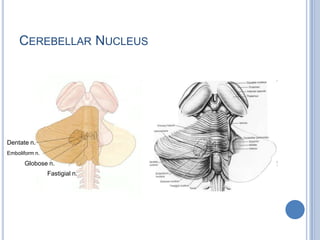
CEREBELLAR NUCLEUS
Dentate n.
Emboliform n.
Globose n.
Fastigial n.
FUNCTION OF CEREBELLAR NUCLEUS
 The fastigial nucleus assists stance & gait &
controls muscles only in the modes of
sitting,standing & walking.
 The nucleus interposed assists segmental reflexes
& speeds the initiation of movement triggered by
somatosensory cues.
 The dentate nucleus assists in tasks requiring fine
dextirity.
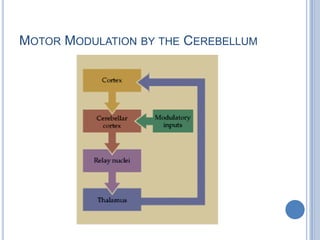
MOTOR MODULATION BY THE CEREBELLUM
INPUT OF CEREBELLUM
CEREBELLAR OUTPUT
VESTIBULOCEREBELLUM
THE SPINOCEREBELLUM CONTAINS TWO SOMATOTOPIC
NEURAL MAPS OF THE BODY
NEOCEREBELLUM
NEURONAL CITCUITS OF CEREBELLUM
CEREBELLAR PATHWAY
Peduncle Description
SUPERIOR some afferent fibers from the anterior spinocerebellar pass to the anterior
cerebellar lobe via this peduncle. Thus, the superior cerebellar peduncle is the
major output pathway of the cerebellum. Most of the efferent fibers originate
within the dentate nu.which in turn project to various midbrain structures
including the red nucleus, the ventral lat./ventral ant. nucleus of the thalamus,
and the medulla. The dentatorubrothalamo cortical& cerebellothalamocortical
pathways are two major pathways that pass through this peduncle and are
important in motor planning.
MIDDLE This is composed entirely of afferent fibers originating within the pontine nuclei
as part of the massive corticoponto cerebellar tract.These fibers descend
from the sensory and motor areas of the cerebral neocortex and make the
middle cerebellar peduncle the largest of the three cerebellar peduncles.
INFERIOR Proprioceptive information from the body is carried to the cerebellum via the
dorsal spinocerebellar tract. This tract passes through the inferior cerebellar
peduncle and synapses within the paleocerebellum. Vestibular information
projects onto the archicerebellum.The climbing fibers of the inferior olive run
through the inferior cerebellar peduncle.This peduncle also carries information
from the Purkinje cells to the vestibular nuclei in the dorsal brainstem located
at the junction between the pons and medulla
Tracts or fiber bundles
Distribution
Inferior cerebellar peduncle
Afferent paths
Olivocerebellar tract
Lateral hemispheres and
cerebellar nucleus
Paraolivocerebellar tract
Vermis, paravermis. and
cerebellar nucleus
Vestibulocerebellar tract
Fastigial nucleus,
flocculonodular lobe, and
uvula
Reticulocerebellar tract
Spinal region of cerebellar
vermis
Posterior spinocerebellar tract
Hind limb region of cerebellar
cortex
Trigeminocerebellar tract
Dentate and emboliform
nucleus
Cuneocerebellar tract
Forelimb and upper trunk
region of cerebellar cortex
Anterior exterior arcuate fibers Flocculus
Arcuatocerebellar fibers (striae
medullares)
Flocculus
Efferent paths
Cerebellovestibular tract Vestibular nucleus
Cerebelloreticular tract
Pontine and medullary
reticular nucleus
CEREBELLAR CONNECTIONS--
Middle cerebellar peduncle
Afferent paths Pontocerebellar tract Neocerebellar cortex
Superior cerebellar peduncle
Afferent paths
Anterior spinocerebellar tract
Hind limb region of cerebellar
cortex
Tectocerebellar tract
Intermediate vermis and
lobulus simplex
Trigeminocerebellar tract
Efferent paths
Dentatorubral fibers Red nucleus
Dentatothalamic fibers
Ventral intermediate (VI) and
ventral anterior (VA) nucleus
of thalamus
Fastigioreticular fibers
Reticular nucleus of midbrain,
pons, and medulla oblongata
CONT.
Afferent connection
MAIN CONNECTIONS OF THE VESTIBULOCEREBELLUM
Floculonodular
Lobe
Vermis
FASTIGIAL
NUCLEUS
VESTIBULAR NUCLEUS
Vestibular
Organ
lower motor neuron
LMN
ARCHICEREBELLUM
vestibulospinal tract
MLF
 RED NUCLEUS
MAIN CONNECTIONS OF THE PALEOCEREBELLUM
RED NUCLEUS
NUCLEUS
INTERPOSITU
S
ANTERIOR
LOBE
PARAVERMA
L ZONE
PALEOCEREBELLUM
Inferior
Olivry
Nucleus
Lower motor
neuron
SPINAL
CORD
Rubro
spinal
tract
spinocerebellar tract
MAIN CONNECTIONS OF THE
NEOCEREBELLUM
CEREBRAL
CORTEX THALAMUS
Pontine
Nucleus
Lower motor
neuron
LMN
DENTATE
NUCLEUS
POSTERIOR
LOBE
CEREBELLAR
HEMISPHERE
NEOCEREBELLUM
Pyramidal
tract
CEREBELLUM AND AUTOMATIC MOTOR
CONTROL
CEREBELLU
M
MOTOR
CORTEX
RED
NUCLEUS
VESTIBULA
R NUCLEUS
RETICULAR
FORMATION
LOWER MOTOR NEURON Proprioceptors
 Corticonuclear Connections
 A zone ---------- fastigial nucleus
 medial vestibular nucleus
 B zone ---------- lateral vestibular nucleus
 C1, C3 zone --- emboliform nucleus
 C2 ---------------- globose nucleus
 D1 ---------------- parvocellular portion of dentate
nucleus
 D2 ---------------- magnocellular portion of dentate
nucleus
VOOGD ORIGINALLY DESCRIBED 4 ZONES,
FROM MEDIAL TO LATERAL--
1. vermis
2. paravermal region
3. cerebella hemisphere
4. nodulus
5. flocculus
6. fastigial nucleus
7. globose nucleus
8. emboliform nucleus
9. dentate nucleus
10. medial vestibular
nucleus
11. lateral vestibular
nucleus
 The inferior olivary nucleus or inferior olive
comprises 3 major divisions –
 the principal olive (PO),
 the dorsal accessory olive (DAO) and
 the medial accessory olive (MAO).
 Different divisions of the olive project to different
cortical zones. The inferior olive is the only source
of climbing fibre inputs to the cerebellum. Inputs
from all other sources are as mossy fibres.
Olivocerebellar Connections
 Caudal portion of
 medial and dorsal accessory olivary nucleus
 ----------------- vermis of cerebellar cortex (A and B)
 fastigial nucleus
 vestibular nucleus
 Rostral portion of
 medial and dorsal accessory olivary nucleus
 ----------------- paravermal region (C1, C2, C3)
 nucleus interpositus
 Principal Inferior Olivary Nucleus
 ----------------- cerebellar hemisphere (D1, D2)
 dentate nucleus
Caudal
portion
Rostral
portion
Principal
inferior olivary
nucleus
medial and dorsal accessory olivary nucleus
 The posterior inferior cerebellar artery (PICA):
supplies-
 Lat.medullary tegmentum,
 inferior cerebellar peduncle
 The ipsilat.portion of the inferior vermis &
 the inferior surface of the cerebellar hemisphere.
 The medial br. of the PICA supplies the medial
cerebellum & the dorsolat. Medulla oblongata.
 The lateral br.supplies the inferoposterolat.
aspect of the cerebellum.
VASCULAR SUPPLY OF THE CEREBELLUM:
CEREBELLAR CIRCULATION
 Maintenance of Equilibrium - balance,
posture, eye movement
 Coordination of half-automatic movement of
walking and posture maintenace - posture,
gait
 Adjustment of Muscle Tone
 Motor Leaning – Motor Skills
 Cognitive Function
CEREBELLUM:FUNCTIONS
ARCHICEREBELUM
 Floculonodular lobe- Vestibulocerebelum
 Function:
 Maintenance of equilibrium
 Suppress Vestibulo Ocular Reflex
 Muscle tone in relation to head posture
 Animal ablation
 Disorder of equilibrium
 Positional nystagmus
 Human: Meduloblastoma
 Trunkal ataxia
 Vestibular nystagmus (fast component towards the side of
lesion)
 Positional nystagmus does not fatigue
 Vertigo
22August2013
PALLEO-CEREBELUM
 Anterior lobe + Vermis
 Afferent:
 Spinocerebellar tract
 Spino-> olivo->cerebellar
 Spino -> reticulo ->
cerebellar
 Efferent
 Festigio -> vestibulo ->
spinal
 Festigio -> Reticulo ->
Spinal
 Function
 Tone control
 Posture of axial muscle
 Equilibrium and locomotion
 Animal ablation
 Increased lengthening and
shortening
 Increased tendon reflex
 Exagerated postural reflex
(positive supporting reflex)
 Human
 Alcoholic degeneration
 Cerebellar degeneration
 Gait ataxia
 Rarely mild hypotonia,
dysmetria and dysarthria
22August2013
NEOCEREBELUM
 Ablation in Dog and Cat inconstant result
 Monkey ablation
 Hypotonia
 Clumsiness of ipsilateral limb
 Dentate nucleus ablation -> more enduring effect
intension tremor
22August2013
CEREBELLAR ZONES
1. Vermis zone: control
posture, tone, locomotion, equilibrium
i. Vestibular connection project to festigial nucleus
ii. Control position of the head in relation to trunk and
extraocular movments
2. Intermediate zone
i. Affrent-
a. proprioceptive from limb
b. Sensorimotor cortex
c. Collateral from corticospinal tract
ii. Efferent globos and embodiform nucleus ->VL thalamus to
motor cortex
iii. Function: Regulation of movment via sensory feedback
from the corticospinal muscle
a. Control velocity, force, pattern of movement
22August2013
CEREBELLAR ZONES: LATERAL
 Afferent: motor and sensory association cortex
 Efferent: Dantate -> thalamus -> motor cortex (open
loop)
 Function: Programing of movement before initiation
 Animal: coordination of ipsilateral movment
 Human: Hypotonia- flabby muscle, abnormal posture
(slopping of shoulder) increased excursion of
outstretched hand tapping. Hyperflexibility of joint,
pendular reflex knee
 Cerebellum control separately the activity of alpha and
gamma motor neuron
 Reduced fusimotor activity from abnormal long loop
reflex through precentral cortex
22August2013
CEREBELLAR DYSFUNCTION
1. Ataxia: Limb, gait and speech
2. Speech: Scanning
3. Tremor: Postural, intention, limb, trunk and head
4. Tone: Hypotonia -> Hyperextensibility, pendular knee
jerk, rebound phenomenon
5. Voluntary movement: Dysmetria, dysynergia,
disdidokokinesia
6. Gait: ataxic, truncal ataxia
7. Head tilt
8. Postural abnormality: due to unequal hypotonia of
truncal muscle -> scoliosis, elevation or depression of
shoulder, pelvic tilt
22August2013
VOLUNTARY MOVEMENT ABNORMALITY
 Gorden Holms : Rate, range and force
 Dyssynergia: Disruption of the normal smooth control of
movement provided by gradual contraction of synergic
muscle and relaxation of their antagonist
 Voluntary movement- longer to start and longer to stop
 Prolongation of interval between the command and triphasic
agonist- antagonist and motor sequence
 Agonist burst may be too long or short or continue into the
antagonist burst -> dysmetria and dysenergia
 Rebound phenomenon (abnormal check reflex)
 Dysdiadokokinesia
 Decomposition of movement
 Scanning speech
 Cogwheel eye moevment
22August2013
VOLUNTARY MOVEMENT ABNORMALITY
 Dysmetria
 Inability of the sensorimotor apparatus to measure distance
in the course of movement
 Hypometria and hypermetria of the limb and eye
 Tremor : Postural and intention
 Ataxia of gait: falling towards the side of lesion
 Nystagmus:
 Gaze paretic (evoked) deviation
 Downbeat
 Rebound
 Sustained horizontal
 Opsoclonus
 Skew deviation
 Weakness, faitibability and loss of associted movement
22August2013
THANKS

Cerebellum Anatomy and Physiology

  • 1.
    CEREBELLUM Dr PS DebMD, DM (Neuro) GNRC Hospitals Guwahati, Assam, India
  • 2.
    SCHEMATIC REPRESENTATION OFTHE MAJOR ANATOMICAL SUBDIVISIONS OF THE CEREBELLUM.
  • 3.
  • 4.
    DEVELOPMENT OF CEREBELLUM Archicerebellum(nodulus) Archicerebellum (flocculus) Paleocerebellum Neocerebellum
  • 5.
  • 6.
    FUNCTIONAL AND PHYLOGENETICROLE Phylogenetic denomination Anatomical parts Role Vestibulocerebellu m (Archicerebellum) Flocculonodular lobe (+ adjacent vermis) Regulates balance and eye movements. Spinocerebellum (Paleocerebellum) Vermis and intermediate parts of the hemispheres ("paravermis") regulates body & limb movements. The spino cerebellum is able to elaborate proprioceptive input in order to anticipate the future position of a body part during the course of a movement. Cerebrocerebellum (Neocerebellum) Middle portion of the vermis & Lateral parts of the hemispheres involved in planning & initiation of movement.It has purely cognitive functions as well.
  • 7.
    CEREBELLAR NUCLEUS Dentate n. Emboliformn. Globose n. Fastigial n.
  • 8.
    FUNCTION OF CEREBELLARNUCLEUS  The fastigial nucleus assists stance & gait & controls muscles only in the modes of sitting,standing & walking.  The nucleus interposed assists segmental reflexes & speeds the initiation of movement triggered by somatosensory cues.  The dentate nucleus assists in tasks requiring fine dextirity.
  • 9.
    MOTOR MODULATION BYTHE CEREBELLUM
  • 10.
  • 11.
  • 12.
  • 13.
    THE SPINOCEREBELLUM CONTAINSTWO SOMATOTOPIC NEURAL MAPS OF THE BODY
  • 14.
  • 15.
  • 16.
  • 19.
    Peduncle Description SUPERIOR someafferent fibers from the anterior spinocerebellar pass to the anterior cerebellar lobe via this peduncle. Thus, the superior cerebellar peduncle is the major output pathway of the cerebellum. Most of the efferent fibers originate within the dentate nu.which in turn project to various midbrain structures including the red nucleus, the ventral lat./ventral ant. nucleus of the thalamus, and the medulla. The dentatorubrothalamo cortical& cerebellothalamocortical pathways are two major pathways that pass through this peduncle and are important in motor planning. MIDDLE This is composed entirely of afferent fibers originating within the pontine nuclei as part of the massive corticoponto cerebellar tract.These fibers descend from the sensory and motor areas of the cerebral neocortex and make the middle cerebellar peduncle the largest of the three cerebellar peduncles. INFERIOR Proprioceptive information from the body is carried to the cerebellum via the dorsal spinocerebellar tract. This tract passes through the inferior cerebellar peduncle and synapses within the paleocerebellum. Vestibular information projects onto the archicerebellum.The climbing fibers of the inferior olive run through the inferior cerebellar peduncle.This peduncle also carries information from the Purkinje cells to the vestibular nuclei in the dorsal brainstem located at the junction between the pons and medulla
  • 20.
    Tracts or fiberbundles Distribution Inferior cerebellar peduncle Afferent paths Olivocerebellar tract Lateral hemispheres and cerebellar nucleus Paraolivocerebellar tract Vermis, paravermis. and cerebellar nucleus Vestibulocerebellar tract Fastigial nucleus, flocculonodular lobe, and uvula Reticulocerebellar tract Spinal region of cerebellar vermis Posterior spinocerebellar tract Hind limb region of cerebellar cortex Trigeminocerebellar tract Dentate and emboliform nucleus Cuneocerebellar tract Forelimb and upper trunk region of cerebellar cortex Anterior exterior arcuate fibers Flocculus Arcuatocerebellar fibers (striae medullares) Flocculus Efferent paths Cerebellovestibular tract Vestibular nucleus Cerebelloreticular tract Pontine and medullary reticular nucleus CEREBELLAR CONNECTIONS--
  • 21.
    Middle cerebellar peduncle Afferentpaths Pontocerebellar tract Neocerebellar cortex Superior cerebellar peduncle Afferent paths Anterior spinocerebellar tract Hind limb region of cerebellar cortex Tectocerebellar tract Intermediate vermis and lobulus simplex Trigeminocerebellar tract Efferent paths Dentatorubral fibers Red nucleus Dentatothalamic fibers Ventral intermediate (VI) and ventral anterior (VA) nucleus of thalamus Fastigioreticular fibers Reticular nucleus of midbrain, pons, and medulla oblongata CONT.
  • 22.
  • 23.
    MAIN CONNECTIONS OFTHE VESTIBULOCEREBELLUM Floculonodular Lobe Vermis FASTIGIAL NUCLEUS VESTIBULAR NUCLEUS Vestibular Organ lower motor neuron LMN ARCHICEREBELLUM vestibulospinal tract MLF
  • 24.
     RED NUCLEUS MAINCONNECTIONS OF THE PALEOCEREBELLUM RED NUCLEUS NUCLEUS INTERPOSITU S ANTERIOR LOBE PARAVERMA L ZONE PALEOCEREBELLUM Inferior Olivry Nucleus Lower motor neuron SPINAL CORD Rubro spinal tract spinocerebellar tract
  • 25.
    MAIN CONNECTIONS OFTHE NEOCEREBELLUM CEREBRAL CORTEX THALAMUS Pontine Nucleus Lower motor neuron LMN DENTATE NUCLEUS POSTERIOR LOBE CEREBELLAR HEMISPHERE NEOCEREBELLUM Pyramidal tract
  • 26.
    CEREBELLUM AND AUTOMATICMOTOR CONTROL CEREBELLU M MOTOR CORTEX RED NUCLEUS VESTIBULA R NUCLEUS RETICULAR FORMATION LOWER MOTOR NEURON Proprioceptors
  • 27.
     Corticonuclear Connections A zone ---------- fastigial nucleus  medial vestibular nucleus  B zone ---------- lateral vestibular nucleus  C1, C3 zone --- emboliform nucleus  C2 ---------------- globose nucleus  D1 ---------------- parvocellular portion of dentate nucleus  D2 ---------------- magnocellular portion of dentate nucleus VOOGD ORIGINALLY DESCRIBED 4 ZONES, FROM MEDIAL TO LATERAL--
  • 28.
    1. vermis 2. paravermalregion 3. cerebella hemisphere 4. nodulus 5. flocculus 6. fastigial nucleus 7. globose nucleus 8. emboliform nucleus 9. dentate nucleus 10. medial vestibular nucleus 11. lateral vestibular nucleus
  • 29.
     The inferiorolivary nucleus or inferior olive comprises 3 major divisions –  the principal olive (PO),  the dorsal accessory olive (DAO) and  the medial accessory olive (MAO).  Different divisions of the olive project to different cortical zones. The inferior olive is the only source of climbing fibre inputs to the cerebellum. Inputs from all other sources are as mossy fibres.
  • 30.
    Olivocerebellar Connections  Caudalportion of  medial and dorsal accessory olivary nucleus  ----------------- vermis of cerebellar cortex (A and B)  fastigial nucleus  vestibular nucleus  Rostral portion of  medial and dorsal accessory olivary nucleus  ----------------- paravermal region (C1, C2, C3)  nucleus interpositus  Principal Inferior Olivary Nucleus  ----------------- cerebellar hemisphere (D1, D2)  dentate nucleus
  • 31.
  • 32.
     The posteriorinferior cerebellar artery (PICA): supplies-  Lat.medullary tegmentum,  inferior cerebellar peduncle  The ipsilat.portion of the inferior vermis &  the inferior surface of the cerebellar hemisphere.  The medial br. of the PICA supplies the medial cerebellum & the dorsolat. Medulla oblongata.  The lateral br.supplies the inferoposterolat. aspect of the cerebellum. VASCULAR SUPPLY OF THE CEREBELLUM:
  • 33.
  • 34.
     Maintenance ofEquilibrium - balance, posture, eye movement  Coordination of half-automatic movement of walking and posture maintenace - posture, gait  Adjustment of Muscle Tone  Motor Leaning – Motor Skills  Cognitive Function CEREBELLUM:FUNCTIONS
  • 35.
    ARCHICEREBELUM  Floculonodular lobe-Vestibulocerebelum  Function:  Maintenance of equilibrium  Suppress Vestibulo Ocular Reflex  Muscle tone in relation to head posture  Animal ablation  Disorder of equilibrium  Positional nystagmus  Human: Meduloblastoma  Trunkal ataxia  Vestibular nystagmus (fast component towards the side of lesion)  Positional nystagmus does not fatigue  Vertigo 22August2013
  • 36.
    PALLEO-CEREBELUM  Anterior lobe+ Vermis  Afferent:  Spinocerebellar tract  Spino-> olivo->cerebellar  Spino -> reticulo -> cerebellar  Efferent  Festigio -> vestibulo -> spinal  Festigio -> Reticulo -> Spinal  Function  Tone control  Posture of axial muscle  Equilibrium and locomotion  Animal ablation  Increased lengthening and shortening  Increased tendon reflex  Exagerated postural reflex (positive supporting reflex)  Human  Alcoholic degeneration  Cerebellar degeneration  Gait ataxia  Rarely mild hypotonia, dysmetria and dysarthria 22August2013
  • 37.
    NEOCEREBELUM  Ablation inDog and Cat inconstant result  Monkey ablation  Hypotonia  Clumsiness of ipsilateral limb  Dentate nucleus ablation -> more enduring effect intension tremor 22August2013
  • 38.
    CEREBELLAR ZONES 1. Vermiszone: control posture, tone, locomotion, equilibrium i. Vestibular connection project to festigial nucleus ii. Control position of the head in relation to trunk and extraocular movments 2. Intermediate zone i. Affrent- a. proprioceptive from limb b. Sensorimotor cortex c. Collateral from corticospinal tract ii. Efferent globos and embodiform nucleus ->VL thalamus to motor cortex iii. Function: Regulation of movment via sensory feedback from the corticospinal muscle a. Control velocity, force, pattern of movement 22August2013
  • 39.
    CEREBELLAR ZONES: LATERAL Afferent: motor and sensory association cortex  Efferent: Dantate -> thalamus -> motor cortex (open loop)  Function: Programing of movement before initiation  Animal: coordination of ipsilateral movment  Human: Hypotonia- flabby muscle, abnormal posture (slopping of shoulder) increased excursion of outstretched hand tapping. Hyperflexibility of joint, pendular reflex knee  Cerebellum control separately the activity of alpha and gamma motor neuron  Reduced fusimotor activity from abnormal long loop reflex through precentral cortex 22August2013
  • 40.
    CEREBELLAR DYSFUNCTION 1. Ataxia:Limb, gait and speech 2. Speech: Scanning 3. Tremor: Postural, intention, limb, trunk and head 4. Tone: Hypotonia -> Hyperextensibility, pendular knee jerk, rebound phenomenon 5. Voluntary movement: Dysmetria, dysynergia, disdidokokinesia 6. Gait: ataxic, truncal ataxia 7. Head tilt 8. Postural abnormality: due to unequal hypotonia of truncal muscle -> scoliosis, elevation or depression of shoulder, pelvic tilt 22August2013
  • 41.
    VOLUNTARY MOVEMENT ABNORMALITY Gorden Holms : Rate, range and force  Dyssynergia: Disruption of the normal smooth control of movement provided by gradual contraction of synergic muscle and relaxation of their antagonist  Voluntary movement- longer to start and longer to stop  Prolongation of interval between the command and triphasic agonist- antagonist and motor sequence  Agonist burst may be too long or short or continue into the antagonist burst -> dysmetria and dysenergia  Rebound phenomenon (abnormal check reflex)  Dysdiadokokinesia  Decomposition of movement  Scanning speech  Cogwheel eye moevment 22August2013
  • 42.
    VOLUNTARY MOVEMENT ABNORMALITY Dysmetria  Inability of the sensorimotor apparatus to measure distance in the course of movement  Hypometria and hypermetria of the limb and eye  Tremor : Postural and intention  Ataxia of gait: falling towards the side of lesion  Nystagmus:  Gaze paretic (evoked) deviation  Downbeat  Rebound  Sustained horizontal  Opsoclonus  Skew deviation  Weakness, faitibability and loss of associted movement 22August2013
  • 43.

Editor's Notes

  • #2 Figure 19.2. Components of the brainstem and diencephalon related to the cerebellum. This sagittal section shows the major structures of the cerebellar system, including the cerebellar cortex, the deep cerebellar nuclei, and the ventroanterior and ventrolateral (VA/VL) complex (which is the target of some of the deep cerebellar nuclei).The CerebellumThe cerebellum (Latin: "little brain") is a region of the brain that plays an important role in the integration of sensory perception and motor control.The cerebellum is located in the inferior posterior portion of the head (the hindrain), directly dorsal to the pons, and inferior to the occipital lobe & separated from cerebrum by tentoriumcerebelli.Weight=150 gmBecause of its large number of tiny granule cells, the cerebellum contains more than 50% of all neurons in the brain, but it only takes up 10% of total brain volume. The cerebellum receives nearly 200 million input fibres.Claude Ghez ,W. Thomas ThachTHE CEREBELLUM (Latin, little brain) constitutes only 10% of the total volume of the brain but contains more than half of all its neurons. These neurons are arranged in a highly regular manner as repeating units, each of which is a basic circuit module. Despite its structural regularity the cerebellum is divided into several distinct regions, each of which receives projections from different portions of the brain and spinal cord and projects to different motor systems. These features suggest that regions of the cerebellum perform similar computational operations but on different inputs.The cerebellum influences the motor systems by evaluating disparities between intention and action and by adjusting the operation of motor centers in the cortex and brain stem while a movement is in progress as well as during repetitions of the same movement. Three aspects of the cerebellum's organization underlie this function. First, the cerebellum is provided with extensive information about the goals, commands, and feedback signals associated with the programming and execution of movement. The importance of this input is evident in the fact that 40 times more axons project into the cerebellum than exit from it. Second, the output projections of the cerebellum are focused mainly on the premotor and motor systems of the cerebral cortex and brain stem, systems that control spinal interneurons and motor neurons directly. Third, synaptic transmission in the circuit modules can be modified, a feature that is crucial for motor adaptation and learning.Organization of the CerebellumThe cerebellum can be subdivided into three main parts based on differences in the sources of input .By far, the largest subdivision in humans is the cerebrocerebellum. It occupies most of the lateral cerebellar hemisphere and receives input from many areas of the cerebral cortex. This region of the cerebellum is especially well developed in primates. The cerebrocerebellum is concerned with the regulation of highly skilled movements, especially the planning and execution of complex spatial and temporal sequences of movement (including speech). The phylogenetically oldest part of the cerebellum is the vestibulocerebellum. This portion of the cerebellum comprises the caudal lobes of the cerebellum and includes the flocculus and the nodulus. As its name suggests, the vestibulocerebellum receives input from the vestibular nuclei in the brainstem and is primarily concerned with the regulation of movements underlying posture and equilibrium. The last of the major subdivisions is the spinocerebellum. The spinocerebellum occupies the median and paramedian zone of the cerebellar hemispheres and is the only part that receives input directly from the spinal cord. The lateral part of the spinocerebellum is primarily concerned with movements of distal muscles, such as the relatively gross movements of the limbs in walking. The central part, called the vermis, is primarily concerned with movements of proximal muscles, and also regulates eye movements in response to vestibular inputs.Dale Purve
  • #3 The cortex is convoluted into many folia. Three major transverse divisions (lobes) are recognized—The anterior lobe is most rostral, posterior lobe and flocculo-nodular lobe more caudally. These lobes are divided by the primary fissure and the posterolateral fissure, respectively. Larselldescribed 10 lobules (subdivisions of the lobes) that can be recognized in all animals. Lobules I-V are within anterior lobe, lobules VI-IX are in posterior lobe and lobule X comprises the floccular-nodular lobe.Anatomical division- :the anterior lobe (rostral to the "primary fissure"), the posterior lobe (dorsal to the "primary fissure") and the flocculonodular lobe,The first two can be further divided in a midline cerebellar vermis and lateral cerebellar hemispheres.
  • #4 Classification by Phylogenetic and Ontogenic Development :ArchicerebellumPaleocerebllumNeocerebellumClassification by Afferent ConnectionVestibulocerebellumSpinocerebellumPontocerebellumClassification by Efferent Connection VermisParavermal Region Cerebellar Hemisphere
  • #5 During the early stages of embryonic development, the brain starts to form in three distinct segments: the prosencephalon, mesencephalon, and rhombencephalon. The rhombencephalon is the most caudal (toward the tail) segment of the embryonic brain.Along the embryonic rhombencephalic segment develop eight swellings, called rhombomeres. The cerebellum arises from two rhombomeres located in the alar plate of the neural tube, a structure that eventually forms the brain and spinal cord.The specific rhombomeres from which the cerebellum forms are rhombomere 1 (Rh.1) caudally (near the tail) and the "isthmus" rostrally (near the front).The cerebellum is of archipalliarphylogenetic origin. The pallium is a term for gray matter that forms the cortex. The archipallium is the one of the most primitive brain regions. The circuits in the cerebellar cortex look similar across all classes of vertibrates, including fish, reptiles, birds, and mammals
  • #6 A striking feature of the surface of the cerebellum is the presence of many parallel convolutions called folia (Latin, leaves) that run from side to side (Figure 42-1). Two deep transverse fissures divide the cerebellum into three lobes. The primary fissure on the dorsal surface separates the anterior and posterior lobes, which together form the body of the cerebellum. The posterolateral fissure on the ventral surface separates the body from the much smaller flocculonodular lobe (Figure 42-2). Sagittal section through the midline shows that shallower fissures further subdivide each lobe into several lobules comprising a variable number of folia.Two longitudinal furrows, which are most prominent ventrally, distinguish three mediolateral regions that are important functionally. The furrows define an elevated ridge in the midline known as the vermis (Latin, worm). On either side of the vermis are the cerebellar hemispheres, each of which is divided into intermediate and lateral regions (Figure 42-2). The three mediolateral regions of the body of the cerebellum (the vermis and intermediate and lateral parts of the hemispheres) and the flocculonodular lobe receive different afferent inputs, project to different parts of the motor systems, and represent distinct functional subdivisions.The flocculonodular lobe is the most primitive part of the cerebellum, appearing first in fishes. Its cortex receives input directly from primary vestibular afferents and projects to the lateral vestibular nuclei (Figure 42-3). In higher vertebrates its function is limited to controlling balance and eye movements and is thus called the vestibulocerebellum.The vermis and hemispheres develop later in phylogeny. The vermis receives visual, auditory, and vestibular input as well as somatic sensory input from the head and proximal parts of the body. It projects by way of the fastigial nucleus to cortical and brain stem regions that give rise to the medial descending systems that control proximal muscles of the body and limbs. The vermis governs posture and locomotion as well as gaze. The adjacent intermediate part of the hemisphere also receives somatosensory input from the limbs. This region projects via the interposed nucleus to lateral corticospinal and rubrospinal systems and thus controls the more distal muscles of the limbs and digits. Because the vermis and intermediate hemispheres are the only regions to receive somatosensory inputs from the spinal cord, they are often called the spinocerebellum.The lateral parts of the hemispheres, which are phylogenetically most recent, are much larger in humans and apes than in monkeys or cats. This region receives input exclusively from the cerebral cortex and is thus called the cerebrocerebellum. Its output is mediated by the dentate nucleus, which projects to motor, premotor, and prefrontal cortices. Recent imaging data indicate that the cerebrocerebellum is intimately involved in planning and mental rehearsal of complex motor actions and in the conscious assessment of movement errors.The connections between the cerebellum and other parts of the nervous system occur by way of three large pathways called cerebellar peduncles. The superior cerebellar peduncle (or brachium conjunctivum) is almost entirely an efferent pathway. The neurons that give rise to this pathway are in the deep cerebellar nuclei, and their axons project to upper motor neurons in the red nucleus, the deep layers of the superior colliculus, and, after a relay in the dorsal thalamus, the primary motor and premotor areas of the cortex.The middle cerebellar peduncle (or brachium pontis) is an afferent pathway to the cerebellum; most of the cell bodies that give rise to this pathway are in the base of the pons, where they form thebpontine nuclei .The pontine nuclei receive input from a wide variety of sources, including almost all areas of the cerebral cortex and the superior colliculus. The axons of the pontine nuclei, called transverse pontine fibers, cross the midline and enter the cerebellum via the middle cerebellar peduncle. Each of the two middle cerebellar peduncles contains over 20 million axons and are thus among the largest pathways in the brain. In comparison, the optic and pyramidal tracts contain only about a million axons. Most of these pontine axons relay information from the cortex to the cerebellum. Finally, the inferior cerebellar peduncle (or restiform body) is the smallest but most complex of the cerebellar peduncles, containing multiple afferent and efferent pathways. Efferent pathways in this peduncle project to the vestibular nuclei and the reticular formation; the afferent pathways include axons from the vestibular nuclei, the spinal cord, and several regions of the brainstem tegmentum.
  • #8 Embedded within the white matter—which is known as the arbor vitae (Tree of Life) in the cerebellum due to its branched, treelike appearance—are four deep cerebellar nuclei:From lateral to medial, they are the dentate, emboliform, globose, and fastigial. These nuclei receive inhibitory (GABAergic) inputs from Purkinje cells in the cerebellar cortex and excitatory (glutamatergic) inputs from mossy fibre pathways. Most output fibers of the cerebellum originate from these nuclei.
  • #34 The ant.inf.cerebellar artery (AICA) supplies- Ant.petrosal surface of the cerebellar hemisphere, Flocculus, Lower portion of the middle cerebellar peduncle & Lat.pontomedullary tegmentum.The superior cerebellar artery (SCA) supplies- The upper surface of the cerebellar hemisphere,Ipsilat.portion of the superior vermis, Most of the dentate nucleus, Upper portion of the MCP,SCP & lat.pontine tegmentum.