

Tips on using my ppt.
1. You can freely download, edit, modify and put your
name etc.
2. Don’t be concerned about number of slides. Half the
slides are blanks except for the title.
3. First show the blank slides (eg. Aetiology ) > Ask
students what they already know about ethology of
today's topic. > Then show next slide which enumerates
aetiologies.
4. At the end rerun the show – show blank> ask questions >
show next slide.
5. This will be an ACTIVE LEARNING SESSION x
three revisions.
6. Good for self study also. Good for self study also.
Display blank slide> Think what you already know about
this > Read next slide.
Introduction
Introduction
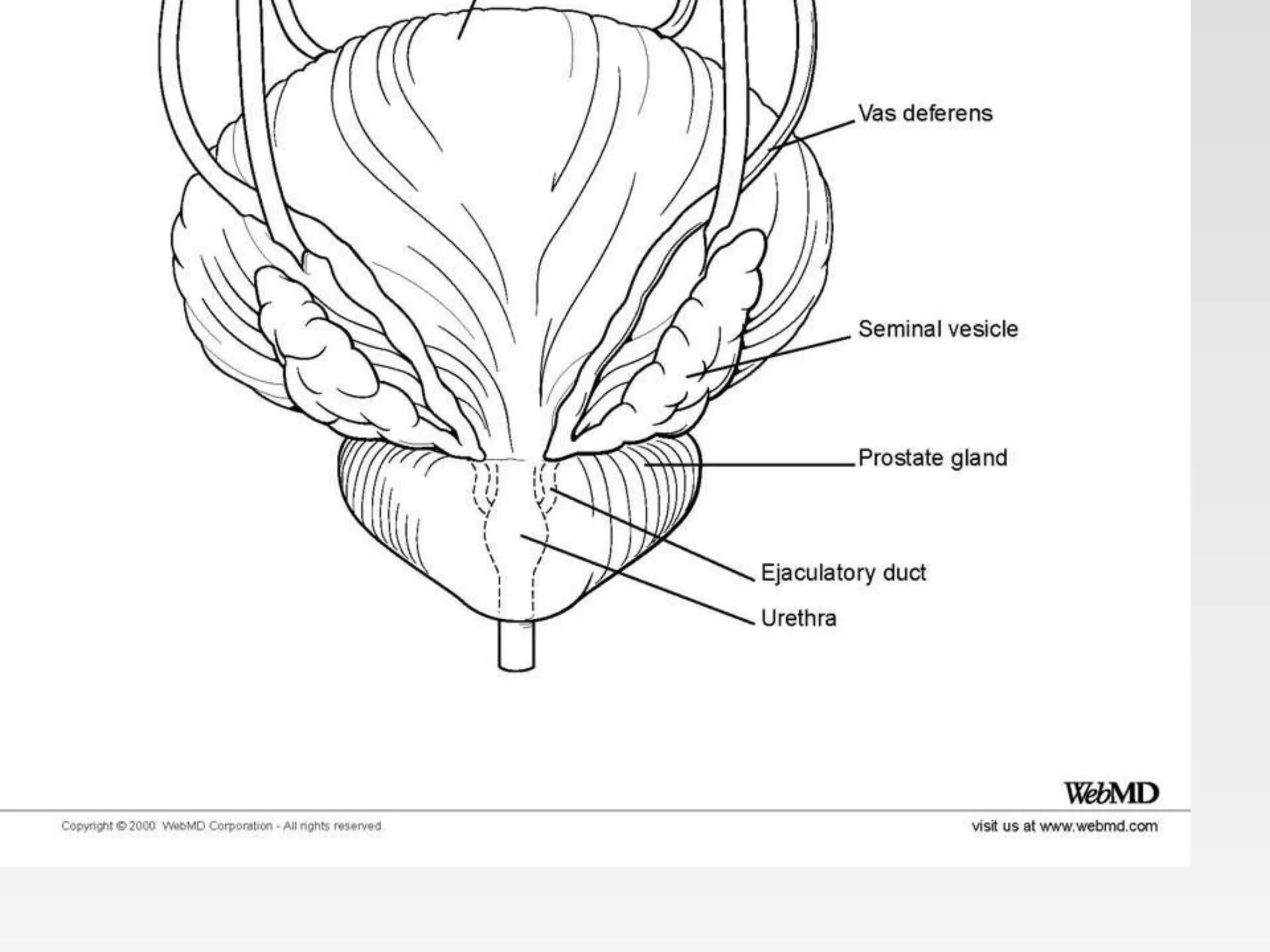
• Prostate is a fibromuscular glandular organ
surrounding the prostatic urethra.
• It lies just below urinary bladder and above
urogenital diaphragm.
• Samosa / Inverted pyramid shaped.
Anatomy
Anatomy
• A normal prostate gland is approximately
20 g in volume, 3 cm in length, 4 cm wide,
and 2 cm in depth.
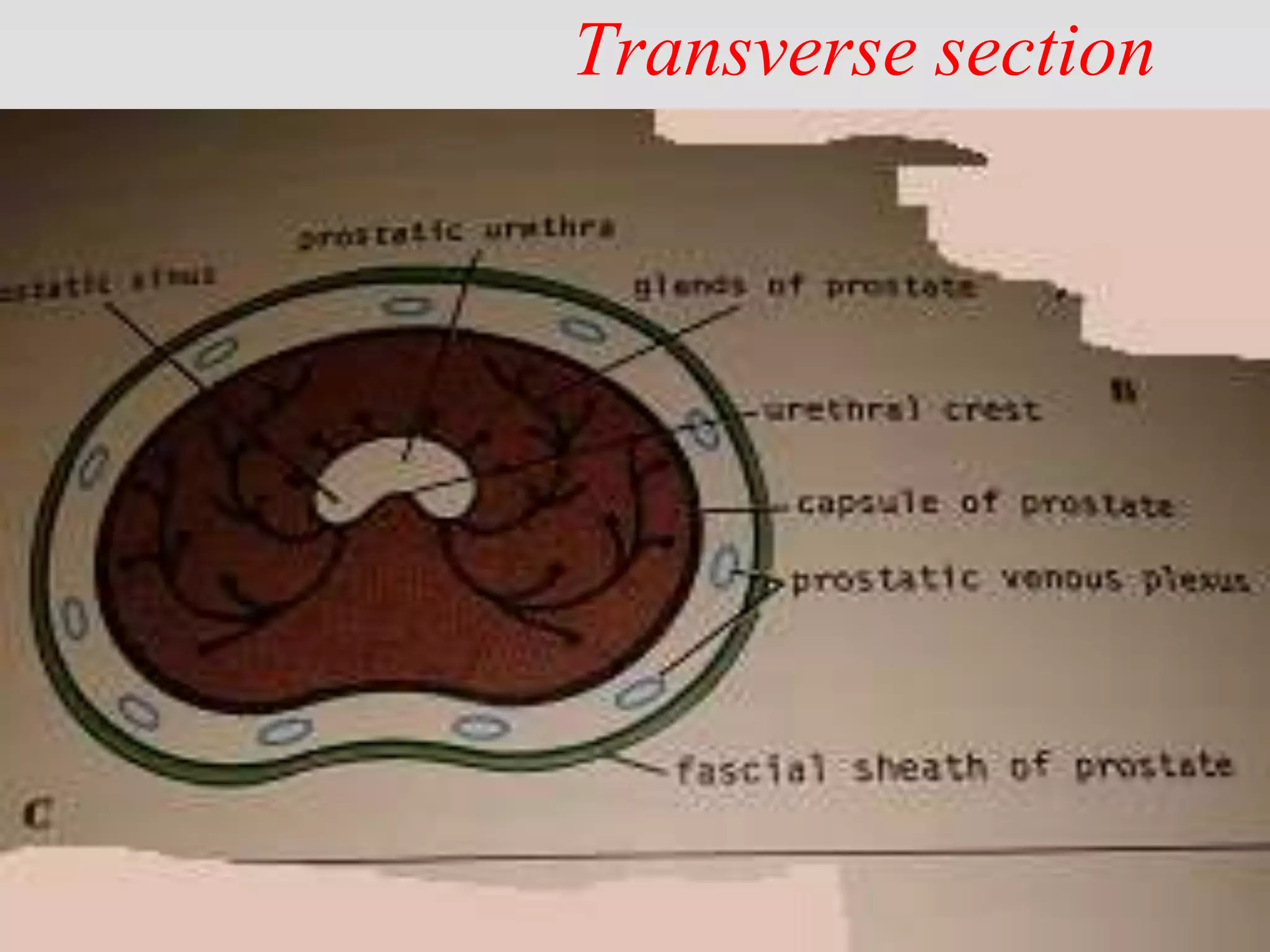
• Surrounded by a fibrous capsule.
• Outside capsule- a fibrous sheath which is
part of visceral layer of pelvic fascia.
Transverse section
Parts
Parts
• Base
• Apex
• 4surfaces-
– Anterior
– Posterior
– 2lateral
Embryology
Embryology
• Embryologically, the prostate, seminal
vesicles, and ductus (vas) deferens originate
from 2 separate structures-
– The prostate arises from a budding collection of
tissue in the urogenital sinus.
– The seminal vesicles and the ductus deferens
are formed from the mesonephric duct.
Embryology
• The prostate develops from epithelial
outgrowths form the prostatic segment of
the urethra that grows into the surrounding
mesenchyme.
• This outgrowth and branching start at week
10 during embryo growth;
Embryology
• by week 12, there are 5 groups of tubules
that form the lobes of the prostate.-
• The first group makes up the middle lobe
• the second and third groups make up the
right and left lateral lobes;
• the fourth group is the posterior lobe that
starts from the floor of the urethra;
• fifth group is the anterior lobe.
Arterial Supply
Arterial Supply
Branches of-
1.Inferior Vesical artery.
2.Middle Rectal artery
Venous Drainage
Venous Drainage
• Veins form Prostatic venous plexus
between capsule and fibrous sheath.
• This plexus receives-
– Deep dorsal vein of penis
– Many visceral veins
• The plexus drains into Internal iliac veins.
Lymphatic Drainage
Lymphatic Drainage
• Into Internal iliac nodes
Nerve Supply
Nerve Supply
• Supplied by Inferior hypogastric plexus.
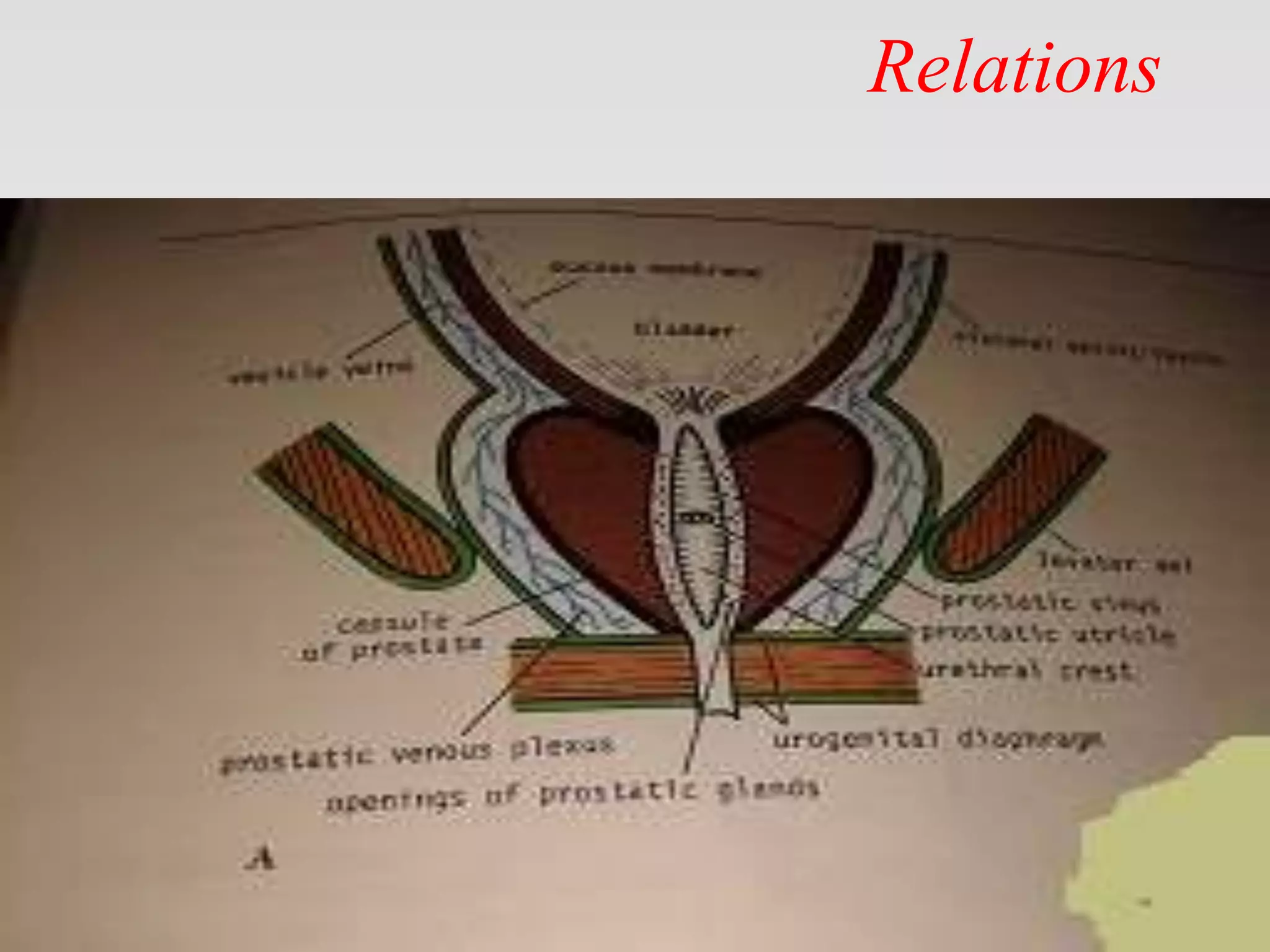
Relations
Relations
Relations
Anterior
• Symphysis Pubis
• Extraperitoneal fat in retroperitoneal space
(Cave of Retzius)
• Puboprostatic ligaments
Relations
Posterior
• Rectum
• Denonvillier’s fascia (Rectovescical
septum)
• The ejaculatory ducts pierce the upper part
to open into prostatic urethra at Veru.
Relations
Superior
• Neck of urinary bladder.
– The urethra enters center of the base .
Relations
Inferior
• Apex lies on urogenital diaphragm.
– The urethra leaves just above the apex on
anterior surface.
Relations
Lateral
• Embraced by the anterior fibres of levator
ani.
Lobes
Lobes
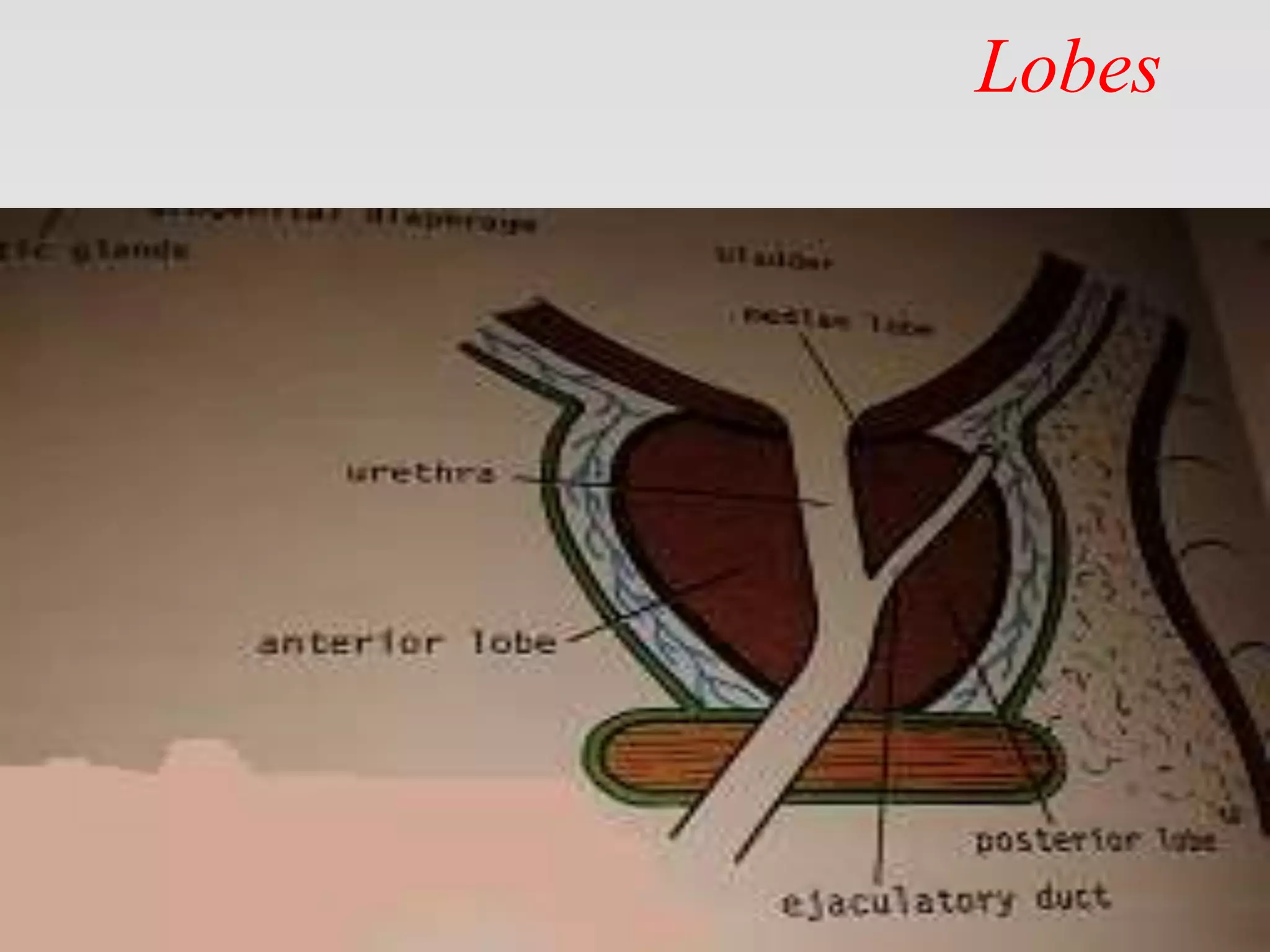
Incompletely divided into five lobes-
1. Anterior lobe (Isthmus)
2. Middle (Median)
3. Posterior
4. And 5 Rt and Lt. Lateral lobes seperated
by median groove.
Lobes
Verumontanum
• the openings of the prostatic ducts
Verumontanum
• The seminal colliculus or verumontanum,
of the prostatic urethra is a landmark near
the entrance of the seminal vesicles.
• Distinctive median elevation of urothelium
• The landmark is important in classification
of several urethral developmental disorders.
The margins of seminal colliculus are the
following:
• the orifices of the prostatic utricle
• the slit-like openings of the ejaculatory
ducts.
Microscopic Anatomy
Microscopic Anatomy
• The glands of the peripheral zone lined by
columnar epithelium, lie in the
fibromuscular stroma, and their ducts,which
are long and branched, open into
posterolateral grooves on either side of the
verumontanum.
• The glands of the CZ and TZ are shorter
and unbranched.
Zonal Anatomy
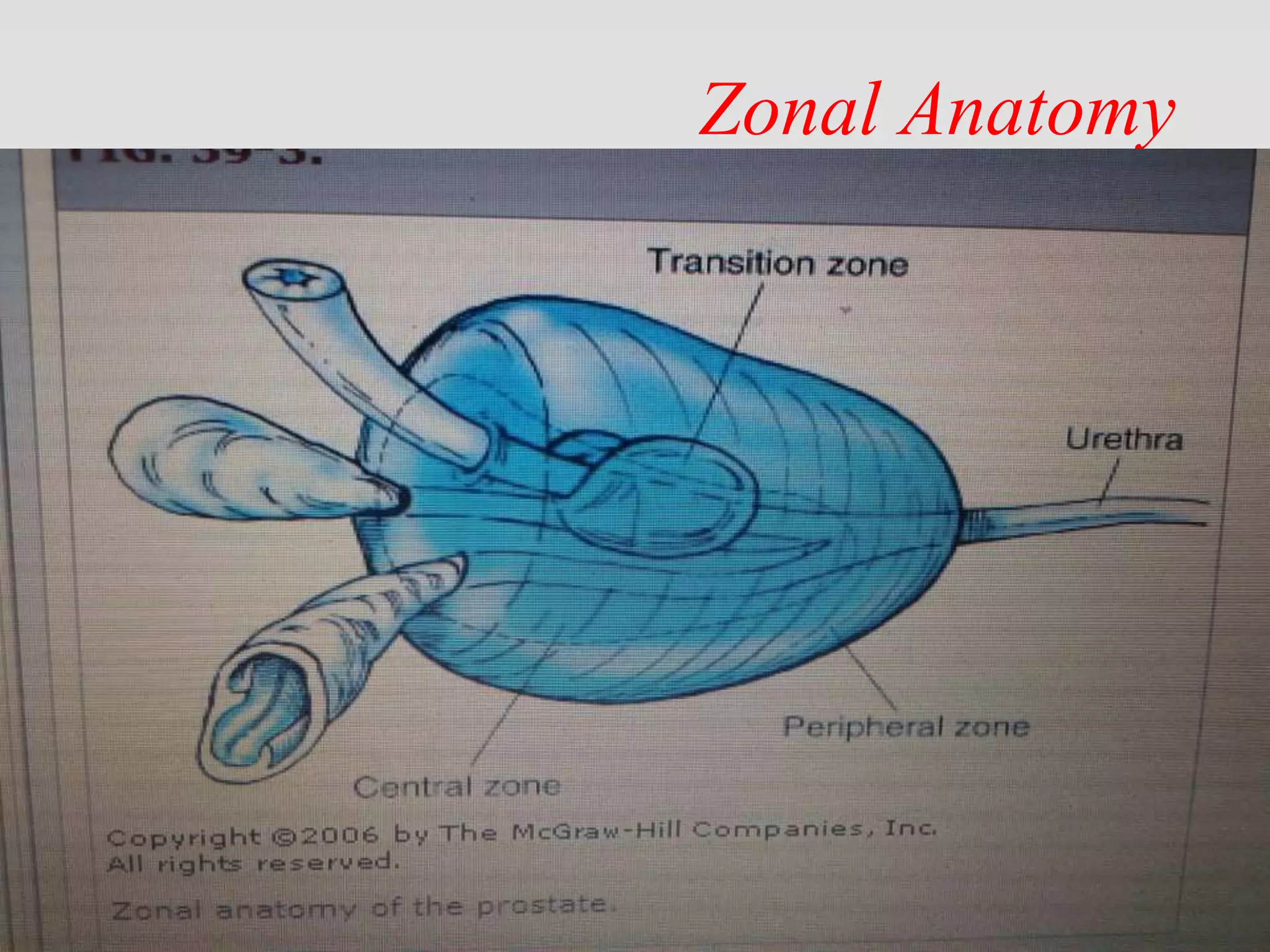
• Peripheral zone (PZ), which lies
mainly posteriorly and from which most
carcinomas arise, and a
• Central zone (CZ), which lies posterior to
the urethral lumen and
• Periurethral transitional zone (TZ), from
which most benign prostatic hyperplasia
(BPH) arises.
Zonal Anatomy
Sphinctors
Sphinctors
• Proximal smooth mucle urethral sphincter
• Distal striated urethral sphincter muscle
Physiology
Physiology
• Prostate produces a thin milky fluid
containing citric acid and acid phosphatase
which is added to the seminal fluid at the
time of ejaculation.
Get this ppt in mobile
1. Download Microsoft
PowerPoint from play
store.
2. Open Google assistant
3. Open Google lens.
4. Scan qr code from
next slide.
Get my ppt collection
• https://www.slideshare.net/drpradeeppande/
edit_my_uploads
• https://www.dropbox.com/sh/x600md3cvj8
5woy/AACVMHuQtvHvl_K8ehc3ltkEa?dl
=0
• https://www.facebook.com/doctorpradeeppa
nde/?ref=pages_you_manage

Prostate Anatomy.pptx

  • 1.
    Tips on usingmy ppt. 1. You can freely download, edit, modify and put your name etc. 2. Don’t be concerned about number of slides. Half the slides are blanks except for the title. 3. First show the blank slides (eg. Aetiology ) > Ask students what they already know about ethology of today's topic. > Then show next slide which enumerates aetiologies. 4. At the end rerun the show – show blank> ask questions > show next slide. 5. This will be an ACTIVE LEARNING SESSION x three revisions. 6. Good for self study also. Good for self study also. Display blank slide> Think what you already know about this > Read next slide.
  • 2.
  • 3.
    Introduction • Prostate isa fibromuscular glandular organ surrounding the prostatic urethra. • It lies just below urinary bladder and above urogenital diaphragm. • Samosa / Inverted pyramid shaped.
  • 5.
  • 6.
    Anatomy • A normalprostate gland is approximately 20 g in volume, 3 cm in length, 4 cm wide, and 2 cm in depth. • Surrounded by a fibrous capsule. • Outside capsule- a fibrous sheath which is part of visceral layer of pelvic fascia.
  • 7.
  • 8.
  • 9.
    Parts • Base • Apex •4surfaces- – Anterior – Posterior – 2lateral
  • 10.
  • 11.
    Embryology • Embryologically, theprostate, seminal vesicles, and ductus (vas) deferens originate from 2 separate structures- – The prostate arises from a budding collection of tissue in the urogenital sinus. – The seminal vesicles and the ductus deferens are formed from the mesonephric duct.
  • 12.
    Embryology • The prostatedevelops from epithelial outgrowths form the prostatic segment of the urethra that grows into the surrounding mesenchyme. • This outgrowth and branching start at week 10 during embryo growth;
  • 13.
    Embryology • by week12, there are 5 groups of tubules that form the lobes of the prostate.- • The first group makes up the middle lobe • the second and third groups make up the right and left lateral lobes; • the fourth group is the posterior lobe that starts from the floor of the urethra; • fifth group is the anterior lobe.
  • 14.
  • 15.
    Arterial Supply Branches of- 1.InferiorVesical artery. 2.Middle Rectal artery
  • 16.
  • 17.
    Venous Drainage • Veinsform Prostatic venous plexus between capsule and fibrous sheath. • This plexus receives- – Deep dorsal vein of penis – Many visceral veins • The plexus drains into Internal iliac veins.
  • 18.
  • 19.
    Lymphatic Drainage • IntoInternal iliac nodes
  • 20.
  • 21.
    Nerve Supply • Suppliedby Inferior hypogastric plexus.
  • 22.
  • 23.
  • 24.
    Relations Anterior • Symphysis Pubis •Extraperitoneal fat in retroperitoneal space (Cave of Retzius) • Puboprostatic ligaments
  • 25.
    Relations Posterior • Rectum • Denonvillier’sfascia (Rectovescical septum) • The ejaculatory ducts pierce the upper part to open into prostatic urethra at Veru.
  • 26.
    Relations Superior • Neck ofurinary bladder. – The urethra enters center of the base .
  • 27.
    Relations Inferior • Apex lieson urogenital diaphragm. – The urethra leaves just above the apex on anterior surface.
  • 28.
    Relations Lateral • Embraced bythe anterior fibres of levator ani.
  • 29.
  • 30.
    Lobes Incompletely divided intofive lobes- 1. Anterior lobe (Isthmus) 2. Middle (Median) 3. Posterior 4. And 5 Rt and Lt. Lateral lobes seperated by median groove.
  • 31.
  • 32.
    Verumontanum • the openingsof the prostatic ducts
  • 33.
    Verumontanum • The seminalcolliculus or verumontanum, of the prostatic urethra is a landmark near the entrance of the seminal vesicles. • Distinctive median elevation of urothelium • The landmark is important in classification of several urethral developmental disorders. The margins of seminal colliculus are the following: • the orifices of the prostatic utricle • the slit-like openings of the ejaculatory ducts.
  • 34.
  • 35.
    Microscopic Anatomy • Theglands of the peripheral zone lined by columnar epithelium, lie in the fibromuscular stroma, and their ducts,which are long and branched, open into posterolateral grooves on either side of the verumontanum. • The glands of the CZ and TZ are shorter and unbranched.
  • 36.
    Zonal Anatomy • Peripheralzone (PZ), which lies mainly posteriorly and from which most carcinomas arise, and a • Central zone (CZ), which lies posterior to the urethral lumen and • Periurethral transitional zone (TZ), from which most benign prostatic hyperplasia (BPH) arises.
  • 37.
  • 38.
  • 39.
    Sphinctors • Proximal smoothmucle urethral sphincter • Distal striated urethral sphincter muscle
  • 40.
  • 41.
    Physiology • Prostate producesa thin milky fluid containing citric acid and acid phosphatase which is added to the seminal fluid at the time of ejaculation.
  • 42.
    Get this pptin mobile 1. Download Microsoft PowerPoint from play store. 2. Open Google assistant 3. Open Google lens. 4. Scan qr code from next slide.
  • 45.
    Get my pptcollection • https://www.slideshare.net/drpradeeppande/ edit_my_uploads • https://www.dropbox.com/sh/x600md3cvj8 5woy/AACVMHuQtvHvl_K8ehc3ltkEa?dl =0 • https://www.facebook.com/doctorpradeeppa nde/?ref=pages_you_manage

Editor's Notes

  • #2 drpradeeppande@gmail.com 7697305442
  • #45 drpradeeppande@gmail.com 7697305442