For the students of Gulf Medical University, Ajman,
MBBS

Dr. Seyed Morteza Mahmoudi,
MBBS
Gulf Medical University, Ajman
 Anatomical

Position
 Orientation Planes and Lines
 Terms of Direction
 Terms of Movement
 Parts and Regions of the Body
 Body Cavities
 Anatomical

Position
 Orientation Planes and Lines
 Terms of Direction
 Terms of Movement
 Parts and Regions of the Body
 Body Cavities
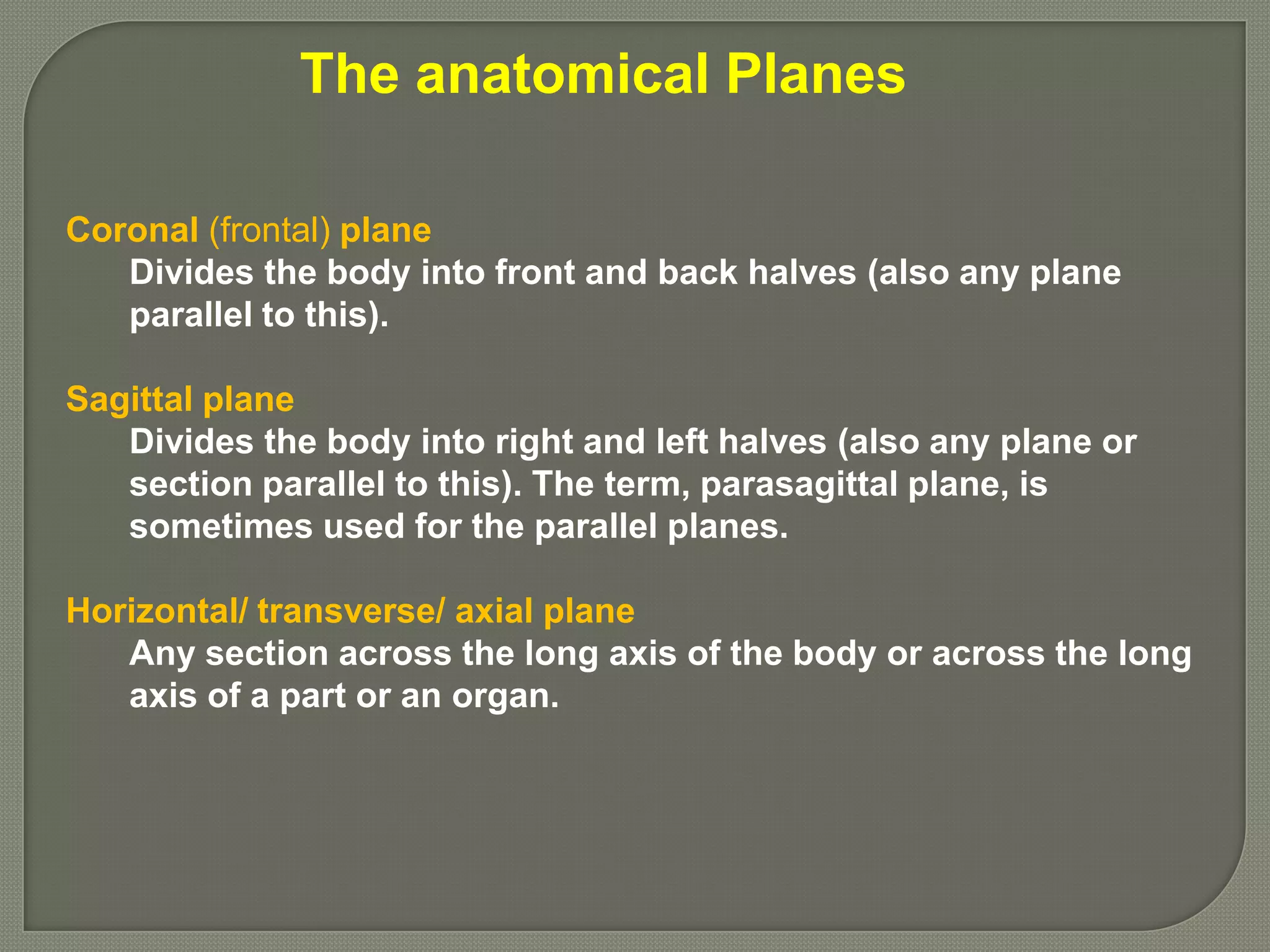
The anatomical Planes
Coronal (frontal) plane
Divides the body into front and back halves (also any plane
parallel to this).
Sagittal plane
Divides the body into right and left halves (also any plane or
section parallel to this). The term, parasagittal plane, is
sometimes used for the parallel planes.
Horizontal/ transverse/ axial plane
Any section across the long axis of the body or across the long
axis of a part or an organ.


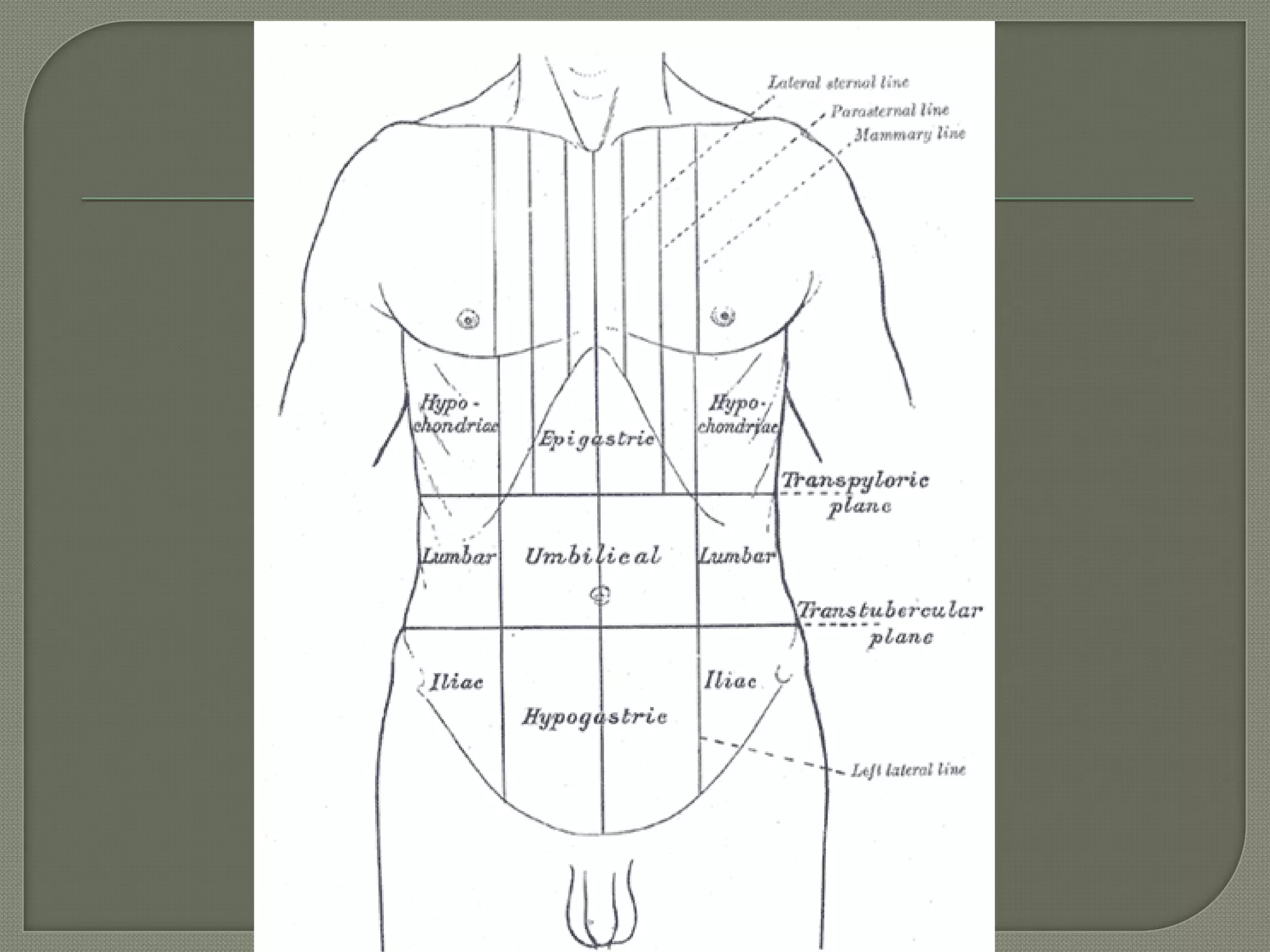
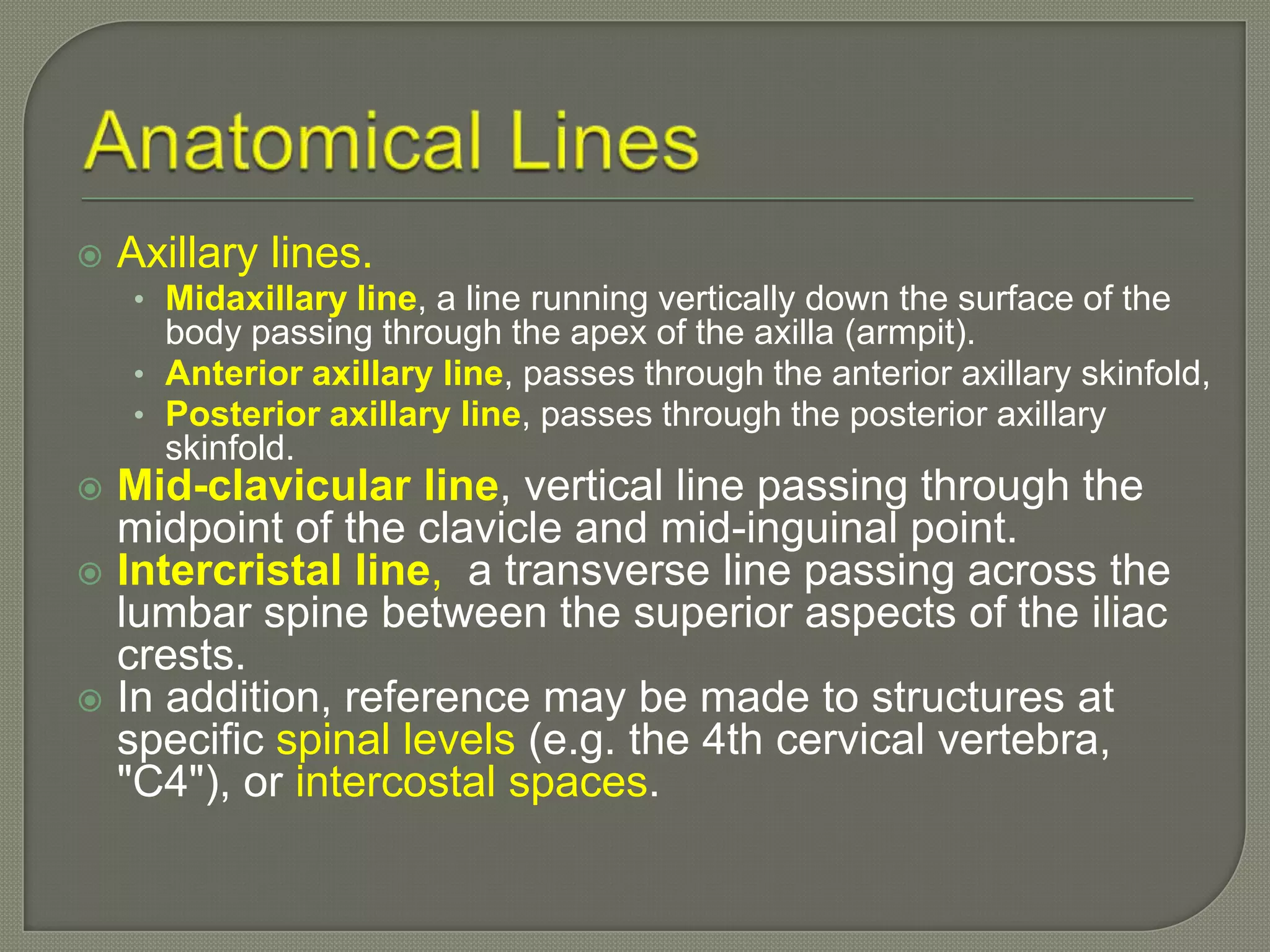
Axillary lines.
• Midaxillary line, a line running vertically down the surface of the

body passing through the apex of the axilla (armpit).
• Anterior axillary line, passes through the anterior axillary skinfold,
• Posterior axillary line, passes through the posterior axillary
skinfold.

Mid-clavicular line, vertical line passing through the
midpoint of the clavicle and mid-inguinal point.
 Intercristal line, a transverse line passing across the
lumbar spine between the superior aspects of the iliac
crests.
 In addition, reference may be made to structures at
specific spinal levels (e.g. the 4th cervical vertebra,
"C4"), or intercostal spaces.

 Anatomical

Position
 Orientation Planes and Lines
 Terms of Direction
 Terms of Movement
 Parts and Regions of the Body
 Body Cavities
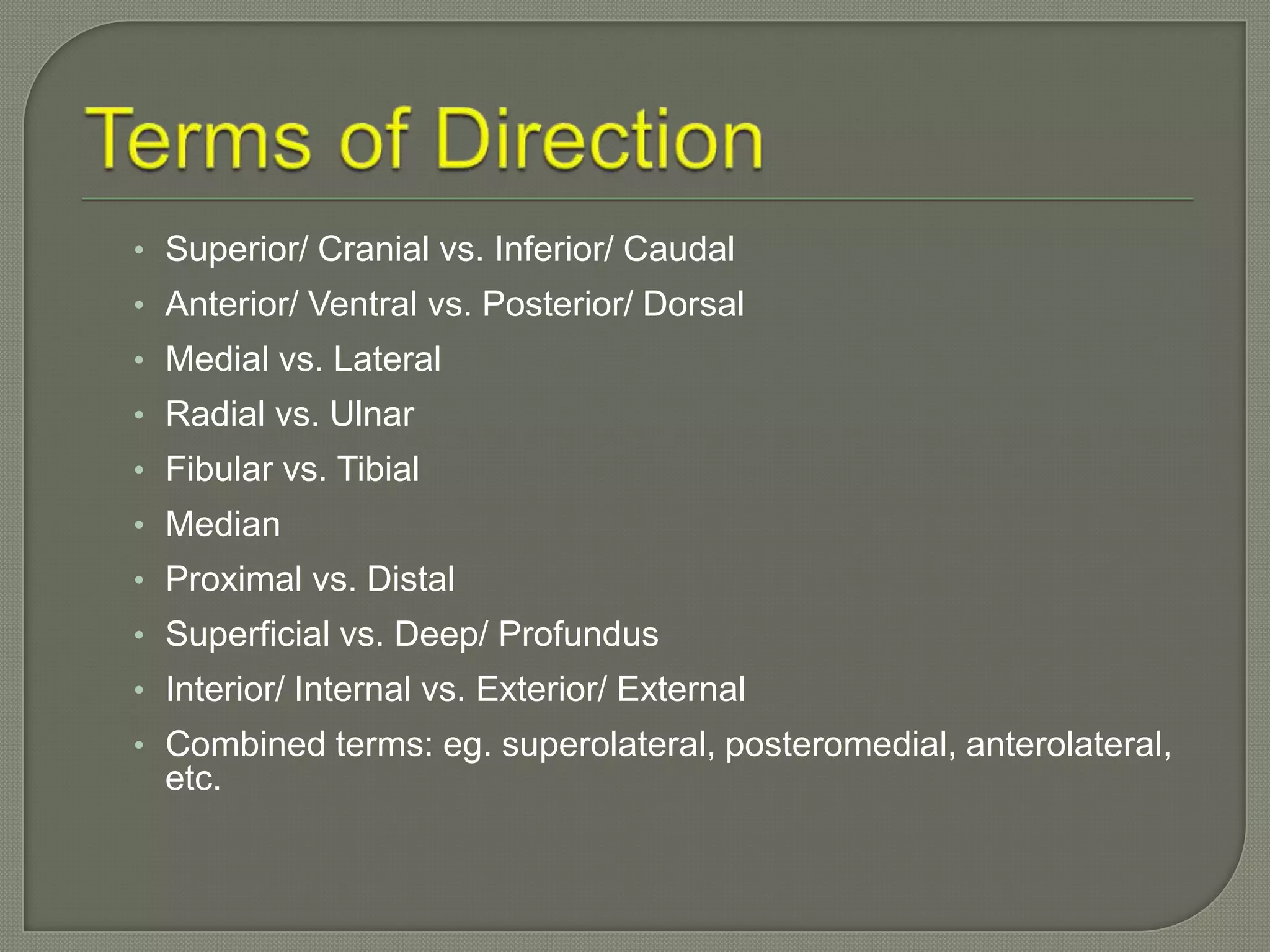
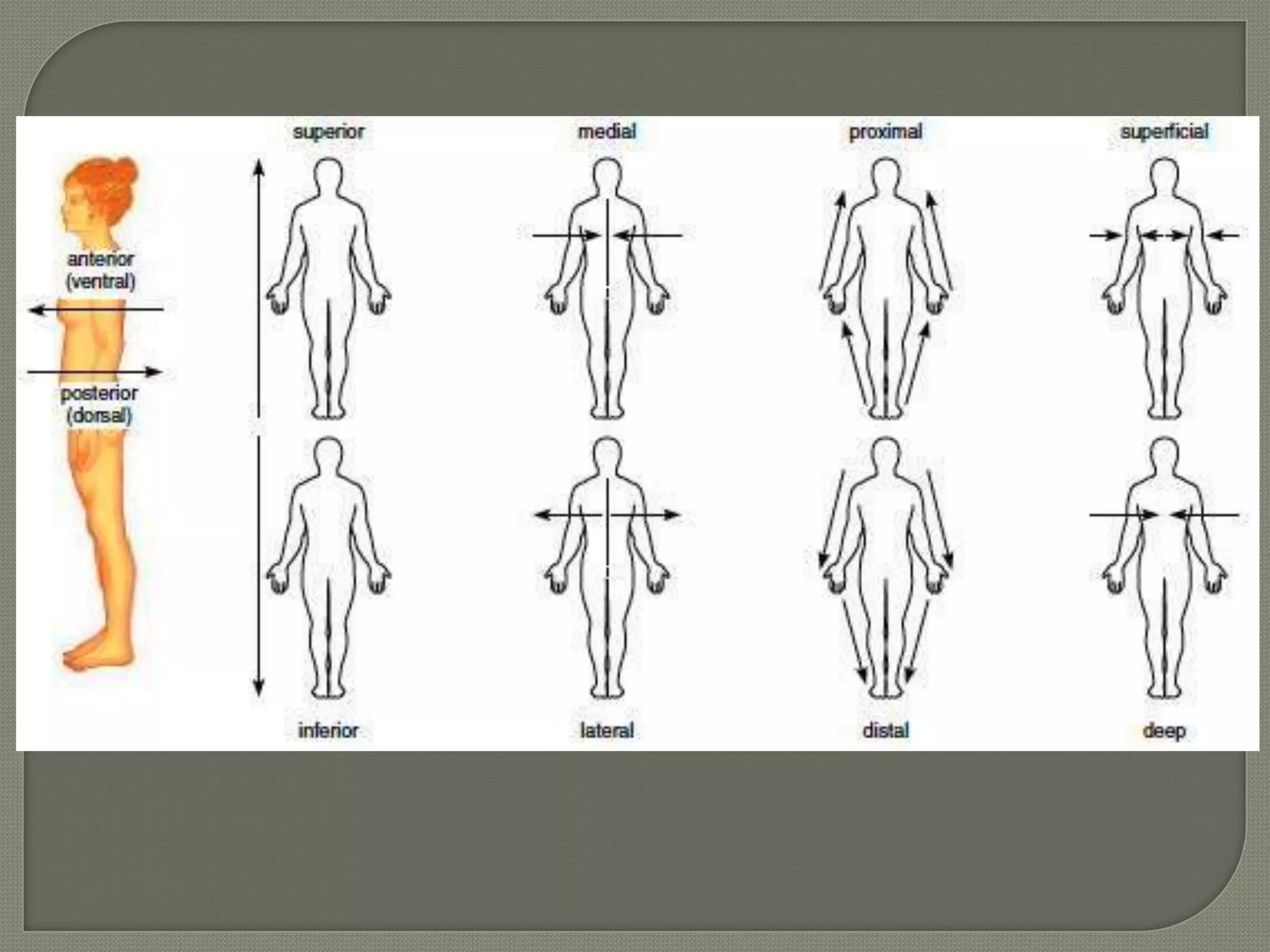
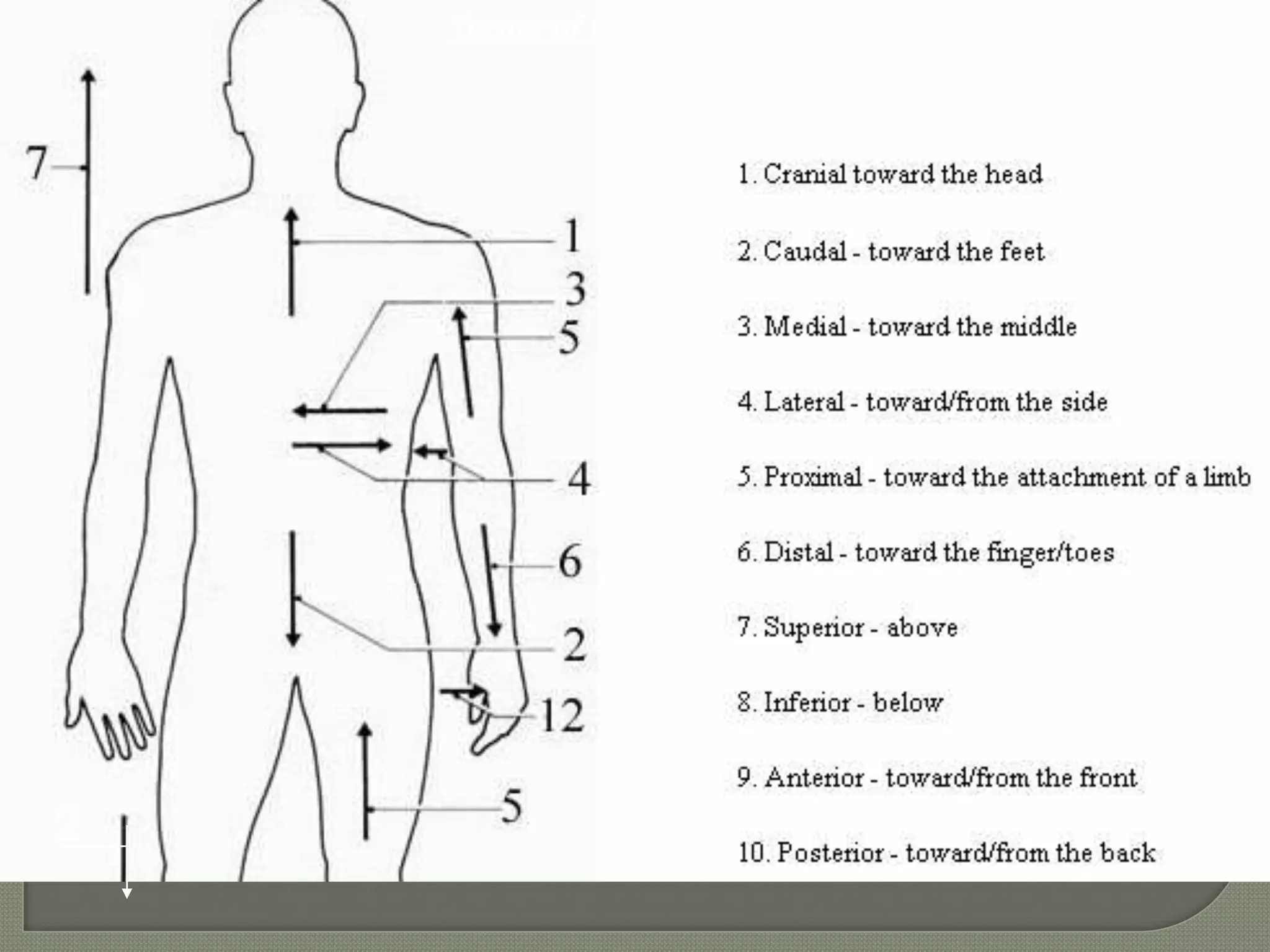
• Superior/ Cranial vs. Inferior/ Caudal
• Anterior/ Ventral vs. Posterior/ Dorsal
• Medial vs. Lateral
• Radial vs. Ulnar
• Fibular vs. Tibial
• Median
• Proximal vs. Distal
• Superficial vs. Deep/ Profundus
• Interior/ Internal vs. Exterior/ External
• Combined terms: eg. superolateral, posteromedial, anterolateral,

etc.
Terms of Direction

2
 Anatomical

Position
 Orientation Planes and Lines
 Terms of Direction
 Terms of Movement
 Parts and Regions of the Body
 Body Cavities


Flexion vs. Extension



Abduction vs. Adduction



Circumduction



Dorsiflexion vs. Plantar flexion



Eversion vs. Inversion



External rotation vs. Internal rotation



Lateral flexion



Pronation vs. Supination



Radial deviation vs. Ulnar deviation
Movements

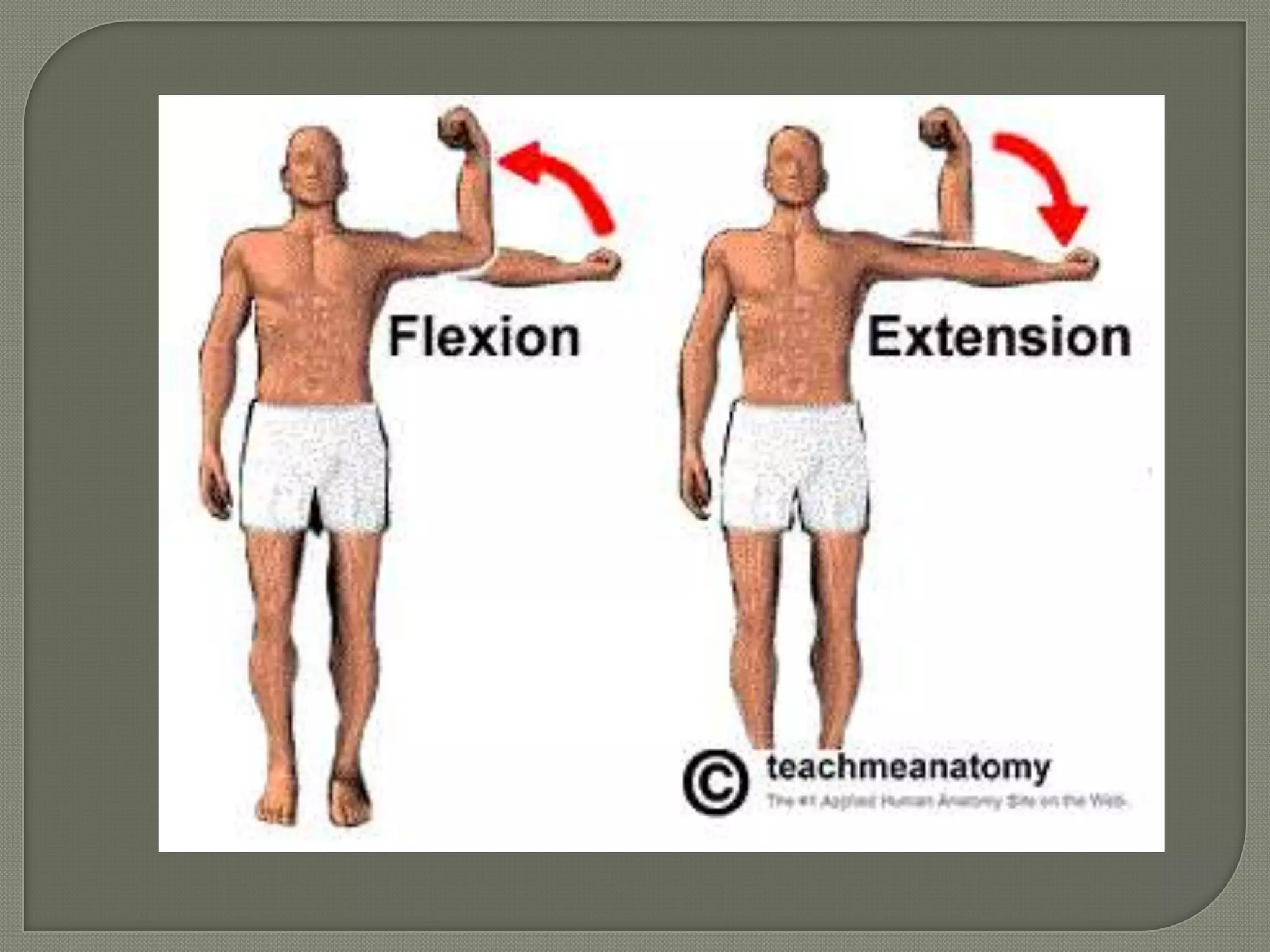
Flexion:
Generally the bending of two surfaces toward
each other.

Extension:
Generally the bending of two surfaces away from
each other. When there might be confusion the
term dorsiflexion is used.
Movements cont.
Abduction:
Any movement away from the midline

Adduction:
Any movement toward the midline
Movements cont.

External (lateral) rotation:
Turning a part of the body to face outward

Internal (medial) rotation:
Turning a part of the body to face inward

Circumduction:
Sometimes used to describe a circular
movement, as when swinging one's arm around
in a circle.
Movements cont.
Special movements of the forearm
Supination: turning the palms to face upward
Pronation: turning the palms to face downward
Special movements of the foot
Eversion: turning the soles of the feet outward
Inversion: turning the soles of the feet inward to
face each other
Note: When describing movement, always refer to
the joint involved, e.g.. flexion of elbow rather than
flexion of forearm. This will avoid much confusion.
 Anatomical

Position
 Orientation Planes and Lines
 Terms of Direction
 Terms of Movement
 Parts and Regions of the Body
 Body Cavities
Parts and Regions of the Body
Head and neck
•Head = cephalus; adjective - cephalic (cranial is sometimes used as
a synonym)
•Neck = cervix; adjective - cervical
Upper limb
•Anterior shoulder = pectoral area
•Arm or brachium = portion between shoulder and elbow (this is not
a synonym for upper limb.)
•Forearm or antebrachium = portion between elbow and wrist
•The hand has a dorsal and a palmar (or volar) surface.
Lower limb
•Buttock = gluteal region
•Thigh = portion from hip to knee.
•Leg = portion from knee to ankle
•The foot has a dorsal and a plantar surface.
Parts and Regions of the Body cont.
Trunk or torso is an anatomical term for the central part of body from which
extend the neck and limbs. The trunk includes the thorax and abdomen.
Thorax or chest
•Adjective - thoracic
•Anterior surface = sternal or pectoral area

•Ribs = costa; adjective - costal
Abdomen
•The anterior wall has several regions which will be encountered later.
e.g. umbilical= around navel, lumbar = flank region, gastric = stomach

Pelvis
•This is actually the inferior continuation of the abdomen.
•The posterior area is called the sacral area because of its relationship
to the sacrum bone.

•Perineum is the area enclosing the external genitalia and anus
 Anatomical

Position
 Orientation Planes and Lines
 Terms of Direction
 Terms of Movement
 Parts and Regions of the Body
 Body Cavities


Cranial regions
•
•
•
•



Parietal
Frontal
Temporal
Occipital

Facial regions
•
•
•
•
•
•
•
•
•
•

Auricular
Buccal
Orbital
Mastoid
Nasal
Mental
Submental
Maxillary
Mandibular
Zygomatic
 Cervical

 Larynx
 Tracheal


Nuchal
 Axillary

 Clavicular
 Sternal
 Pectoral

 Mammary
 Costal
 Scapular
 Hypochondriac

 Epigastric
 Umbilical
 Hypogastric

 Inguinal/
 Lumbar

iliac
 Deltoid
 Acromial
 Brachial
 Antebrachial
 Antecubital
 Olecranon
 Carpal
 Palmar
 Digital
 Phalangeal
 Pollex
 Femoral

 Patellar
 Crural
 Popliteal

 Sural
 Tarsal
 Pedal
 Calcaneal
Posterior Body Regions
•Occipital
•Deltoid

•Popliteal
•Gluteal
•Scapular
•Lumbar
•Vertebral
•Sacral
 Anatomical

Position
 Orientation Planes and Lines
 Terms of Direction
 Terms of Movement
 Parts and Regions of the Body
 Body Cavities
Pleural

Pericardial
Body Cavities

Dorsal Body Cavity

Ventral Body Cavity

•Cranial Cavity

•Thoracic Cavity

•Spinal Cavity

•Abdominopelvic Cavity

Abdominal & Pelvic
Introduction to Anatomy (Anatomical Terms)

Introduction to Anatomy (Anatomical Terms)

  • 2.
    For the studentsof Gulf Medical University, Ajman, MBBS Dr. Seyed Morteza Mahmoudi, MBBS Gulf Medical University, Ajman
  • 3.
     Anatomical Position  OrientationPlanes and Lines  Terms of Direction  Terms of Movement  Parts and Regions of the Body  Body Cavities
  • 11.
     Anatomical Position  OrientationPlanes and Lines  Terms of Direction  Terms of Movement  Parts and Regions of the Body  Body Cavities
  • 19.
    The anatomical Planes Coronal(frontal) plane Divides the body into front and back halves (also any plane parallel to this). Sagittal plane Divides the body into right and left halves (also any plane or section parallel to this). The term, parasagittal plane, is sometimes used for the parallel planes. Horizontal/ transverse/ axial plane Any section across the long axis of the body or across the long axis of a part or an organ.
  • 22.
     Axillary lines. • Midaxillaryline, a line running vertically down the surface of the body passing through the apex of the axilla (armpit). • Anterior axillary line, passes through the anterior axillary skinfold, • Posterior axillary line, passes through the posterior axillary skinfold. Mid-clavicular line, vertical line passing through the midpoint of the clavicle and mid-inguinal point.  Intercristal line, a transverse line passing across the lumbar spine between the superior aspects of the iliac crests.  In addition, reference may be made to structures at specific spinal levels (e.g. the 4th cervical vertebra, "C4"), or intercostal spaces. 
  • 23.
     Anatomical Position  OrientationPlanes and Lines  Terms of Direction  Terms of Movement  Parts and Regions of the Body  Body Cavities
  • 26.
    • Superior/ Cranialvs. Inferior/ Caudal • Anterior/ Ventral vs. Posterior/ Dorsal • Medial vs. Lateral • Radial vs. Ulnar • Fibular vs. Tibial • Median • Proximal vs. Distal • Superficial vs. Deep/ Profundus • Interior/ Internal vs. Exterior/ External • Combined terms: eg. superolateral, posteromedial, anterolateral, etc.
  • 32.
  • 34.
     Anatomical Position  OrientationPlanes and Lines  Terms of Direction  Terms of Movement  Parts and Regions of the Body  Body Cavities
  • 35.
     Flexion vs. Extension  Abductionvs. Adduction  Circumduction  Dorsiflexion vs. Plantar flexion  Eversion vs. Inversion  External rotation vs. Internal rotation  Lateral flexion  Pronation vs. Supination  Radial deviation vs. Ulnar deviation
  • 42.
    Movements Flexion: Generally the bendingof two surfaces toward each other. Extension: Generally the bending of two surfaces away from each other. When there might be confusion the term dorsiflexion is used.
  • 43.
    Movements cont. Abduction: Any movementaway from the midline Adduction: Any movement toward the midline
  • 44.
    Movements cont. External (lateral)rotation: Turning a part of the body to face outward Internal (medial) rotation: Turning a part of the body to face inward Circumduction: Sometimes used to describe a circular movement, as when swinging one's arm around in a circle.
  • 45.
    Movements cont. Special movementsof the forearm Supination: turning the palms to face upward Pronation: turning the palms to face downward Special movements of the foot Eversion: turning the soles of the feet outward Inversion: turning the soles of the feet inward to face each other Note: When describing movement, always refer to the joint involved, e.g.. flexion of elbow rather than flexion of forearm. This will avoid much confusion.
  • 46.
     Anatomical Position  OrientationPlanes and Lines  Terms of Direction  Terms of Movement  Parts and Regions of the Body  Body Cavities
  • 49.
    Parts and Regionsof the Body Head and neck •Head = cephalus; adjective - cephalic (cranial is sometimes used as a synonym) •Neck = cervix; adjective - cervical Upper limb •Anterior shoulder = pectoral area •Arm or brachium = portion between shoulder and elbow (this is not a synonym for upper limb.) •Forearm or antebrachium = portion between elbow and wrist •The hand has a dorsal and a palmar (or volar) surface. Lower limb •Buttock = gluteal region •Thigh = portion from hip to knee. •Leg = portion from knee to ankle •The foot has a dorsal and a plantar surface.
  • 50.
    Parts and Regionsof the Body cont. Trunk or torso is an anatomical term for the central part of body from which extend the neck and limbs. The trunk includes the thorax and abdomen. Thorax or chest •Adjective - thoracic •Anterior surface = sternal or pectoral area •Ribs = costa; adjective - costal Abdomen •The anterior wall has several regions which will be encountered later. e.g. umbilical= around navel, lumbar = flank region, gastric = stomach Pelvis •This is actually the inferior continuation of the abdomen. •The posterior area is called the sacral area because of its relationship to the sacrum bone. •Perineum is the area enclosing the external genitalia and anus
  • 51.
     Anatomical Position  OrientationPlanes and Lines  Terms of Direction  Terms of Movement  Parts and Regions of the Body  Body Cavities
  • 54.
  • 55.
     Cervical  Larynx Tracheal  Nuchal
  • 56.
     Axillary  Clavicular Sternal  Pectoral  Mammary  Costal  Scapular
  • 57.
     Hypochondriac  Epigastric Umbilical  Hypogastric  Inguinal/  Lumbar iliac
  • 59.
     Deltoid  Acromial Brachial  Antebrachial  Antecubital  Olecranon  Carpal  Palmar  Digital  Phalangeal  Pollex
  • 60.
     Femoral  Patellar Crural  Popliteal  Sural  Tarsal  Pedal  Calcaneal
  • 64.
  • 66.
     Anatomical Position  OrientationPlanes and Lines  Terms of Direction  Terms of Movement  Parts and Regions of the Body  Body Cavities
  • 67.
  • 68.
    Body Cavities Dorsal BodyCavity Ventral Body Cavity •Cranial Cavity •Thoracic Cavity •Spinal Cavity •Abdominopelvic Cavity Abdominal & Pelvic