Basic Immunology Dr Russell Watkins


INTRODUCTION Immunology  is the study of host defence mechanisms. Immunity  is the ability of the host to protect itself against foreign organisms. The immune system comprises the tissues, cells & molecules which mount  the immune response .
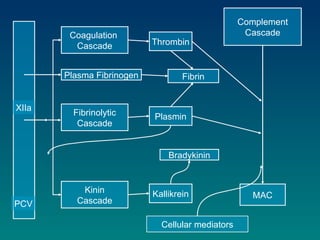
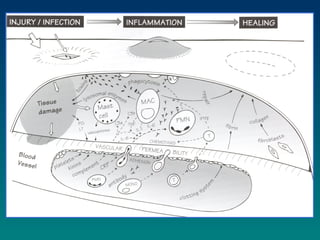
Coagulation  Cascade Fibrinolytic Cascade Kinin Cascade Thrombin Plasmin Kallikrein Plasma Fibrinogen Complement Cascade MAC Bradykinin Fibrin XIIa PCV Cellular mediators
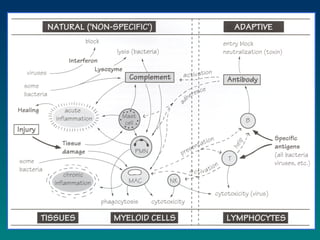
Immunology Natural (‘innate’) immune system Skin, tears, saliva, mucus, acids Property of all living creatures Adaptive (‘acquired’) immune system Specialist cells, cytokines, antibodies Specific and has ‘memory’ Specialised mucosal lymphoid tissue


INTRODUCTION Immunogenicity  is the capacity to induce an immune response by foreign, complex, high molecular weight compounds Antigenicity  is the ability to bind to Ig or immune cells; an immune response need not result Haptens
INTRODUCTION Epitopes aka antigenic determinants Immunological cross-reactivity the sharing of epitopes by different substances toxoids & immunisation
THE INNATE IMMUNE SYSTEM Synonyms are the  natural  or  native  immune system Rapidly mobilised first line of defence Not dependent on prior exposure to a foreign invader Non-specific May not be sufficient to prevent foreign material persisting in the host
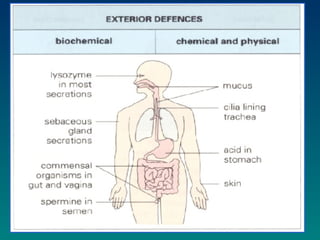
THE INNATE IMMUNE SYSTEM Innate immunity comprises: physicochemical barriers molecules normally present in body fluids e.g. lysozyme, complement, antiproteases phagocytic & cytotoxic cells such as neutrophils, macrophages, natural killer cells
 
THE INNATE IMMUNE SYSTEM The “Respiratory Burst” aka the “oxidative burst” membrane-bound NADPH system produces superoxide radicals hyperchlorous acid H 2 O 2 chloramines
THE INNATE IMMUNE SYSTEM A reliable means of protecting the host in the first instance against many extracellular organisms It is a property of every living organism Unable to deal with all intracellular organisms (e.g protozoa, viruses & certain bacteria are not killed)
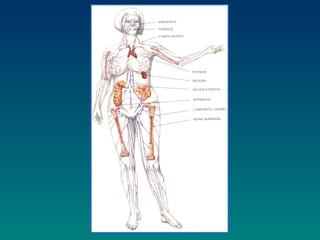
THE ACQUIRED IMMUNE SYSTEM Specific & has immunologic memory Dedicated immune cells - the lymphoid cells (lymphocytes) Molecules that specifically counteract antigens (antibodies or immunoglobulins) Specific immune systems associated with barrier surfaces e.g. MALT, GALT Lymphocyte secreted cytokines
T-LYMPHOCYTES Cell-mediated immunity especially intracellular organisms, protozoa & fungi Graft rejection Immune surveillance of neoplasia 70-80% of total lymphocytes Long-lived memory cells Activity is by cytokine production
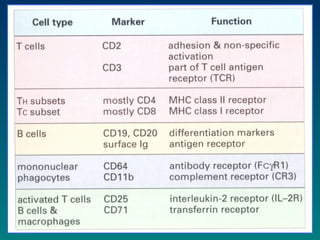
T-LYMPHOCYTES T h  - CD4+: Respond to antigen in association with MHC Class II T c  - CD8+: Respond to antigen presented via MHC Class I Antigen MUST be peptide T dth T s
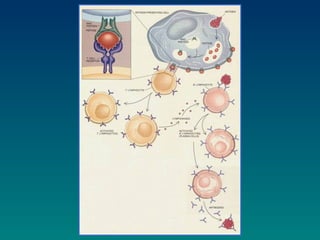
T-LYMPHOCYTES CD4+ cells recognize antigens that have been taken up by antigen presenting cells which present antigen fragments on the cell surface CD8+ cells recognise cells infected with virus, which they then kill
T-LYMPHOCYTES CD4 (T h ) cells interact directly with other cells by releasing cytokines to control development of the immune response Two types of T h  cell T h -1 cells activate macrophages to destroy material phagocytosed T h -2 cells help B-cells make antibody
B-LYMPHOCYTES Specialised for the production of immunoglobulins after differentiation into plasma cells Controls pyogenic bacteria Prevents blood-borne infections Neutralise toxins 12% of total lymphocytes
B-LYMPHOCYTES Can respond to peptide, carbohydrate & glycolipids Usually require T-cell help to respond to antigen (interleukins) but can also recognise antigen directly through surface Ig B cells mature & proliferate in lymph nodes
B-LYMPHOCYTES B-cells process & present antigen via surface MHC class II Responses are antigen-specific but effects are not specific - mainly via complement
IMMUNOGLOBULINS The 5 classes of Ig are: IgM IgA IgD IgG IgE
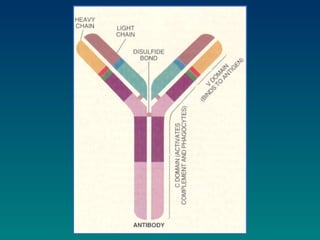
IMMUNOGLOBULINS 4-chain structure 2 light chains 2 heavy chains Chains linked by disulphide bonds Chains are coiled into “domains” 110 amino acids stabilised by intrachain disulphide bond
 
IMMUNOGLOBULINS Terminal regions of H & L chains are the variable regions The variable region is the site where Ig combines with antigen This region’s variability is responsible for wide range of antigen specificity
IMMUNOGLOBULINS The other domains are the constant regions which are similar within isotypes of Ig Using enzymes, a number of Ig fragments have been identified. Important ones are: F ab F c
IMMUNOGLOBULINS F c  regions formed from H chains & determine isotype & so biological function Hinge region also has effect on function These functions are distinct from antigen binding
IMMUNOGLOBULINS IgG neutralises toxins activates complement opsonisation able to cross placenta (only Ig that can)
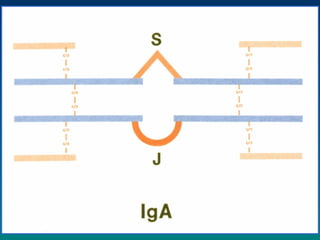
IMMUNOGLOBULINS IgA monomeric & dimeric forms dimeric = “secretory IgA” - found in secretions important antiviral Ig
 
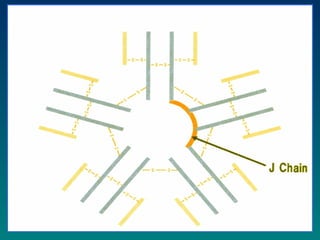
IMMUNOGLOBULINS IgM pentameric good agglutinator good at activating complement
 
IMMUNOGLOBULINS IgD true function unknown appears to be involved in B-cell differentiation
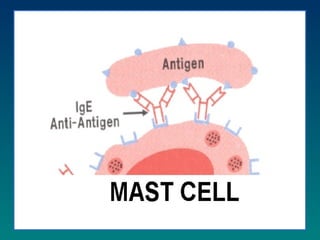
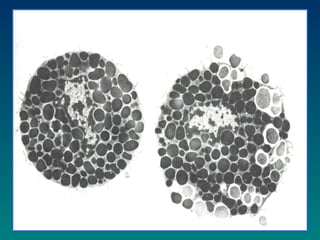
IMMUNOGLOBULINS IgE parasitic infections F c  portion binds to mast cells triggers mast cell degranulation
 
 
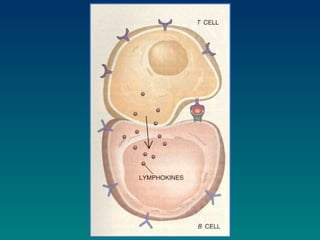
T- & B-LYMPHOCYTES T- & B-cells recognise the antigen, proliferate in response to it, & migrate back to the site of injury There they release cytokines that attract effector cells (cytotoxic T-cells, activated macrophages, committed B-cells)
 
THE ACQUIRED IMMUNE SYSTEM CD System WBCs are distinguished according to groups of molecules they express on their surfaces - mostly “CD” molecules >130 CD molecules identified may be lineage specific or shared between different cell types may only appear during cell development or only when activated
 
THE ACQUIRED IMMUNE SYSTEM MHC expression Class I molecules expressed on all nucleated cells Class II molecules expressed on a small group of antigen presenting cells Class II molecules may also be induced to be expressed on other cells during immune reactions by interferon- 
THE ACQUIRED IMMUNE SYSTEM Cytokines are short-range, multifunctional, short-acting mediators of cellular activities, especially within the immune system Released primarily by activated T-cells & other immune and non-immune cells.
THE ACQUIRED IMMUNE SYSTEM There are 4 major classes of cytokines interleukins (IL-1 to IL-12) interferons (IF-  , IF-   & IF-  ) colony stimulating factors (CSFs) tumour necrosis factors (TNF-   & TNF-  )
NATURAL KILLER CELLS Natural Killer (NK) cells: classed as part of the lymphoid system but have no differentiating surface markers they are particularly effective against virus-infected & tumour cells also called large granular lymphocytes
ANTIGEN PRESENTING CELLS Examples of APCs are: macrophages B-cells dendritic cells Macrophages & B-cells recognise antigen through the Ig molecule Dendritic cells process & present antigen to naïve T-cells via MHC Class II
THE ACQUIRED IMMUNE SYSTEM Macrophages long-lived widespread distribution they express receptors for Ig & activated complement components which they use to take up immune complexes
ANTIGEN PRESENTING CELLS Antigen Presenting Cells (APCs): normally, initiation of the acquired immune response does not take place at the site of injury or penetration of foreign organisms antigen is taken up by APCs at the site of inflammation & transported to regional lymph nodes &/or spleen where it is presented to T- & B-cells
 
THE ACQUIRED IMMUNE SYSTEM Macrophages & B-cells are involved in the perpetuation of the immune response  Dendritic cells are implicated in the initiation of the immune response
THE ACQUIRED IMMUNE SYSTEM Antigen specificity is the single most important aspect of the acquired immune system (mediated by lymphocytes) Each clone of a lymphoid cell responds only to a single antigen T-cells deal with surface bound antigen (usually cell associated) B-cells deal with soluble (extracellular) antigen
THE ACQUIRED IMMUNE SYSTEM Specific immunity is termed humoral when antibodies are involved in removing the antigen It is termed cell-mediated when T-cells & macrophages are involved
 
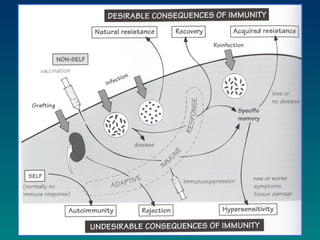
THE ACQUIRED IMMUNE SYSTEM Immunity after infection is termed active immunity (because the host has responded actively to the stimulus) Immunity may be transferred passively by antibodies or cells (breast milk, vaccination) Vaccination may be passive (using Ig) or active (using antigen or attenuated organism)
THE ACQUIRED IMMUNE SYSTEM The development of acquired immunity begins with a  primary immune response : an afferent phase involving APCs T-cell  transformation  from a resting to an active state an effector phase - induction of other cells (B-cells & macrophages) by active T-cells
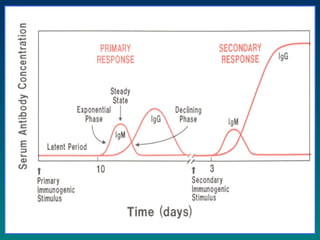
THE ACQUIRED IMMUNE SYSTEM The primary immune response is accompanied by the appearance of antigen-specific T-cells & Ig-secreting B-cells The  secondary immune response : on second (& subsequent) exposure to the same antigen, antigen-specific memory T- & B-cells are recruited much sooner & more efficiently Ig levels are consequently much higher
 
INNATE & ACQUIRED IMMUNITY Extracellular foreign antigen is normally cleared by the innate immune system, with some assistance from B-cell activity Intracellular foreign antigen is handled by the acquired immune system in which self & foreign antigen are jointly recognised All cellular defence mechanisms involve interactions of cell surface molecules (receptors) with complementary molecules (ligands)
COMPLEMENT The complement system  comprises at least 9 plasma proteins & some regulatory factors, that mediate several functions of the inflammatory process synthesised by macrophages or hepatocytes usually circulate as inactive proenzymes heat labile (c.f. Ig is heat stable)
COMPLEMENT Complement pathways Cascade of sequential activation converts each proenzyme into its active state & amplifies the response. Two main pathways: “ Classical” pathway - bound IgG, IgM “ Alternative” pathway - certain antigens (LPS, endotoxin, IC)
COMPLEMENT Functions opsonisation, chemotaxis, immune adherence (MAC) acceleration of acute inflammation immune cytolysis virus neutralisation
 

Basic Immunology

  • 1.
    Basic Immunology DrRussell Watkins
  • 2.
  • 3.
  • 4.
  • 5.
    INTRODUCTION Immunology is the study of host defence mechanisms. Immunity is the ability of the host to protect itself against foreign organisms. The immune system comprises the tissues, cells & molecules which mount the immune response .
  • 6.
    Coagulation CascadeFibrinolytic Cascade Kinin Cascade Thrombin Plasmin Kallikrein Plasma Fibrinogen Complement Cascade MAC Bradykinin Fibrin XIIa PCV Cellular mediators
  • 7.
    Immunology Natural (‘innate’)immune system Skin, tears, saliva, mucus, acids Property of all living creatures Adaptive (‘acquired’) immune system Specialist cells, cytokines, antibodies Specific and has ‘memory’ Specialised mucosal lymphoid tissue
  • 8.
  • 9.
  • 10.
  • 11.
    INTRODUCTION Immunogenicity is the capacity to induce an immune response by foreign, complex, high molecular weight compounds Antigenicity is the ability to bind to Ig or immune cells; an immune response need not result Haptens
  • 12.
    INTRODUCTION Epitopes akaantigenic determinants Immunological cross-reactivity the sharing of epitopes by different substances toxoids & immunisation
  • 13.
    THE INNATE IMMUNESYSTEM Synonyms are the natural or native immune system Rapidly mobilised first line of defence Not dependent on prior exposure to a foreign invader Non-specific May not be sufficient to prevent foreign material persisting in the host
  • 14.
    THE INNATE IMMUNESYSTEM Innate immunity comprises: physicochemical barriers molecules normally present in body fluids e.g. lysozyme, complement, antiproteases phagocytic & cytotoxic cells such as neutrophils, macrophages, natural killer cells
  • 15.
  • 16.
    THE INNATE IMMUNESYSTEM The “Respiratory Burst” aka the “oxidative burst” membrane-bound NADPH system produces superoxide radicals hyperchlorous acid H 2 O 2 chloramines
  • 17.
    THE INNATE IMMUNESYSTEM A reliable means of protecting the host in the first instance against many extracellular organisms It is a property of every living organism Unable to deal with all intracellular organisms (e.g protozoa, viruses & certain bacteria are not killed)
  • 18.
    THE ACQUIRED IMMUNESYSTEM Specific & has immunologic memory Dedicated immune cells - the lymphoid cells (lymphocytes) Molecules that specifically counteract antigens (antibodies or immunoglobulins) Specific immune systems associated with barrier surfaces e.g. MALT, GALT Lymphocyte secreted cytokines
  • 19.
    T-LYMPHOCYTES Cell-mediated immunityespecially intracellular organisms, protozoa & fungi Graft rejection Immune surveillance of neoplasia 70-80% of total lymphocytes Long-lived memory cells Activity is by cytokine production
  • 20.
    T-LYMPHOCYTES T h - CD4+: Respond to antigen in association with MHC Class II T c - CD8+: Respond to antigen presented via MHC Class I Antigen MUST be peptide T dth T s
  • 21.
    T-LYMPHOCYTES CD4+ cellsrecognize antigens that have been taken up by antigen presenting cells which present antigen fragments on the cell surface CD8+ cells recognise cells infected with virus, which they then kill
  • 22.
    T-LYMPHOCYTES CD4 (Th ) cells interact directly with other cells by releasing cytokines to control development of the immune response Two types of T h cell T h -1 cells activate macrophages to destroy material phagocytosed T h -2 cells help B-cells make antibody
  • 23.
    B-LYMPHOCYTES Specialised forthe production of immunoglobulins after differentiation into plasma cells Controls pyogenic bacteria Prevents blood-borne infections Neutralise toxins 12% of total lymphocytes
  • 24.
    B-LYMPHOCYTES Can respondto peptide, carbohydrate & glycolipids Usually require T-cell help to respond to antigen (interleukins) but can also recognise antigen directly through surface Ig B cells mature & proliferate in lymph nodes
  • 25.
    B-LYMPHOCYTES B-cells process& present antigen via surface MHC class II Responses are antigen-specific but effects are not specific - mainly via complement
  • 26.
    IMMUNOGLOBULINS The 5classes of Ig are: IgM IgA IgD IgG IgE
  • 27.
    IMMUNOGLOBULINS 4-chain structure2 light chains 2 heavy chains Chains linked by disulphide bonds Chains are coiled into “domains” 110 amino acids stabilised by intrachain disulphide bond
  • 28.
  • 29.
    IMMUNOGLOBULINS Terminal regionsof H & L chains are the variable regions The variable region is the site where Ig combines with antigen This region’s variability is responsible for wide range of antigen specificity
  • 30.
    IMMUNOGLOBULINS The otherdomains are the constant regions which are similar within isotypes of Ig Using enzymes, a number of Ig fragments have been identified. Important ones are: F ab F c
  • 31.
    IMMUNOGLOBULINS F c regions formed from H chains & determine isotype & so biological function Hinge region also has effect on function These functions are distinct from antigen binding
  • 32.
    IMMUNOGLOBULINS IgG neutralisestoxins activates complement opsonisation able to cross placenta (only Ig that can)
  • 33.
    IMMUNOGLOBULINS IgA monomeric& dimeric forms dimeric = “secretory IgA” - found in secretions important antiviral Ig
  • 34.
  • 35.
    IMMUNOGLOBULINS IgM pentamericgood agglutinator good at activating complement
  • 36.
  • 37.
    IMMUNOGLOBULINS IgD truefunction unknown appears to be involved in B-cell differentiation
  • 38.
    IMMUNOGLOBULINS IgE parasiticinfections F c portion binds to mast cells triggers mast cell degranulation
  • 39.
  • 40.
  • 41.
    T- & B-LYMPHOCYTEST- & B-cells recognise the antigen, proliferate in response to it, & migrate back to the site of injury There they release cytokines that attract effector cells (cytotoxic T-cells, activated macrophages, committed B-cells)
  • 42.
  • 43.
    THE ACQUIRED IMMUNESYSTEM CD System WBCs are distinguished according to groups of molecules they express on their surfaces - mostly “CD” molecules >130 CD molecules identified may be lineage specific or shared between different cell types may only appear during cell development or only when activated
  • 44.
  • 45.
    THE ACQUIRED IMMUNESYSTEM MHC expression Class I molecules expressed on all nucleated cells Class II molecules expressed on a small group of antigen presenting cells Class II molecules may also be induced to be expressed on other cells during immune reactions by interferon- 
  • 46.
    THE ACQUIRED IMMUNESYSTEM Cytokines are short-range, multifunctional, short-acting mediators of cellular activities, especially within the immune system Released primarily by activated T-cells & other immune and non-immune cells.
  • 47.
    THE ACQUIRED IMMUNESYSTEM There are 4 major classes of cytokines interleukins (IL-1 to IL-12) interferons (IF-  , IF-  & IF-  ) colony stimulating factors (CSFs) tumour necrosis factors (TNF-  & TNF-  )
  • 48.
    NATURAL KILLER CELLSNatural Killer (NK) cells: classed as part of the lymphoid system but have no differentiating surface markers they are particularly effective against virus-infected & tumour cells also called large granular lymphocytes
  • 49.
    ANTIGEN PRESENTING CELLSExamples of APCs are: macrophages B-cells dendritic cells Macrophages & B-cells recognise antigen through the Ig molecule Dendritic cells process & present antigen to naïve T-cells via MHC Class II
  • 50.
    THE ACQUIRED IMMUNESYSTEM Macrophages long-lived widespread distribution they express receptors for Ig & activated complement components which they use to take up immune complexes
  • 51.
    ANTIGEN PRESENTING CELLSAntigen Presenting Cells (APCs): normally, initiation of the acquired immune response does not take place at the site of injury or penetration of foreign organisms antigen is taken up by APCs at the site of inflammation & transported to regional lymph nodes &/or spleen where it is presented to T- & B-cells
  • 52.
  • 53.
    THE ACQUIRED IMMUNESYSTEM Macrophages & B-cells are involved in the perpetuation of the immune response Dendritic cells are implicated in the initiation of the immune response
  • 54.
    THE ACQUIRED IMMUNESYSTEM Antigen specificity is the single most important aspect of the acquired immune system (mediated by lymphocytes) Each clone of a lymphoid cell responds only to a single antigen T-cells deal with surface bound antigen (usually cell associated) B-cells deal with soluble (extracellular) antigen
  • 55.
    THE ACQUIRED IMMUNESYSTEM Specific immunity is termed humoral when antibodies are involved in removing the antigen It is termed cell-mediated when T-cells & macrophages are involved
  • 56.
  • 57.
    THE ACQUIRED IMMUNESYSTEM Immunity after infection is termed active immunity (because the host has responded actively to the stimulus) Immunity may be transferred passively by antibodies or cells (breast milk, vaccination) Vaccination may be passive (using Ig) or active (using antigen or attenuated organism)
  • 58.
    THE ACQUIRED IMMUNESYSTEM The development of acquired immunity begins with a primary immune response : an afferent phase involving APCs T-cell transformation from a resting to an active state an effector phase - induction of other cells (B-cells & macrophages) by active T-cells
  • 59.
    THE ACQUIRED IMMUNESYSTEM The primary immune response is accompanied by the appearance of antigen-specific T-cells & Ig-secreting B-cells The secondary immune response : on second (& subsequent) exposure to the same antigen, antigen-specific memory T- & B-cells are recruited much sooner & more efficiently Ig levels are consequently much higher
  • 60.
  • 61.
    INNATE & ACQUIREDIMMUNITY Extracellular foreign antigen is normally cleared by the innate immune system, with some assistance from B-cell activity Intracellular foreign antigen is handled by the acquired immune system in which self & foreign antigen are jointly recognised All cellular defence mechanisms involve interactions of cell surface molecules (receptors) with complementary molecules (ligands)
  • 62.
    COMPLEMENT The complementsystem comprises at least 9 plasma proteins & some regulatory factors, that mediate several functions of the inflammatory process synthesised by macrophages or hepatocytes usually circulate as inactive proenzymes heat labile (c.f. Ig is heat stable)
  • 63.
    COMPLEMENT Complement pathwaysCascade of sequential activation converts each proenzyme into its active state & amplifies the response. Two main pathways: “ Classical” pathway - bound IgG, IgM “ Alternative” pathway - certain antigens (LPS, endotoxin, IC)
  • 64.
    COMPLEMENT Functions opsonisation,chemotaxis, immune adherence (MAC) acceleration of acute inflammation immune cytolysis virus neutralisation
  • 65.