ANTIBODIES
PRESENTED BY,
S.SHRUTHI
III BSc.CLT
DR.N.G.P ARTS AND SCIENCE COLLEGE
DEPARTMENT OF CLINICAL LAB TECHNOLOGY
WHAT ARE ANTIBODIES?
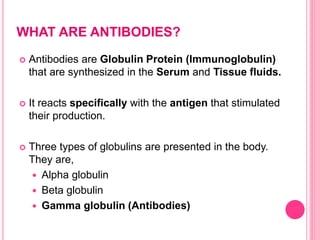
 Antibodies are Globulin Protein (Immunoglobulin)
that are synthesized in the Serum and Tissue fluids.
 It reacts specifically with the antigen that stimulated
their production.
 Three types of globulins are presented in the body.
They are,
 Alpha globulin
 Beta globulin
 Gamma globulin (Antibodies)
HISTORY
 Von Behring & Kitasato performed the first experiment that
proved the physical existence of Abs in 1890.
 Tizzoni & Cattani in 1891 named the Abs as Antitoxin – an
unknown substance present in the serum that provided
protection.
 Experimental works by Paul Ehrlich & Jules Bordet
demonstrated that a protective response could be generated
even against whole cells.
 Tiselius & Kabat accomplished the first attempt to identify
antibody molecules in 1939.
 Rodney Porter in 1959 proposed the basic structure of
Immunoglobulin.
The most important function of the Abs
are to confer protection against microbial pathogens.
Abs confer protection in the following ways:
 They prevent the attachment of microbes to mucosal
surface of the host.
 They reduce the virulence of microbes by neutralizing
the toxins and viruses.
 They facilitate the phagocytosis by opsonization of
microbes,
 They activate complement, leading to complement-
mediated activities against microbes
IMMUNOGLOBULINS
 The World Health Organization (WHO) in the year 1964
coined the term Immunoglobulin (Ig) for the term
antibody.
 The immunoglobulins not only includes the antibody
globulins but also the,
 Cryoglobulins
 Macroglobulins
 Abnormal myeloma proteins
Immunoglobulins are immunologically active
serum proteins
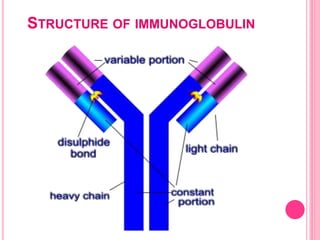
STRUCTURE OF IMMUNOGLOBULIN
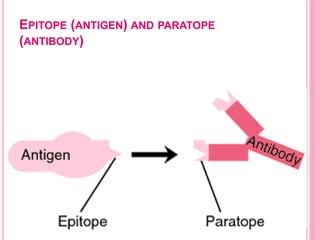
EPITOPE (ANTIGEN) AND PARATOPE
(ANTIBODY)
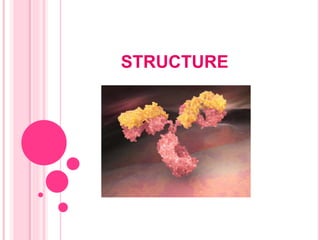
STRUCTURE
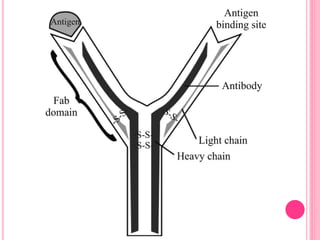
 Immunoglobulin is a glycoprotein.
 It is an Y or T shaped molecule.
 It is made up of 4 polypeptide chain.
 Of these, 2 chains are short chains, also called as Light
chains. (L – Chain) they are identical.
 The other two are longer chains, called as Heavy chain.
(H - Chain) they are also identical.
 Each light chain is made of 214 Amino Acids.
Each heavy chain is made up of 450 – 700 Amino
Acids.
There are two types of light chains, named as,
 Kappa (k) chain - K type (60%)
 Lambda (λ) chain - L type (40%)
Heavy chains are of 5 types. They are;
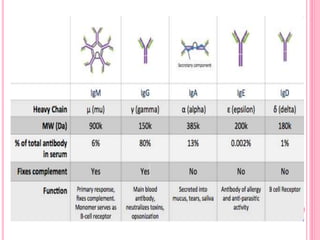
 Gamma () - IgG
 Alpha () - IgA
 Mu () - IgM
 Delta () - IgD
 Epsilon () - IgE
 One end of chain is called as Amino acid terminal end
or N - terminal end.
 Other end is called as Carboxy terminal end or C -
terminal end.
 The four chains are interconnected by Interchain
disulfide bonds. The two heavy chains are linked by 1
– 13 interchain disulfide bonds. Each light chain is
linked to heavy chain by a single interchain disulfide
bond.
 The light chain has 2 intrachain disulfide bonds and
the heavy chain has 4 intrachain disulfide bonds.
 The immunoglobulin consists of two regions, namely a
Variable region (V - Region) and
Constant region (C - region).
 In the constant region, the amino acid sequence remains
constant in most of the immunoglobulins. In the variable
region, the amino acid sequence shows variability.
 The variable region is located at the extremity, in the N –
Terminal end, constant region in the C – Terminal end.
 Based on the function aspect, two regions can be
recognized in the immunoglobulin. Fab & Fc.
PROPERTIES OF IMMUNOGLOBULINS
 They have definite sedimentation coefficient.
 The molecular weight ranges from 15,0000 to 950000.
 Typically an immunoglobulin molecule is made up of 4
polypeptide chains. Of which 2 are light chains and
remaining two are heavy chains.
 The valency for antigen binding varies from 2 to 10.
 The carbohydrate content varies from 3% to 12%.
 They contain disulfide bonds.
 They agglutinate antigens.
 They form precipitate with antigens.
 They cross placenta (IgG).
 They have reaginic activity (IgE).
 They are involved in complement fixation (IgG & IgM).
 They fix macrophages (IgG).
 They fix mast and basophils cells (IgG).
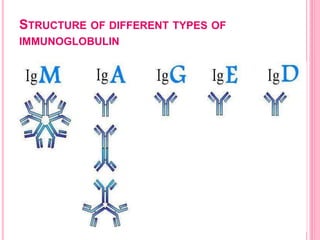
STRUCTURE OF DIFFERENT TYPES OF
IMMUNOGLOBULIN
ANTIGEN – ANTIBODY
REACTION
DEFINITION
The binding of an antibody with an antigen of
the type that stimulated the formation of antibody that
results in the following reaction
 Agglutination
 Precipitation
 Complement fixation
 Phagocytosis
 Neutralization of an exotoxin
 Opsonization
 Tissue fixation
 Chemotaxis
 Activation of mast cells and basophils
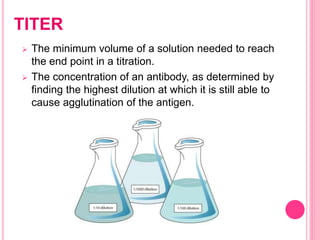
TITER
 The minimum volume of a solution needed to reach
the end point in a titration.
 The concentration of an antibody, as determined by
finding the highest dilution at which it is still able to
cause agglutination of the antigen.
FACTORS THAT AFFECT ANTIGEN-
ANTIBODY REACTION
 pH
 Salt concentration
 Temperature
 Concentration of antigen and antibody
 Affinity and avidity of the antibody
AGGLUTINATION
 When antibodies are mixed with their corresponding
antigens on the surface of large, easily sedimented
particles such as animal cells, erythrocytes, or bacteria, the
antibodies cross-link the particles, forming visible clumps.
This reaction is termed as Agglutination.
 The antibodies that cause agglutination is called as
Agglutinins, and the particulate antigens aggregate are
called as Agglutinogen.
 Patterns of agglutination are the following:
 Direct microbial agglutination
 Latex agglutination
 Hemagglutination
 Microbial hemagglutination
 Passive hemagglutination
APPLICATION OF AGGLUTINATION TEST
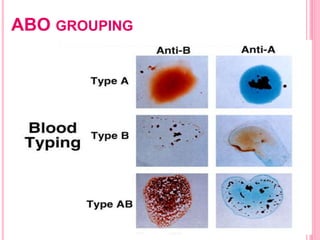
 Blood Typing
 Rh Typing
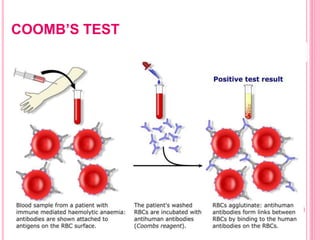
 Coomb’s Test
 Diagnosis of bacterial infection.
Ex: typhoid fever (Widal test), Brucellosis, leptopspirosis
 Diagnosis of viral infections (Haemagglutination)
Ex: Diarrhea caused by Rota virus.
 Diagnosis of protozoal infection.
Ex: Toxoplasmosis.
 Diagnosis of some autoimmune diseases.
Ex: Rheumatoid factor, Systemic Lupus Erythematosus
(SLE).
SLIDE AGGLUTINATION (QUALITATIVE TEST)
 Bring the test reagents and samples to room
temperature.
 Resuspend the antigens in the vial gently.
 Place 5 μl of the serum into a row on the card. Place 1
drop of +ev & -ev controls.
 Add 1 drop of each antigens next to the drops of serum.
 Mix the antigens and serum sample with stirrer/
applicator stick.
 Rock the slide gently by hand for 1 min.
 Observe the agglutination under light source.
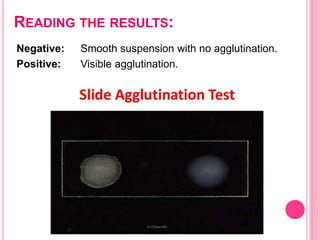
READING THE RESULTS:
Negative: Smooth suspension with no agglutination.
Positive: Visible agglutination.
ABO GROUPING
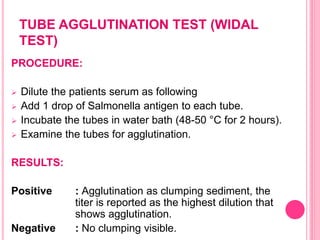
TUBE AGGLUTINATION TEST (WIDAL
TEST)
PROCEDURE:
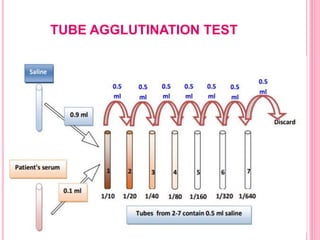
 Dilute the patients serum as following
 Add 1 drop of Salmonella antigen to each tube.
 Incubate the tubes in water bath (48-50 °C for 2 hours).
 Examine the tubes for agglutination.
RESULTS:
Positive : Agglutination as clumping sediment, the
titer is reported as the highest dilution that
shows agglutination.
Negative : No clumping visible.
TUBE AGGLUTINATION TEST
COOMB’S TEST
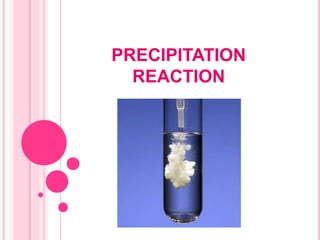
PRECIPITATION
REACTION
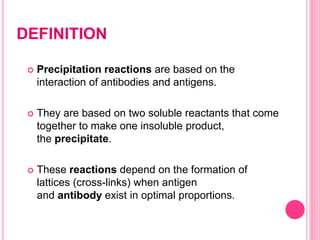
DEFINITION
 Precipitation reactions are based on the
interaction of antibodies and antigens.
 They are based on two soluble reactants that come
together to make one insoluble product,
the precipitate.
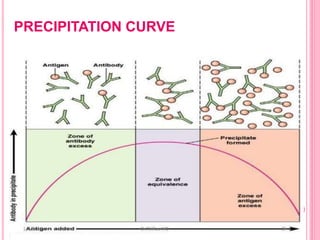
 These reactions depend on the formation of
lattices (cross-links) when antigen
and antibody exist in optimal proportions.
PRECIPITATION CURVE
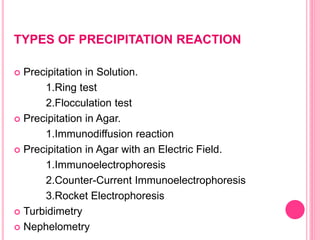
TYPES OF PRECIPITATION REACTION
 Precipitation in Solution.
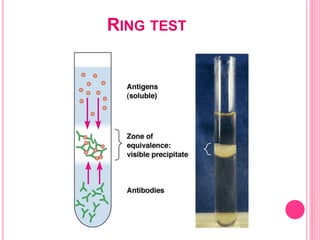
1.Ring test
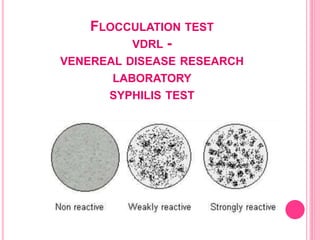
2.Flocculation test
 Precipitation in Agar.
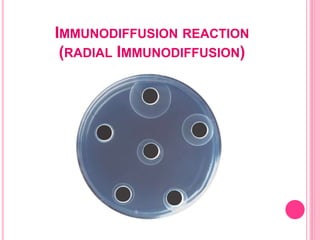
1.Immunodiffusion reaction
 Precipitation in Agar with an Electric Field.
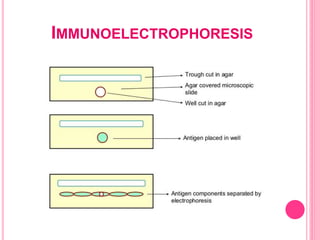
1.Immunoelectrophoresis
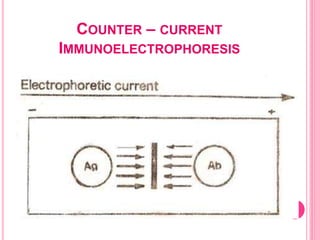
2.Counter-Current Immunoelectrophoresis
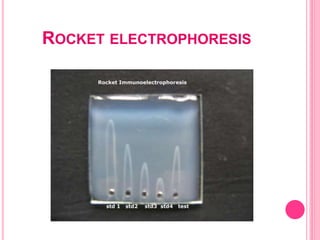
3.Rocket Electrophoresis
 Turbidimetry
 Nephelometry
RING TEST
FLOCCULATION TEST
VDRL -
VENEREAL DISEASE RESEARCH
LABORATORY
SYPHILIS TEST
IMMUNODIFFUSION REACTION
(RADIAL IMMUNODIFFUSION)
IMMUNOELECTROPHORESIS
COUNTER – CURRENT
IMMUNOELECTROPHORESIS
ROCKET ELECTROPHORESIS
THANK YOU!

Antibodies

  • 1.
    ANTIBODIES PRESENTED BY, S.SHRUTHI III BSc.CLT DR.N.G.PARTS AND SCIENCE COLLEGE DEPARTMENT OF CLINICAL LAB TECHNOLOGY
  • 2.
    WHAT ARE ANTIBODIES? Antibodies are Globulin Protein (Immunoglobulin) that are synthesized in the Serum and Tissue fluids.  It reacts specifically with the antigen that stimulated their production.  Three types of globulins are presented in the body. They are,  Alpha globulin  Beta globulin  Gamma globulin (Antibodies)
  • 3.
    HISTORY  Von Behring& Kitasato performed the first experiment that proved the physical existence of Abs in 1890.  Tizzoni & Cattani in 1891 named the Abs as Antitoxin – an unknown substance present in the serum that provided protection.  Experimental works by Paul Ehrlich & Jules Bordet demonstrated that a protective response could be generated even against whole cells.  Tiselius & Kabat accomplished the first attempt to identify antibody molecules in 1939.  Rodney Porter in 1959 proposed the basic structure of Immunoglobulin.
  • 4.
    The most importantfunction of the Abs are to confer protection against microbial pathogens. Abs confer protection in the following ways:  They prevent the attachment of microbes to mucosal surface of the host.  They reduce the virulence of microbes by neutralizing the toxins and viruses.  They facilitate the phagocytosis by opsonization of microbes,  They activate complement, leading to complement- mediated activities against microbes
  • 5.
    IMMUNOGLOBULINS  The WorldHealth Organization (WHO) in the year 1964 coined the term Immunoglobulin (Ig) for the term antibody.  The immunoglobulins not only includes the antibody globulins but also the,  Cryoglobulins  Macroglobulins  Abnormal myeloma proteins Immunoglobulins are immunologically active serum proteins
  • 6.
  • 8.
    EPITOPE (ANTIGEN) ANDPARATOPE (ANTIBODY)
  • 9.
  • 10.
     Immunoglobulin isa glycoprotein.  It is an Y or T shaped molecule.  It is made up of 4 polypeptide chain.  Of these, 2 chains are short chains, also called as Light chains. (L – Chain) they are identical.  The other two are longer chains, called as Heavy chain. (H - Chain) they are also identical.  Each light chain is made of 214 Amino Acids. Each heavy chain is made up of 450 – 700 Amino Acids.
  • 11.
    There are twotypes of light chains, named as,  Kappa (k) chain - K type (60%)  Lambda (λ) chain - L type (40%) Heavy chains are of 5 types. They are;  Gamma () - IgG  Alpha () - IgA  Mu () - IgM  Delta () - IgD  Epsilon () - IgE
  • 12.
     One endof chain is called as Amino acid terminal end or N - terminal end.  Other end is called as Carboxy terminal end or C - terminal end.  The four chains are interconnected by Interchain disulfide bonds. The two heavy chains are linked by 1 – 13 interchain disulfide bonds. Each light chain is linked to heavy chain by a single interchain disulfide bond.  The light chain has 2 intrachain disulfide bonds and the heavy chain has 4 intrachain disulfide bonds.
  • 13.
     The immunoglobulinconsists of two regions, namely a Variable region (V - Region) and Constant region (C - region).  In the constant region, the amino acid sequence remains constant in most of the immunoglobulins. In the variable region, the amino acid sequence shows variability.  The variable region is located at the extremity, in the N – Terminal end, constant region in the C – Terminal end.  Based on the function aspect, two regions can be recognized in the immunoglobulin. Fab & Fc.
  • 14.
    PROPERTIES OF IMMUNOGLOBULINS They have definite sedimentation coefficient.  The molecular weight ranges from 15,0000 to 950000.  Typically an immunoglobulin molecule is made up of 4 polypeptide chains. Of which 2 are light chains and remaining two are heavy chains.  The valency for antigen binding varies from 2 to 10.
  • 15.
     The carbohydratecontent varies from 3% to 12%.  They contain disulfide bonds.  They agglutinate antigens.  They form precipitate with antigens.  They cross placenta (IgG).  They have reaginic activity (IgE).  They are involved in complement fixation (IgG & IgM).  They fix macrophages (IgG).  They fix mast and basophils cells (IgG).
  • 16.
    STRUCTURE OF DIFFERENTTYPES OF IMMUNOGLOBULIN
  • 18.
  • 19.
    DEFINITION The binding ofan antibody with an antigen of the type that stimulated the formation of antibody that results in the following reaction  Agglutination  Precipitation  Complement fixation  Phagocytosis  Neutralization of an exotoxin  Opsonization  Tissue fixation  Chemotaxis  Activation of mast cells and basophils
  • 20.
    TITER  The minimumvolume of a solution needed to reach the end point in a titration.  The concentration of an antibody, as determined by finding the highest dilution at which it is still able to cause agglutination of the antigen.
  • 21.
    FACTORS THAT AFFECTANTIGEN- ANTIBODY REACTION  pH  Salt concentration  Temperature  Concentration of antigen and antibody  Affinity and avidity of the antibody
  • 22.
  • 23.
     When antibodiesare mixed with their corresponding antigens on the surface of large, easily sedimented particles such as animal cells, erythrocytes, or bacteria, the antibodies cross-link the particles, forming visible clumps. This reaction is termed as Agglutination.  The antibodies that cause agglutination is called as Agglutinins, and the particulate antigens aggregate are called as Agglutinogen.  Patterns of agglutination are the following:  Direct microbial agglutination  Latex agglutination  Hemagglutination  Microbial hemagglutination  Passive hemagglutination
  • 24.
    APPLICATION OF AGGLUTINATIONTEST  Blood Typing  Rh Typing  Coomb’s Test  Diagnosis of bacterial infection. Ex: typhoid fever (Widal test), Brucellosis, leptopspirosis  Diagnosis of viral infections (Haemagglutination) Ex: Diarrhea caused by Rota virus.  Diagnosis of protozoal infection. Ex: Toxoplasmosis.  Diagnosis of some autoimmune diseases. Ex: Rheumatoid factor, Systemic Lupus Erythematosus (SLE).
  • 25.
    SLIDE AGGLUTINATION (QUALITATIVETEST)  Bring the test reagents and samples to room temperature.  Resuspend the antigens in the vial gently.  Place 5 μl of the serum into a row on the card. Place 1 drop of +ev & -ev controls.  Add 1 drop of each antigens next to the drops of serum.  Mix the antigens and serum sample with stirrer/ applicator stick.  Rock the slide gently by hand for 1 min.  Observe the agglutination under light source.
  • 26.
    READING THE RESULTS: Negative:Smooth suspension with no agglutination. Positive: Visible agglutination.
  • 27.
  • 28.
    TUBE AGGLUTINATION TEST(WIDAL TEST) PROCEDURE:  Dilute the patients serum as following  Add 1 drop of Salmonella antigen to each tube.  Incubate the tubes in water bath (48-50 °C for 2 hours).  Examine the tubes for agglutination. RESULTS: Positive : Agglutination as clumping sediment, the titer is reported as the highest dilution that shows agglutination. Negative : No clumping visible.
  • 29.
  • 30.
  • 31.
  • 32.
    DEFINITION  Precipitation reactionsare based on the interaction of antibodies and antigens.  They are based on two soluble reactants that come together to make one insoluble product, the precipitate.  These reactions depend on the formation of lattices (cross-links) when antigen and antibody exist in optimal proportions.
  • 33.
  • 34.
    TYPES OF PRECIPITATIONREACTION  Precipitation in Solution. 1.Ring test 2.Flocculation test  Precipitation in Agar. 1.Immunodiffusion reaction  Precipitation in Agar with an Electric Field. 1.Immunoelectrophoresis 2.Counter-Current Immunoelectrophoresis 3.Rocket Electrophoresis  Turbidimetry  Nephelometry
  • 35.
  • 36.
    FLOCCULATION TEST VDRL - VENEREALDISEASE RESEARCH LABORATORY SYPHILIS TEST
  • 37.
  • 38.
  • 39.
  • 40.
  • 41.