Severe Combined Immunodeficiency
       (bubble boy disease)


                      Presented
                         By
                   SUBASH SAPKOTA
CONTENTS

Introduction
Types of SCID
Symptoms and diagnosis of
  SCID
Treatment for SCID
Transplant for SCID
References
Introduction


 Severe combined immunodeficiency (SCID), is a
  genetic disorder in which both "arms" (B cells and T
  cells) of the adaptive immune system are impaired due to
  a defect in one of several possible genes.
 SCID is a severe form of heritable immunodeficiency.
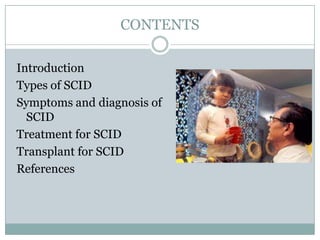
 It is also known as the bubble boy disease because its
  victims are extremely vulnerable to infectious diseases
  and some of them, such as David Vetter, become
  famous for living in a sterile environment.
 SCID is the result of an immune system so highly
  compromised that it is considered almost absent.
Types of SCID

   X-linked severe combined immunodeficiency
   Adenosine deaminase deficiency
   Omenn syndrome
   Bare lymphocyte syndrome
   JAK3
   Artemis/DCLRE1C
Symptoms and diagnosis of SCID

   Children with SCID are at risk for life-threatening
    infections. From their first months of life, they have
    infections that may be frequent, severe, long-lasting
    or hard to treat. Infections may occur in the lungs
    (pneumonia), around the brain and spinal cord
    (meningitis) or in the blood stream.
   Several US states are performing pilot studies to
    diagnose SCID in newborns through the use of T-
    cell recombinant excision circles.
   The delay in detection is because newborns carry
    their mother's antibodies for the first few weeks of
    life and SCID babies look normal.
Treatment for SCID

   Preventing infections
   Enzyme therapy for ADA deficiency SCID
    The standard treatment for ADA deficiency SCID is treatment with a
    form of the ADA enzyme called PEG-ADA. Treatment with PEG-
    ADA is effective in about 90% of children. However, despite PEG-
    ADA therapy, some children continue to require IVIG treatments.
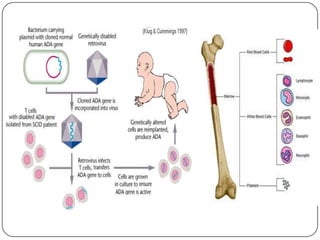
   Gene therapy
    A treatment option being studied in clinical trials is gene therapy.
    Gene therapy has shown promising results for some patients with
    ADA deficiency SCID. At first, gene therapy also appeared to be a
    promising treatment for X-linked SCID, but some children treated
    with gene therapy developed leukemia. New trials of gene therapy
    are in progress. But despite some promising results, gene therapy
    remains an experimental treatment for SCID.
Transplant for SCID
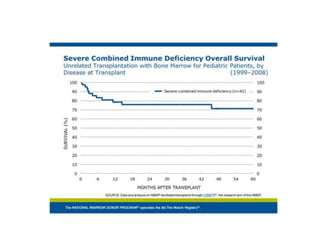
 The most common treatment for SCID is bone marrow
    transplantation, which has been successful using either a matched
    related or unrelated donor, or a half-matched donor, who would be
    either parent.
   The half-matched type of transplant is called haploidentical and was
    perfected by Memorial Sloan Kettering Cancer Center in New York
    and also Duke University Medical Center which currently does the
    highest number of these transplants of any center in the world.
    Haploidentical bone marrow transplants require the donor marrow to
    be depleted of all mature T cells to avoid the occurrence of graft-
    versus-host disease (GVHD).
   Consequently, a functional immune system takes longer to develop
    in a patient who receives a haploidentical bone marrow transplant
    compared to a patient receiving a matched transplant.
   David Vetter, the original "bubble boy", had one of the first
    transplantations but eventually died because of an unscreened virus,
    Epstein-Barr (tests were not available at the time), in his newly
    transplanted bone marrow from his sister.
References
http://www.cga.ct.gov/2008/rpt/2008-R-0564.htm
"Severe combined immunodeficiency: A national
surveillance study“
"Jak3, severe combined immunodeficiency, and a new class
of immunosuppressive drugs“
Fischer A, Hacein-Bey S, Cavazzana-Calvo M (2002). "Gene
therapy of severe combined immunodeficiencies". Nat Rev
Immunol 2 (8): 615-621.
Rapini, Ronald P.; Bolognia, Jean L.; Jorizzo, Joseph L.
(2007). Dermatology: 2-Volume Set. St. Louis: Mosby.
ISBN 1-4160-2999-0
THANK YOU

Severe combined immunodeficiency

  • 1.
    Severe Combined Immunodeficiency (bubble boy disease) Presented By SUBASH SAPKOTA
  • 2.
    CONTENTS Introduction Types of SCID Symptomsand diagnosis of SCID Treatment for SCID Transplant for SCID References
  • 3.
    Introduction  Severe combinedimmunodeficiency (SCID), is a genetic disorder in which both "arms" (B cells and T cells) of the adaptive immune system are impaired due to a defect in one of several possible genes.  SCID is a severe form of heritable immunodeficiency.  It is also known as the bubble boy disease because its victims are extremely vulnerable to infectious diseases and some of them, such as David Vetter, become famous for living in a sterile environment.  SCID is the result of an immune system so highly compromised that it is considered almost absent.
  • 4.
    Types of SCID  X-linked severe combined immunodeficiency  Adenosine deaminase deficiency  Omenn syndrome  Bare lymphocyte syndrome  JAK3  Artemis/DCLRE1C
  • 5.
    Symptoms and diagnosisof SCID  Children with SCID are at risk for life-threatening infections. From their first months of life, they have infections that may be frequent, severe, long-lasting or hard to treat. Infections may occur in the lungs (pneumonia), around the brain and spinal cord (meningitis) or in the blood stream.  Several US states are performing pilot studies to diagnose SCID in newborns through the use of T- cell recombinant excision circles.  The delay in detection is because newborns carry their mother's antibodies for the first few weeks of life and SCID babies look normal.
  • 6.
    Treatment for SCID  Preventing infections  Enzyme therapy for ADA deficiency SCID The standard treatment for ADA deficiency SCID is treatment with a form of the ADA enzyme called PEG-ADA. Treatment with PEG- ADA is effective in about 90% of children. However, despite PEG- ADA therapy, some children continue to require IVIG treatments.  Gene therapy A treatment option being studied in clinical trials is gene therapy. Gene therapy has shown promising results for some patients with ADA deficiency SCID. At first, gene therapy also appeared to be a promising treatment for X-linked SCID, but some children treated with gene therapy developed leukemia. New trials of gene therapy are in progress. But despite some promising results, gene therapy remains an experimental treatment for SCID.
  • 8.
    Transplant for SCID The most common treatment for SCID is bone marrow transplantation, which has been successful using either a matched related or unrelated donor, or a half-matched donor, who would be either parent.  The half-matched type of transplant is called haploidentical and was perfected by Memorial Sloan Kettering Cancer Center in New York and also Duke University Medical Center which currently does the highest number of these transplants of any center in the world.  Haploidentical bone marrow transplants require the donor marrow to be depleted of all mature T cells to avoid the occurrence of graft- versus-host disease (GVHD).  Consequently, a functional immune system takes longer to develop in a patient who receives a haploidentical bone marrow transplant compared to a patient receiving a matched transplant.  David Vetter, the original "bubble boy", had one of the first transplantations but eventually died because of an unscreened virus, Epstein-Barr (tests were not available at the time), in his newly transplanted bone marrow from his sister.
  • 10.
    References http://www.cga.ct.gov/2008/rpt/2008-R-0564.htm "Severe combined immunodeficiency:A national surveillance study“ "Jak3, severe combined immunodeficiency, and a new class of immunosuppressive drugs“ Fischer A, Hacein-Bey S, Cavazzana-Calvo M (2002). "Gene therapy of severe combined immunodeficiencies". Nat Rev Immunol 2 (8): 615-621. Rapini, Ronald P.; Bolognia, Jean L.; Jorizzo, Joseph L. (2007). Dermatology: 2-Volume Set. St. Louis: Mosby. ISBN 1-4160-2999-0
  • 11.