CELLULAR IMMUNE
RESPONSE
Dr Vishal Kulkarni
Introduction-
• Cellular immune response (CMI) is a specific immune
response mediated by sensitized T cells independent
of Abs.
• It was 1st observed by Jenner(1798) & later described
by Koch(1890).
• Delayed hypersensitivity- appearance of skin lesion
48-72 hrs after administration of Ag
• DH & CMI are mediated by T lymphocytes.
Induction of CMI-
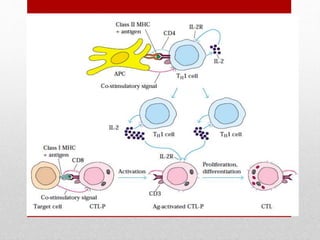
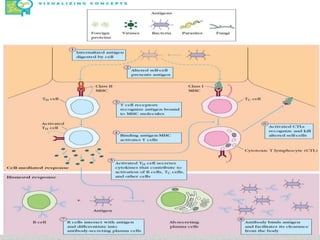
• Ag is presented by macrophage or react directly.
• Binding of Ag with T cell receptors.
• Proliferation & sequence of morphological &
biochemical events occurs.
• Blast transformation, clonal proliferation,
differentiation occurs.
• Generation of –
• Th & Ts cells
• Cytotoxic T cells
• Lymphokines producing T cells
• Memory cells
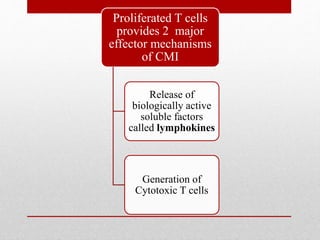
Proliferated T cells
provides 2 major
effector mechanisms
of CMI
Release of
biologically active
soluble factors
called lymphokines
Generation of
Cytotoxic T cells
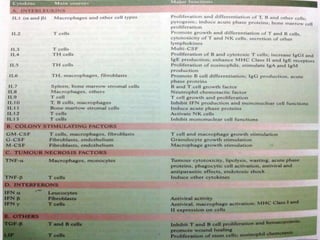
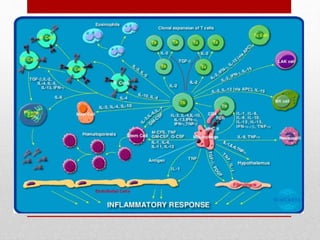
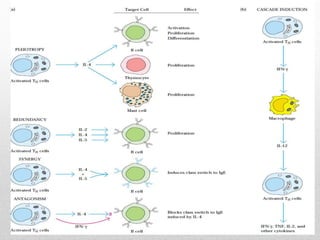
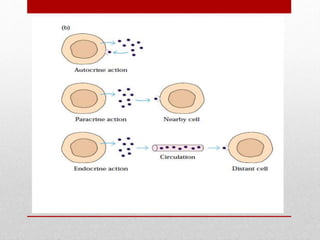
Cytokines-
Lymphokines- released by activated T lymphocytes.
are regulatory proteins.( mole wt20000-80000)
Monokines- produced by monocytes & macrophages.
Interleukins- product of leucocytes which exert
regulatory influence on other cells.
The lymphokines, monokines, interferons, growth
factors etc. have similer biological effects. Therefore
they are grouped as Cytokines .
1)Cytokines affecting lymphocytes-
 IL-1- is a polypeptide-monokine released by macrophage &
other Ag presenting cells
-Occurs in 2 forms- alpha & beta with same function
-production is stimulated by Ags, toxins, injury, inflamm. Processes.
-inhibited by cyclosporin-A, corticosteroids & prostaglandins.
Immunological effects-
-stimulates activation of Th cells for prod. of IL-2
-stimulate B-cell proliferation & Ab synthesis.
-Stimulate granulocytes & phagocytosis
-mediates various metabolic, physiological, inflammatory&
haematological effects by acting on various types of cells.
-is an endogenous pyrogen.
-with TNF, induces haematologic changes in septic shock.
-has beneficial effects in severe infections in immunocompromised hosts..
 IL-2(TCGF)-
-Produced by activated T cells
-is a powerful modulater of the immune response.
-promotes growth & differentiation of T & B cells.
-stimulates cytotoxic T cells & NK cells.
-Convert large granular lymphocytes into LAK cells which can
destroy NK resistant tumor cells.
-this property can be used in T/t of certain types of cancers.
 IL-3( Multi CSF)-
-Produced by T cells.
-growth factor for bone marrow stem cells.
-Stimutates multilineage haematopoesis.
 IL-4(B Cell differntiating factor)-
-produced by Th cells
-activates resting B cell.
-enhances activity of cytotoxic T cells.
-increases synthesis of IgG & IgE & may play role in atopic
hypersensitivity.
 IL-5
-causes proliferation of activated B cells & eosinophils.
-stimulate production of IgA & IgM
 IL-6
-produced by stimulated T & B cells, macrophages & fibroblasts.
-promotes terminal differentiation of B cells into Ab producing
plasma cells & increases IgG production.
-has stimulatory effect on hepatocytes, nerve cells, &
haematopoetic cells.
• Mitogenic/Blastogenic factor-
-released by sensitized T cells stimulated by specific Ag.
-induces nonspecific blast transformation of normal unsensitized
T lymphocytes.
-is imp. in augmenting or amplifying cell mediated immune
response by recruiting uncommited lymphocytes.
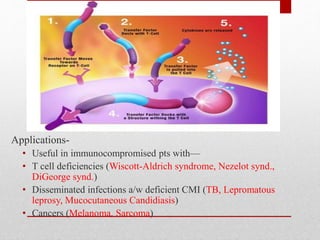
 Transfer factor-
-An extract from specific Ag sensitized lymphocytes that mediates
passive transfer of CMI is k/a transfer factor.
-both dialyzable & nondialyzable transfer factors have been
identified.
-dialyzable one has LMW(2000-4000)
-Is resistant to treatment with DNAse, RNAse, trypsin, freeze
thawing.
-chemically is a polypeptide-polynucleotide.
-it is immunologically specific.
-highly potent
Applications-
• Useful in immunocompromised pts with—
• T cell deficiencies (Wiscott-Aldrich syndrome, Nezelot synd.,
DiGeorge synd.)
• Disseminated infections a/w deficient CMI (TB, Lepromatous
leprosy, Mucocutaneous Candidiasis)
• Cancers (Melanoma, Sarcoma)
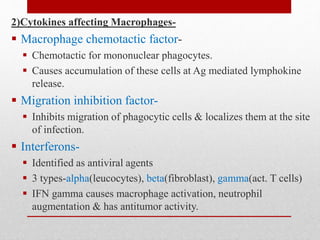
2)Cytokines affecting Macrophages-
 Macrophage chemotactic factor-
 Chemotactic for mononuclear phagocytes.
 Causes accumulation of these cells at Ag mediated lymphokine
release.
 Migration inhibition factor-
 Inhibits migration of phagocytic cells & localizes them at the site
of infection.
 Interferons-
 Identified as antiviral agents
 3 types-alpha(leucocytes), beta(fibroblast), gamma(act. T cells)
 IFN gamma causes macrophage activation, neutrophil
augmentation & has antitumor activity.
3)Cytotoxic Lymphokines-
Lymphotoxin-
-released by CTLs cells.
-also k/a TNF-B
-Cytotoxic for tumor cells, transplanted cells & microorganisms.
Tumor necrosis factor alpha-
-causes lysis of tumor cells.
-elimination of certain bacteria & parasites.
-also k/a ‘cachectin’ causing cachexia– a wasting syndrome
during chronic infection because of pronounced catabolic effects.
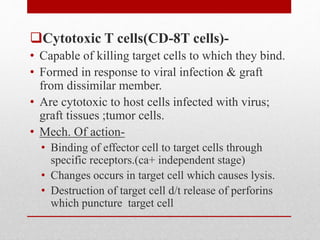
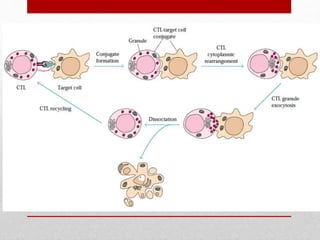
Cytotoxic T cells(CD-8T cells)-
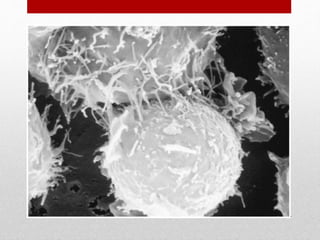
• Capable of killing target cells to which they bind.
• Formed in response to viral infection & graft
from dissimilar member.
• Are cytotoxic to host cells infected with virus;
graft tissues ;tumor cells.
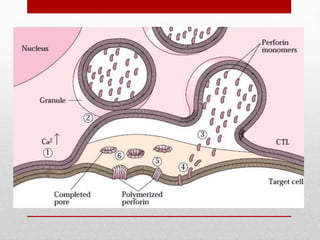
• Mech. Of action-
• Binding of effector cell to target cells through
specific receptors.(ca+ independent stage)
• Changes occurs in target cell which causes lysis.
• Destruction of target cell d/t release of perforins
which puncture target cell
Detection of CMI-
In vivo- Skin Test
In vitro-
1.Lymphocyte Transformation Test
2.Target Cell Destruction
3.Migration inhibiting factor test-
-most commonly used test
-macrophages packed in capillary tube are placed in tissue
culture medium in a chamber.
-macrophages migrate out & form lacy fan like appearance
over the glass wall.
• If macrophages are from sensitized guinae pig, addition of Ag to
the culture chamber inhibits migration.
• Clinical use- human leucocytes- Ag interaction test.
Scope of CMI- plays important role in
-immunity against infectious diseases caused by obligate & facultative
intracellular pathogens.
-delayed hypersensitivity.
-transplantation immunity & graft vs. host reaction.
-Immunological surviellance & immunity against cancer (tumor
rejection)
-Pathogenesis of certain autoimmune diseases e.g. Thyroiditis,
encephalomyelitis.
Thank
you.!

Cellular immune response

  • 1.
  • 2.
    Introduction- • Cellular immuneresponse (CMI) is a specific immune response mediated by sensitized T cells independent of Abs. • It was 1st observed by Jenner(1798) & later described by Koch(1890). • Delayed hypersensitivity- appearance of skin lesion 48-72 hrs after administration of Ag • DH & CMI are mediated by T lymphocytes.
  • 3.
    Induction of CMI- •Ag is presented by macrophage or react directly. • Binding of Ag with T cell receptors. • Proliferation & sequence of morphological & biochemical events occurs. • Blast transformation, clonal proliferation, differentiation occurs. • Generation of – • Th & Ts cells • Cytotoxic T cells • Lymphokines producing T cells • Memory cells
  • 4.
    Proliferated T cells provides2 major effector mechanisms of CMI Release of biologically active soluble factors called lymphokines Generation of Cytotoxic T cells
  • 5.
    Cytokines- Lymphokines- released byactivated T lymphocytes. are regulatory proteins.( mole wt20000-80000) Monokines- produced by monocytes & macrophages. Interleukins- product of leucocytes which exert regulatory influence on other cells. The lymphokines, monokines, interferons, growth factors etc. have similer biological effects. Therefore they are grouped as Cytokines .
  • 6.
    1)Cytokines affecting lymphocytes- IL-1- is a polypeptide-monokine released by macrophage & other Ag presenting cells -Occurs in 2 forms- alpha & beta with same function -production is stimulated by Ags, toxins, injury, inflamm. Processes. -inhibited by cyclosporin-A, corticosteroids & prostaglandins. Immunological effects- -stimulates activation of Th cells for prod. of IL-2 -stimulate B-cell proliferation & Ab synthesis. -Stimulate granulocytes & phagocytosis -mediates various metabolic, physiological, inflammatory& haematological effects by acting on various types of cells. -is an endogenous pyrogen. -with TNF, induces haematologic changes in septic shock. -has beneficial effects in severe infections in immunocompromised hosts..
  • 7.
     IL-2(TCGF)- -Produced byactivated T cells -is a powerful modulater of the immune response. -promotes growth & differentiation of T & B cells. -stimulates cytotoxic T cells & NK cells. -Convert large granular lymphocytes into LAK cells which can destroy NK resistant tumor cells. -this property can be used in T/t of certain types of cancers.
  • 9.
     IL-3( MultiCSF)- -Produced by T cells. -growth factor for bone marrow stem cells. -Stimutates multilineage haematopoesis.  IL-4(B Cell differntiating factor)- -produced by Th cells -activates resting B cell. -enhances activity of cytotoxic T cells. -increases synthesis of IgG & IgE & may play role in atopic hypersensitivity.
  • 10.
     IL-5 -causes proliferationof activated B cells & eosinophils. -stimulate production of IgA & IgM  IL-6 -produced by stimulated T & B cells, macrophages & fibroblasts. -promotes terminal differentiation of B cells into Ab producing plasma cells & increases IgG production. -has stimulatory effect on hepatocytes, nerve cells, & haematopoetic cells.
  • 11.
    • Mitogenic/Blastogenic factor- -releasedby sensitized T cells stimulated by specific Ag. -induces nonspecific blast transformation of normal unsensitized T lymphocytes. -is imp. in augmenting or amplifying cell mediated immune response by recruiting uncommited lymphocytes.
  • 12.
     Transfer factor- -Anextract from specific Ag sensitized lymphocytes that mediates passive transfer of CMI is k/a transfer factor. -both dialyzable & nondialyzable transfer factors have been identified. -dialyzable one has LMW(2000-4000) -Is resistant to treatment with DNAse, RNAse, trypsin, freeze thawing. -chemically is a polypeptide-polynucleotide. -it is immunologically specific. -highly potent
  • 13.
    Applications- • Useful inimmunocompromised pts with— • T cell deficiencies (Wiscott-Aldrich syndrome, Nezelot synd., DiGeorge synd.) • Disseminated infections a/w deficient CMI (TB, Lepromatous leprosy, Mucocutaneous Candidiasis) • Cancers (Melanoma, Sarcoma)
  • 14.
    2)Cytokines affecting Macrophages- Macrophage chemotactic factor-  Chemotactic for mononuclear phagocytes.  Causes accumulation of these cells at Ag mediated lymphokine release.  Migration inhibition factor-  Inhibits migration of phagocytic cells & localizes them at the site of infection.  Interferons-  Identified as antiviral agents  3 types-alpha(leucocytes), beta(fibroblast), gamma(act. T cells)  IFN gamma causes macrophage activation, neutrophil augmentation & has antitumor activity.
  • 15.
    3)Cytotoxic Lymphokines- Lymphotoxin- -released byCTLs cells. -also k/a TNF-B -Cytotoxic for tumor cells, transplanted cells & microorganisms. Tumor necrosis factor alpha- -causes lysis of tumor cells. -elimination of certain bacteria & parasites. -also k/a ‘cachectin’ causing cachexia– a wasting syndrome during chronic infection because of pronounced catabolic effects.
  • 20.
    Cytotoxic T cells(CD-8Tcells)- • Capable of killing target cells to which they bind. • Formed in response to viral infection & graft from dissimilar member. • Are cytotoxic to host cells infected with virus; graft tissues ;tumor cells. • Mech. Of action- • Binding of effector cell to target cells through specific receptors.(ca+ independent stage) • Changes occurs in target cell which causes lysis. • Destruction of target cell d/t release of perforins which puncture target cell
  • 25.
    Detection of CMI- Invivo- Skin Test In vitro- 1.Lymphocyte Transformation Test 2.Target Cell Destruction 3.Migration inhibiting factor test- -most commonly used test -macrophages packed in capillary tube are placed in tissue culture medium in a chamber. -macrophages migrate out & form lacy fan like appearance over the glass wall.
  • 26.
    • If macrophagesare from sensitized guinae pig, addition of Ag to the culture chamber inhibits migration. • Clinical use- human leucocytes- Ag interaction test.
  • 27.
    Scope of CMI-plays important role in -immunity against infectious diseases caused by obligate & facultative intracellular pathogens. -delayed hypersensitivity. -transplantation immunity & graft vs. host reaction. -Immunological surviellance & immunity against cancer (tumor rejection) -Pathogenesis of certain autoimmune diseases e.g. Thyroiditis, encephalomyelitis.
  • 28.