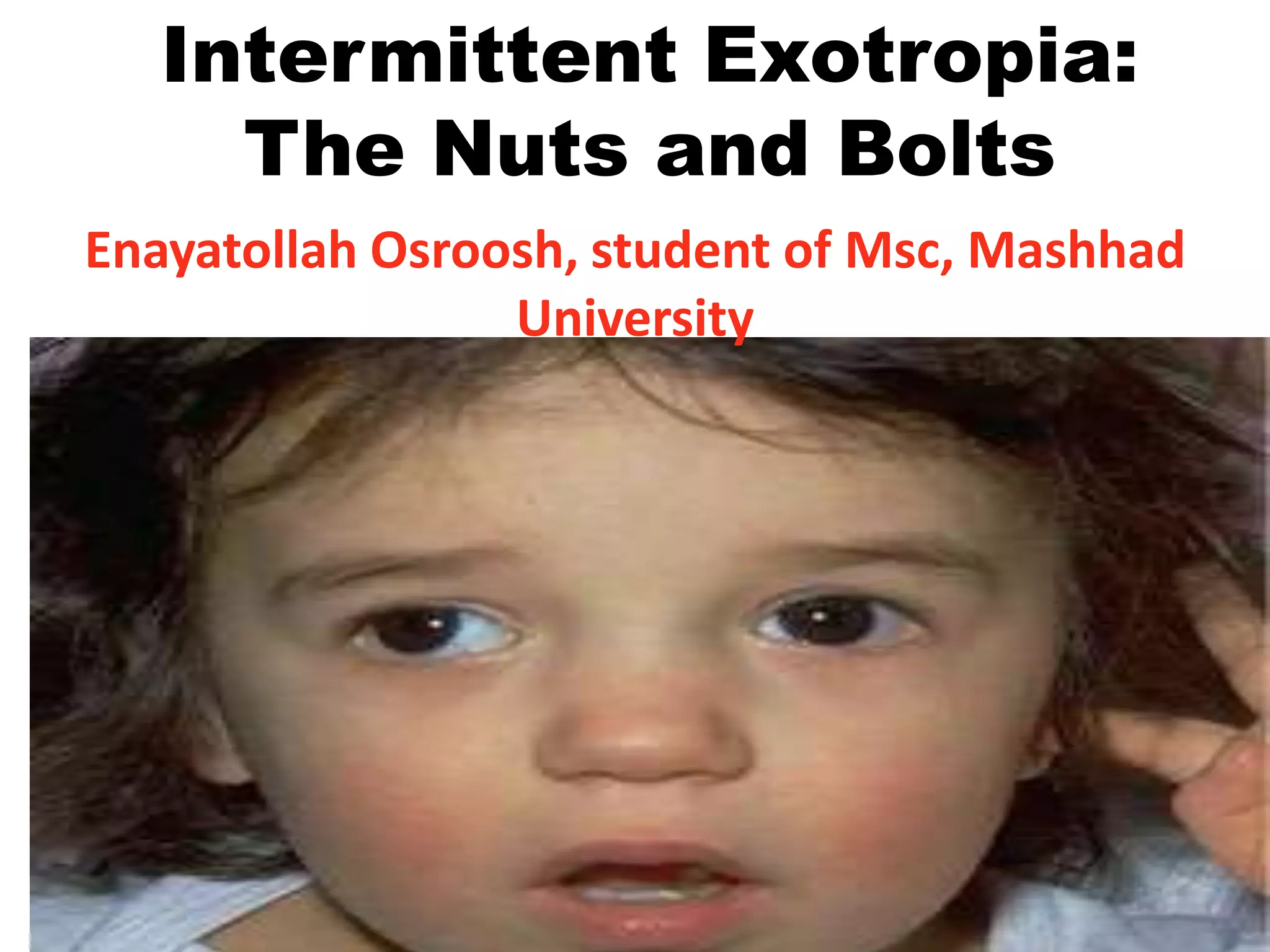
Intermittent Exotropia:
The Nuts and Bolts
Enayatollah Osroosh, student of Msc, Mashhad
University
ACKNOWLEDGEMENT
Susan A, Cotter, OD, MS
for use of data slides.
 Most common form of XT
 Onset: typically first few years of life
 Most common symptoms
• Cosmesis
• Blur
• Astenopia
• Diplopia
• Monocular eye closure in bright sunlight
• None (suppression/ARC)
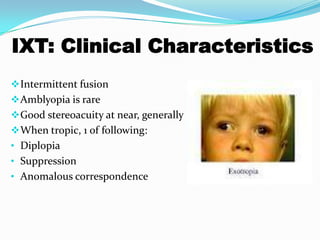
IXT: Clinical Characteristics
Intermittent fusion
Amblyopia is rare
Good stereoacuity at near, generally
When tropic, 1 of following:
• Diplopia
• Suppression
• Anomalous correspondence
 Divergence excess
• Far > near angle: high AC/A
• True vs. psuedo (simulated)
 Basic
• Near = far angle; normal AC/A
 Convergence insufficiency
• Near > far angle; low AC/A
Follow/Treat
How can we tell if a patient is getting
worse or better?
Determine magnitude under
dissociated conditions?
Or frequency ?
• Ask parents
• In-office cover test findings
Problems with both
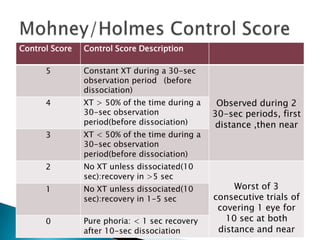
Control Score DescriptionControl Score
Observed during 2
30-sec periods, first
distance ,then near
Constant XT during a 30-sec
observation period (before
dissociation)
5
XT > 50% of the time during a
30-sec observation
period(before dissociation)
4
XT < 50% of the time during a
30-sec observation
period(before dissociation)
3
Worst of 3
consecutive trials of
covering 1 eye for
10 sec at both
distance and near
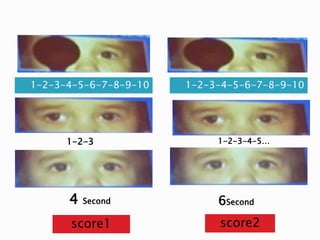
No XT unless dissociated(10
sec):recovery in >5 sec
2
No XT unless dissociated(10
sec):recovery in 1-5 sec
1
Pure phoria: < 1 sec recovery
after 10-sec dissociation
0
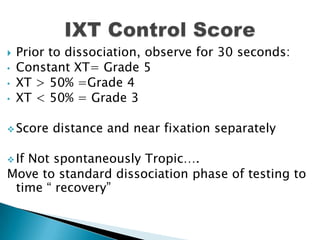
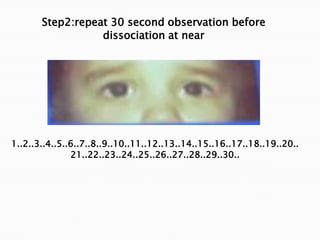
 Prior to dissociation, observe for 30 seconds:
• Constant XT= Grade 5
• XT > 50% =Grade 4
• XT < 50% = Grade 3
 Score distance and near fixation separately
 If Not spontaneously Tropic….
Move to standard dissociation phase of testing to
time “ recovery”
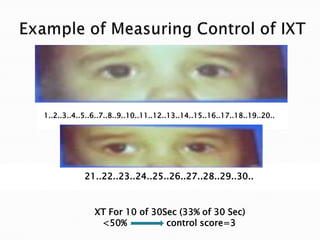
1..2..3..4..5..6..7..8..9..10..11..12..13..14..15..16..17..18..19..20..
21..22..23..24..25..26..27..28..29..30..
XT For 10 of 30Sec (33% of 30 Sec)
<50% control score=3
1..2..3..4..5..6..7..8..9..10..11..12..13..14..15..16..17..18..19..20..
21..22..23..24..25..26..27..28..29..30..
Step2:repeat 30 second observation before
dissociation at near
1-2-3-4-5-6-7-8-9-10
1-2-3
4 Second
1-2-3-4-5-6-7-8-9-10
1-2-3-4-5…
6Second
score1 score2
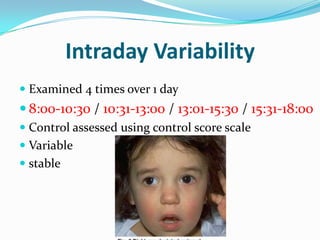
Intraday Variability
 Examined 4 times over 1 day
 8:00-10:30 / 10:31-13:00 / 13:01-15:30 / 15:31-18:00
 Control assessed using control score scale
 Variable
 stable
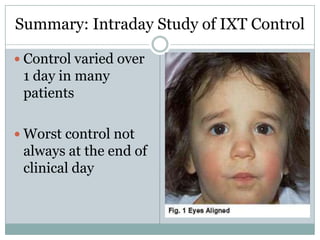
Summary: Intraday Study of IXT Control
 Control varied over
1 day in many
patients
 Worst control not
always at the end of
clinical day
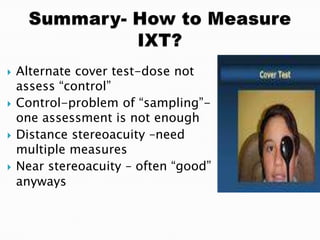
 Alternate cover test-dose not
assess “control”
 Control-problem of “sampling”-
one assessment is not enough
 Distance stereoacuity –need
multiple measures
 Near stereoacuity – often “good”
anyways
IXT: Other Diagnostic Evaluation
Consideration
 Cycloplegic refraction
 Cover test at remote distance
 Sensorimotor evaluation
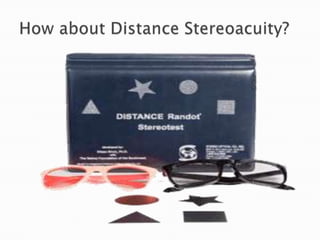
 Distance Randot stereo test
 Worth 4 –dot when tropia is manifest
 Hering-Bielschowsky Afterimage Test when
tropia manifest?
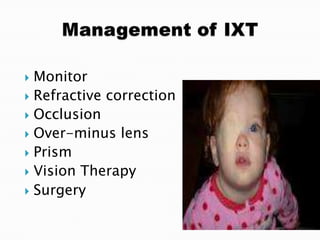
 Monitor
 Refractive correction
 Occlusion
 Over-minus lens
 Prism
 Vision Therapy
 Surgery
 uncorrected ametropia?
 equally accommodative accuracy
 Discourage suppression
 Promote sensory fusion
 Moderate/high hyperopia consideration?
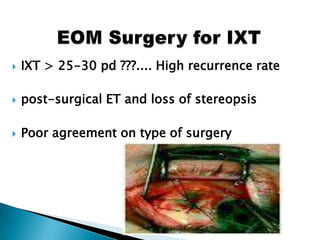
 IXT > 25-30 pd ???.... High recurrence rate
 post-surgical ET and loss of stereopsis
 Poor agreement on type of surgery
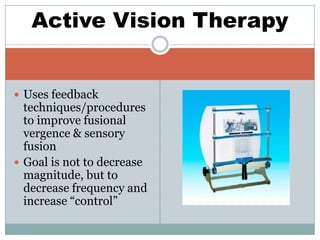
 Uses feedback
techniques/procedures
to improve fusional
vergence & sensory
fusion
 Goal is not to decrease
magnitude, but to
decrease frequency and
increase “control”
Active Vision Therapy
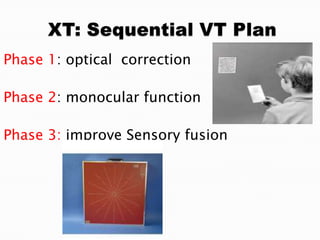
Phase 1: optical correction
Phase 2: monocular function
Phase 3: improve Sensory fusion
 Gross convergence
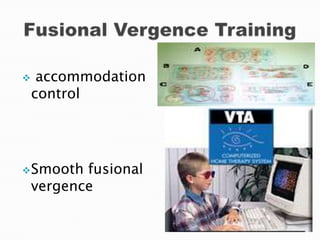
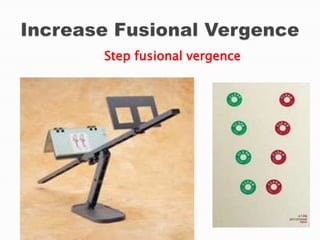
 Fusional vergence
 Anti-suppression therapy, including diplopia
awareness when XT
 Convergence surprise
 Pencil push up
 Brock string
 3.dot card
 Goal: Voluntary Convergence
 accommodation
control
Smooth fusional
vergence
Step fusional vergence
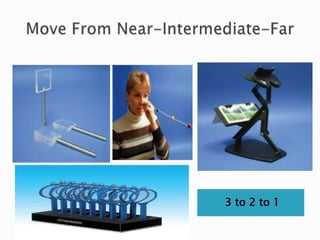
3 to 2 to 1
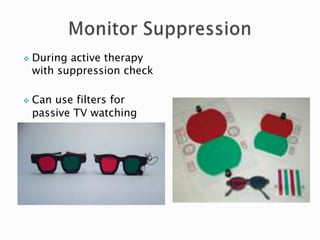
 During active therapy
with suppression check
 Can use filters for
passive TV watching
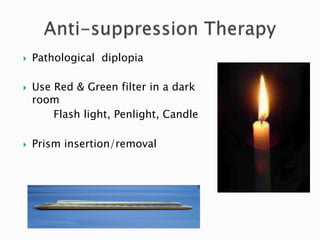
 Pathological diplopia
 Use Red & Green filter in a dark
room
Flash light, Penlight, Candle
 Prism insertion/removal
Intermittent exotropia

Intermittent exotropia