Optometry:
A Focus on Vision
Brian Godard, O.D.
Optometrist

Presentation created by:
Taline Farra, OD, MSc, FAAO
Associate Professor of Optometry
New England College of Optometry
Director of Admissions
What is a Doctor of Optometry?
► A primary health care professional for the eye.
► Examine, diagnose, treat, and manage

diseases, injuries, and disorders of the visual
system, the eye, and associated structures.

► Identify related systemic conditions affecting

the eye.

- American Optometric Association
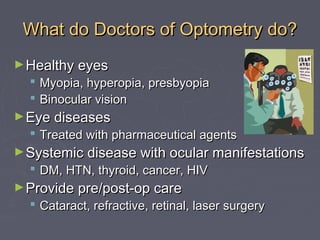
What do Doctors of Optometry do?
► Healthy eyes

 Myopia, hyperopia, presbyopia
 Binocular vision

► Eye diseases

 Treated with pharmaceutical agents

► Systemic disease with ocular manifestations

 DM, HTN, thyroid, cancer, HIV

► Provide pre/post-op care

 Cataract, refractive, retinal, laser surgery
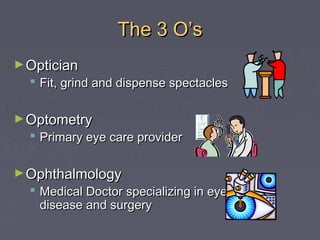
The 3 O’s
► Optician

 Fit, grind and dispense spectacles

► Optometry

 Primary eye care provider

► Ophthalmology

 Medical Doctor specializing in eye
disease and surgery
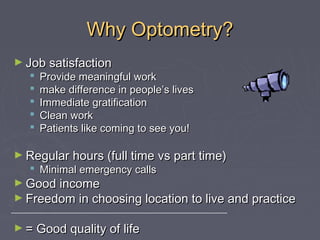
Why Optometry?
► Job satisfaction







Provide meaningful work
make difference in people’s lives
Immediate gratification
Clean work
Patients like coming to see you!

► Regular hours (full time vs part time)

 Minimal emergency calls

► Good income

► Freedom in choosing location to live and practice

______________________________________________________

► = Good quality of life
Go eyes!

Alcon

► Optometry ranked 2nd
-

best profession

US News and World Report Jan 5, 2006

► Optometry rated “excellent” in a guide to careers
-

US News and World Report March 19, 2007

► Optometry rated as one of “Best Careers 2008”
-

US News and World Report Dec 19, 2007
Modes of Practice
► Solo Private Practice

► Partnership or Group Practice
► Interdisciplinary Care

► Retail/Optical Settings

► Optometric/Ophthalmologic Professional Settings
► Health Maintenance Organizations (HMOs)
► Military/Public Health
► Academic/Research
► Corporate/Industrial
► Consultants
Annual Net Income Potential
Median

Mean

Self-Employed

$140,000

$175,000

Salaried

$90,000

$98,000

- 2007 American Optometric Association Economic Survey

For estimated figures by location, visit: www.salary.com
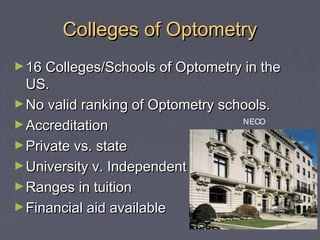
Colleges of Optometry
► 16 Colleges/Schools of Optometry in the

US.
► No valid ranking of Optometry schools.
NECO
► Accreditation
► Private vs. state
► University v. Independent
► Ranges in tuition
► Financial aid available
Common Prerequisite Courses
► Biology with lab

► Calculus

► Physics with lab

► Statistics

► Chemistry with lab
► Organic chemistry

► Biochemistry with lab
► Microbiology with lab

► 3 + 4 year program

► Psychology
► English

► Social Sciences

► Other Humanities
Requirements for Optometry School
► A properly completed application for

admission, including a personal essay
► Official transcripts from all colleges attended
► Official Optometry Admission Test (OAT)
scores (for more info: www.opted.org)
► Letters of recommendation
► Optometry experience/exposure
► Personal interview
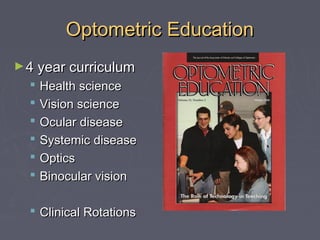
Optometric Education
► 4 year curriculum








Health science
Vision science
Ocular disease
Systemic disease
Optics
Binocular vision

 Clinical Rotations
Post-Optometric Education
► Residency

 Primary Care
Optometry
 Pediatric Optometry
 Geriatric Optometry
 Vision Therapy
 Low Vision
 Cornea and contact
lens
 Ocular Disease

► Research

 Masters
 PhD
Licensure
► Doctor of Optometry degree
► Pass National Board Examinations in

Optometry
► Individual State Requirements
Significant Future Demand!
► Aging population of baby boomers will

increase demand for optometric services

► Replacement of retiring optometrist
Important Websites
► www.aoa.org and www.opted.org

Any additional questions?

drgodard@gmail.com
The New England
College of Optometry
Dr Taline Farra
Director of Admissions
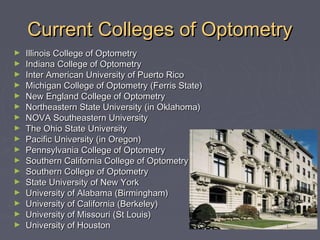
Current Colleges of Optometry
►
►
►
►
►
►
►
►
►
►
►
►
►
►
►
►
►

Illinois College of Optometry
Indiana College of Optometry
Inter American University of Puerto Rico
Michigan College of Optometry (Ferris State)
New England College of Optometry
Northeastern State University (in Oklahoma)
NOVA Southeastern University
The Ohio State University
Pacific University (in Oregon)
Pennsylvania College of Optometry
Southern California College of Optometry
Southern College of Optometry
State University of New York
University of Alabama (Birmingham)
University of California (Berkeley)
University of Missouri (St Louis)
University of Houston
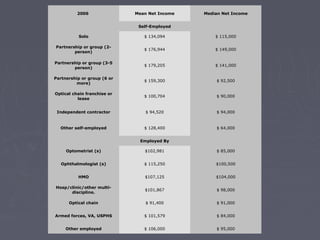
2006 

Mean Net Income

Median Net Income

Self-Employed
Solo

$ 134,094

$ 115,000

Partnership or group (2person)

$ 176,944

$ 149,000

Partnership or group (3-5 
person)

$ 179,205

$ 141,000

Partnership or group (6 or 
more)

$ 159,300

$ 92,500

Optical chain franchise or 
lease

$ 100,704

$ 90,000

Independent contractor

$ 94,520

$ 94,000

Other self-employed

$ 128,400

$ 64,000

Employed By
Optometrist (s)

$102,981

$ 85,000

Ophthalmologist (s)

$ 115,250

$100,500

HMO

$107,125

$104,000

Hosp/clinic/other multidiscipline.

$101,867

$ 98,000

Optical chain

$ 91,400

$ 91,000

Armed forces, VA, USPHS

$ 101,579

$ 84,000

Other employed

$ 106,000

$ 95,000
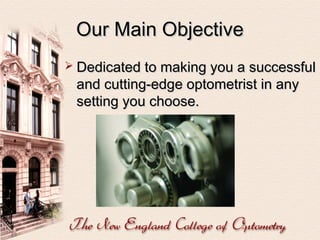
Our Main Objective
 Dedicated to making you a successful

and cutting-edge optometrist in any
setting you choose.
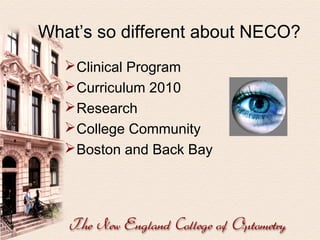
What’s so different about NECO?
 Clinical Program
 Curriculum 2010
 Research
 College Community
 Boston and Back Bay
The New England Eye Institute
The Clinical Affiliate of NECO

 Clinical network dedicated to patient
care and clinical teaching.
 Widely distributed throughout Boston
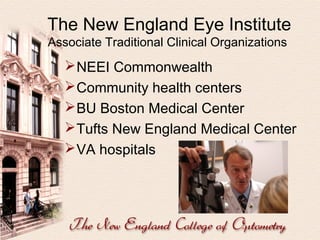
The New England Eye Institute
Associate Traditional Clinical Organizations

 NEEI Commonwealth
 Community health centers
 BU Boston Medical Center
 Tufts New England Medical Center
 VA hospitals
The New England Eye Institute
Innovative Clinical Programs

 Homeless Service
 Low vision and Geriatrics Service
 Pediatric school health programs
and rehabilitation programs
 International Programs
 VOSH
The New England Eye Institute
Student Involvement

 1st year: Screenings
 2nd year: Clerkships
 3rd year: Primary Care Rotations
 4th year: Full-time patient care
Community-based health center
Veterans Affairs Medical Center
Special Populations
Elective Rotation
Curriculum 2010
 Prepares you to practice as a future
optometrist.
 Prepares you for Credentialing and
Privileging within the NEEI system.
Research
 Among the top optometry schools in
National Eye Institute research
funding.
 Only private optometry school
committed to research
 Combined M.Sc./O.D. Program for
selected students
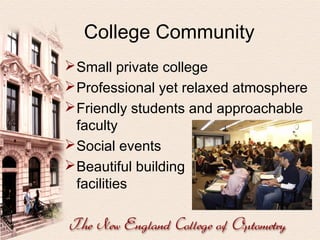
College Community
 Small private college
 Professional yet relaxed atmosphere
 Friendly students and approachable
faculty
 Social events
 Beautiful building
and
facilities
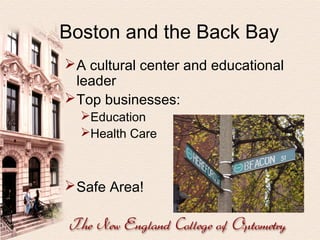
Boston and the Back Bay
 A cultural center and educational
leader
 Top businesses:
Education
Health Care

 Safe Area!
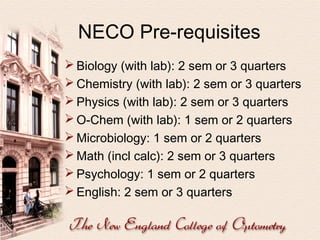
NECO Pre-requisites
 Biology (with lab): 2 sem or 3 quarters
 Chemistry (with lab): 2 sem or 3 quarters
 Physics (with lab): 2 sem or 3 quarters
 O-Chem (with lab): 1 sem or 2 quarters
 Microbiology: 1 sem or 2 quarters
 Math (incl calc): 2 sem or 3 quarters
 Psychology: 1 sem or 2 quarters
 English: 2 sem or 3 quarters
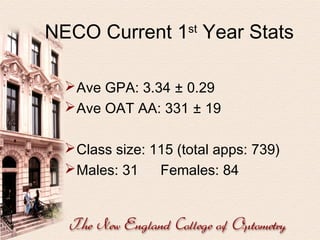
NECO Current 1st Year Stats
 Ave GPA: 3.34 ± 0.29
 Ave OAT AA: 331 ± 19
 Class size: 115 (total apps: 739)
 Males: 31
Females: 84

Optometry, a focus on vision

  • 1.
    Optometry: A Focus onVision Brian Godard, O.D. Optometrist Presentation created by: Taline Farra, OD, MSc, FAAO Associate Professor of Optometry New England College of Optometry Director of Admissions
  • 2.
    What is aDoctor of Optometry? ► A primary health care professional for the eye. ► Examine, diagnose, treat, and manage diseases, injuries, and disorders of the visual system, the eye, and associated structures. ► Identify related systemic conditions affecting the eye. - American Optometric Association
  • 3.
    What do Doctorsof Optometry do? ► Healthy eyes  Myopia, hyperopia, presbyopia  Binocular vision ► Eye diseases  Treated with pharmaceutical agents ► Systemic disease with ocular manifestations  DM, HTN, thyroid, cancer, HIV ► Provide pre/post-op care  Cataract, refractive, retinal, laser surgery
  • 6.
    The 3 O’s ►Optician  Fit, grind and dispense spectacles ► Optometry  Primary eye care provider ► Ophthalmology  Medical Doctor specializing in eye disease and surgery
  • 7.
    Why Optometry? ► Jobsatisfaction      Provide meaningful work make difference in people’s lives Immediate gratification Clean work Patients like coming to see you! ► Regular hours (full time vs part time)  Minimal emergency calls ► Good income ► Freedom in choosing location to live and practice ______________________________________________________ ► = Good quality of life
  • 8.
    Go eyes! Alcon ► Optometryranked 2nd - best profession US News and World Report Jan 5, 2006 ► Optometry rated “excellent” in a guide to careers - US News and World Report March 19, 2007 ► Optometry rated as one of “Best Careers 2008” - US News and World Report Dec 19, 2007
  • 9.
    Modes of Practice ►Solo Private Practice ► Partnership or Group Practice ► Interdisciplinary Care ► Retail/Optical Settings ► Optometric/Ophthalmologic Professional Settings ► Health Maintenance Organizations (HMOs) ► Military/Public Health ► Academic/Research ► Corporate/Industrial ► Consultants
  • 10.
    Annual Net IncomePotential Median Mean Self-Employed $140,000 $175,000 Salaried $90,000 $98,000 - 2007 American Optometric Association Economic Survey For estimated figures by location, visit: www.salary.com
  • 11.
    Colleges of Optometry ►16 Colleges/Schools of Optometry in the US. ► No valid ranking of Optometry schools. NECO ► Accreditation ► Private vs. state ► University v. Independent ► Ranges in tuition ► Financial aid available
  • 12.
    Common Prerequisite Courses ►Biology with lab ► Calculus ► Physics with lab ► Statistics ► Chemistry with lab ► Organic chemistry ► Biochemistry with lab ► Microbiology with lab ► 3 + 4 year program ► Psychology ► English ► Social Sciences ► Other Humanities
  • 13.
    Requirements for OptometrySchool ► A properly completed application for admission, including a personal essay ► Official transcripts from all colleges attended ► Official Optometry Admission Test (OAT) scores (for more info: www.opted.org) ► Letters of recommendation ► Optometry experience/exposure ► Personal interview
  • 14.
    Optometric Education ► 4year curriculum       Health science Vision science Ocular disease Systemic disease Optics Binocular vision  Clinical Rotations
  • 15.
    Post-Optometric Education ► Residency Primary Care Optometry  Pediatric Optometry  Geriatric Optometry  Vision Therapy  Low Vision  Cornea and contact lens  Ocular Disease ► Research  Masters  PhD
  • 16.
    Licensure ► Doctor ofOptometry degree ► Pass National Board Examinations in Optometry ► Individual State Requirements
  • 17.
    Significant Future Demand! ►Aging population of baby boomers will increase demand for optometric services ► Replacement of retiring optometrist
  • 18.
    Important Websites ► www.aoa.organd www.opted.org Any additional questions? drgodard@gmail.com
  • 19.
    The New England Collegeof Optometry Dr Taline Farra Director of Admissions
  • 20.
    Current Colleges ofOptometry ► ► ► ► ► ► ► ► ► ► ► ► ► ► ► ► ► Illinois College of Optometry Indiana College of Optometry Inter American University of Puerto Rico Michigan College of Optometry (Ferris State) New England College of Optometry Northeastern State University (in Oklahoma) NOVA Southeastern University The Ohio State University Pacific University (in Oregon) Pennsylvania College of Optometry Southern California College of Optometry Southern College of Optometry State University of New York University of Alabama (Birmingham) University of California (Berkeley) University of Missouri (St Louis) University of Houston
  • 21.
    2006  Mean Net Income Median Net Income Self-Employed Solo $ 134,094 $ 115,000 Partnership or group (2person) $176,944 $ 149,000 Partnership or group (3-5  person) $ 179,205 $ 141,000 Partnership or group (6 or  more) $ 159,300 $ 92,500 Optical chain franchise or  lease $ 100,704 $ 90,000 Independent contractor $ 94,520 $ 94,000 Other self-employed $ 128,400 $ 64,000 Employed By Optometrist (s) $102,981 $ 85,000 Ophthalmologist (s) $ 115,250 $100,500 HMO $107,125 $104,000 Hosp/clinic/other multidiscipline. $101,867 $ 98,000 Optical chain $ 91,400 $ 91,000 Armed forces, VA, USPHS $ 101,579 $ 84,000 Other employed $ 106,000 $ 95,000
  • 22.
    Our Main Objective Dedicated to making you a successful and cutting-edge optometrist in any setting you choose.
  • 23.
    What’s so differentabout NECO?  Clinical Program  Curriculum 2010  Research  College Community  Boston and Back Bay
  • 24.
    The New EnglandEye Institute The Clinical Affiliate of NECO  Clinical network dedicated to patient care and clinical teaching.  Widely distributed throughout Boston
  • 25.
    The New EnglandEye Institute Associate Traditional Clinical Organizations  NEEI Commonwealth  Community health centers  BU Boston Medical Center  Tufts New England Medical Center  VA hospitals
  • 26.
    The New EnglandEye Institute Innovative Clinical Programs  Homeless Service  Low vision and Geriatrics Service  Pediatric school health programs and rehabilitation programs  International Programs  VOSH
  • 27.
    The New EnglandEye Institute Student Involvement  1st year: Screenings  2nd year: Clerkships  3rd year: Primary Care Rotations  4th year: Full-time patient care Community-based health center Veterans Affairs Medical Center Special Populations Elective Rotation
  • 28.
    Curriculum 2010  Preparesyou to practice as a future optometrist.  Prepares you for Credentialing and Privileging within the NEEI system.
  • 29.
    Research  Among thetop optometry schools in National Eye Institute research funding.  Only private optometry school committed to research  Combined M.Sc./O.D. Program for selected students
  • 30.
    College Community  Smallprivate college  Professional yet relaxed atmosphere  Friendly students and approachable faculty  Social events  Beautiful building and facilities
  • 31.
    Boston and theBack Bay  A cultural center and educational leader  Top businesses: Education Health Care  Safe Area!
  • 32.
    NECO Pre-requisites  Biology(with lab): 2 sem or 3 quarters  Chemistry (with lab): 2 sem or 3 quarters  Physics (with lab): 2 sem or 3 quarters  O-Chem (with lab): 1 sem or 2 quarters  Microbiology: 1 sem or 2 quarters  Math (incl calc): 2 sem or 3 quarters  Psychology: 1 sem or 2 quarters  English: 2 sem or 3 quarters
  • 33.
    NECO Current 1stYear Stats  Ave GPA: 3.34 ± 0.29  Ave OAT AA: 331 ± 19  Class size: 115 (total apps: 739)  Males: 31 Females: 84