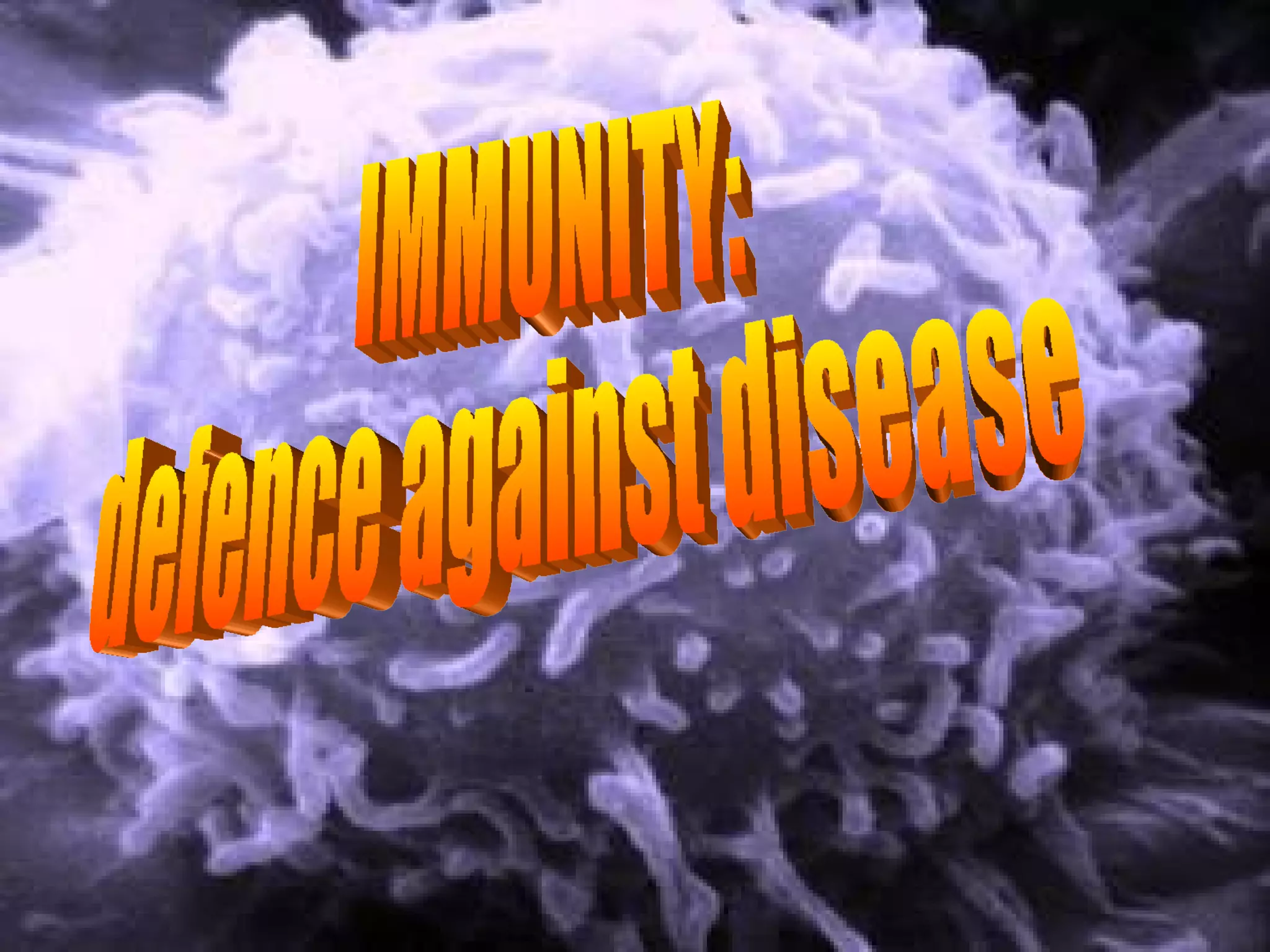
IMMUNITY: defence against disease
What is the Immune System? Immunity is all about the body’s ability to distinguish “self” from “non-self” Can be broadly separated in to ‘specific’ and ‘non-specific’ immunity.
Non-Specific Immunity First line of defence Prevention: barriers to foreign particles Skin (physical barrier including fats and salts) Mucous membranes (in throat / nose) Natural secretions (sweat, tears, stomach acid, milk, semen – all contain antimicrobial agents) Natural flora (good bacteria)
Second line of defence Phagocytes and Killer Cells … are white blood cells Phagocyctes are produced in the bone marrow and move to the point of entry of the foreign article and engulf / destroy Neutrophils (most common WBC) Monocytes (largest WBC) When leaving the blood, mature in to macrophages Can target free-floating microorganisms Will ingest and use some parts, excrete the rest
Second line of defence Natural Killer (NK) cells … are also white blood cells Target and destroy body cells that have been infected by viruses Other white blood cells Attach to and destroy multi-cellular pathogens that are too large to be engulfed
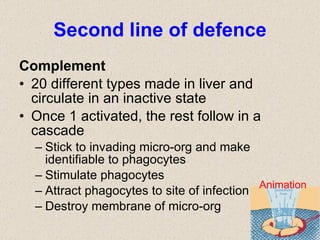
Second line of defence Complement 20 different types made in liver and circulate in an inactive state Once 1 activated, the rest follow in a cascade Stick to invading micro-org and make identifiable to phagocytes Stimulate phagocytes Attract phagocytes to site of infection Destroy membrane of micro-org Animation
Second line of defence Interferon An infected cell will release interferon that will stimulate the release of viral resistant proteins by nearby cells Cytokines Hormone-like (receptor specific) chemical messengers used by cells of the immune system
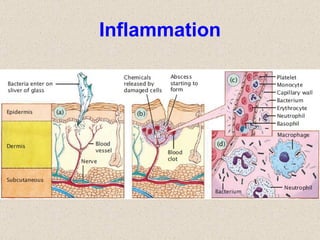
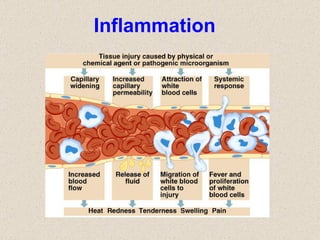
Second line of defence INFLAMMATION Release of seratonin causes arterioles around cut to dilate to increase blood flow and become more permeable to p’cytes P’cytes release histamine to attract more p’cytes Clot forms to contain infection Pus forms (living & dead WBCs and debris) Eventually re-absorbed by cells, excreted vi blood or secreted through skin
Inflammation
Inflammation
Specific Immunity Third line of defence Initiated by foreign particle entering body Adaptive & acquired Long lasting – often for life Recognises, reacts & remembers Reacts faster in future occurrences
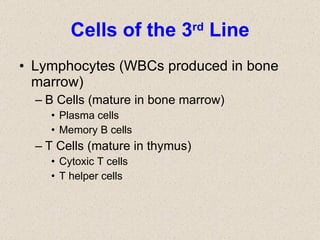
Cells of the 3 rd  Line Lymphocytes (WBCs produced in bone marrow) B Cells (mature in bone marrow) Plasma cells Memory B cells T Cells (mature in thymus) Cytoxic T cells T helper cells
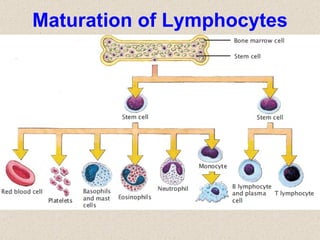
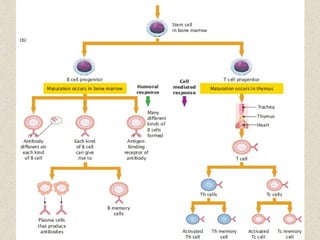
Maturation of Lymphocytes
 
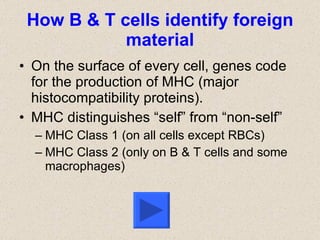
How B & T cells identify foreign material On the surface of every cell, genes code for the production of MHC (major histocompatibility proteins). MHC distinguishes “self” from “non-self” MHC Class 1 (on all cells except RBCs) MHC Class 2 (only on B & T cells and some macrophages)
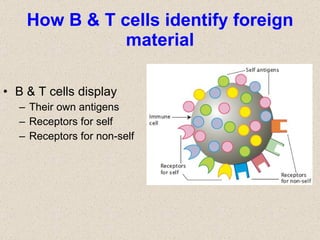
How B & T cells identify foreign material B & T cells display Their own antigens Receptors for self Receptors for non-self
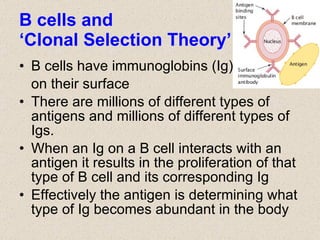
B cells and  ‘Clonal Selection Theory’ B cells have immunoglobins (Ig)  on their surface There are millions of different types of antigens and millions of different types of Igs. When an Ig on a B cell interacts with an antigen it results in the proliferation of that type of B cell and its corresponding Ig Effectively the antigen is determining what type of Ig becomes abundant in the body
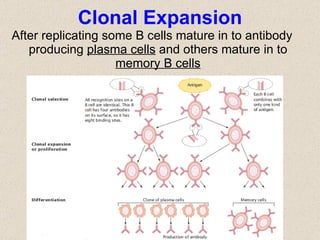
Clonal Expansion After replicating some B cells mature in to antibody producing  plasma cells  and others mature in to  memory B cells
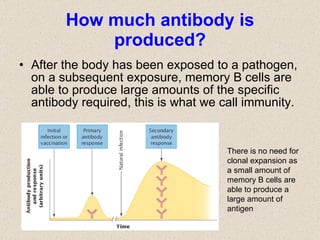
How much antibody is produced? After the body has been exposed to a pathogen, on a subsequent exposure, memory B cells are able to produce large amounts of the specific antibody required, this is what we call immunity. There is no need for clonal expansion as a small amount of memory B cells are able to produce a large amount of antigen
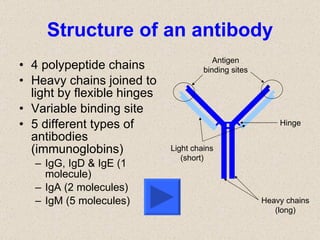
Structure of an antibody 4 polypeptide chains Heavy chains joined to light by flexible hinges Variable binding site 5 different types of antibodies (immunoglobins) IgG, IgD & IgE (1 molecule) IgA (2 molecules) IgM (5 molecules) Heavy chains (long) Light chains (short) Hinge Antigen binding sites
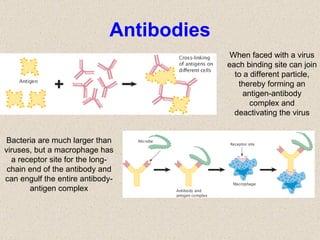
Antibodies When faced with a virus each binding site can join to a different particle, thereby forming an antigen-antibody complex and deactivating the virus Bacteria are much larger than viruses, but a macrophage has a receptor site for the long-chain end of the antibody and can engulf the entire antibody-antigen complex
T cells B cells are produced in the bone marrow but mature in the thymus. Similar to B cells, the body produces millions of varieties of T cells When a pathogen is encountered, the T cells with the corresponding binding site will proliferate. T cells do not produce antibodies – with phagocytes they form the body’s cellular immunity.
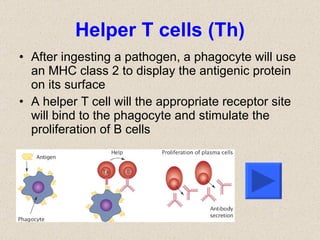
Helper T cells (Th) After ingesting a pathogen, a phagocyte will use an MHC class 2 to display the antigenic protein on its surface A helper T cell will the appropriate receptor site will bind to the phagocyte and stimulate the proliferation of B cells
Cytotoxic T cells (Tc) Uses MHC class 1 & 2 molecules to identify whether a cell contains any ‘non-self’ proteins Destroys cells via proteins that punch holes in the cell membrane Will ideally destroy a cell before a the contained virus can replicate Can’t kill free-floating virus particles (non-cellular agents)
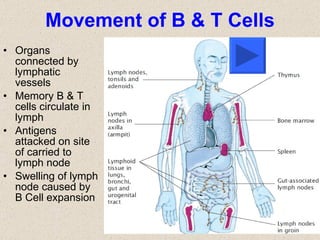
Movement of B & T Cells Organs connected by lymphatic vessels Memory B & T cells circulate in lymph Antigens attacked on site of carried to lymph node Swelling of lymph node caused by B Cell expansion
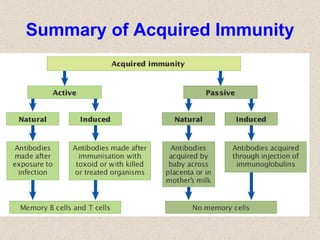
Acquiring Specific Immunity Active Immunity Natural  (B & T cell proliferation in response to    antigen) Induced  (Immune response triggered by    induced antigen A dead microorganism Attenuated (unable to reproduce) microorganism Toxoid (artificial low-dose toxin) Booster shot on any of the above may be required to maintain immunity (maintain levels of B & T memory cells in lymph) Passive Immunity Natural  (mother to foetus / breastfeeding baby) Induced  (administered antibiotic)
Passive Immunity Called passive as the antibodies are not made by user An advantage is that the user receives a lot of antibodies in a very short space of time A disadvantage is that the immunity is temporary as no memory cells are created
Summary of Acquired Immunity
Monoclonal antibody production Snake antivenom is produced in rabbits Rabbit is injected with very small dose of venom to produce immune response Doses of venom gradually increased Blood harvested, antibodies isolated Rabbit makes more blood with more antibodies
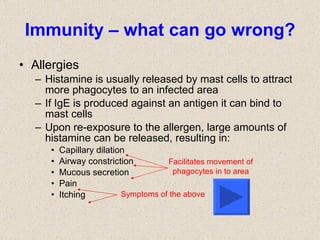
Immunity – what can go wrong? Allergies Histamine is usually released by mast cells to attract more phagocytes to an infected area If IgE is produced against an antigen it can bind to mast cells Upon re-exposure to the allergen, large amounts of histamine can be released, resulting in: Capillary dilation Airway constriction Mucous secretion Pain Itching Facilitates movement of  phagocytes in to area   Symptoms of the above
Rh Incompatibility Human blood cells have certain marker proteins that belong to either the ABO or Rhesus (Rh) blood group Rh is inherited as a dominant allele, so Rh + Rh +  or Rh + Rh -  = Rh positive Rh - Rh -  = Rh negative  So an Rh -  mother can still have an Rh +  child due to the father’s genotype
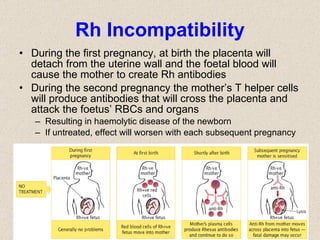
Rh Incompatibility During the first pregnancy, at birth the placenta will detach from the uterine wall and the foetal blood will cause the mother to create Rh antibodies During the second pregnancy the mother’s T helper cells will produce antibodies that will cross the placenta and attack the foetus’ RBCs and organs Resulting in haemolytic disease of the newborn If untreated, effect will worsen with each subsequent pregnancy
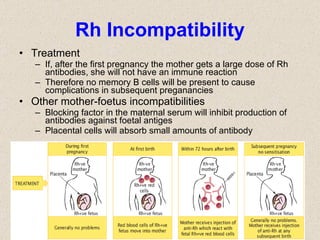
Rh Incompatibility Treatment If, after the first pregnancy the mother gets a large dose of Rh antibodies, she will not have an immune reaction  Therefore no memory B cells will be present to cause complications in subsequent preganancies Other mother-foetus incompatibilities Blocking factor in the maternal serum will inhibit production of antibodies against foetal antiges Placental cells will absorb small amounts of antibody
Auto-immune diseases Breakdown of ability to distinguish ‘self ‘from ‘non-self’ B & T cells attack and destroy own body cells eg. Multiple sclerosis (MS), approx 1:1000 Immune system attacks own myelin sheath Results in short-circuits in the CNS and impaired communication between CNS and PNS Sites of damage can vary so symptoms differ Damage from initial attack/s can be repaired As more attacks occur scarring (plaques) build up Once this occurs damage can’t be reversed Disease is progressive in nature
Multiple Sclerosis Diagnosis Originally had to be done via observations Now an MRI can be used to find areas of brain with higher water content (plaques) Cause Unknown but possibly linked to a viruses which have proteins very simillar to our myelin proteins. Once the immune system disposes if it,, it continues to attack myelin sheath Strong linkage with people living in colder climates Treatment Nothing very effective Cortisone & B interferon can cause mild temporary improvement
Rejection of Organ Transplant Only identical twins can be a perfect match Recipient and donor typed to match as closely as possible Helper T cells are the main immune cell responsible for transplant rejection Recipient must take cyclosporin (a helper T cell inhibitor) for the rest of their lives to prevent rejection
Immune Deficiency Disease (IDD) Immune system is immature at birth Once maternal antibodies from placenta and breast milk wear off, baby is exposed If immune system dysfunctional, death will occur not long afterwards People can be sustained through the donation of bone marrow (where immune cells are produced) Donor and recipient must be typed on ABO, Rh and a number of other MHCs
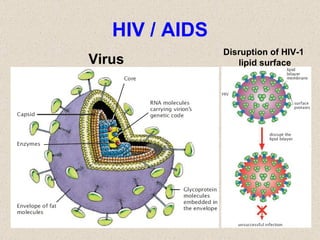
Acquired Immune Deficiency Syndrome (AIDS) Caused by the Human Immunodeficiency Virus (HIV) Infects only Helper T Cells and macrophages Victims will usually die of a disease or infection that their body could not fight off HIV can lay dormant for years Death will usually follow onset of “full-blown” AIDS Drugs that affect the membrane lipid bilayer of the virus can delay death
HIV / AIDS Virus Disruption of HIV-1  lipid surface
Plants Plants have no true immune system Resistance to infectious agents has evolved through natural selection Plants have mechanical barriers to infection Cuticle and epidermal cells form barrier Infection will often enter through stomata Plants have chemical barriers to infection Citrus and mint plants produce oils Stone fruit plants seal off infection site with “gum’ Other plants have resins, tanins and phenolic substances

8 - Immunity: Defence Against Disease

  • 1.
  • 2.
    What is theImmune System? Immunity is all about the body’s ability to distinguish “self” from “non-self” Can be broadly separated in to ‘specific’ and ‘non-specific’ immunity.
  • 3.
    Non-Specific Immunity Firstline of defence Prevention: barriers to foreign particles Skin (physical barrier including fats and salts) Mucous membranes (in throat / nose) Natural secretions (sweat, tears, stomach acid, milk, semen – all contain antimicrobial agents) Natural flora (good bacteria)
  • 4.
    Second line ofdefence Phagocytes and Killer Cells … are white blood cells Phagocyctes are produced in the bone marrow and move to the point of entry of the foreign article and engulf / destroy Neutrophils (most common WBC) Monocytes (largest WBC) When leaving the blood, mature in to macrophages Can target free-floating microorganisms Will ingest and use some parts, excrete the rest
  • 5.
    Second line ofdefence Natural Killer (NK) cells … are also white blood cells Target and destroy body cells that have been infected by viruses Other white blood cells Attach to and destroy multi-cellular pathogens that are too large to be engulfed
  • 6.
    Second line ofdefence Complement 20 different types made in liver and circulate in an inactive state Once 1 activated, the rest follow in a cascade Stick to invading micro-org and make identifiable to phagocytes Stimulate phagocytes Attract phagocytes to site of infection Destroy membrane of micro-org Animation
  • 7.
    Second line ofdefence Interferon An infected cell will release interferon that will stimulate the release of viral resistant proteins by nearby cells Cytokines Hormone-like (receptor specific) chemical messengers used by cells of the immune system
  • 8.
    Second line ofdefence INFLAMMATION Release of seratonin causes arterioles around cut to dilate to increase blood flow and become more permeable to p’cytes P’cytes release histamine to attract more p’cytes Clot forms to contain infection Pus forms (living & dead WBCs and debris) Eventually re-absorbed by cells, excreted vi blood or secreted through skin
  • 9.
  • 10.
  • 11.
    Specific Immunity Thirdline of defence Initiated by foreign particle entering body Adaptive & acquired Long lasting – often for life Recognises, reacts & remembers Reacts faster in future occurrences
  • 12.
    Cells of the3 rd Line Lymphocytes (WBCs produced in bone marrow) B Cells (mature in bone marrow) Plasma cells Memory B cells T Cells (mature in thymus) Cytoxic T cells T helper cells
  • 13.
  • 14.
  • 15.
    How B &T cells identify foreign material On the surface of every cell, genes code for the production of MHC (major histocompatibility proteins). MHC distinguishes “self” from “non-self” MHC Class 1 (on all cells except RBCs) MHC Class 2 (only on B & T cells and some macrophages)
  • 16.
    How B &T cells identify foreign material B & T cells display Their own antigens Receptors for self Receptors for non-self
  • 17.
    B cells and ‘Clonal Selection Theory’ B cells have immunoglobins (Ig) on their surface There are millions of different types of antigens and millions of different types of Igs. When an Ig on a B cell interacts with an antigen it results in the proliferation of that type of B cell and its corresponding Ig Effectively the antigen is determining what type of Ig becomes abundant in the body
  • 18.
    Clonal Expansion Afterreplicating some B cells mature in to antibody producing plasma cells and others mature in to memory B cells
  • 19.
    How much antibodyis produced? After the body has been exposed to a pathogen, on a subsequent exposure, memory B cells are able to produce large amounts of the specific antibody required, this is what we call immunity. There is no need for clonal expansion as a small amount of memory B cells are able to produce a large amount of antigen
  • 20.
    Structure of anantibody 4 polypeptide chains Heavy chains joined to light by flexible hinges Variable binding site 5 different types of antibodies (immunoglobins) IgG, IgD & IgE (1 molecule) IgA (2 molecules) IgM (5 molecules) Heavy chains (long) Light chains (short) Hinge Antigen binding sites
  • 21.
    Antibodies When facedwith a virus each binding site can join to a different particle, thereby forming an antigen-antibody complex and deactivating the virus Bacteria are much larger than viruses, but a macrophage has a receptor site for the long-chain end of the antibody and can engulf the entire antibody-antigen complex
  • 22.
    T cells Bcells are produced in the bone marrow but mature in the thymus. Similar to B cells, the body produces millions of varieties of T cells When a pathogen is encountered, the T cells with the corresponding binding site will proliferate. T cells do not produce antibodies – with phagocytes they form the body’s cellular immunity.
  • 23.
    Helper T cells(Th) After ingesting a pathogen, a phagocyte will use an MHC class 2 to display the antigenic protein on its surface A helper T cell will the appropriate receptor site will bind to the phagocyte and stimulate the proliferation of B cells
  • 24.
    Cytotoxic T cells(Tc) Uses MHC class 1 & 2 molecules to identify whether a cell contains any ‘non-self’ proteins Destroys cells via proteins that punch holes in the cell membrane Will ideally destroy a cell before a the contained virus can replicate Can’t kill free-floating virus particles (non-cellular agents)
  • 25.
    Movement of B& T Cells Organs connected by lymphatic vessels Memory B & T cells circulate in lymph Antigens attacked on site of carried to lymph node Swelling of lymph node caused by B Cell expansion
  • 26.
    Acquiring Specific ImmunityActive Immunity Natural (B & T cell proliferation in response to antigen) Induced (Immune response triggered by induced antigen A dead microorganism Attenuated (unable to reproduce) microorganism Toxoid (artificial low-dose toxin) Booster shot on any of the above may be required to maintain immunity (maintain levels of B & T memory cells in lymph) Passive Immunity Natural (mother to foetus / breastfeeding baby) Induced (administered antibiotic)
  • 27.
    Passive Immunity Calledpassive as the antibodies are not made by user An advantage is that the user receives a lot of antibodies in a very short space of time A disadvantage is that the immunity is temporary as no memory cells are created
  • 28.
  • 29.
    Monoclonal antibody productionSnake antivenom is produced in rabbits Rabbit is injected with very small dose of venom to produce immune response Doses of venom gradually increased Blood harvested, antibodies isolated Rabbit makes more blood with more antibodies
  • 30.
    Immunity – whatcan go wrong? Allergies Histamine is usually released by mast cells to attract more phagocytes to an infected area If IgE is produced against an antigen it can bind to mast cells Upon re-exposure to the allergen, large amounts of histamine can be released, resulting in: Capillary dilation Airway constriction Mucous secretion Pain Itching Facilitates movement of phagocytes in to area Symptoms of the above
  • 31.
    Rh Incompatibility Humanblood cells have certain marker proteins that belong to either the ABO or Rhesus (Rh) blood group Rh is inherited as a dominant allele, so Rh + Rh + or Rh + Rh - = Rh positive Rh - Rh - = Rh negative So an Rh - mother can still have an Rh + child due to the father’s genotype
  • 32.
    Rh Incompatibility Duringthe first pregnancy, at birth the placenta will detach from the uterine wall and the foetal blood will cause the mother to create Rh antibodies During the second pregnancy the mother’s T helper cells will produce antibodies that will cross the placenta and attack the foetus’ RBCs and organs Resulting in haemolytic disease of the newborn If untreated, effect will worsen with each subsequent pregnancy
  • 33.
    Rh Incompatibility TreatmentIf, after the first pregnancy the mother gets a large dose of Rh antibodies, she will not have an immune reaction Therefore no memory B cells will be present to cause complications in subsequent preganancies Other mother-foetus incompatibilities Blocking factor in the maternal serum will inhibit production of antibodies against foetal antiges Placental cells will absorb small amounts of antibody
  • 34.
    Auto-immune diseases Breakdownof ability to distinguish ‘self ‘from ‘non-self’ B & T cells attack and destroy own body cells eg. Multiple sclerosis (MS), approx 1:1000 Immune system attacks own myelin sheath Results in short-circuits in the CNS and impaired communication between CNS and PNS Sites of damage can vary so symptoms differ Damage from initial attack/s can be repaired As more attacks occur scarring (plaques) build up Once this occurs damage can’t be reversed Disease is progressive in nature
  • 35.
    Multiple Sclerosis DiagnosisOriginally had to be done via observations Now an MRI can be used to find areas of brain with higher water content (plaques) Cause Unknown but possibly linked to a viruses which have proteins very simillar to our myelin proteins. Once the immune system disposes if it,, it continues to attack myelin sheath Strong linkage with people living in colder climates Treatment Nothing very effective Cortisone & B interferon can cause mild temporary improvement
  • 36.
    Rejection of OrganTransplant Only identical twins can be a perfect match Recipient and donor typed to match as closely as possible Helper T cells are the main immune cell responsible for transplant rejection Recipient must take cyclosporin (a helper T cell inhibitor) for the rest of their lives to prevent rejection
  • 37.
    Immune Deficiency Disease(IDD) Immune system is immature at birth Once maternal antibodies from placenta and breast milk wear off, baby is exposed If immune system dysfunctional, death will occur not long afterwards People can be sustained through the donation of bone marrow (where immune cells are produced) Donor and recipient must be typed on ABO, Rh and a number of other MHCs
  • 38.
    Acquired Immune DeficiencySyndrome (AIDS) Caused by the Human Immunodeficiency Virus (HIV) Infects only Helper T Cells and macrophages Victims will usually die of a disease or infection that their body could not fight off HIV can lay dormant for years Death will usually follow onset of “full-blown” AIDS Drugs that affect the membrane lipid bilayer of the virus can delay death
  • 39.
    HIV / AIDSVirus Disruption of HIV-1 lipid surface
  • 40.
    Plants Plants haveno true immune system Resistance to infectious agents has evolved through natural selection Plants have mechanical barriers to infection Cuticle and epidermal cells form barrier Infection will often enter through stomata Plants have chemical barriers to infection Citrus and mint plants produce oils Stone fruit plants seal off infection site with “gum’ Other plants have resins, tanins and phenolic substances