TONOMETRY
H.Kangari O.D.
Different technique in measurement of the
Intra Ocular Pressure(IOP):
 Goldmann Applination Tonometry
 Perkins Tonometer
 Non-Contact Tonometry
 Digital Evaluation


TONOMETRY/H.KangariO.D.

2
Goldmann Applination Tonometry is the
most accurate method of measuring
Intraocular Pressure.
 Measuring the intraocular pressure is
important in diagnosis and management
of Glaucoma and Ocular Hypertension.


TONOMETRY/H.KangariO.D.

3
CONTRAINDICATIONS TO IOP
MEASUREMENT WITH GOLDMAN
TECHNIQUE
1)Active Infection
 2)Patients with recurrent corneal erosions
 3) Corneal abrasions that are not totally
healed


TONOMETRY/H.KangariO.D.

4


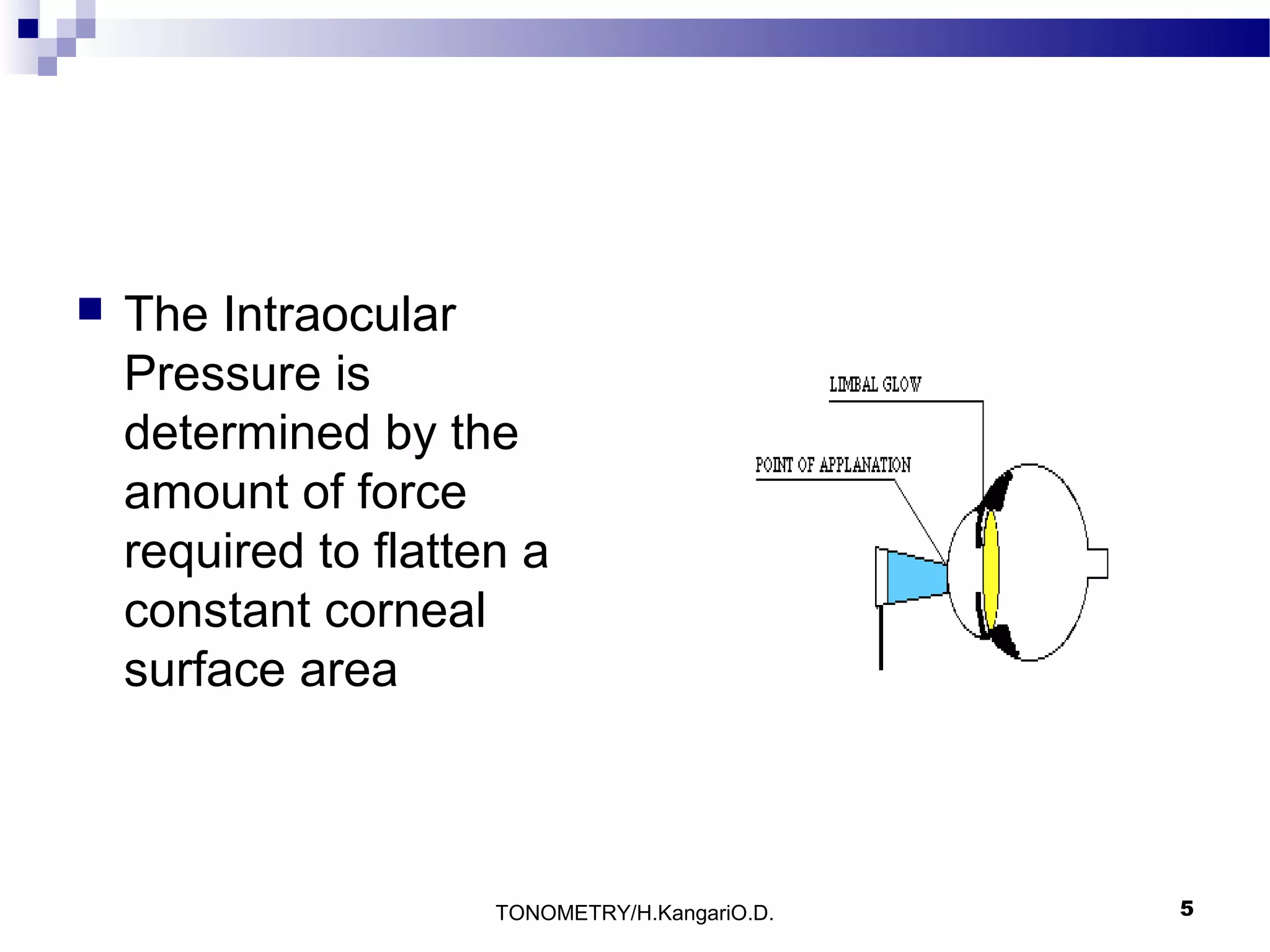
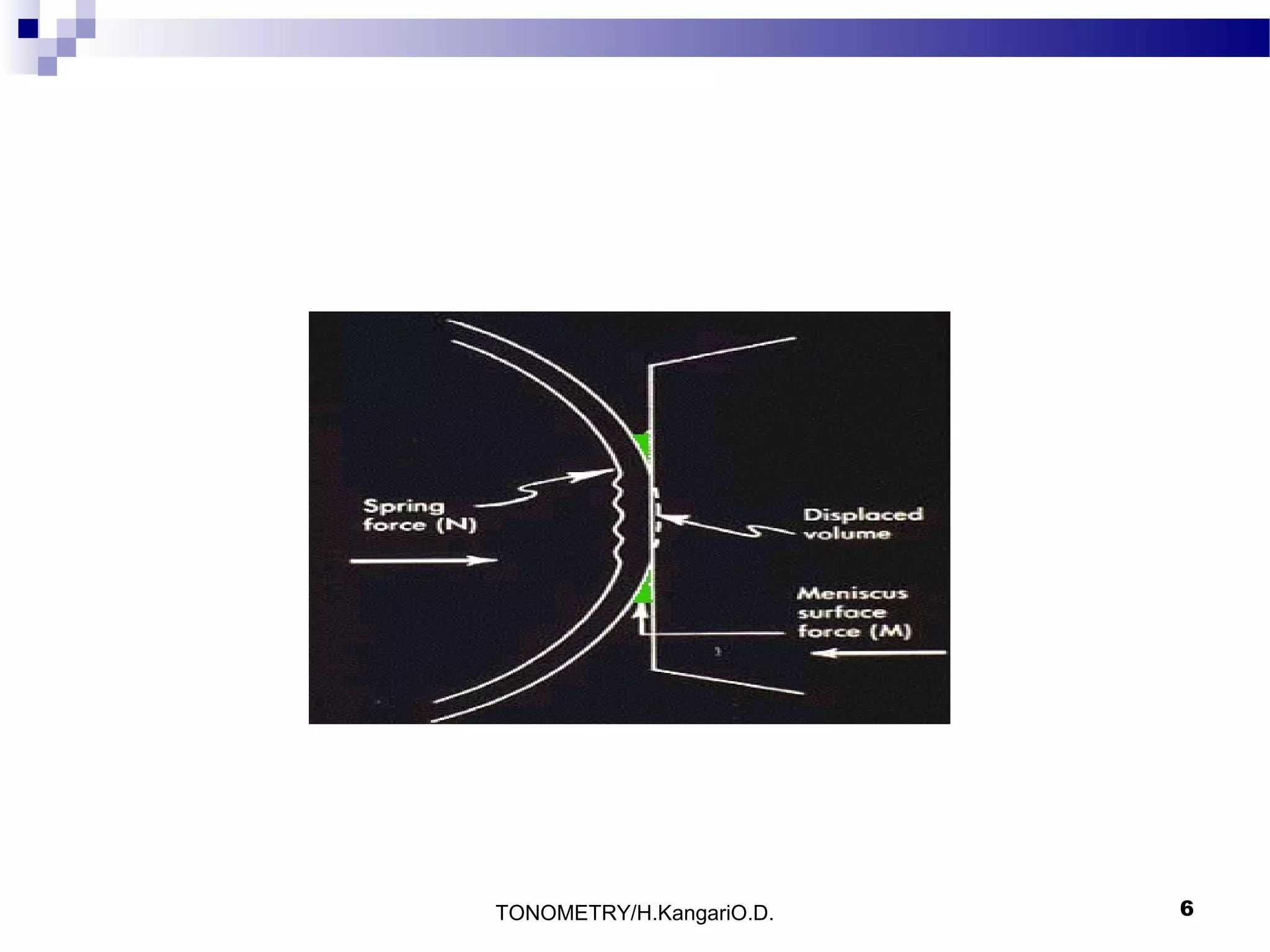
The Intraocular
Pressure is
determined by the
amount of force
required to flatten a
constant corneal
surface area

TONOMETRY/H.KangariO.D.

5
TONOMETRY/H.KangariO.D.

6
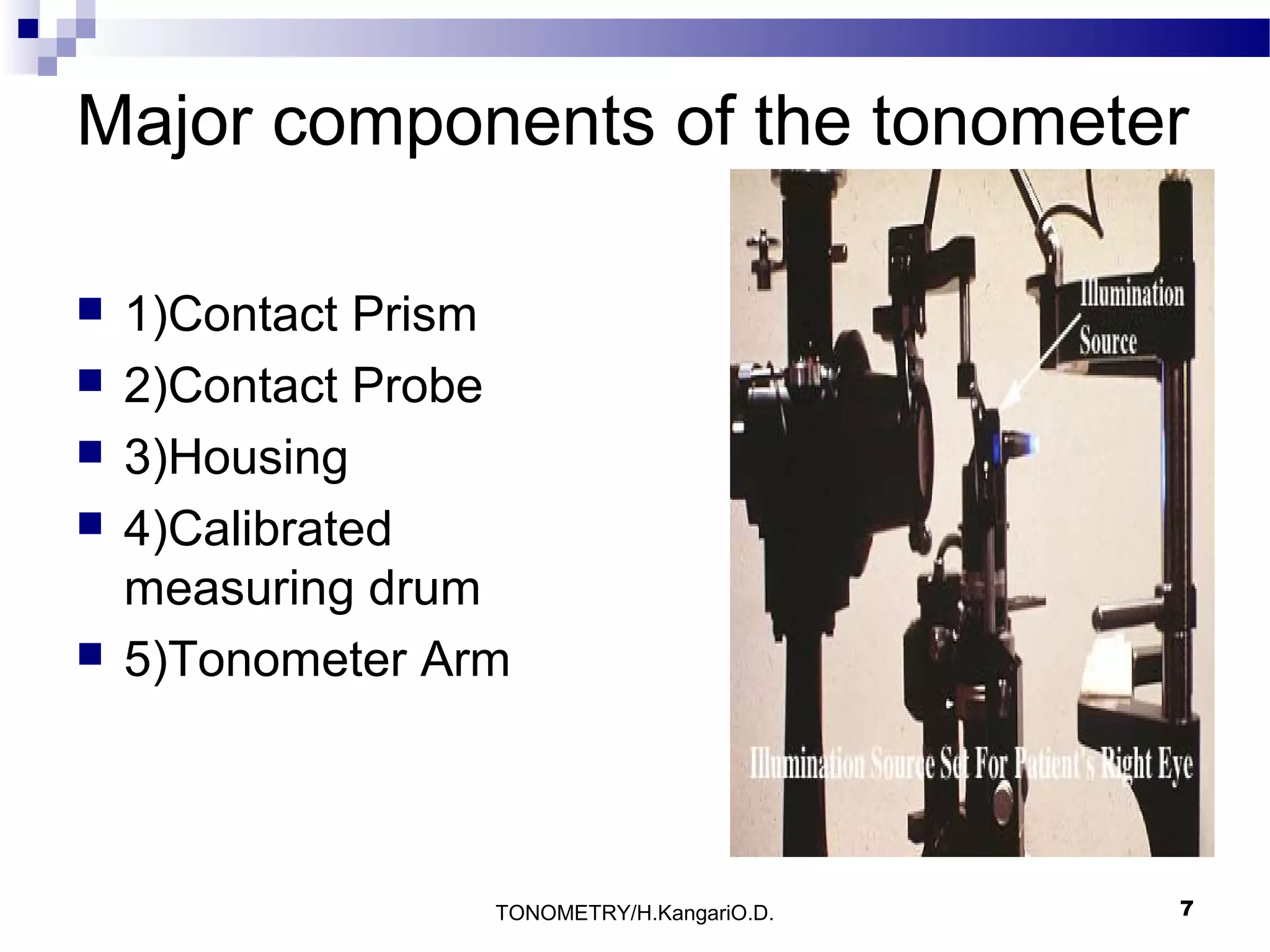
Major components of the tonometer







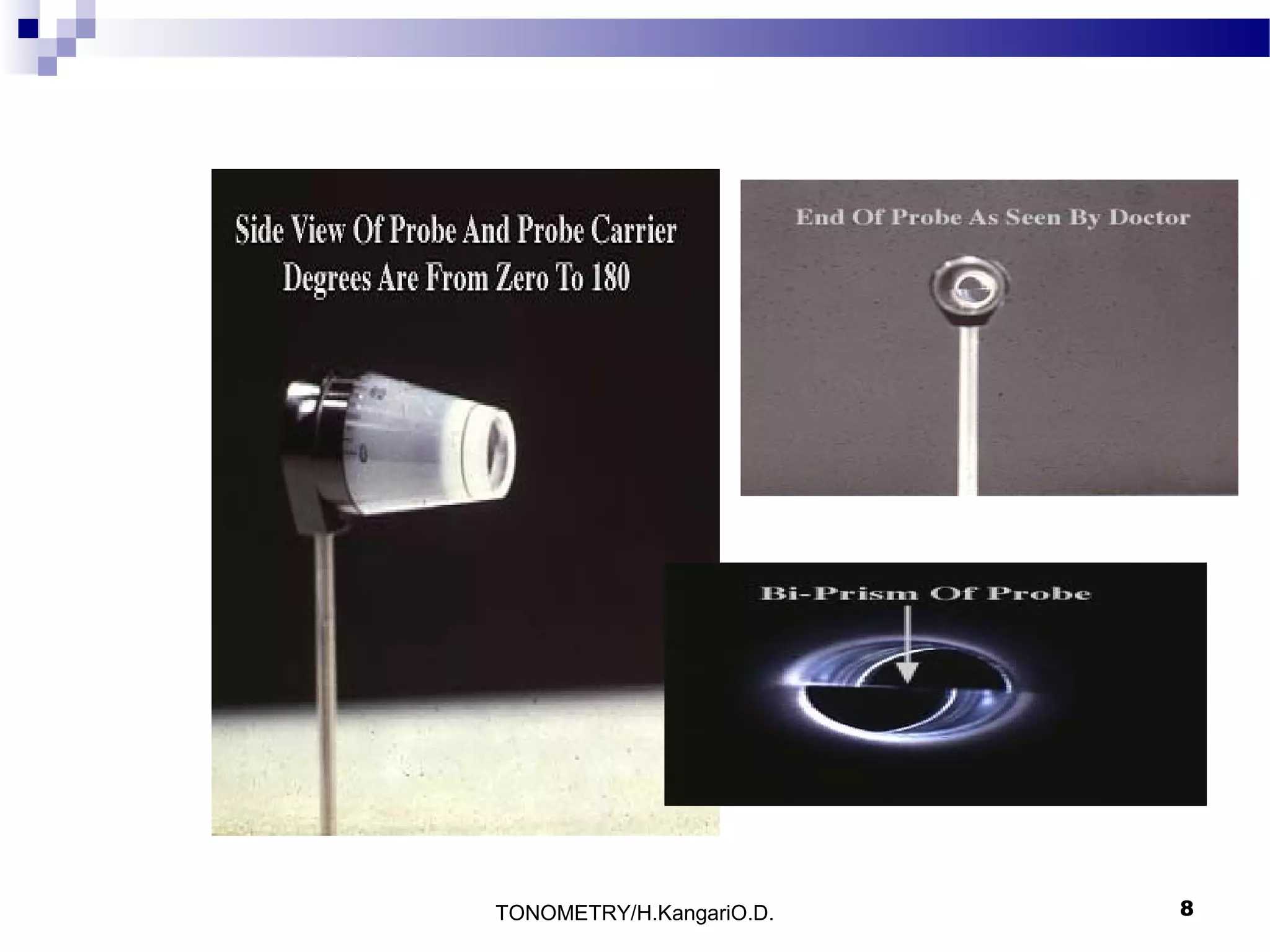
1)Contact Prism
2)Contact Probe
3)Housing
4)Calibrated
measuring drum
5)Tonometer Arm

TONOMETRY/H.KangariO.D.

7
TONOMETRY/H.KangariO.D.

8
TONOMETRY/H.KangariO.D.

9
CHECKING THE
INSTRUMENT







To calibrate the instrument a control weight bar
is used. Only a trained technician can calibrate
the tonometer.
To grossly check the calibration:
Turn the measuring drum below zero (the arm
should move backward)
Then turn the measuring drum past the zero
mark and the arm should move forward.
The arm should move in the same degree in
both direction, above and below the zero mark.
TONOMETRY/H.KangariO.D.

10
PROBE STERILAZATION








Always clean the tonometer probe before and
after each use.
Remove the probe from contact holder (hold the
arm before you remove the probe)
Wet a tissue with alcohol and apply to probe in a
circular fashion for 5 seconds.
Rinse the probe with Saline Solution and blot dry
with a tissue.
TONOMETRY/H.KangariO.D.

11
PROBE STERILAZATION
OR insert the probe into Hydrogen
Peroxide 3% for 5 to 10 minutes.
 Rinse the probe with Saline Solution and
blot dry with a tissue.


TONOMETRY/H.KangariO.D.

12
CLEANING & STERILIZING THE
PROBE


some factors to be considered such as the following:



(1) 3% H2O2 will ruin the probes in a short period of time and if not properly
dried can cause marked pain and a secondary anterior uveitis that is very
difficult to resolve. Minimum of 5 minutes maximum of 10 minutes.



(2) 70% Isopropyl alcohol will also destroy the probes and if not properly
dried can also cause marked pain and a secondary anterior uveitis that is
very difficult to resolve.
When Using Either Of The Above Recommended Procedures Make Sure
You Always Rinse The Probe Thoroughly With Saline Solution Then Dry It
Completely Before Using It On The Patient's Eye. Never Leave The Probe
In The Hydrogen Peroxide For Longer Than 10 Minutes.



TONOMETRY/H.KangariO.D.

13




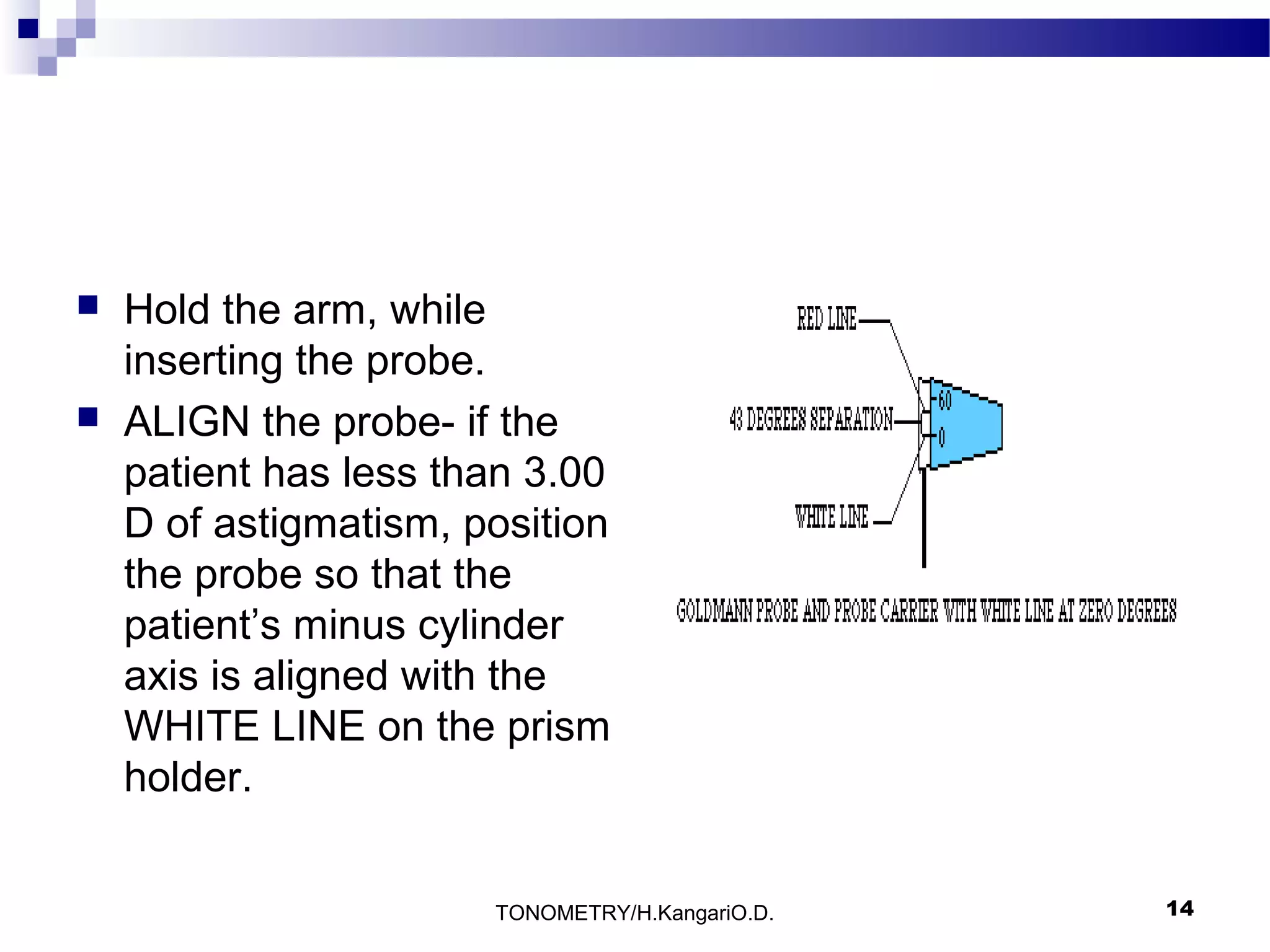
Hold the arm, while
inserting the probe.
ALIGN the probe- if the
patient has less than 3.00
D of astigmatism, position
the probe so that the
patient’s minus cylinder
axis is aligned with the
WHITE LINE on the prism
holder.
TONOMETRY/H.KangariO.D.

14


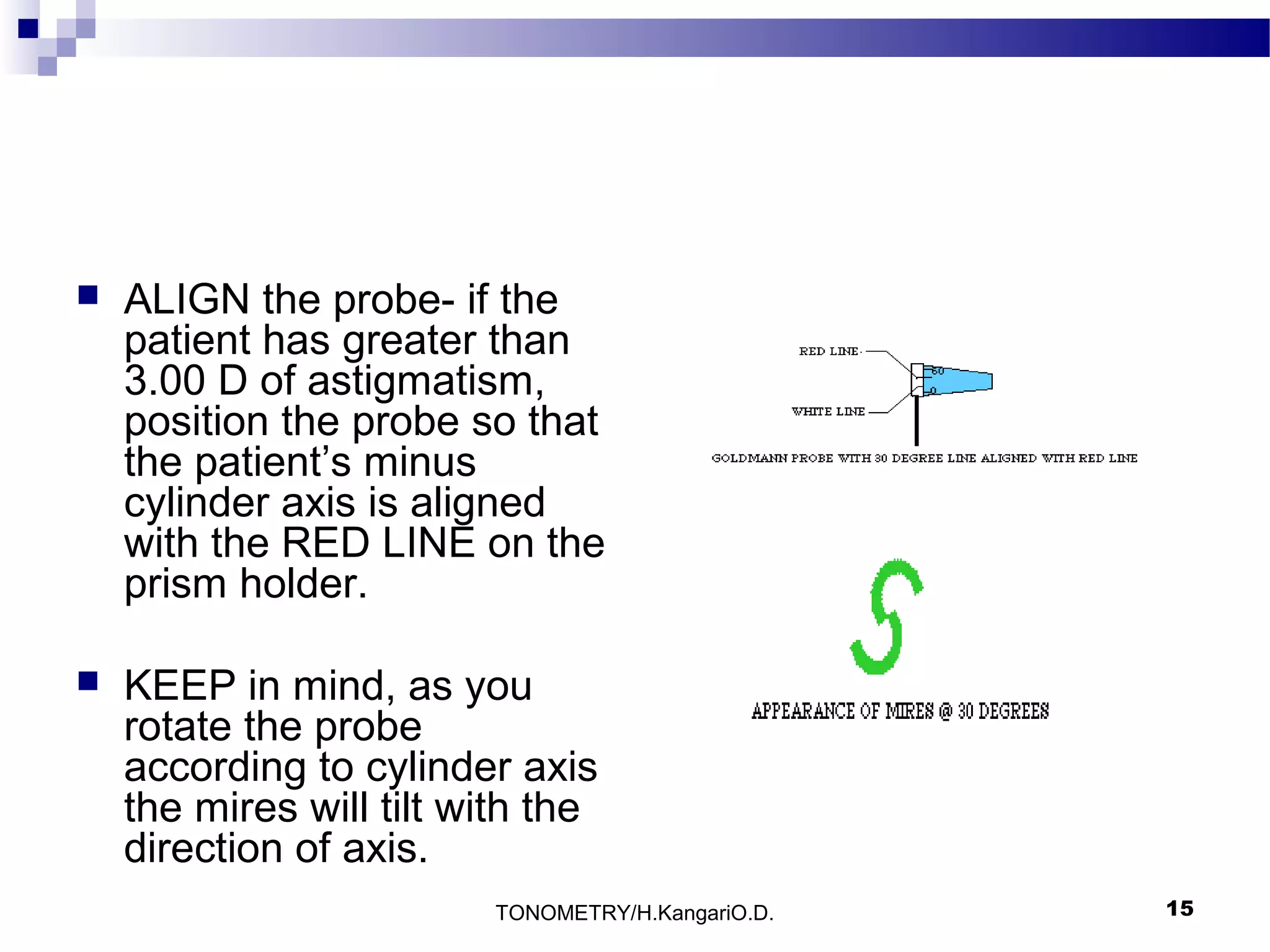
ALIGN the probe- if the
patient has greater than
3.00 D of astigmatism,
position the probe so that
the patient’s minus
cylinder axis is aligned
with the RED LINE on the
prism holder.



KEEP in mind, as you
rotate the probe
according to cylinder axis
the mires will tilt with the
direction of axis.
TONOMETRY/H.KangariO.D.

15
PATIENT PREPARATION







After you have completed a full refractive,
binocular and slit lamp evaluation proceed to
tonometry.
Anesthetize the cornea. Inform the patient that
you are going to put a drop in their eye which will
burn and their lids will feel heavy afterwards.
Place a drop of Tetracaine 0.5% in each eye
Wet a strip of fluorescein with sterile saline and
place it is superior or inferior bulbar conjunctiva.
TONOMETRY/H.KangariO.D.

16
Position the patient comfortably at slit
lamp.
 With the COBALT BLUE filter scan the
cornea
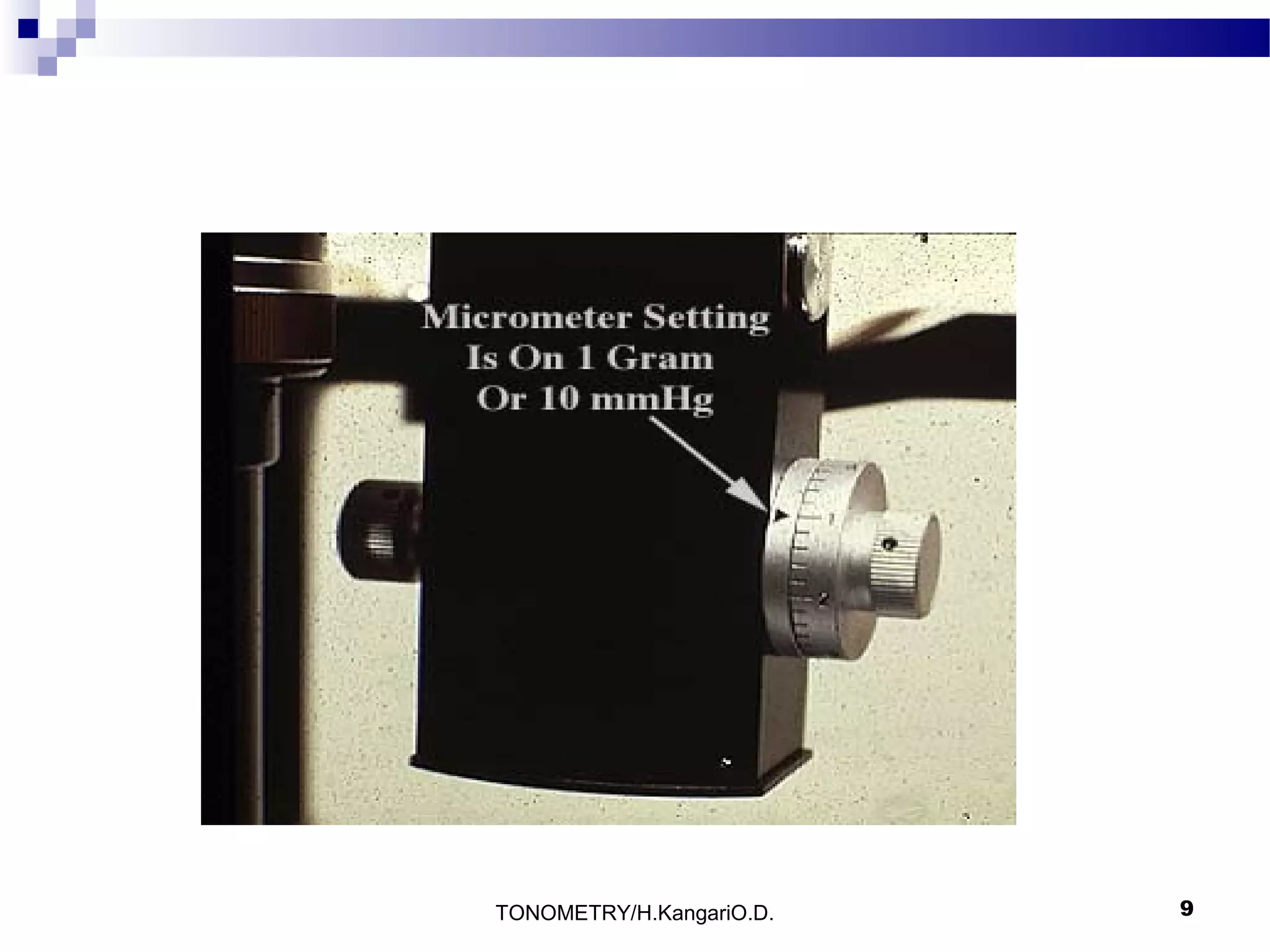
 Place the measuring drum at 10 mmHg
 Use Low Magnification


TONOMETRY/H.KangariO.D.

17



Give proper instructions to the patient:
“ I want you to keep your forehead and Chin in
the rest all the time. I want you to look at this
point ( based on the eye being tested give an
appropriate place for the patient to look at ).
Keep your eyes open as wide as you can and try
not to blink. I am going get close to your eye with
this blue light.

TONOMETRY/H.KangariO.D.

18
APPLINATION
From the outside instrument get as close
as you can to the cornea and center the
probe on the cornea.
 If you now look in through the microscope,
you will see two faint blue mires (semi
circles)
 If you don’t see this, AGAIN center the
probe from the outside of the instrument.


TONOMETRY/H.KangariO.D.

19
When you see two faint mires, move in the
instrument with the joy stick to touch the
cornea.
 When you touch the cornea, the mires will
turn fluorescent green.


TONOMETRY/H.KangariO.D.

20


If semicircles move freely with the rotation
of the measuring drum, the initial contact
is correct.

TONOMETRY/H.KangariO.D.

21




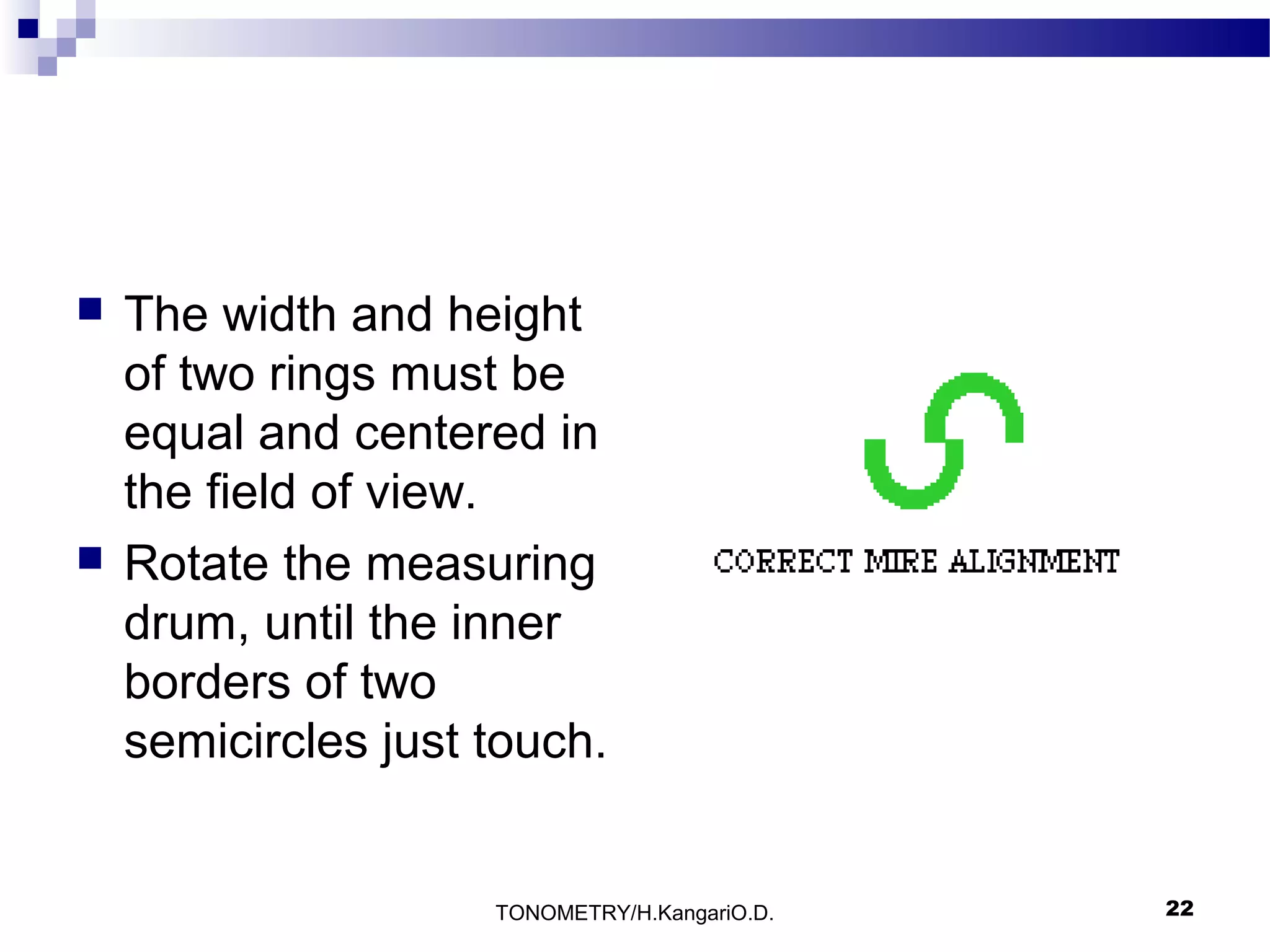
The width and height
of two rings must be
equal and centered in
the field of view.
Rotate the measuring
drum, until the inner
borders of two
semicircles just touch.

TONOMETRY/H.KangariO.D.

22
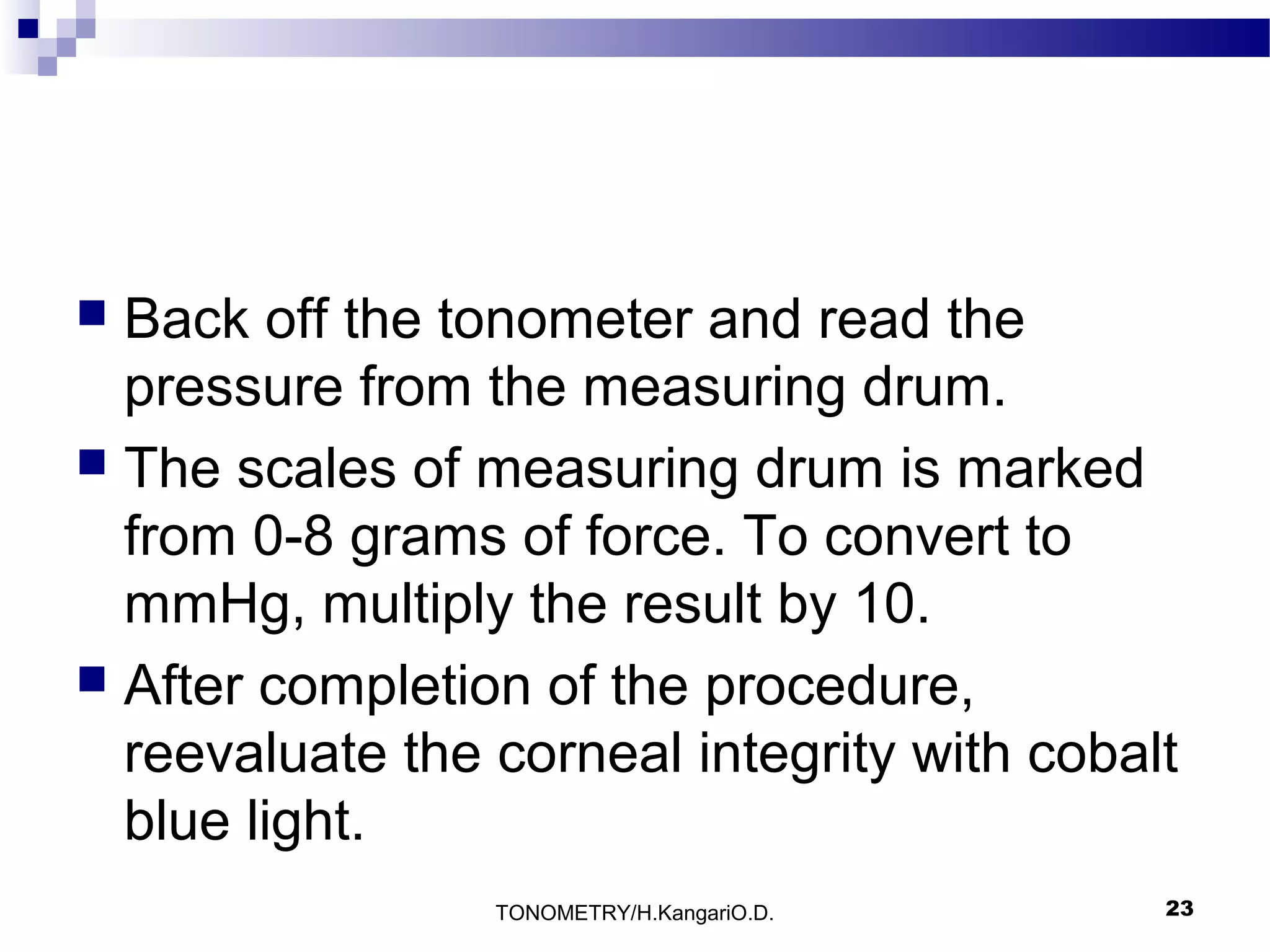
Back off the tonometer and read the
pressure from the measuring drum.
 The scales of measuring drum is marked
from 0-8 grams of force. To convert to
mmHg, multiply the result by 10.
 After completion of the procedure,
reevaluate the corneal integrity with cobalt
blue light.


TONOMETRY/H.KangariO.D.

23


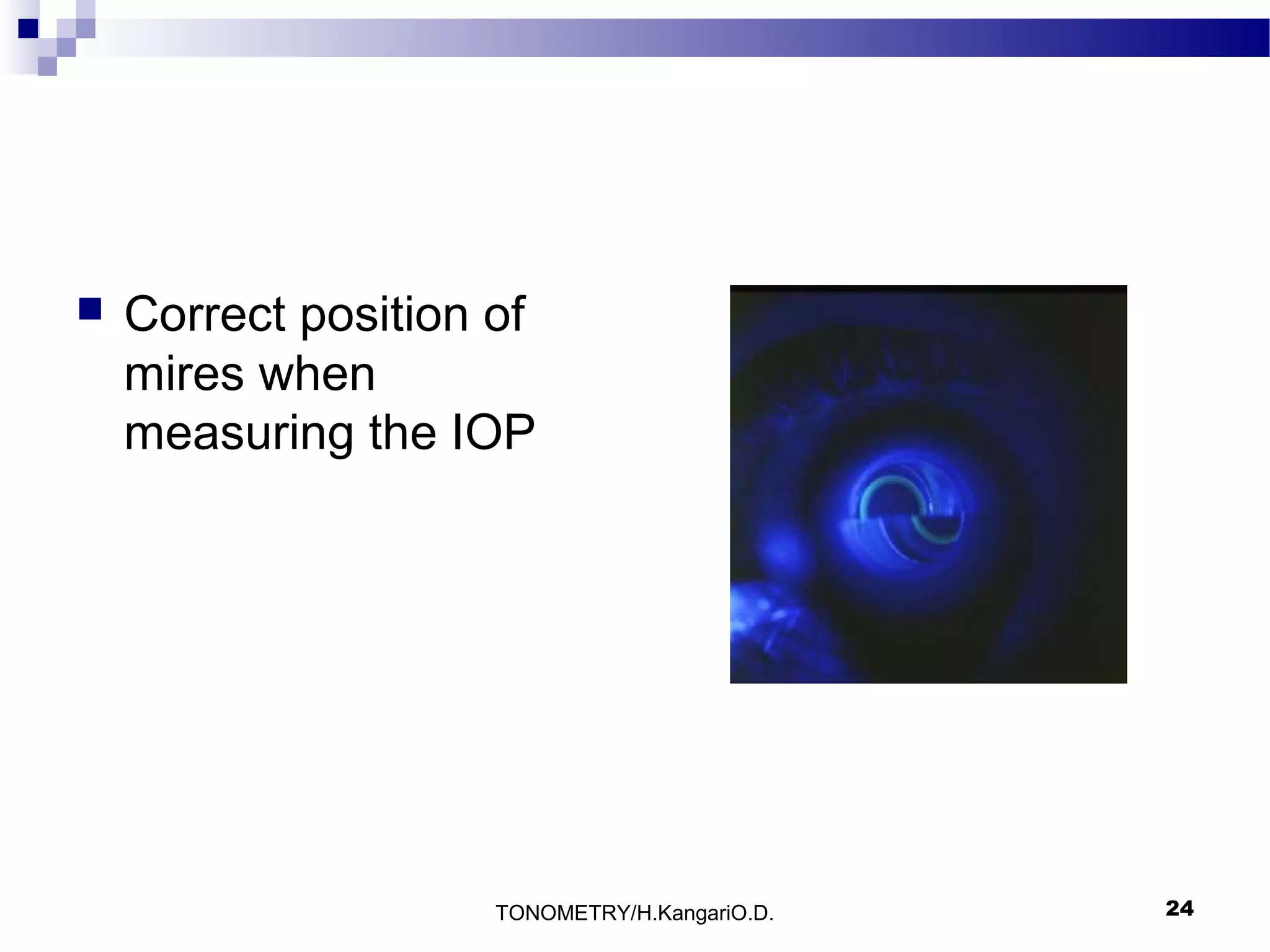
Correct position of
mires when
measuring the IOP

TONOMETRY/H.KangariO.D.

24




If this is the left eye,
the contact of the
probe is too much to
temporal side.
Move the probe to
nasal side

TONOMETRY/H.KangariO.D.

25
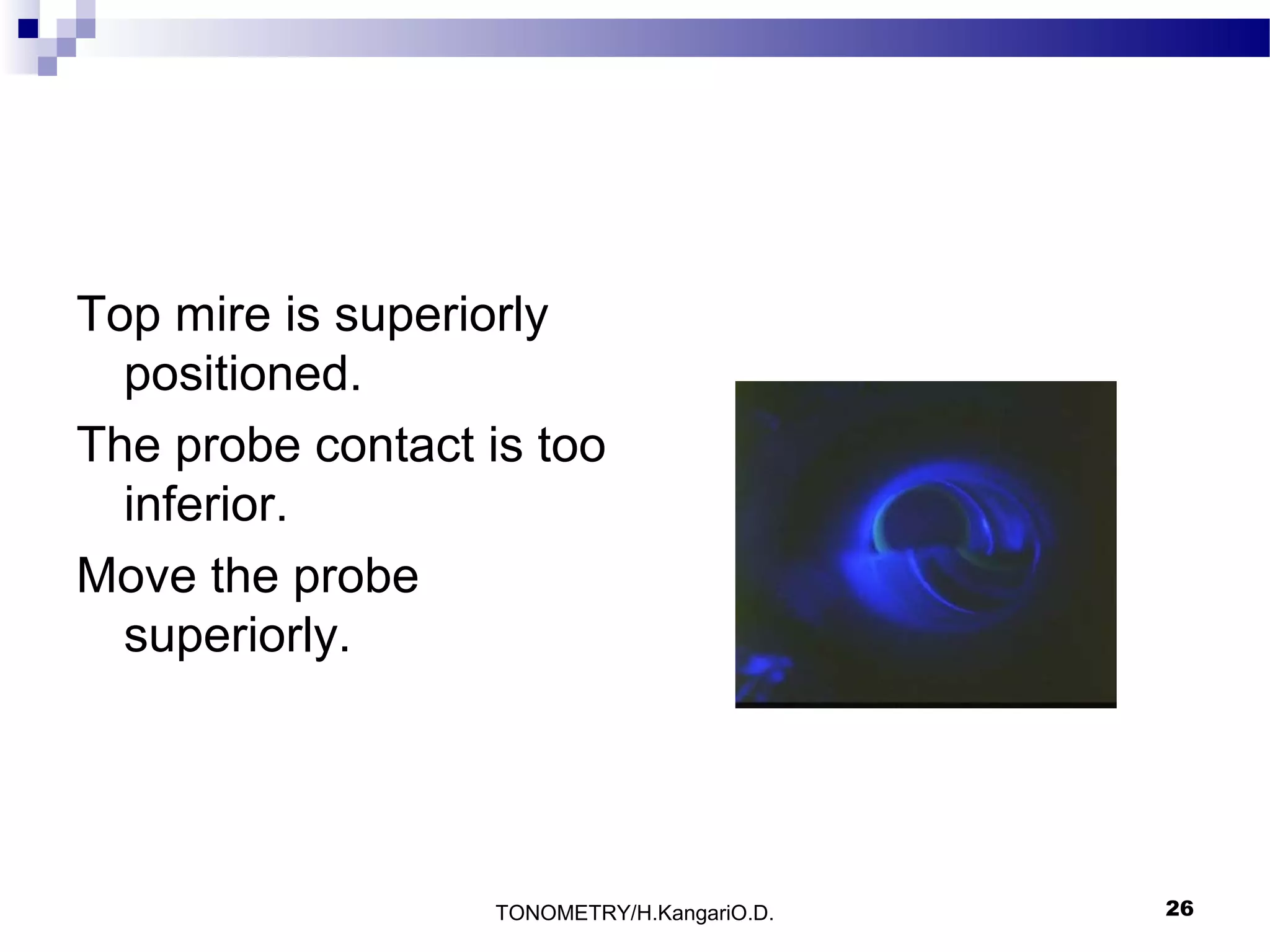
Top mire is superiorly
positioned.
The probe contact is too
inferior.
Move the probe
superiorly.

TONOMETRY/H.KangariO.D.

26




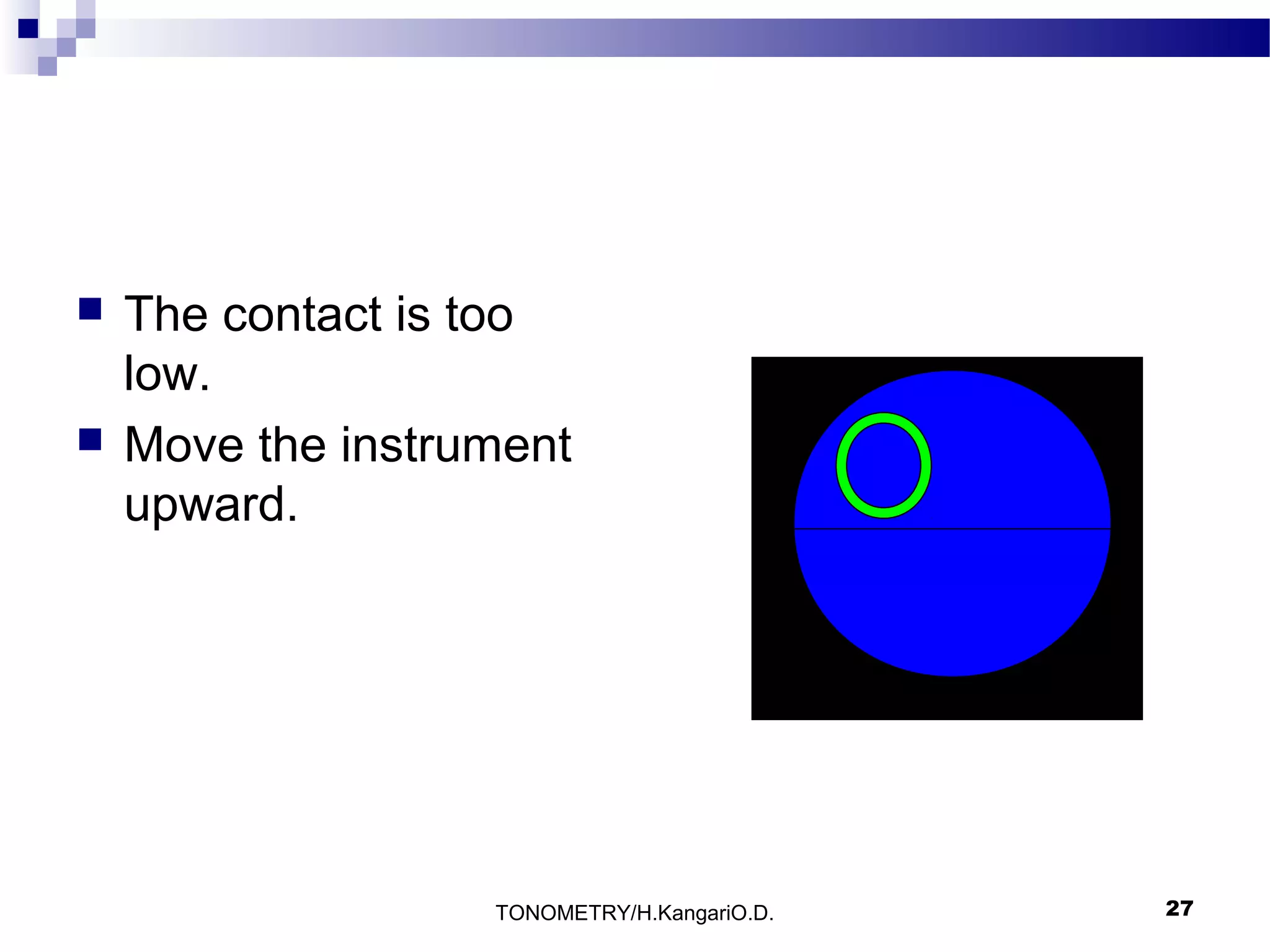
The contact is too
low.
Move the instrument
upward.

TONOMETRY/H.KangariO.D.

27
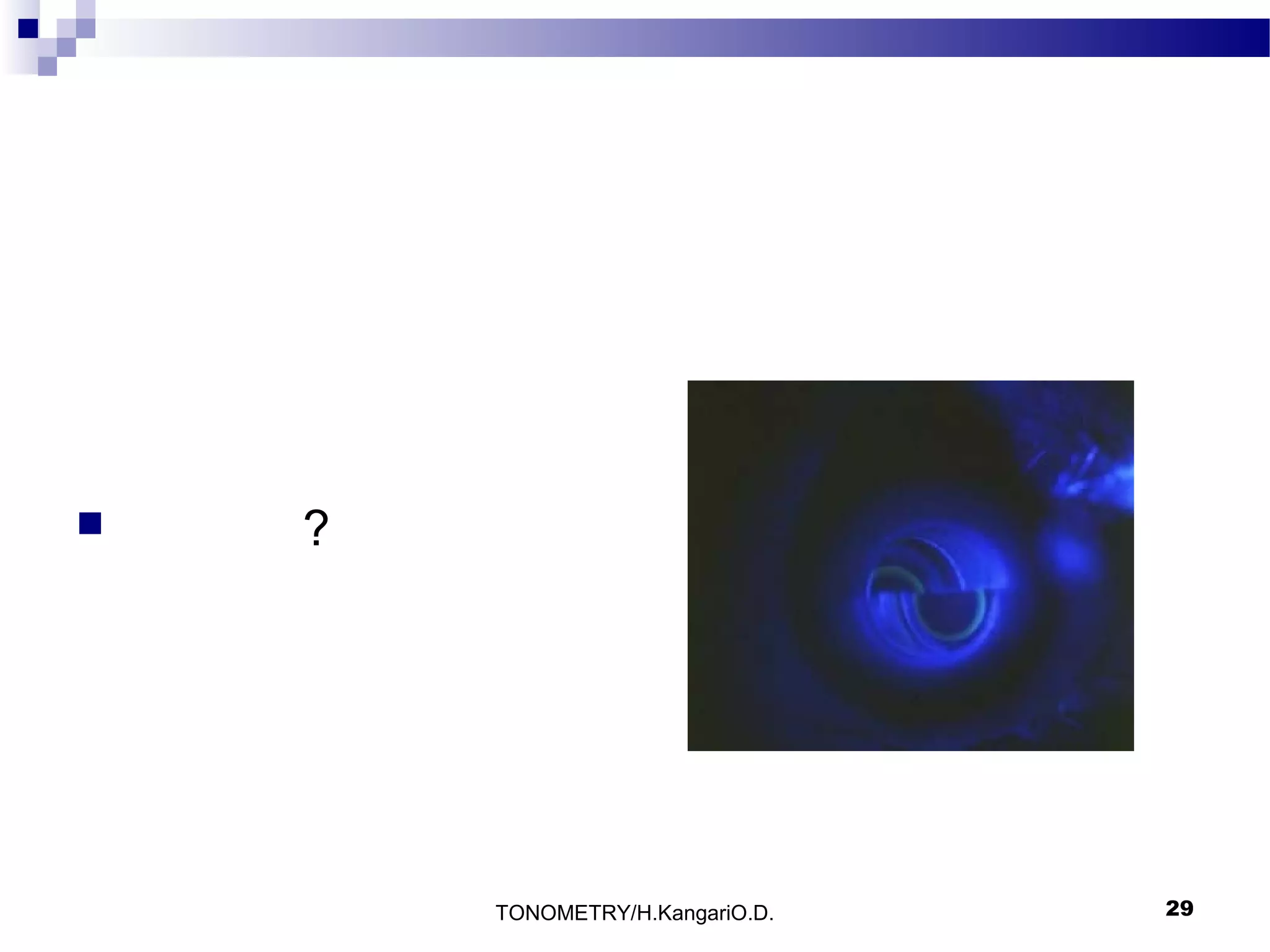


?

TONOMETRY/H.KangariO.D.

28


?

TONOMETRY/H.KangariO.D.

29







Inappropriate contact
The instrument has been
moved too much toward
the patient.
The mires will not move
by changing the drum.
Move backward and
reapplinate.

TONOMETRY/H.KangariO.D.

30



Mires are too thin.
Add more flourescein.

TONOMETRY/H.KangariO.D.

31


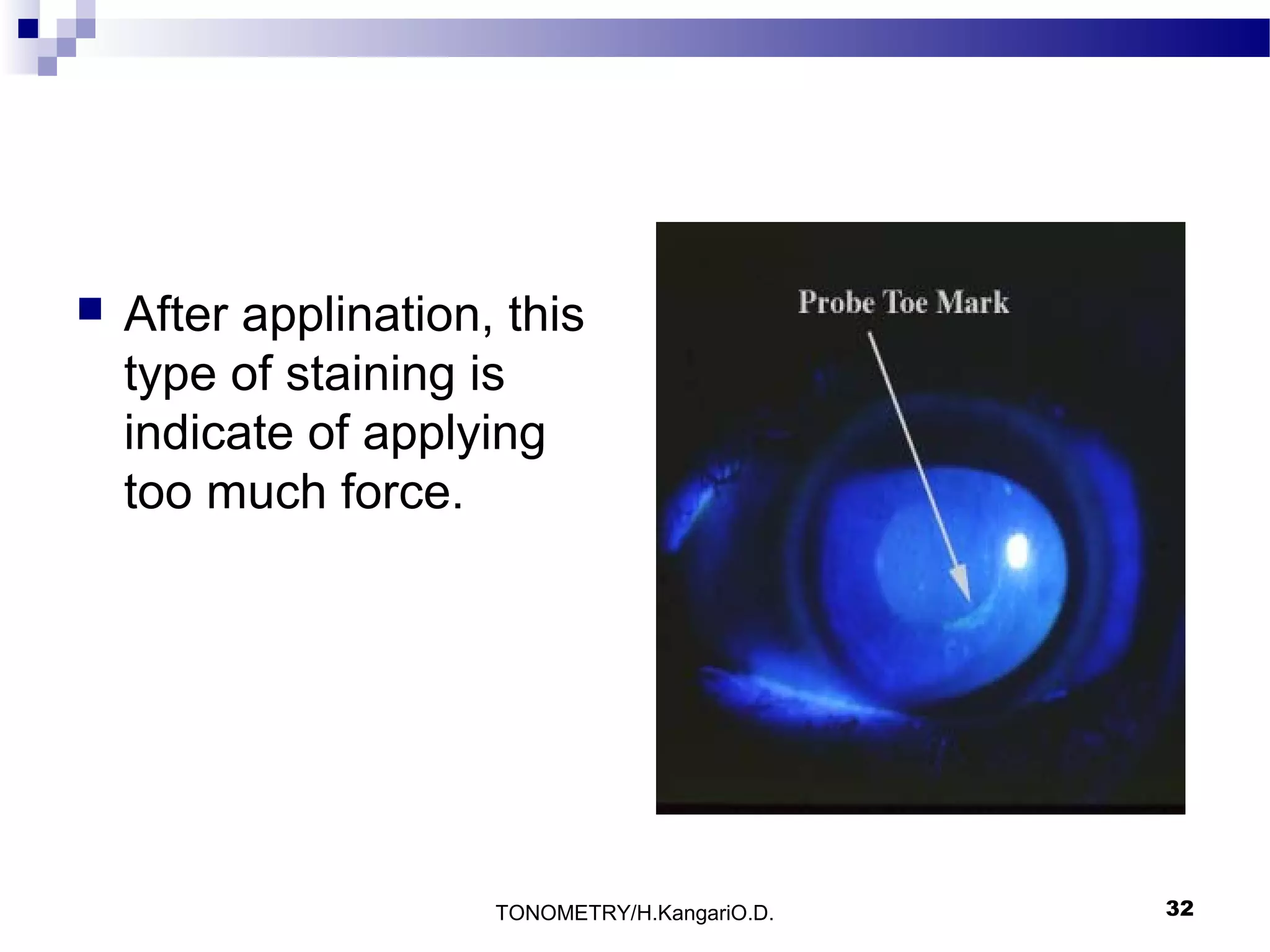
After applination, this
type of staining is
indicate of applying
too much force.

TONOMETRY/H.KangariO.D.

32
DIURNAL VARIATION






Generally, the variation in intraocular pressure over a 24
hour period is considered to be 3 to 5 mmHg with the
highest readings being about (6:00 a.m.).
However, there is recent evidence that known glaucoma
patient's highest pressure findings are in the afternoon.
Therefore, it would be best to monitor any questionable
patients. Take diurnal pressure measurements during
the day looking for any pressure spikes with variations
greater than 5 mmHg. Example: 14 mmHg O.U. @ 8:30
a.m. and 21 mmHg O.U. @ 3:30 p.m. is diagnostic.
Differences in pressure readings between the two eyes
of 3 mmHg or more must be questioned, this is not
normal.
TONOMETRY/H.KangariO.D.

33
Latest information:




Intraocular pressures (IOP) following Laser In Situ Keratomileusis
(LASIK) and Photorefractive Keratectomy (PRK) are
underestimated.
It depends on the patient's Pre-Op refractive prescription and how
much tissue needs to be removed. There is about 10 microns of
tissue removed per diopter of refractive error. A patient with a
refractive error of 3 diopters of myopia will have approximately 30
microns of tissue removed. For this patient the IOP findings would
be underestimated by about 2mm Hg and more for higher refractive
errors. This underestimation has been reported for Goldmann
applanation tonometry. It is an important new finding and appears to
be related to changes in corneal thickness. This might help explain
normal tension glaucoma where these patients may have thinner
corneas.

TONOMETRY/H.KangariO.D.

34
PERKINS TONOMETER


For patients with physical constraints who
cannot be positioned in the slit lamp or
bedriden patients Perkins tonometer (a
hand held tonometer can be used)

TONOMETRY/H.KangariO.D.

35
TONOMETRY/H.KangariO.D.

36
DIGITAL INTRAOCULAR
PRESSURE ASSESSMENT
This technique is used in those individual,
where the slit-mounted instrument or the
hand-held tonometer cannot be used.
 In very young children, extremely anxious
patient or developmentally delayed
individuals.
 The firmness of the globe is subjectively
evaluated as soft, meduim, or hard. The
harder the globe the higher the IOP.


TONOMETRY/H.KangariO.D.

37
Digital IOP assessment is contraindicated
for eyes with a recent history of blunt
trauma, penetrating ocular injury, or
intraocular surgery.
 Sedation might be recommended for more
accurate measurement of the pressure.


TONOMETRY/H.KangariO.D.

38


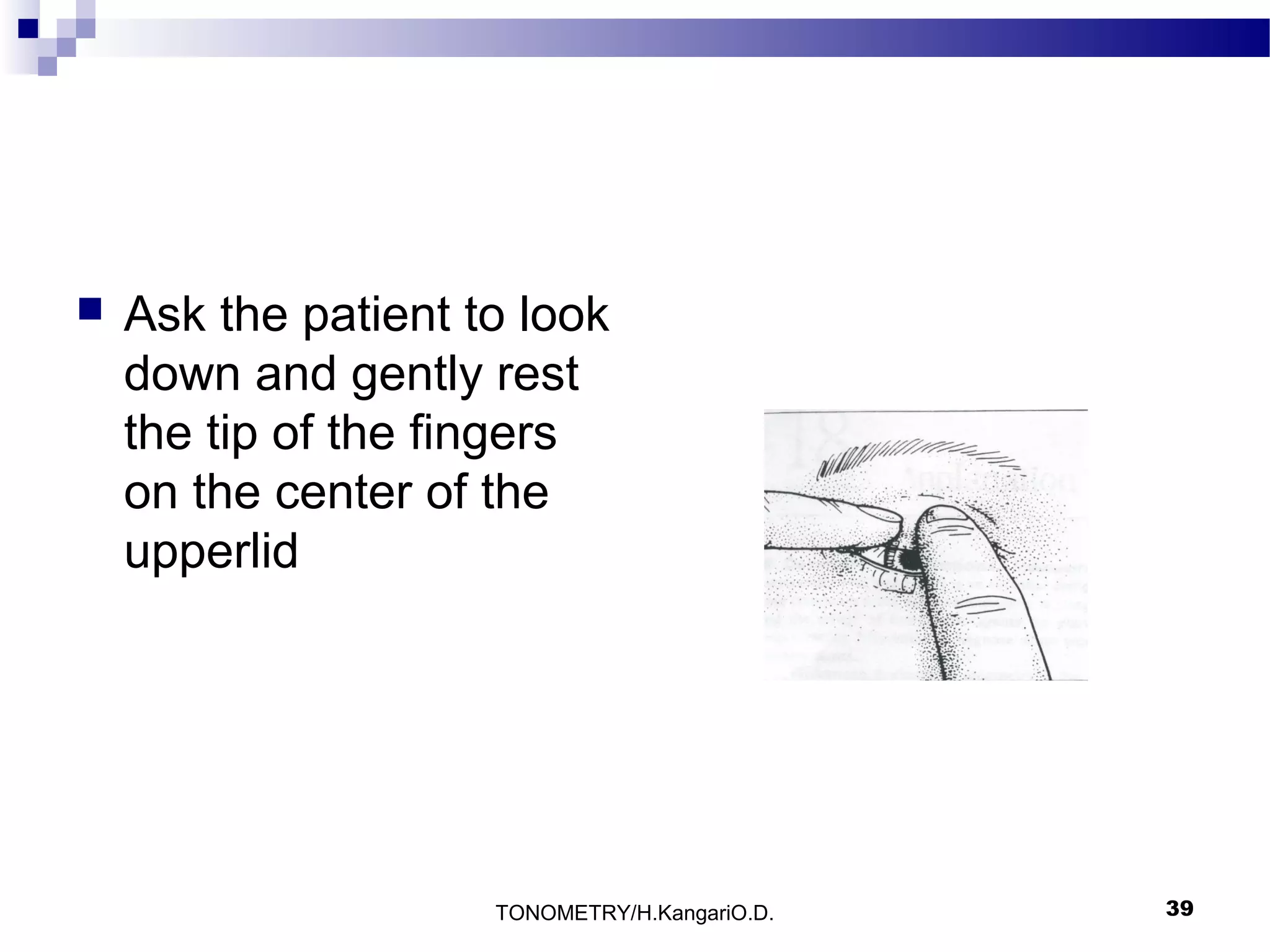
Ask the patient to look
down and gently rest
the tip of the fingers
on the center of the
upperlid

TONOMETRY/H.KangariO.D.

39




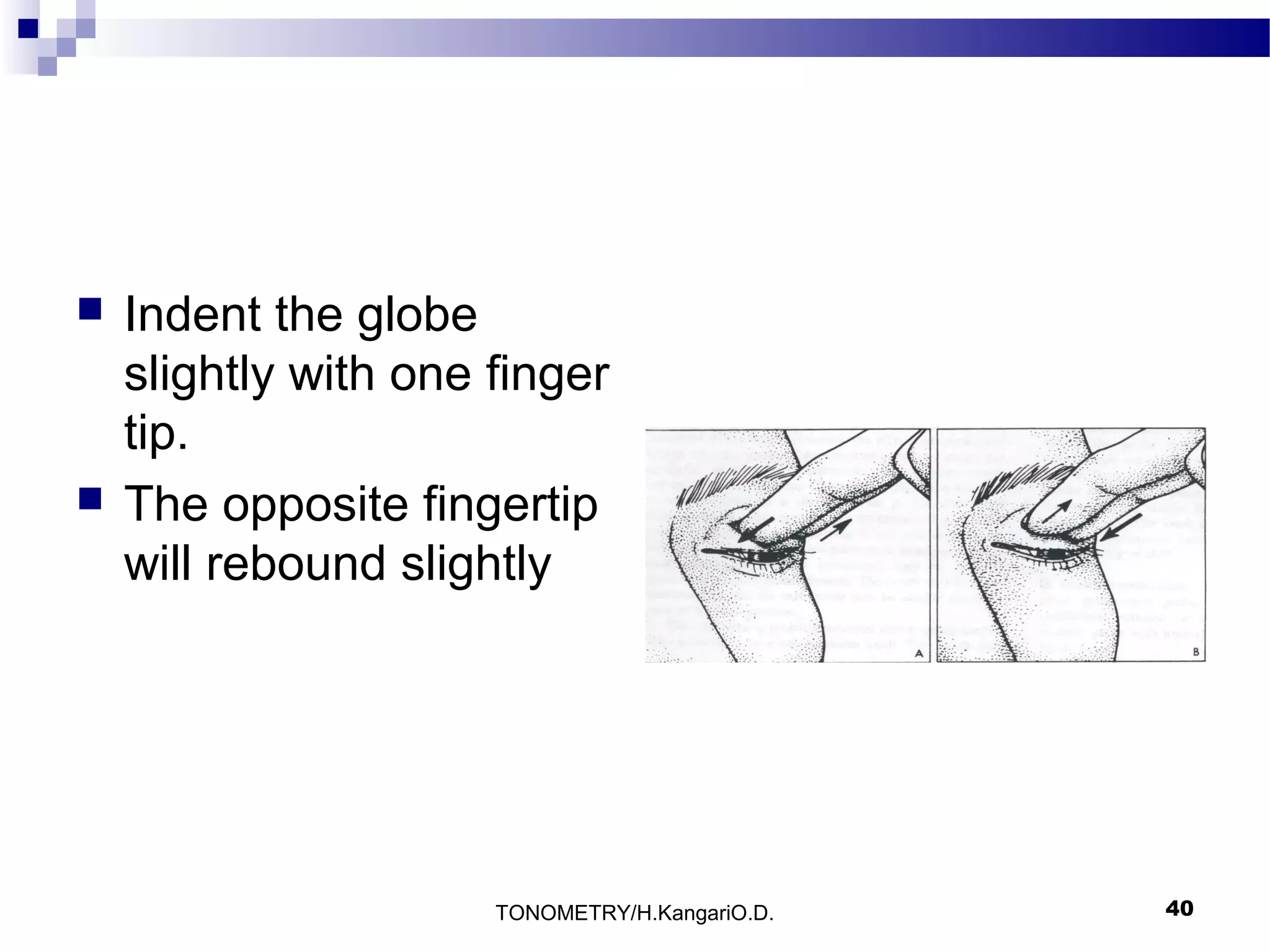
Indent the globe
slightly with one finger
tip.
The opposite fingertip
will rebound slightly

TONOMETRY/H.KangariO.D.

40
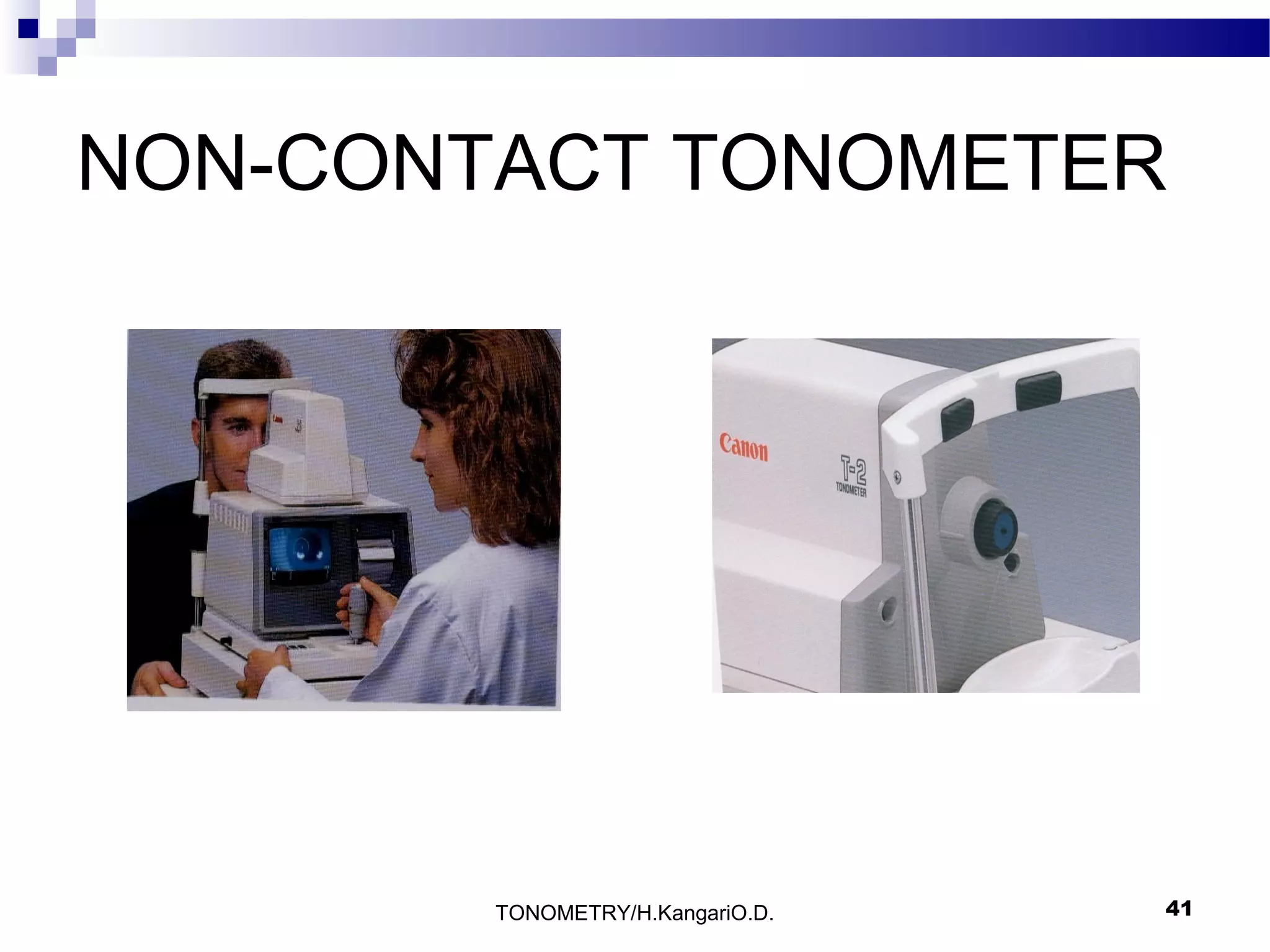
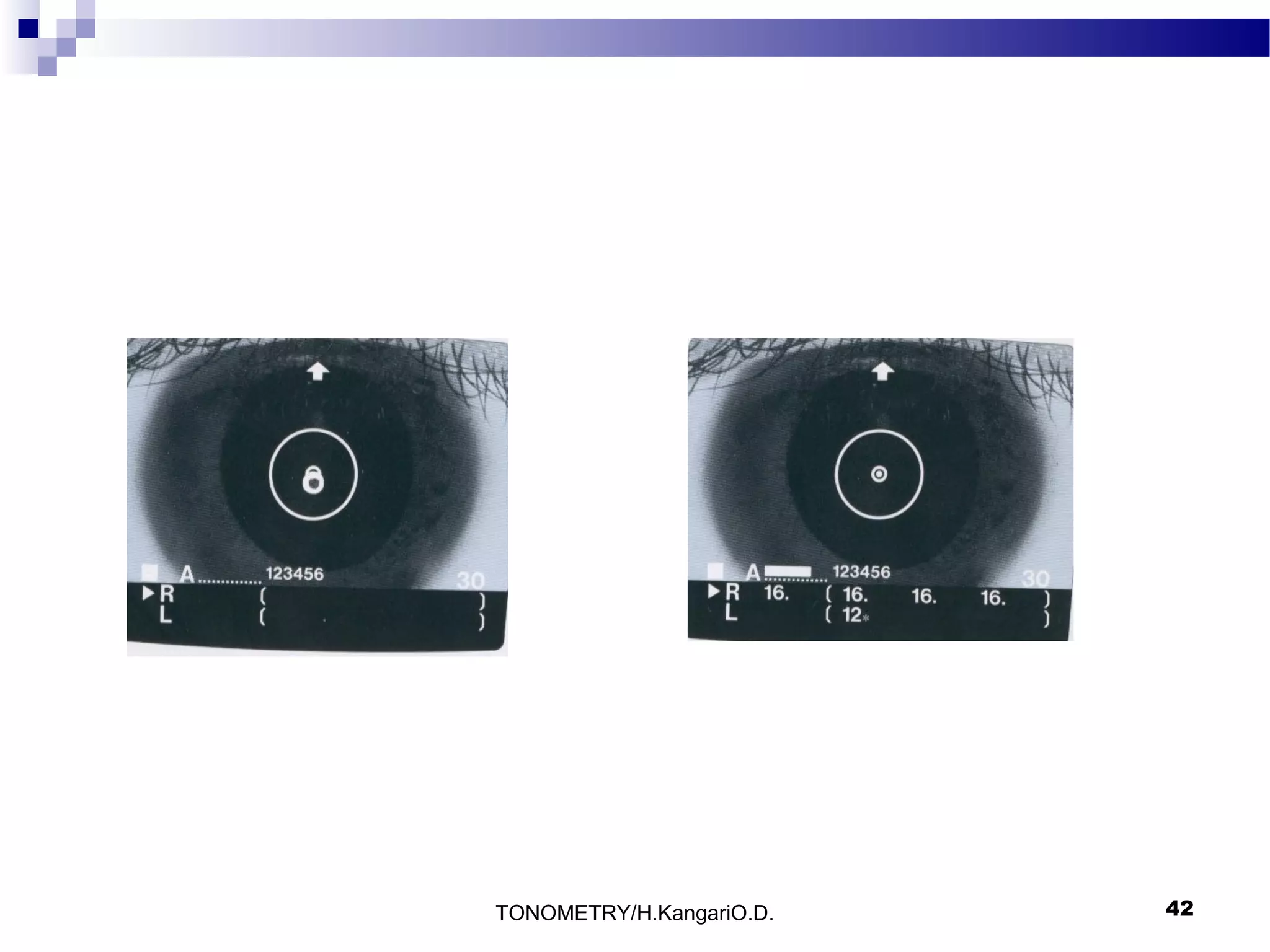
NON-CONTACT TONOMETER

TONOMETRY/H.KangariO.D.

41
TONOMETRY/H.KangariO.D.

42
TONOMETRY/H.KangariO.D.

43
TONOMETRY/H.KangariO.D.

44

Goldman applanation tonometry

  • 1.
  • 2.
    Different technique inmeasurement of the Intra Ocular Pressure(IOP):  Goldmann Applination Tonometry  Perkins Tonometer  Non-Contact Tonometry  Digital Evaluation  TONOMETRY/H.KangariO.D. 2
  • 3.
    Goldmann Applination Tonometryis the most accurate method of measuring Intraocular Pressure.  Measuring the intraocular pressure is important in diagnosis and management of Glaucoma and Ocular Hypertension.  TONOMETRY/H.KangariO.D. 3
  • 4.
    CONTRAINDICATIONS TO IOP MEASUREMENTWITH GOLDMAN TECHNIQUE 1)Active Infection  2)Patients with recurrent corneal erosions  3) Corneal abrasions that are not totally healed  TONOMETRY/H.KangariO.D. 4
  • 5.
     The Intraocular Pressure is determinedby the amount of force required to flatten a constant corneal surface area TONOMETRY/H.KangariO.D. 5
  • 6.
  • 7.
    Major components ofthe tonometer      1)Contact Prism 2)Contact Probe 3)Housing 4)Calibrated measuring drum 5)Tonometer Arm TONOMETRY/H.KangariO.D. 7
  • 8.
  • 9.
  • 10.
    CHECKING THE INSTRUMENT      To calibratethe instrument a control weight bar is used. Only a trained technician can calibrate the tonometer. To grossly check the calibration: Turn the measuring drum below zero (the arm should move backward) Then turn the measuring drum past the zero mark and the arm should move forward. The arm should move in the same degree in both direction, above and below the zero mark. TONOMETRY/H.KangariO.D. 10
  • 11.
    PROBE STERILAZATION     Always cleanthe tonometer probe before and after each use. Remove the probe from contact holder (hold the arm before you remove the probe) Wet a tissue with alcohol and apply to probe in a circular fashion for 5 seconds. Rinse the probe with Saline Solution and blot dry with a tissue. TONOMETRY/H.KangariO.D. 11
  • 12.
    PROBE STERILAZATION OR insertthe probe into Hydrogen Peroxide 3% for 5 to 10 minutes.  Rinse the probe with Saline Solution and blot dry with a tissue.  TONOMETRY/H.KangariO.D. 12
  • 13.
    CLEANING & STERILIZINGTHE PROBE  some factors to be considered such as the following:  (1) 3% H2O2 will ruin the probes in a short period of time and if not properly dried can cause marked pain and a secondary anterior uveitis that is very difficult to resolve. Minimum of 5 minutes maximum of 10 minutes.  (2) 70% Isopropyl alcohol will also destroy the probes and if not properly dried can also cause marked pain and a secondary anterior uveitis that is very difficult to resolve. When Using Either Of The Above Recommended Procedures Make Sure You Always Rinse The Probe Thoroughly With Saline Solution Then Dry It Completely Before Using It On The Patient's Eye. Never Leave The Probe In The Hydrogen Peroxide For Longer Than 10 Minutes.  TONOMETRY/H.KangariO.D. 13
  • 14.
      Hold the arm,while inserting the probe. ALIGN the probe- if the patient has less than 3.00 D of astigmatism, position the probe so that the patient’s minus cylinder axis is aligned with the WHITE LINE on the prism holder. TONOMETRY/H.KangariO.D. 14
  • 15.
     ALIGN the probe-if the patient has greater than 3.00 D of astigmatism, position the probe so that the patient’s minus cylinder axis is aligned with the RED LINE on the prism holder.  KEEP in mind, as you rotate the probe according to cylinder axis the mires will tilt with the direction of axis. TONOMETRY/H.KangariO.D. 15
  • 16.
    PATIENT PREPARATION     After youhave completed a full refractive, binocular and slit lamp evaluation proceed to tonometry. Anesthetize the cornea. Inform the patient that you are going to put a drop in their eye which will burn and their lids will feel heavy afterwards. Place a drop of Tetracaine 0.5% in each eye Wet a strip of fluorescein with sterile saline and place it is superior or inferior bulbar conjunctiva. TONOMETRY/H.KangariO.D. 16
  • 17.
    Position the patientcomfortably at slit lamp.  With the COBALT BLUE filter scan the cornea  Place the measuring drum at 10 mmHg  Use Low Magnification  TONOMETRY/H.KangariO.D. 17
  • 18.
      Give proper instructionsto the patient: “ I want you to keep your forehead and Chin in the rest all the time. I want you to look at this point ( based on the eye being tested give an appropriate place for the patient to look at ). Keep your eyes open as wide as you can and try not to blink. I am going get close to your eye with this blue light. TONOMETRY/H.KangariO.D. 18
  • 19.
    APPLINATION From the outsideinstrument get as close as you can to the cornea and center the probe on the cornea.  If you now look in through the microscope, you will see two faint blue mires (semi circles)  If you don’t see this, AGAIN center the probe from the outside of the instrument.  TONOMETRY/H.KangariO.D. 19
  • 20.
    When you seetwo faint mires, move in the instrument with the joy stick to touch the cornea.  When you touch the cornea, the mires will turn fluorescent green.  TONOMETRY/H.KangariO.D. 20
  • 21.
     If semicircles movefreely with the rotation of the measuring drum, the initial contact is correct. TONOMETRY/H.KangariO.D. 21
  • 22.
      The width andheight of two rings must be equal and centered in the field of view. Rotate the measuring drum, until the inner borders of two semicircles just touch. TONOMETRY/H.KangariO.D. 22
  • 23.
    Back off thetonometer and read the pressure from the measuring drum.  The scales of measuring drum is marked from 0-8 grams of force. To convert to mmHg, multiply the result by 10.  After completion of the procedure, reevaluate the corneal integrity with cobalt blue light.  TONOMETRY/H.KangariO.D. 23
  • 24.
     Correct position of mireswhen measuring the IOP TONOMETRY/H.KangariO.D. 24
  • 25.
      If this isthe left eye, the contact of the probe is too much to temporal side. Move the probe to nasal side TONOMETRY/H.KangariO.D. 25
  • 26.
    Top mire issuperiorly positioned. The probe contact is too inferior. Move the probe superiorly. TONOMETRY/H.KangariO.D. 26
  • 27.
      The contact istoo low. Move the instrument upward. TONOMETRY/H.KangariO.D. 27
  • 28.
  • 29.
  • 30.
        Inappropriate contact The instrumenthas been moved too much toward the patient. The mires will not move by changing the drum. Move backward and reapplinate. TONOMETRY/H.KangariO.D. 30
  • 31.
      Mires are toothin. Add more flourescein. TONOMETRY/H.KangariO.D. 31
  • 32.
     After applination, this typeof staining is indicate of applying too much force. TONOMETRY/H.KangariO.D. 32
  • 33.
    DIURNAL VARIATION    Generally, thevariation in intraocular pressure over a 24 hour period is considered to be 3 to 5 mmHg with the highest readings being about (6:00 a.m.). However, there is recent evidence that known glaucoma patient's highest pressure findings are in the afternoon. Therefore, it would be best to monitor any questionable patients. Take diurnal pressure measurements during the day looking for any pressure spikes with variations greater than 5 mmHg. Example: 14 mmHg O.U. @ 8:30 a.m. and 21 mmHg O.U. @ 3:30 p.m. is diagnostic. Differences in pressure readings between the two eyes of 3 mmHg or more must be questioned, this is not normal. TONOMETRY/H.KangariO.D. 33
  • 34.
    Latest information:   Intraocular pressures(IOP) following Laser In Situ Keratomileusis (LASIK) and Photorefractive Keratectomy (PRK) are underestimated. It depends on the patient's Pre-Op refractive prescription and how much tissue needs to be removed. There is about 10 microns of tissue removed per diopter of refractive error. A patient with a refractive error of 3 diopters of myopia will have approximately 30 microns of tissue removed. For this patient the IOP findings would be underestimated by about 2mm Hg and more for higher refractive errors. This underestimation has been reported for Goldmann applanation tonometry. It is an important new finding and appears to be related to changes in corneal thickness. This might help explain normal tension glaucoma where these patients may have thinner corneas. TONOMETRY/H.KangariO.D. 34
  • 35.
    PERKINS TONOMETER  For patientswith physical constraints who cannot be positioned in the slit lamp or bedriden patients Perkins tonometer (a hand held tonometer can be used) TONOMETRY/H.KangariO.D. 35
  • 36.
  • 37.
    DIGITAL INTRAOCULAR PRESSURE ASSESSMENT Thistechnique is used in those individual, where the slit-mounted instrument or the hand-held tonometer cannot be used.  In very young children, extremely anxious patient or developmentally delayed individuals.  The firmness of the globe is subjectively evaluated as soft, meduim, or hard. The harder the globe the higher the IOP.  TONOMETRY/H.KangariO.D. 37
  • 38.
    Digital IOP assessmentis contraindicated for eyes with a recent history of blunt trauma, penetrating ocular injury, or intraocular surgery.  Sedation might be recommended for more accurate measurement of the pressure.  TONOMETRY/H.KangariO.D. 38
  • 39.
     Ask the patientto look down and gently rest the tip of the fingers on the center of the upperlid TONOMETRY/H.KangariO.D. 39
  • 40.
      Indent the globe slightlywith one finger tip. The opposite fingertip will rebound slightly TONOMETRY/H.KangariO.D. 40
  • 41.
  • 42.
  • 43.
  • 44.