+  
AGGLUTINATION 
Dr Rania Abo-Shady 
Ain Shams University
Tests Based on Ag/Ab Reactions 
• All tests based on Ag/Ab reactions will have to 
depend on lattice formation or they will have 
to utilize ways to detect small immune 
complexes 
• All tests based on Ag/Ab reactions can be used 
to detect either Ag or Ab
Complex may be directly visible or invisible 
Directly visible – agglutination 
Invisible 
• requires specific probes (enzyme-labelled anti-immunoglobulin, 
isotope-labelled anti-immunoglobulin, 
etc.) 
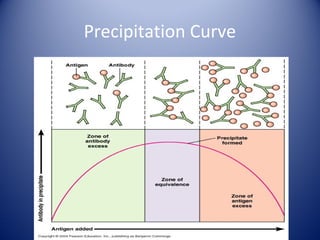
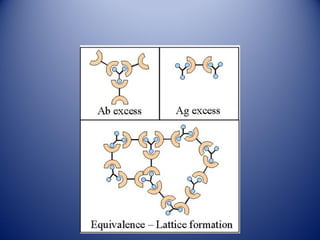
• binds Ag-Ab complex and amplifys signals 
• signals can be measured by naked eyes or specific 
equipment e.g. in ELISA, RIA, IFA
Methods for Ag-Ab detection 
• Precipitation 
• Agglutination 
• Hemagglutination and hemagglutination 
inhibition 
• Viral neutralization test 
• Radio-immunoassays 
• ELISA 
• Immunoflourescence 
• Immunoblotting 
• Immunochromatography
5 
• Agglutination 
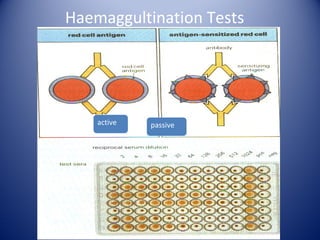
1- Active (direct) agglutination. 
2- Passive (Indirect) agglutination. 
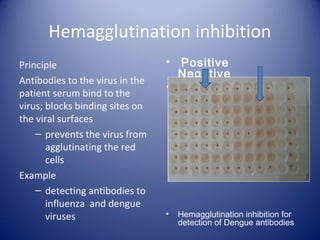
3- Reverse Passive agglutination. 
4- Hemagglutination 
5- Hemagglutination inhibition. 
6- Viral Hemagglutination. 
• Precipitation(Immunodiffusion) 
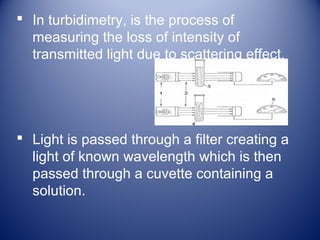
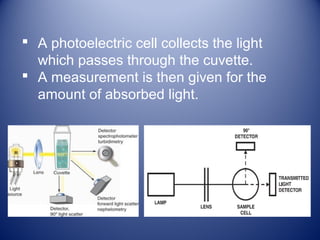
A-Immunodiffusion in gel (Passive e.g RID- Active e.g 
electroimmunodiffusion) 
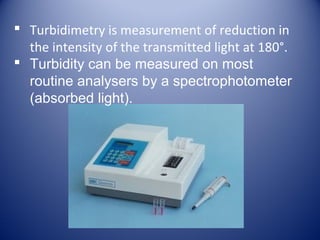
B- Fluid phase Immunoprecipitation e.g. nephelometry and 
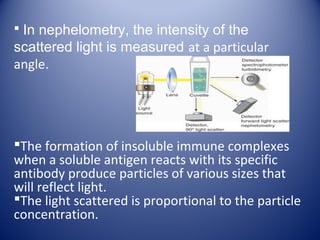
turbidimetry
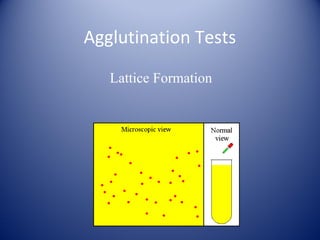
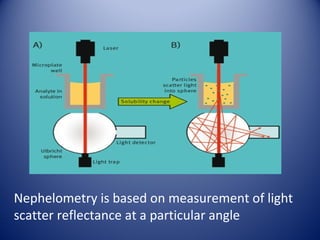
Agglutination Tests 
Lattice Formation
Agglutination 
• The interaction between antibody and a 
particulate(Insoluble) antigen results in visible 
clumping called agglutination. 
• Particulate antigen include: 
– bacteria, 
– white blood cells, 
– red blood cells, 
– latex particles 
7
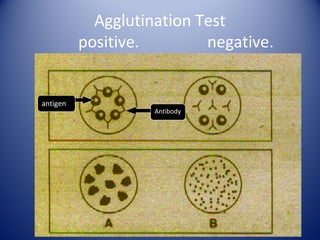
Agglutination Test 
positive. negative. 
Antibody 
. 
antigen
Phases of Agglutination 
• Agglutination is a two-Phase reaction that results in 
the formation of a stable lattice network 
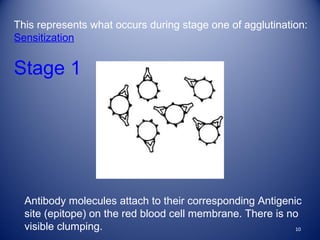
• Primary Phase (Sensitization) 
– Ab reacts with a single antigenic determinant on the 
surface of Ag. 
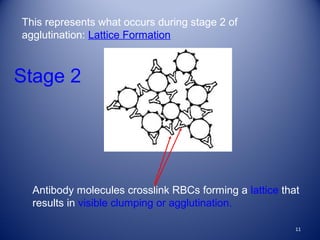
• Secondary Phase (Lattice formation) 
– Ab must be able to bridge the gap between particles so 
that at least one Fab portion is attached to an antigenic 
determinant on each of two adjacent particles, is 
dependent on environmental conditions and the relative 
concentrations of antigen and antibody. 
9
This represents what occurs during stage one of agglutination: 
Sensitization 
Stage 1 
Antibody molecules attach to their corresponding Antigenic 
site (epitope) on the red blood cell membrane. There is no 
visible clumping. 
10
This represents what occurs during stage 2 of 
agglutination: Lattice Formation 
Stage 2 
Antibody molecules crosslink RBCs forming a lattice that 
results in visible clumping or agglutination. 
11
Agglutinin and Agglutinogen 
• An agglutinin is an antibody that interacts with 
antigen on the surface of particles such as 
erythrocytes, bacteria, or latex particles to cause 
their agglutination. 
• An agglutinogen is an antigen on the surface of 
particles such as red blood cells that react with 
the antibody known as agglutinin to produce 
agglutination. 
• The most widely known agglutinogens are those 
of the ABO and related blood group systems. 
12
• The following examples of agglutination 
reactions : 
• 1. Rheumatoid factor latex agglutination 
• 2. Bacterial latex agglutination 
• 3. Coombs test 
• 4. Blood typing
Agglutination 
 In this test the antigen is particulate (visible, 
big and insoluble) (e.g. bacteria and red blood 
cells) or an inert particle (latex beads) 
coated with antigen. 
 Antibody is divalent and cross links the 
multivalent antigen to form a lattice 
network or clumps (agglutination). 
 This reaction can be performed in a tube 
or on a glass slide e.g. ABO blood 
grouping.
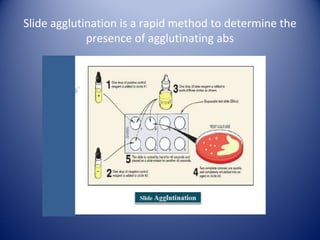
Slide agglutination is a rapid method to determine the 
presence of agglutinating abs
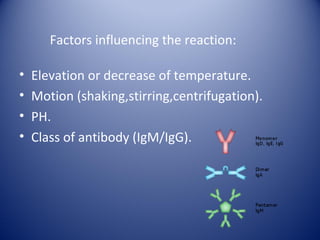
Factors influencing the reaction: 
• Elevation or decrease of temperature. 
• Motion (shaking,stirring,centrifugation). 
• PH. 
• Class of antibody (IgM/IgG).
When Abs & Ags are present in equimolar 
ratios They form insoluble complexes that 
ppt 
(ZONE OF EQUIVALENCE) 
• Decreased amounts of ppt are formed in 
zones of Ag or Ab excess.
Precipitation Curve
Prozone phenomena 
In an agglutination or precipitation reaction, the 
zone of relatively high antibody concentrations 
within which no reaction occurs. As the antibody 
concentration is lowered below the prozone, the 
reaction occurs.(solve by dilution) 
This phenomenon may be due simply to antibody 
excess or it may be due to blocking antibody or to 
nonspecific inhibitors in serum.
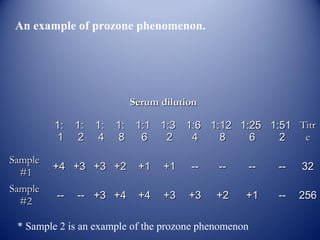
An example of prozone phenomenon. 
SSeerruumm ddiilluuttiioonn 
1 
11: 1 
:2 
11: 2 
:1: 1:44 
8 
11: 8 
:11::11 
66 
11::33 
22 
11::66 
44 
11::1122 
88 
11::2255 
66 
11::5511 
22 
TTiittrr 
ee 
SSaammppllee 
##11 ++44 ++33 ++33 ++22 ++11 ++11 ---- ---- ---- ---- 3322 
SSaammppllee 
##22 ---- ---- ++33 ++44 ++44 ++33 ++33 ++22 ++11 ---- 225566 
* Sample 2 is an example of the prozone phenomenon
A)Qualitative agglutination tests 
Agglutination tests can be used in a qualitative 
manner to assay for the presence of an antigen or 
an antibody. 
The antibody is mixed with the particulate antigen 
and a positive test is indicated by the 
agglutination of the particulate antigen . 
B) Quantitative Agglutination Test 
The Ab titre can be determined using serial 
dilution of the patient serum.
Serial Dilution 
A serial dilution is simply a series of simple dilutions 
which amplifies the dilution factor quickly beginning 
with a small initial quantity of material (i.e., bacterial 
culture, a chemical, orange juice, etc.). The source of 
dilution material for each step comes from the diluted 
material of the previous. In a serial dilution the total 
dilution factor at any point is the product of the 
individual dilution factors in each step up to it. 
Final dilution factor (DF) = DF1 × DF2 × DF3 etc.
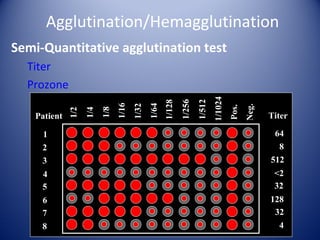
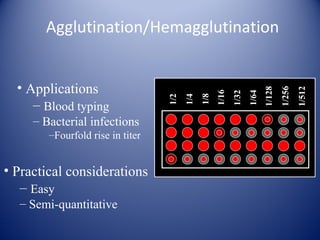
Agglutination/Hemagglutination 
Semi-Quantitative agglutination test 
Titer 
Prozone 
1/2 
1/4 
1/8 
1/16 
1/32 
1/64 
1/128 
1/256 
1/512 
1/1024 
Pos. 
Neg. 
Titer 
64 
8 
512 
<2 
32 
128 
32 
4 
Patient 
1 
2 
3 
4 
5 
6 
7 
8
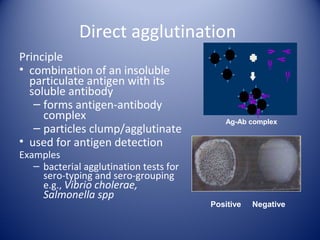
Direct agglutination 
Principle 
• combination of an insoluble 
particulate antigen with its 
soluble antibody 
– forms antigen-antibody 
complex 
– particles clump/agglutinate 
• used for antigen detection 
Examples 
– bacterial agglutination tests for 
sero-typing and sero-grouping 
e.g., Vibrio cholerae, 
Salmonella spp 
Ag-Ab complex 
Positive Negative
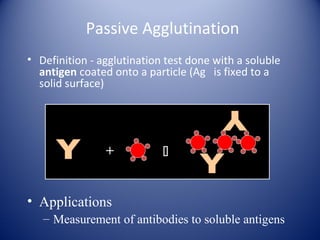
Passive Agglutination 
• Definition - agglutination test done with a soluble 
antigen coated onto a particle (Ag is fixed to a 
solid surface) 
+  
• Applications 
– Measurement of antibodies to soluble antigens
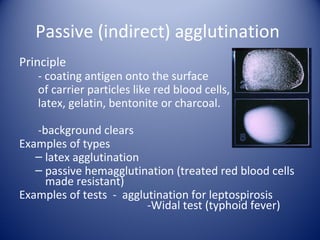
Passive (indirect) agglutination 
Principle 
- coating antigen onto the surface 
of carrier particles like red blood cells, 
latex, gelatin, bentonite or charcoal. 
-background clears 
Examples of types 
– latex agglutination 
– passive hemagglutination (treated red blood cells 
made resistant) 
Examples of tests - agglutination for leptospirosis 
-Widal test (typhoid fever)
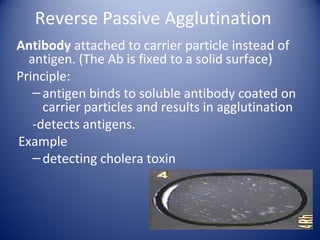
Reverse Passive Agglutination 
Antibody attached to carrier particle instead of 
antigen. (The Ab is fixed to a solid surface) 
Principle: 
– antigen binds to soluble antibody coated on 
carrier particles and results in agglutination 
-detects antigens. 
Example 
– detecting cholera toxin
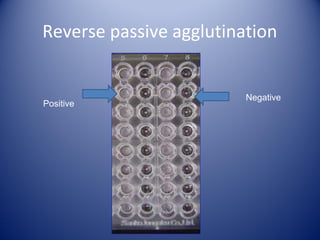
Reverse passive agglutination 
Negative 
Positive
Agglutination: 
Performance, applications 
Advantages 
– sensitive for antibody detection 
Limitations 
– Prozone phenomenon: 
• requires the right combination of quantities of antigen 
and antibody 
• handled through dilution to improve the match 
Time taken 
– 10-30 minutes
Advantages: 
-Portable. 
-Rapid. 
-efficient. 
-quick and simple. 
N.B: they are semiquatitative assays. 
Applications: 
More than 100 infectious disease. 
More than 60 chemical analyte e.g. hCG, CRP, 
ASO,fecal occult blood.
Hemagglutination 
Principle 
- It is a type of agglutination test performed on 
RBCs. 
- many human viruses have the ability to bind to 
the surface structures on red blood cells from 
different species thereby causing 
agglutination 
Example 
– influenza virus binds to fowl’s red blood cells
Haemaggultination Tests: 
 It has two types: 
 Active: the antigen is the RBC itself. 
 Viruses can clump red blood cells from one 
species or another (active 
hemagglutination) 
 Example is the test used in ABO grouping. 
 Passive: the antigen here is not the RBC. The 
RBC absorbs it and expresses it on the surface. 
 It will form clumps when mixed with 
antibodies. 
 i.e. red cells are passive carriers .
Haemaggultination Tests 
active passive
Hemagglutination inhibition 
Principle 
Antibodies to the virus in the 
patient serum bind to the 
virus; blocks binding sites on 
the viral surfaces 
– prevents the virus from 
agglutinating the red 
cells 
Example 
– detecting antibodies to 
influenza and dengue 
viruses 
• Positive 
Negative 
• 
• Hemagglutination inhibition for 
detection of Dengue antibodies
Hemagglutination: 
Performance, applications 
Advantages 
– highly specific 
– can be used as gold standard 
Limitations 
– technically demanding 
– time consuming 
– cannot distinguish IgG from IgM 
Time taken 
– 1 day
Agglutination/Hemagglutination 
• Applications 
– Blood typing 
– Bacterial infections 
–Fourfold rise in titer 
• Practical considerations 
– Easy 
– Semi-quantitative 
1/2 
1/4 
1/8 
1/16 
1/32 
1/64 
1/128 
1/256 
1/512
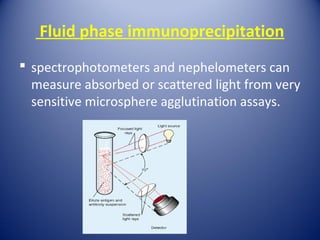
Fluid phase immunoprecipitation 
 spectrophotometers and nephelometers can 
measure absorbed or scattered light from very 
sensitive microsphere agglutination assays.
Turbidity and Nephelometry Light scattering 
PRINCIPLES: 
Light scattering is the physical phenomenon 
resulting from the interaction of light with a 
particle(s) in solution. 
Dependent on: 
•Particle size 
•Wavelength 
•Distance of observation, 
•Concentration of particles 
•MW of particles
 In turbidimetry, is the process of 
measuring the loss of intensity of 
transmitted light due to scattering effect. 
 Light is passed through a filter creating a 
light of known wavelength which is then 
passed through a cuvette containing a 
solution.
 A photoelectric cell collects the light 
which passes through the cuvette. 
 A measurement is then given for the 
amount of absorbed light.
 Turbidimetry is measurement of reduction in 
the intensity of the transmitted light at 180°. 
 Turbidity can be measured on most 
routine analysers by a spectrophotometer 
(absorbed light).
 In nephelometry, the intensity of the 
scattered light is measured at a particular 
angle. 
The formation of insoluble immune complexes 
when a soluble antigen reacts with its specific 
antibody produce particles of various sizes that 
will reflect light. 
The light scattered is proportional to the particle 
concentration.
Nephelometry is based on measurement of light 
scatter reflectance at a particular angle
. 
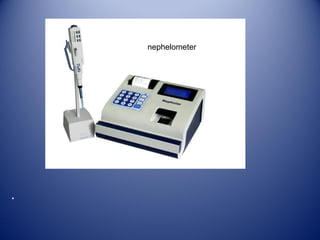
nephelometer
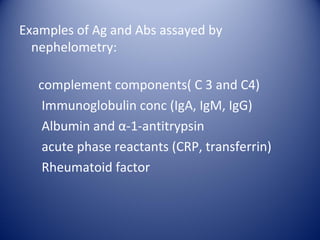
Examples of Ag and Abs assayed by 
nephelometry: 
complement components( C 3 and C4) 
Immunoglobulin conc (IgA, IgM, IgG) 
Albumin and α-1-antitrypsin 
acute phase reactants (CRP, transferrin) 
Rheumatoid factor
Agglutination

Agglutination

  • 1.
    +  AGGLUTINATION Dr Rania Abo-Shady Ain Shams University
  • 2.
    Tests Based onAg/Ab Reactions • All tests based on Ag/Ab reactions will have to depend on lattice formation or they will have to utilize ways to detect small immune complexes • All tests based on Ag/Ab reactions can be used to detect either Ag or Ab
  • 3.
    Complex may bedirectly visible or invisible Directly visible – agglutination Invisible • requires specific probes (enzyme-labelled anti-immunoglobulin, isotope-labelled anti-immunoglobulin, etc.) • binds Ag-Ab complex and amplifys signals • signals can be measured by naked eyes or specific equipment e.g. in ELISA, RIA, IFA
  • 4.
    Methods for Ag-Abdetection • Precipitation • Agglutination • Hemagglutination and hemagglutination inhibition • Viral neutralization test • Radio-immunoassays • ELISA • Immunoflourescence • Immunoblotting • Immunochromatography
  • 5.
    5 • Agglutination 1- Active (direct) agglutination. 2- Passive (Indirect) agglutination. 3- Reverse Passive agglutination. 4- Hemagglutination 5- Hemagglutination inhibition. 6- Viral Hemagglutination. • Precipitation(Immunodiffusion) A-Immunodiffusion in gel (Passive e.g RID- Active e.g electroimmunodiffusion) B- Fluid phase Immunoprecipitation e.g. nephelometry and turbidimetry
  • 6.
  • 7.
    Agglutination • Theinteraction between antibody and a particulate(Insoluble) antigen results in visible clumping called agglutination. • Particulate antigen include: – bacteria, – white blood cells, – red blood cells, – latex particles 7
  • 8.
    Agglutination Test positive.negative. Antibody . antigen
  • 9.
    Phases of Agglutination • Agglutination is a two-Phase reaction that results in the formation of a stable lattice network • Primary Phase (Sensitization) – Ab reacts with a single antigenic determinant on the surface of Ag. • Secondary Phase (Lattice formation) – Ab must be able to bridge the gap between particles so that at least one Fab portion is attached to an antigenic determinant on each of two adjacent particles, is dependent on environmental conditions and the relative concentrations of antigen and antibody. 9
  • 10.
    This represents whatoccurs during stage one of agglutination: Sensitization Stage 1 Antibody molecules attach to their corresponding Antigenic site (epitope) on the red blood cell membrane. There is no visible clumping. 10
  • 11.
    This represents whatoccurs during stage 2 of agglutination: Lattice Formation Stage 2 Antibody molecules crosslink RBCs forming a lattice that results in visible clumping or agglutination. 11
  • 12.
    Agglutinin and Agglutinogen • An agglutinin is an antibody that interacts with antigen on the surface of particles such as erythrocytes, bacteria, or latex particles to cause their agglutination. • An agglutinogen is an antigen on the surface of particles such as red blood cells that react with the antibody known as agglutinin to produce agglutination. • The most widely known agglutinogens are those of the ABO and related blood group systems. 12
  • 13.
    • The followingexamples of agglutination reactions : • 1. Rheumatoid factor latex agglutination • 2. Bacterial latex agglutination • 3. Coombs test • 4. Blood typing
  • 14.
    Agglutination  Inthis test the antigen is particulate (visible, big and insoluble) (e.g. bacteria and red blood cells) or an inert particle (latex beads) coated with antigen.  Antibody is divalent and cross links the multivalent antigen to form a lattice network or clumps (agglutination).  This reaction can be performed in a tube or on a glass slide e.g. ABO blood grouping.
  • 15.
    Slide agglutination isa rapid method to determine the presence of agglutinating abs
  • 16.
    Factors influencing thereaction: • Elevation or decrease of temperature. • Motion (shaking,stirring,centrifugation). • PH. • Class of antibody (IgM/IgG).
  • 17.
    When Abs &Ags are present in equimolar ratios They form insoluble complexes that ppt (ZONE OF EQUIVALENCE) • Decreased amounts of ppt are formed in zones of Ag or Ab excess.
  • 18.
  • 19.
    Prozone phenomena Inan agglutination or precipitation reaction, the zone of relatively high antibody concentrations within which no reaction occurs. As the antibody concentration is lowered below the prozone, the reaction occurs.(solve by dilution) This phenomenon may be due simply to antibody excess or it may be due to blocking antibody or to nonspecific inhibitors in serum.
  • 21.
    An example ofprozone phenomenon. SSeerruumm ddiilluuttiioonn 1 11: 1 :2 11: 2 :1: 1:44 8 11: 8 :11::11 66 11::33 22 11::66 44 11::1122 88 11::2255 66 11::5511 22 TTiittrr ee SSaammppllee ##11 ++44 ++33 ++33 ++22 ++11 ++11 ---- ---- ---- ---- 3322 SSaammppllee ##22 ---- ---- ++33 ++44 ++44 ++33 ++33 ++22 ++11 ---- 225566 * Sample 2 is an example of the prozone phenomenon
  • 22.
    A)Qualitative agglutination tests Agglutination tests can be used in a qualitative manner to assay for the presence of an antigen or an antibody. The antibody is mixed with the particulate antigen and a positive test is indicated by the agglutination of the particulate antigen . B) Quantitative Agglutination Test The Ab titre can be determined using serial dilution of the patient serum.
  • 23.
    Serial Dilution Aserial dilution is simply a series of simple dilutions which amplifies the dilution factor quickly beginning with a small initial quantity of material (i.e., bacterial culture, a chemical, orange juice, etc.). The source of dilution material for each step comes from the diluted material of the previous. In a serial dilution the total dilution factor at any point is the product of the individual dilution factors in each step up to it. Final dilution factor (DF) = DF1 × DF2 × DF3 etc.
  • 24.
    Agglutination/Hemagglutination Semi-Quantitative agglutinationtest Titer Prozone 1/2 1/4 1/8 1/16 1/32 1/64 1/128 1/256 1/512 1/1024 Pos. Neg. Titer 64 8 512 <2 32 128 32 4 Patient 1 2 3 4 5 6 7 8
  • 25.
    Direct agglutination Principle • combination of an insoluble particulate antigen with its soluble antibody – forms antigen-antibody complex – particles clump/agglutinate • used for antigen detection Examples – bacterial agglutination tests for sero-typing and sero-grouping e.g., Vibrio cholerae, Salmonella spp Ag-Ab complex Positive Negative
  • 26.
    Passive Agglutination •Definition - agglutination test done with a soluble antigen coated onto a particle (Ag is fixed to a solid surface) +  • Applications – Measurement of antibodies to soluble antigens
  • 27.
    Passive (indirect) agglutination Principle - coating antigen onto the surface of carrier particles like red blood cells, latex, gelatin, bentonite or charcoal. -background clears Examples of types – latex agglutination – passive hemagglutination (treated red blood cells made resistant) Examples of tests - agglutination for leptospirosis -Widal test (typhoid fever)
  • 28.
    Reverse Passive Agglutination Antibody attached to carrier particle instead of antigen. (The Ab is fixed to a solid surface) Principle: – antigen binds to soluble antibody coated on carrier particles and results in agglutination -detects antigens. Example – detecting cholera toxin
  • 29.
  • 30.
    Agglutination: Performance, applications Advantages – sensitive for antibody detection Limitations – Prozone phenomenon: • requires the right combination of quantities of antigen and antibody • handled through dilution to improve the match Time taken – 10-30 minutes
  • 31.
    Advantages: -Portable. -Rapid. -efficient. -quick and simple. N.B: they are semiquatitative assays. Applications: More than 100 infectious disease. More than 60 chemical analyte e.g. hCG, CRP, ASO,fecal occult blood.
  • 32.
    Hemagglutination Principle -It is a type of agglutination test performed on RBCs. - many human viruses have the ability to bind to the surface structures on red blood cells from different species thereby causing agglutination Example – influenza virus binds to fowl’s red blood cells
  • 33.
    Haemaggultination Tests: It has two types:  Active: the antigen is the RBC itself.  Viruses can clump red blood cells from one species or another (active hemagglutination)  Example is the test used in ABO grouping.  Passive: the antigen here is not the RBC. The RBC absorbs it and expresses it on the surface.  It will form clumps when mixed with antibodies.  i.e. red cells are passive carriers .
  • 34.
  • 35.
    Hemagglutination inhibition Principle Antibodies to the virus in the patient serum bind to the virus; blocks binding sites on the viral surfaces – prevents the virus from agglutinating the red cells Example – detecting antibodies to influenza and dengue viruses • Positive Negative • • Hemagglutination inhibition for detection of Dengue antibodies
  • 36.
    Hemagglutination: Performance, applications Advantages – highly specific – can be used as gold standard Limitations – technically demanding – time consuming – cannot distinguish IgG from IgM Time taken – 1 day
  • 37.
    Agglutination/Hemagglutination • Applications – Blood typing – Bacterial infections –Fourfold rise in titer • Practical considerations – Easy – Semi-quantitative 1/2 1/4 1/8 1/16 1/32 1/64 1/128 1/256 1/512
  • 38.
    Fluid phase immunoprecipitation  spectrophotometers and nephelometers can measure absorbed or scattered light from very sensitive microsphere agglutination assays.
  • 39.
    Turbidity and NephelometryLight scattering PRINCIPLES: Light scattering is the physical phenomenon resulting from the interaction of light with a particle(s) in solution. Dependent on: •Particle size •Wavelength •Distance of observation, •Concentration of particles •MW of particles
  • 40.
     In turbidimetry,is the process of measuring the loss of intensity of transmitted light due to scattering effect.  Light is passed through a filter creating a light of known wavelength which is then passed through a cuvette containing a solution.
  • 41.
     A photoelectriccell collects the light which passes through the cuvette.  A measurement is then given for the amount of absorbed light.
  • 42.
     Turbidimetry ismeasurement of reduction in the intensity of the transmitted light at 180°.  Turbidity can be measured on most routine analysers by a spectrophotometer (absorbed light).
  • 43.
     In nephelometry,the intensity of the scattered light is measured at a particular angle. The formation of insoluble immune complexes when a soluble antigen reacts with its specific antibody produce particles of various sizes that will reflect light. The light scattered is proportional to the particle concentration.
  • 44.
    Nephelometry is basedon measurement of light scatter reflectance at a particular angle
  • 45.
  • 46.
    Examples of Agand Abs assayed by nephelometry: complement components( C 3 and C4) Immunoglobulin conc (IgA, IgM, IgG) Albumin and α-1-antitrypsin acute phase reactants (CRP, transferrin) Rheumatoid factor

Editor's Notes

  • #23 Agglutination/Hemagglutination - When the antigen is particulate the reaction of an antibody with the antigen can be detected by agglutination (clumping) of the antigen. When the antigen is an erythrocyte the term hemagglutination is used. The term agglutinin is used to describe antibodies that agglutinate particulate antigens. When the antigen is an erythrocyte the term hemagglutinin is often used. All antibodies can theoretically agglutinate particulate antigens but IgM due to its high valence is particularly good agglutinin and one sometimes infers that an antibody may be of the IgM class if it is a good agglutinating antibody. e.g. A patients red blood cells mixed with antibody to a blood group antigen to determine a persons blood type. e.g. A patients serum mixed with red blood cells of known blood type to assay for the presence of antibodies to that blood type in the patient&amp;apos;s serum.