Aman Ullah
Medical Microbiology-II
Classification of Medically important
virus
Viruses are classified according to their
1)Nucleic acid:
 Type of nucleic acid: DNA, RNA
 Double- vs. single-stranded
 Single or segmented pieces of nucleic acid
 Positive (+) or negative (-) stranded RNA
 Complexity of genome
2) Capsid:
 Icosahedral
 Helical
3) Envelope:
 Naked
 Enveloped
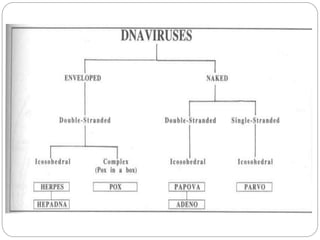
DNA Viruses
 Sometimes referred to as the HHAPPPy viruses:
 Herpes
 Hepadna
 Adeno
 Papova
 Parvo
 Pox
 Most DNA viruses are double-stranded, show
icosahedral symmetry, and replicate in the
nucleus.
DNA Viruses
 Two DNA viruses break these rules:
1) Parvoviridae: This virus is so simple that it
only has a single strand of DNA
2) Poxviridae: This virus is at the opposite end
of the spectrum and is extremely complex.
Although it does have double-stranded DNA, the
DNA is complex in nature, coding for hundreds of
proteins. This virus does not have icosahedral
symmetry. The DNA is surrounded by complex
structural proteins looking much like a box ( POX
IN A BOX). This virus replicates in the
cytoplasm
DNA Viruses
Three of the DNA viruses have envelopes:
 Herpes Hepadna Pox
Three are naked: A woman must be naked for
the PAP smear exam.
 PApova Adeno PArvo
RNA Viruses
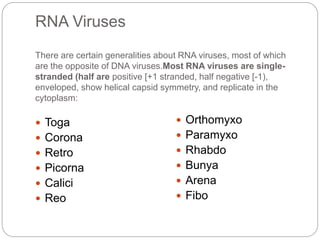
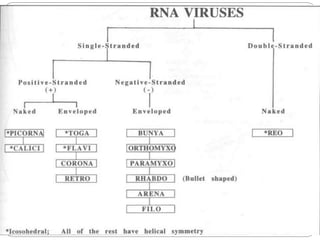
There are certain generalities about RNA viruses, most of which
are the opposite of DNA viruses.Most RNA viruses are single-
stranded (half are positive [+1 stranded, half negative [-1),
enveloped, show helical capsid symmetry, and replicate in the
cytoplasm:
 Toga
 Corona
 Retro
 Picorna
 Calici
 Reo
 Orthomyxo
 Paramyxo
 Rhabdo
 Bunya
 Arena
 Fibo
RNA Viruses
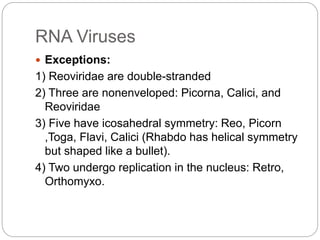
 Exceptions:
1) Reoviridae are double-stranded
2) Three are nonenveloped: Picorna, Calici, and
Reoviridae
3) Five have icosahedral symmetry: Reo, Picorn
,Toga, Flavi, Calici (Rhabdo has helical symmetry
but shaped like a bullet).
4) Two undergo replication in the nucleus: Retro,
Orthomyxo.
Classification of virus

Classification of virus

  • 1.
  • 2.
    Classification of Medicallyimportant virus Viruses are classified according to their 1)Nucleic acid:  Type of nucleic acid: DNA, RNA  Double- vs. single-stranded  Single or segmented pieces of nucleic acid  Positive (+) or negative (-) stranded RNA  Complexity of genome 2) Capsid:  Icosahedral  Helical 3) Envelope:  Naked  Enveloped
  • 3.
    DNA Viruses  Sometimesreferred to as the HHAPPPy viruses:  Herpes  Hepadna  Adeno  Papova  Parvo  Pox  Most DNA viruses are double-stranded, show icosahedral symmetry, and replicate in the nucleus.
  • 4.
    DNA Viruses  TwoDNA viruses break these rules: 1) Parvoviridae: This virus is so simple that it only has a single strand of DNA 2) Poxviridae: This virus is at the opposite end of the spectrum and is extremely complex. Although it does have double-stranded DNA, the DNA is complex in nature, coding for hundreds of proteins. This virus does not have icosahedral symmetry. The DNA is surrounded by complex structural proteins looking much like a box ( POX IN A BOX). This virus replicates in the cytoplasm
  • 5.
    DNA Viruses Three ofthe DNA viruses have envelopes:  Herpes Hepadna Pox Three are naked: A woman must be naked for the PAP smear exam.  PApova Adeno PArvo
  • 7.
    RNA Viruses There arecertain generalities about RNA viruses, most of which are the opposite of DNA viruses.Most RNA viruses are single- stranded (half are positive [+1 stranded, half negative [-1), enveloped, show helical capsid symmetry, and replicate in the cytoplasm:  Toga  Corona  Retro  Picorna  Calici  Reo  Orthomyxo  Paramyxo  Rhabdo  Bunya  Arena  Fibo
  • 8.
    RNA Viruses  Exceptions: 1)Reoviridae are double-stranded 2) Three are nonenveloped: Picorna, Calici, and Reoviridae 3) Five have icosahedral symmetry: Reo, Picorn ,Toga, Flavi, Calici (Rhabdo has helical symmetry but shaped like a bullet). 4) Two undergo replication in the nucleus: Retro, Orthomyxo.