BACTERIAL
CAPSULE
BY- MOHIT HINSU
INTRODUCTION
■ Bacterial capsule a gelatinous envelope surrounding a
bacterial cell, usually polysaccharide but sometimes polypeptide
in nature; it is associated with the virulence of pathogenic bacteria.
■ capsulated cells of pathogenic bacteria are usually more
virulent than cells without capsules because the former are more
resistant to phagocytic action. [destruction by white blood
cells (phagocytosis)]
■ When growing on agar media, encapsulated bacteria usually
form colonies with distinct appearance and morphology. In some
bacteria, the colonies of encapsulated bacteria are referred to as
‘smooth’ colonies, where as those of unencapsulated bacteria
take on ‘rough’ morphology (relatively small in size and dry in
texture)
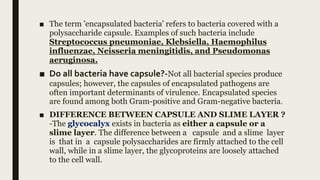
■ The term 'encapsulated bacteria' refers to bacteria covered with a
polysaccharide capsule. Examples of such bacteria include
Streptococcus pneumoniae, Klebsiella, Haemophilus
influenzae, Neisseria meningitidis, and Pseudomonas
aeruginosa.
■ Do all bacteria have capsule?-Not all bacterial species produce
capsules; however, the capsules of encapsulated pathogens are
often important determinants of virulence. Encapsulated species
are found among both Gram-positive and Gram-negative bacteria.
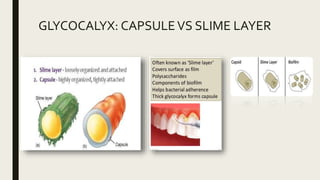
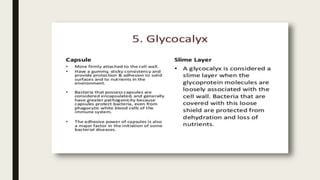
■ DIFFERENCE BETWEEN CAPSULE AND SLIME LAYER ?
-The glycocalyx exists in bacteria as either a capsule or a
slime layer. The difference between a capsule and a slime layer
is that in a capsule polysaccharides are firmly attached to the cell
wall, while in a slime layer, the glycoproteins are loosely attached
to the cell wall.
GLYCOCALYX: CAPSULEVS SLIME LAYER
COMPOSITION OF BACTERIAL CAPSULE
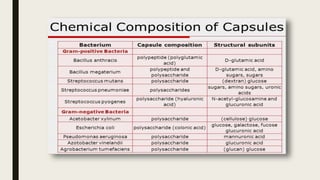
■ Capsule is a gelatinous polymer made up of either polysaccharide or
polypeptide or both.
■ Capsules are usually polymers of simple sugars (polysaccharides),
although the capsule of Bacillus anthracis is made of polyglutamic
acid.
■ Most capsules are hydrophilic (“water-loving”) and may help the
bacterium avoid desiccation (dehydration) by preventing water loss.
■ Capsules can be seen under a light microscope by placing the cells in a
suspension of India ink. [FIGURE]The capsules exclude the ink and
appear as clear halos surrounding the bacterial cells.
■ Capsule is found most commonly among Gram-negative bacteria,
for example, Escherichia coli, Neisseria meningitidis, Klebsiella
pneumoniae, Haemophilus influenza, and Pseudomonas
aeruginosa. However, some Gram-positive bacteria like Bacillus
megaterium, Streptococcus pyogenes, Streptococcus pneumonia,
and Streptococcus agalactiae.
■ The presence of a capsule in Streptococcus pneumoniae is the most
important factor in its ability to cause pneumonia. Mutant strains
of S. pneumoniae that have lost the ability to form a capsule are
readily taken up by white blood cells and do not cause disease.
FUNCTION OF CAPSULE:
■ A capsular layer of extracellular polysaccharide material can enclose
many bacteria into a biofilm and serves many functions.
■ A number of functions have been assigned to bacterial capsules in
different bacteria including adhesion, transmission, resistance to
innate host defenses, resistance to the host’s adaptive immune
response, and intracellular survival .
■ 1.Attachement to the surfaces.
■ 2.Protection against phagocytic engulfment.
■ 3.Protecting the cell wall against attack by various kind of
antibacterial agents, lysozyme, bacteriophages etc.
■ 4.Protection against osmotic stress.
■ 5.Protection from chemical present in environment, eg. detergents.
■ 6.Protection against harsh environment condition.
■ In human[human specimen sample] detection of pathogenic
bacteria[disease causing bacteria] use a capsule staining widely
for this purpose because of most of bacteria which contain capsule
they are pathogenic in nature mostly.
MICROSCOPIC IMAGES OF BACTERIA
WITH CAPSULE
Bacterial capsule

Bacterial capsule

  • 1.
  • 2.
    INTRODUCTION ■ Bacterial capsulea gelatinous envelope surrounding a bacterial cell, usually polysaccharide but sometimes polypeptide in nature; it is associated with the virulence of pathogenic bacteria. ■ capsulated cells of pathogenic bacteria are usually more virulent than cells without capsules because the former are more resistant to phagocytic action. [destruction by white blood cells (phagocytosis)] ■ When growing on agar media, encapsulated bacteria usually form colonies with distinct appearance and morphology. In some bacteria, the colonies of encapsulated bacteria are referred to as ‘smooth’ colonies, where as those of unencapsulated bacteria take on ‘rough’ morphology (relatively small in size and dry in texture)
  • 3.
    ■ The term'encapsulated bacteria' refers to bacteria covered with a polysaccharide capsule. Examples of such bacteria include Streptococcus pneumoniae, Klebsiella, Haemophilus influenzae, Neisseria meningitidis, and Pseudomonas aeruginosa. ■ Do all bacteria have capsule?-Not all bacterial species produce capsules; however, the capsules of encapsulated pathogens are often important determinants of virulence. Encapsulated species are found among both Gram-positive and Gram-negative bacteria. ■ DIFFERENCE BETWEEN CAPSULE AND SLIME LAYER ? -The glycocalyx exists in bacteria as either a capsule or a slime layer. The difference between a capsule and a slime layer is that in a capsule polysaccharides are firmly attached to the cell wall, while in a slime layer, the glycoproteins are loosely attached to the cell wall.
  • 4.
  • 6.
    COMPOSITION OF BACTERIALCAPSULE ■ Capsule is a gelatinous polymer made up of either polysaccharide or polypeptide or both. ■ Capsules are usually polymers of simple sugars (polysaccharides), although the capsule of Bacillus anthracis is made of polyglutamic acid. ■ Most capsules are hydrophilic (“water-loving”) and may help the bacterium avoid desiccation (dehydration) by preventing water loss. ■ Capsules can be seen under a light microscope by placing the cells in a suspension of India ink. [FIGURE]The capsules exclude the ink and appear as clear halos surrounding the bacterial cells.
  • 8.
    ■ Capsule isfound most commonly among Gram-negative bacteria, for example, Escherichia coli, Neisseria meningitidis, Klebsiella pneumoniae, Haemophilus influenza, and Pseudomonas aeruginosa. However, some Gram-positive bacteria like Bacillus megaterium, Streptococcus pyogenes, Streptococcus pneumonia, and Streptococcus agalactiae. ■ The presence of a capsule in Streptococcus pneumoniae is the most important factor in its ability to cause pneumonia. Mutant strains of S. pneumoniae that have lost the ability to form a capsule are readily taken up by white blood cells and do not cause disease.
  • 9.
    FUNCTION OF CAPSULE: ■A capsular layer of extracellular polysaccharide material can enclose many bacteria into a biofilm and serves many functions. ■ A number of functions have been assigned to bacterial capsules in different bacteria including adhesion, transmission, resistance to innate host defenses, resistance to the host’s adaptive immune response, and intracellular survival . ■ 1.Attachement to the surfaces. ■ 2.Protection against phagocytic engulfment. ■ 3.Protecting the cell wall against attack by various kind of antibacterial agents, lysozyme, bacteriophages etc. ■ 4.Protection against osmotic stress.
  • 10.
    ■ 5.Protection fromchemical present in environment, eg. detergents. ■ 6.Protection against harsh environment condition. ■ In human[human specimen sample] detection of pathogenic bacteria[disease causing bacteria] use a capsule staining widely for this purpose because of most of bacteria which contain capsule they are pathogenic in nature mostly.
  • 11.
    MICROSCOPIC IMAGES OFBACTERIA WITH CAPSULE