BLOTTING
TECHNIQUES
What is blotting?
Technique for transferring
• DNA
• RNA
• Proteins
onto a carrier so they can be separated,
and often follows the use of a gel
electrophoresis.
TYPES OF BLOTTING
TECHNIQUES
BLOTTING
TECHNIQUES
Southern Blot
It is used to detect
the DNA.
Northern blot
It is used to detect
the RNA.
Western blot
It is used to detect
proteins.
Blotting sheet
• Whatman 3mm paper….. world’s most widely used
blotting paper.
 REASON????
• high quality
• purity
• consistency
Creating the Sandwich
• The sandwich consists of :
filter paper
Nitrocellulose membrane
gel matrix
another piece of filter paper
SOUTHERN BLOTTING
History:
• Named after Sir Edwin
Southern
• Developed in 1975
SOUTHERN BLOTTING
“Used to detect the DNA”
• This method Involves:
 Separation
 Transfer
 Hybridization.
• This DNA can be:
• Single gene
• Part of a larger piece of DNA……..viral genome
“The key to this method is Hybridization”
Hybridization
“Process of forming a
dsDNA molecule between a
ssDNA probe and a ss-target
patient DNA”
PRINCIPLE
 The mixture of molecules is separated.
 Immobilized on a matrix.
 Probe addition to the matrix to bind to the
molecules.
 Unbound probes are removed.
“The place where the probe is connected
corresponds to the location of the immobilized
target molecule.”
Steps in southern blotting
The DNA is digested
Fragments
Gel electrophoresis
Transfer to membrane
Probing
Autoradiogram
APPLICATIONS
Southern blotting is used in:
• Gene discovery
• Mapping
• Evolution
• Development studies
• Diagnostics
• Forensics
Northern Blotting
History:
Northern blotting was developed by James
Alwine and George Stark at Stanford
University.
Northern blotting is a technique for
detection of specific RNA sequences
Steps involved in N.B
RNA isolation
Loading of sample on Agarose gel
Blotting on nitrocellulose membrane
Labeling with probe
Washing to remove unbound probe
Detection by autoradiogram
APPLICATIONS
• A standard for the direct study of gene expression at
the level of mRNA (mRNA transcripts)
• Detection of mRNA transcript size
• Study RNA degradation
• Study RNA splicing - can detect alternatively spliced
transcripts
• Study RNA half-life
• Study IRES (internal ribosomal entry site) – to
remove possibility of RNA digestion vs. 2nd cistron
translation.
Western blotting
Discovery???
• Dr. Douglas Lake of the University of Arizona School of
Medicine's Department of Microbiology and Immunology
“A technique in which proteins are
separated by gel electrophoresis and
transferred to a membrane sheet. A
specific protein is then identified through
its reaction with a labeled antibody.”
Principle
This technique works on
the principle on
“Antigen-Antibody”
relationship
Prerequisite for W.B
The SDS PAGE technique is a
prerequisite for Western
blotting.
“SDS (sodium dodecyl sulfate) is a
detergent (soap) that can dissolve
hydrophobic molecules but also has
a negative charge (sulfate) attached
to it.”
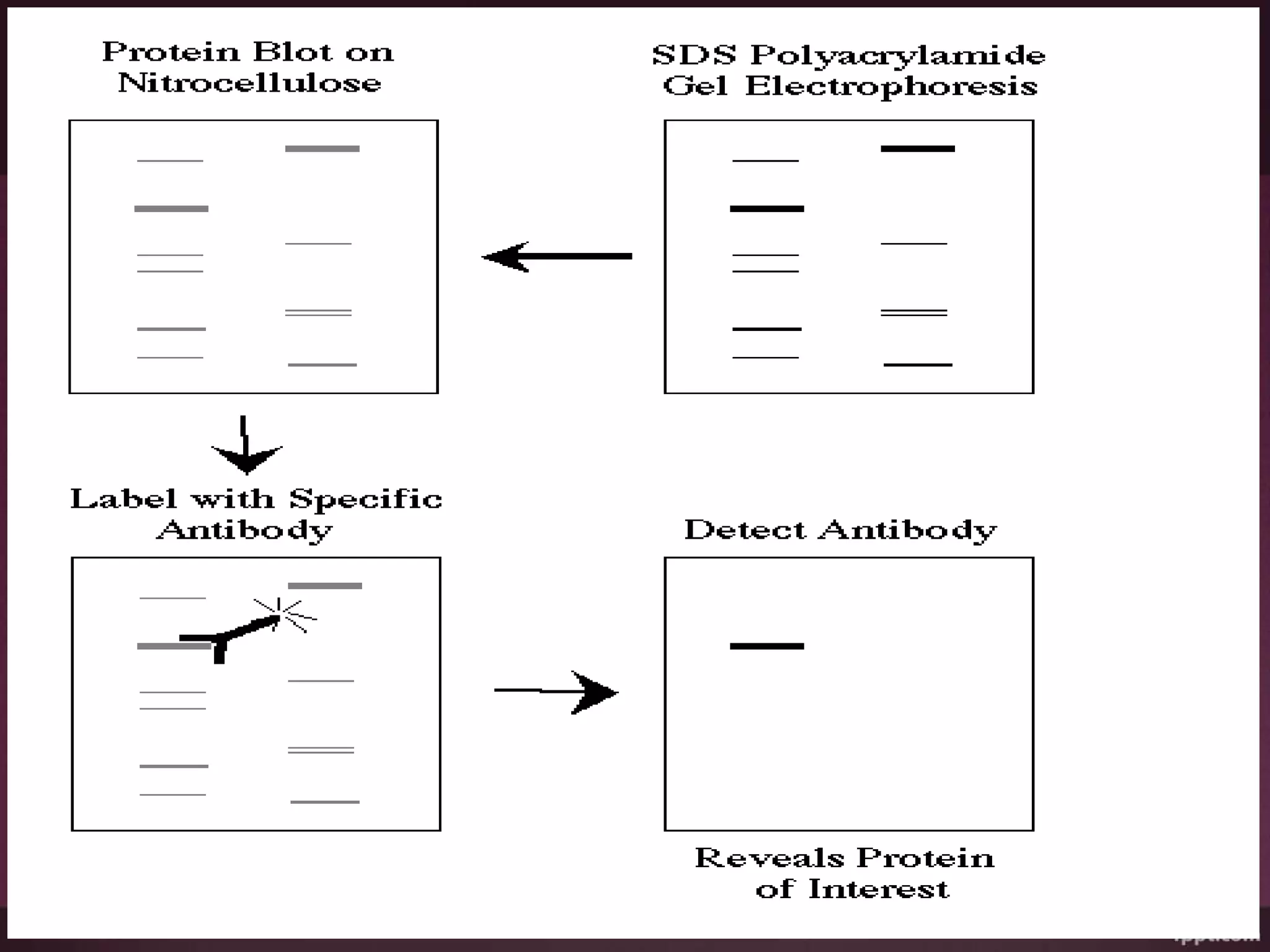
Steps in W.B
1. Gel electrophoresis:
The proteins are separated according to size.
2. Membrane Transfer:
Transferring to nitrocellulose by applying current.
3. Blocking:
Done to prevent non-specific protein interactions
between the membrane and the antibody protein.
Blocking in W.B
• The blot is incubated with a generic protein (such as
milk proteins) which binds to any remaining sticky
places on the nitrocellulose.
• An antibody that is specific for the protein of
interest(the primary antibody - Ab1) is added to
the nitrocellulose sheet and reacts with the antigen.
• Only the band containing the protein of interest
binds the antibody, forming a layer of antibody
molecules .
Cont..
• Following several rinses for removal of non-
specifically bound Ab1, the Ab1-antigen complex on
the nitrocellulose sheet is incubated with a second
antibody (Ab2), which recognizes the primary
antibody and binds it.
• Ab2 is radioactively labeled, or is covalently linked to
a reporter enzyme, which allows to visualize the
protein-Ab1-Ab2 complex
Applications
• To identify the specific proteins
• To identify their masses
• The confirmatory HIV test to detect anti-HIV antibody in a
human serum sample.
• The definitive test for Bovine spongiform encephalopathy
(BSE, commonly referred to as 'mad cow disease').
• Some forms of Lyme disease testing also employ Western
blotting.
Protein gel (SDS-PAGE) that has
been stained with Coomassie Blue.
Faster Way to Western
Blot
• The Quick Western Kit provides a universal detection
reagent that can be combined with the primary
antibody incubation step, eliminating the need for a
secondary antibody incubation step.
• This kit works with a variety of primary antibodies.
• This reduces the overall time to complete a Western
blot.
Standard Western Blot
Blotting (Southern, Northern and Eastern)

Blotting (Southern, Northern and Eastern)

  • 2.
  • 3.
    What is blotting? Techniquefor transferring • DNA • RNA • Proteins onto a carrier so they can be separated, and often follows the use of a gel electrophoresis.
  • 4.
    TYPES OF BLOTTING TECHNIQUES BLOTTING TECHNIQUES SouthernBlot It is used to detect the DNA. Northern blot It is used to detect the RNA. Western blot It is used to detect proteins.
  • 5.
    Blotting sheet • Whatman3mm paper….. world’s most widely used blotting paper.  REASON???? • high quality • purity • consistency
  • 6.
    Creating the Sandwich •The sandwich consists of : filter paper Nitrocellulose membrane gel matrix another piece of filter paper
  • 7.
    SOUTHERN BLOTTING History: • Namedafter Sir Edwin Southern • Developed in 1975
  • 8.
    SOUTHERN BLOTTING “Used todetect the DNA” • This method Involves:  Separation  Transfer  Hybridization. • This DNA can be: • Single gene • Part of a larger piece of DNA……..viral genome “The key to this method is Hybridization”
  • 9.
    Hybridization “Process of forminga dsDNA molecule between a ssDNA probe and a ss-target patient DNA”
  • 10.
    PRINCIPLE  The mixtureof molecules is separated.  Immobilized on a matrix.  Probe addition to the matrix to bind to the molecules.  Unbound probes are removed. “The place where the probe is connected corresponds to the location of the immobilized target molecule.”
  • 11.
    Steps in southernblotting The DNA is digested Fragments Gel electrophoresis Transfer to membrane Probing Autoradiogram
  • 13.
    APPLICATIONS Southern blotting isused in: • Gene discovery • Mapping • Evolution • Development studies • Diagnostics • Forensics
  • 14.
    Northern Blotting History: Northern blottingwas developed by James Alwine and George Stark at Stanford University. Northern blotting is a technique for detection of specific RNA sequences
  • 15.
    Steps involved inN.B RNA isolation Loading of sample on Agarose gel Blotting on nitrocellulose membrane Labeling with probe Washing to remove unbound probe Detection by autoradiogram
  • 17.
    APPLICATIONS • A standardfor the direct study of gene expression at the level of mRNA (mRNA transcripts) • Detection of mRNA transcript size • Study RNA degradation • Study RNA splicing - can detect alternatively spliced transcripts • Study RNA half-life • Study IRES (internal ribosomal entry site) – to remove possibility of RNA digestion vs. 2nd cistron translation.
  • 18.
    Western blotting Discovery??? • Dr.Douglas Lake of the University of Arizona School of Medicine's Department of Microbiology and Immunology “A technique in which proteins are separated by gel electrophoresis and transferred to a membrane sheet. A specific protein is then identified through its reaction with a labeled antibody.”
  • 19.
    Principle This technique workson the principle on “Antigen-Antibody” relationship
  • 20.
    Prerequisite for W.B TheSDS PAGE technique is a prerequisite for Western blotting. “SDS (sodium dodecyl sulfate) is a detergent (soap) that can dissolve hydrophobic molecules but also has a negative charge (sulfate) attached to it.”
  • 21.
    Steps in W.B 1.Gel electrophoresis: The proteins are separated according to size. 2. Membrane Transfer: Transferring to nitrocellulose by applying current. 3. Blocking: Done to prevent non-specific protein interactions between the membrane and the antibody protein.
  • 23.
    Blocking in W.B •The blot is incubated with a generic protein (such as milk proteins) which binds to any remaining sticky places on the nitrocellulose. • An antibody that is specific for the protein of interest(the primary antibody - Ab1) is added to the nitrocellulose sheet and reacts with the antigen. • Only the band containing the protein of interest binds the antibody, forming a layer of antibody molecules .
  • 24.
    Cont.. • Following severalrinses for removal of non- specifically bound Ab1, the Ab1-antigen complex on the nitrocellulose sheet is incubated with a second antibody (Ab2), which recognizes the primary antibody and binds it. • Ab2 is radioactively labeled, or is covalently linked to a reporter enzyme, which allows to visualize the protein-Ab1-Ab2 complex
  • 25.
    Applications • To identifythe specific proteins • To identify their masses • The confirmatory HIV test to detect anti-HIV antibody in a human serum sample. • The definitive test for Bovine spongiform encephalopathy (BSE, commonly referred to as 'mad cow disease'). • Some forms of Lyme disease testing also employ Western blotting.
  • 27.
    Protein gel (SDS-PAGE)that has been stained with Coomassie Blue.
  • 28.
    Faster Way toWestern Blot • The Quick Western Kit provides a universal detection reagent that can be combined with the primary antibody incubation step, eliminating the need for a secondary antibody incubation step. • This kit works with a variety of primary antibodies. • This reduces the overall time to complete a Western blot.
  • 29.