Structure and
classification of virus
Atia Ali
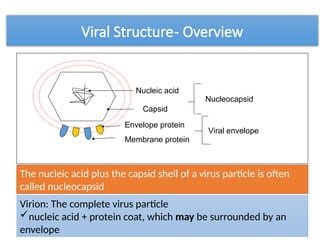
Viral Structure- Overview
Nucleic acid
Capsid
Nucleocapsid
Envelope protein
Membrane protein
Viral envelope
Virion: The complete virus particle
nucleic acid + protein coat, which may be surrounded by an
envelope
The nucleic acid plus the capsid shell of a virus particle is often
called nucleocapsid
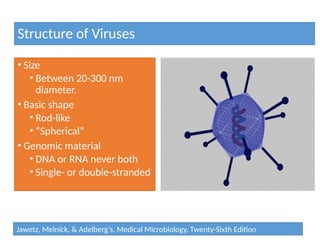
• Size
• Between 20-300 nm
diameter.
• Basic shape
• Rod-like
• “Spherical”
• Genomic material
• DNA or RNA never both
• Single- or double-stranded
Structure of Viruses
Jawetz, Melnick, & Adelberg’s, Medical Microbiology, Twenty-Sixth Edition
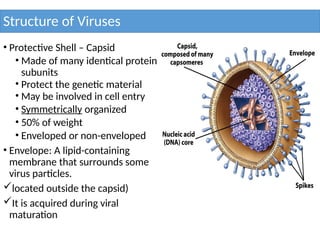
• Protective Shell – Capsid
• Made of many identical protein
subunits
• Protect the genetic material
• May be involved in cell entry
• Symmetrically organized
• 50% of weight
• Enveloped or non-enveloped
• Envelope: A lipid-containing
membrane that surrounds some
virus particles.
located outside the capsid)
It is acquired during viral
maturation
Structure of Viruses
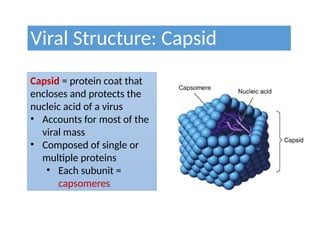
Viral Structure: Capsid
Capsid = protein coat that
encloses and protects the
nucleic acid of a virus
• Accounts for most of the
viral mass
• Composed of single or
multiple proteins
• Each subunit =
capsomeres
Virus Classification 2
Based on Shape
• Polyhedral viruses
• Helical Viruses
• Complex viruses
Based on Envelope
• Naked viruses
• Enveloped viruses
General Morphology
Capsid Structure determines shape:
• Helical Viruses = nucleic acid is inside a hollow cylindrical
capsid with a helical structure
• Rabies, Ebola viruses, Tobacco Mosaic Virus
• Polyhedral viruses = many sided; icosahedron is common with
20 equilateral triangles as sides and 12 vertices
• Poliovirus, Adenovirus, herpes,
• Complex structures
• Pox virus & bacteriophage
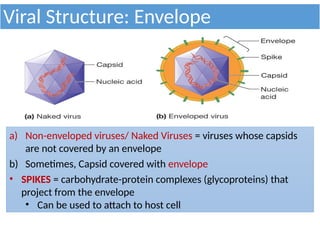
Viral Structure: Envelope
a) Non-enveloped viruses/ Naked Viruses = viruses whose capsids
are not covered by an envelope
b) Sometimes, Capsid covered with envelope
• SPIKES = carbohydrate-protein complexes (glycoproteins) that
project from the envelope
• Can be used to attach to host cell
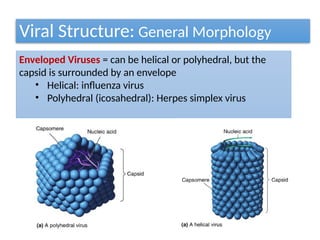
Viral Structure: General Morphology
Enveloped Viruses = can be helical or polyhedral, but the
capsid is surrounded by an envelope
• Helical: influenza virus
• Polyhedral (icosahedral): Herpes simplex virus
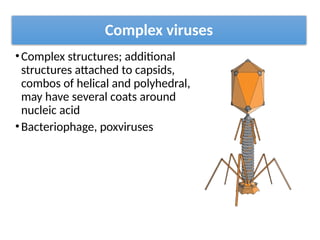
Complex viruses
•Complex structures; additional
structures attached to capsids,
combos of helical and polyhedral,
may have several coats around
nucleic acid
•Bacteriophage, poxviruses
BACTERIOPHAGE4
•Viruses that infect bacterial cells are called
bacteriophages (phages for short), which means
‘bacteria eaters’
•These are large, complex viruses, with a
characteristic head and tail structure
•The double-stranded, linear DNA genome contains
over 100 genes, and is contained within the
icosahedral head
Essential Microbiology, Stuart Hogg, The University of Glamorgan, UK
12
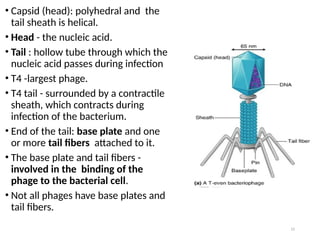
• Capsid (head): polyhedral and the
tail sheath is helical.
• Head - the nucleic acid.
• Tail : hollow tube through which the
nucleic acid passes during infection
• T4 -largest phage.
• T4 tail - surrounded by a contractile
sheath, which contracts during
infection of the bacterium.
• End of the tail: base plate and one
or more tail fibers attached to it.
• The base plate and tail fibers -
involved in the binding of the
phage to the bacterial cell.
• Not all phages have base plates and
tail fibers.
Classification of major virus groups
1. Herpesvirus
2. Poxvirus
3. Adenovirus
4. Parvovirus
5. Papovavirus
1. Orthomyxovirus
2. Paramyxovirus
3. Rhabdovirus
4. Tagovirus
5. Retrovirus
6. Reovirus
7. Picornavirus
8. Coronavirus
Shafer’s textbook of oral pathology, 6th
edition
DNA VIRUSES RNA VIRUS
Virus Classification 2
• Based on genome structure
•BALTIMORE CLASSIFICATION
• DNA or RNA (never both)
• ssDNA viruses
• dsDNA viruses
• ssRNA viruses
• Plus Strand (+RNA viruses)
• Same
• Negative strand (- RNA viruses)
• Complementary
• Retroviruses
• Converted into complementary DNA, then into the cell for
replication
• dsRNA viruses
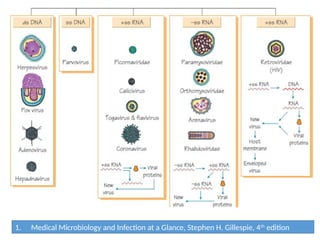
1. Medical Microbiology and Infection at a Glance, Stephen H. Gillespie, 4th
edition
1- Double stranded DNA families
• 1- POX VIRUS
• 2- HERPES VIRUS
• 3- HEPADNA VIRUS
• 4- ADENO VIRUS
• 5- PAPOVA VIRUS
2- Single stranded DNA families.
3- Double stranded RNA families.
• Single stranded DNA family:
1- Parvoviridae.
• Double stranded RNA family:
1- Reoviridae .
4- Single stranded RNA families with positive strands
• 1-Picornaviridae.
• 2- Caliciviridae.
• 3- Astroviridae.
• 4- Coronaviridae.
• 5- Flaviviradae.
• 6- Togaviridae.
• The viral genome acts directly as m-RNA.
5- Single stranded RNA families with negative strands
• 1- Orthomyxoviridae.
• 2- Paramyxoviridae.
• 3- Rhabdoviridae.
• 4- Filoviridae.
• The viral genome does not act as m-RNA.
• It must be transcribed by the viral enzyme transcriptase into
m-RNA.
• Virions contain the enzyme transcriptase.
6-Single stranded RNA viruses associated with the
enzyme reverse transcriptase
• Retroviruses.
• The viral genome is reverse transcribed into a
complementary DNA strand using the enzyme reverse
transcriptase.
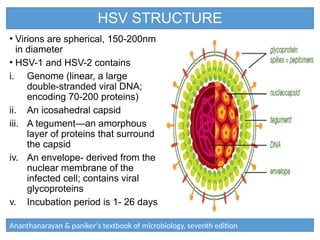
HSV STRUCTURE
• Virions are spherical, 150-200nm
in diameter
• HSV-1 and HSV-2 contains
i. Genome (linear, a large
double-stranded viral DNA;
encoding 70-200 proteins)
ii. An icosahedral capsid
iii. A tegument—an amorphous
layer of proteins that surround
the capsid
iv. An envelope- derived from the
nuclear membrane of the
infected cell; contains viral
glycoproteins
v. Incubation period is 1- 26 days
Ananthanarayan & paniker’s textbook of microbiology, seventh edition
Herpes viruses1
Herpesviruses are divided into three groups:
• α-herpesviruses are fast-growing cytolytic viruses that
establish latent infections in neurones (e.g. herpes simplex
and varicella zoster);
• β-herpesviruses are slow-growing viruses that become
latent in secretory glands and kidneys (e.g. cytomegalovirus
[CMV], HHV6 and 7);
• γ-herpesviruses are latent in lymphoid tissues (e.g. Epstein–
Barr virus [EBV], HHV-8).
Classification
Medical Microbiology and Infection at a Glance, Stephen H. Gillespie, 4th
edition
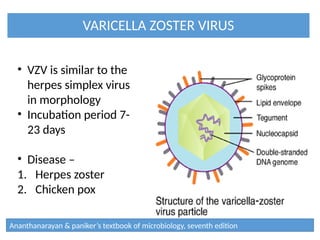
VARICELLA ZOSTER VIRUS
• VZV is similar to the
herpes simplex virus
in morphology
• Incubation period 7-
23 days
• Disease –
1. Herpes zoster
2. Chicken pox
Ananthanarayan & paniker’s textbook of microbiology, seventh edition
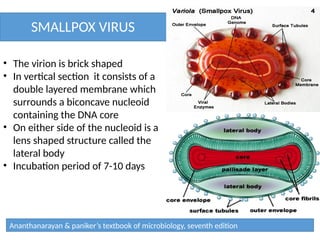
SMALLPOX VIRUS
• The virion is brick shaped
• In vertical section it consists of a
double layered membrane which
surrounds a biconcave nucleoid
containing the DNA core
• On either side of the nucleoid is a
lens shaped structure called the
lateral body
• Incubation period of 7-10 days
Ananthanarayan & paniker’s textbook of microbiology, seventh edition
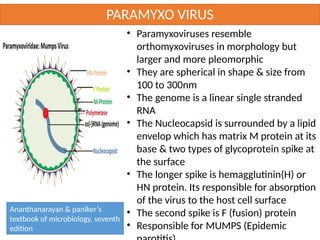
PARAMYXO VIRUS
• Paramyxoviruses resemble
orthomyxoviruses in morphology but
larger and more pleomorphic
• They are spherical in shape & size from
100 to 300nm
• The genome is a linear single stranded
RNA
• The Nucleocapsid is surrounded by a lipid
envelop which has matrix M protein at its
base & two types of glycoprotein spike at
the surface
• The longer spike is hemagglutinin(H) or
HN protein. Its responsible for absorption
of the virus to the host cell surface
• The second spike is F (fusion) protein
• Responsible for MUMPS (Epidemic
Ananthanarayan & paniker’s
textbook of microbiology, seventh
edition
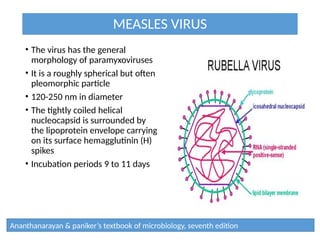
MEASLES VIRUS
• The virus has the general
morphology of paramyxoviruses
• It is a roughly spherical but often
pleomorphic particle
• 120-250 nm in diameter
• The tightly coiled helical
nucleocapsid is surrounded by
the lipoprotein envelope carrying
on its surface hemagglutinin (H)
spikes
• Incubation periods 9 to 11 days
Ananthanarayan & paniker’s textbook of microbiology, seventh edition
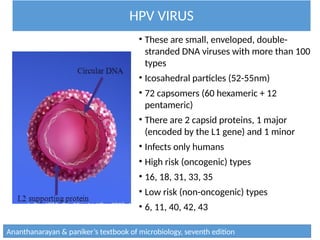
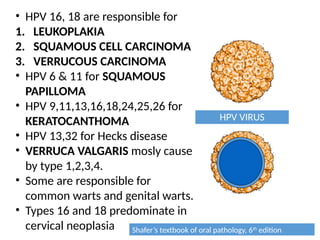
HPV VIRUS
• These are small, enveloped, double-
stranded DNA viruses with more than 100
types
• Icosahedral particles (52-55nm)
• 72 capsomers (60 hexameric + 12
pentameric)
• There are 2 capsid proteins, 1 major
(encoded by the L1 gene) and 1 minor
• Infects only humans
• High risk (oncogenic) types
• 16, 18, 31, 33, 35
• Low risk (non-oncogenic) types
• 6, 11, 40, 42, 43
Ananthanarayan & paniker’s textbook of microbiology, seventh edition
• HPV 16, 18 are responsible for
1. LEUKOPLAKIA
2. SQUAMOUS CELL CARCINOMA
3. VERRUCOUS CARCINOMA
• HPV 6 & 11 for SQUAMOUS
PAPILLOMA
• HPV 9,11,13,16,18,24,25,26 for
KERATOCANTHOMA
• HPV 13,32 for Hecks disease
• VERRUCA VALGARIS mosly cause
by type 1,2,3,4.
• Some are responsible for
common warts and genital warts.
• Types 16 and 18 predominate in
cervical neoplasia
HPV VIRUS
Shafer’s textbook of oral pathology, 6th
edition
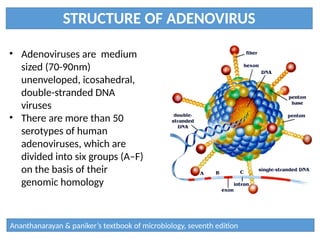
STRUCTURE OF ADENOVIRUS
• Adenoviruses are medium
sized (70-90nm)
unenveloped, icosahedral,
double-stranded DNA
viruses
• There are more than 50
serotypes of human
adenoviruses, which are
divided into six groups (A–F)
on the basis of their
genomic homology
Ananthanarayan & paniker’s textbook of microbiology, seventh edition
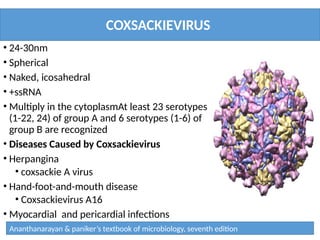
COXSACKIEVIRUS
• 24-30nm
• Spherical
• Naked, icosahedral
• +ssRNA
• Multiply in the cytoplasmAt least 23 serotypes
(1-22, 24) of group A and 6 serotypes (1-6) of
group B are recognized
• Diseases Caused by Coxsackievirus
• Herpangina
• coxsackie A virus
• Hand-foot-and-mouth disease
• Coxsackievirus A16
• Myocardial and pericardial infections
• coxsackie B virus. (B3)
Ananthanarayan & paniker’s textbook of microbiology, seventh edition
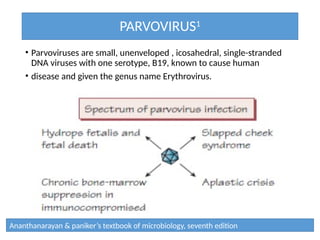
PARVOVIRUS1
• Parvoviruses are small, unenveloped , icosahedral, single-stranded
DNA viruses with one serotype, B19, known to cause human
• disease and given the genus name Erythrovirus.
Ananthanarayan & paniker’s textbook of microbiology, seventh edition
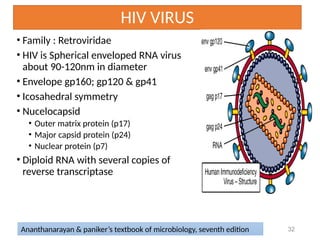
HIV VIRUS
• Family : Retroviridae
• HIV is Spherical enveloped RNA virus
about 90-120nm in diameter
• Envelope gp160; gp120 & gp41
• Icosahedral symmetry
• Nucelocapsid
• Outer matrix protein (p17)
• Major capsid protein (p24)
• Nuclear protein (p7)
• Diploid RNA with several copies of
reverse transcriptase
32
Ananthanarayan & paniker’s textbook of microbiology, seventh edition
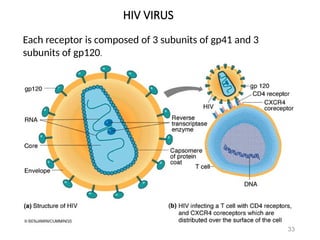
HIV VIRUS
33
Each receptor is composed of 3 subunits of gp41 and 3
subunits of gp120.
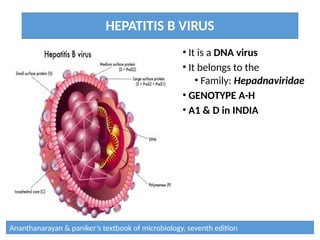
HEPATITIS B VIRUS
• It is a DNA virus
• It belongs to the
• Family: Hepadnaviridae
• GENOTYPE A-H
• A1 & D in INDIA
Ananthanarayan & paniker’s textbook of microbiology, seventh edition
.
• Surface of virions consists of possibly 240 subunits comprising
of 3 different polypeptides termed Large, middle, small
surface(HBs) proteins
• The lipid in the outer protein shell or the HBs particles is
derived from an intracellular compartment & not the plasma
membrane

Structures and classification of viruses

  • 1.
  • 2.
    Viral Structure- Overview Nucleicacid Capsid Nucleocapsid Envelope protein Membrane protein Viral envelope Virion: The complete virus particle nucleic acid + protein coat, which may be surrounded by an envelope The nucleic acid plus the capsid shell of a virus particle is often called nucleocapsid
  • 3.
    • Size • Between20-300 nm diameter. • Basic shape • Rod-like • “Spherical” • Genomic material • DNA or RNA never both • Single- or double-stranded Structure of Viruses Jawetz, Melnick, & Adelberg’s, Medical Microbiology, Twenty-Sixth Edition
  • 4.
    • Protective Shell– Capsid • Made of many identical protein subunits • Protect the genetic material • May be involved in cell entry • Symmetrically organized • 50% of weight • Enveloped or non-enveloped • Envelope: A lipid-containing membrane that surrounds some virus particles. located outside the capsid) It is acquired during viral maturation Structure of Viruses
  • 5.
    Viral Structure: Capsid Capsid= protein coat that encloses and protects the nucleic acid of a virus • Accounts for most of the viral mass • Composed of single or multiple proteins • Each subunit = capsomeres
  • 6.
    Virus Classification 2 Basedon Shape • Polyhedral viruses • Helical Viruses • Complex viruses Based on Envelope • Naked viruses • Enveloped viruses
  • 7.
    General Morphology Capsid Structuredetermines shape: • Helical Viruses = nucleic acid is inside a hollow cylindrical capsid with a helical structure • Rabies, Ebola viruses, Tobacco Mosaic Virus • Polyhedral viruses = many sided; icosahedron is common with 20 equilateral triangles as sides and 12 vertices • Poliovirus, Adenovirus, herpes, • Complex structures • Pox virus & bacteriophage
  • 8.
    Viral Structure: Envelope a)Non-enveloped viruses/ Naked Viruses = viruses whose capsids are not covered by an envelope b) Sometimes, Capsid covered with envelope • SPIKES = carbohydrate-protein complexes (glycoproteins) that project from the envelope • Can be used to attach to host cell
  • 9.
    Viral Structure: GeneralMorphology Enveloped Viruses = can be helical or polyhedral, but the capsid is surrounded by an envelope • Helical: influenza virus • Polyhedral (icosahedral): Herpes simplex virus
  • 10.
    Complex viruses •Complex structures;additional structures attached to capsids, combos of helical and polyhedral, may have several coats around nucleic acid •Bacteriophage, poxviruses
  • 11.
    BACTERIOPHAGE4 •Viruses that infectbacterial cells are called bacteriophages (phages for short), which means ‘bacteria eaters’ •These are large, complex viruses, with a characteristic head and tail structure •The double-stranded, linear DNA genome contains over 100 genes, and is contained within the icosahedral head Essential Microbiology, Stuart Hogg, The University of Glamorgan, UK
  • 12.
    12 • Capsid (head):polyhedral and the tail sheath is helical. • Head - the nucleic acid. • Tail : hollow tube through which the nucleic acid passes during infection • T4 -largest phage. • T4 tail - surrounded by a contractile sheath, which contracts during infection of the bacterium. • End of the tail: base plate and one or more tail fibers attached to it. • The base plate and tail fibers - involved in the binding of the phage to the bacterial cell. • Not all phages have base plates and tail fibers.
  • 13.
    Classification of majorvirus groups 1. Herpesvirus 2. Poxvirus 3. Adenovirus 4. Parvovirus 5. Papovavirus 1. Orthomyxovirus 2. Paramyxovirus 3. Rhabdovirus 4. Tagovirus 5. Retrovirus 6. Reovirus 7. Picornavirus 8. Coronavirus Shafer’s textbook of oral pathology, 6th edition DNA VIRUSES RNA VIRUS
  • 14.
    Virus Classification 2 •Based on genome structure •BALTIMORE CLASSIFICATION • DNA or RNA (never both) • ssDNA viruses • dsDNA viruses • ssRNA viruses • Plus Strand (+RNA viruses) • Same • Negative strand (- RNA viruses) • Complementary • Retroviruses • Converted into complementary DNA, then into the cell for replication • dsRNA viruses
  • 15.
    1. Medical Microbiologyand Infection at a Glance, Stephen H. Gillespie, 4th edition
  • 16.
    1- Double strandedDNA families • 1- POX VIRUS • 2- HERPES VIRUS • 3- HEPADNA VIRUS • 4- ADENO VIRUS • 5- PAPOVA VIRUS
  • 17.
    2- Single strandedDNA families. 3- Double stranded RNA families. • Single stranded DNA family: 1- Parvoviridae. • Double stranded RNA family: 1- Reoviridae .
  • 18.
    4- Single strandedRNA families with positive strands • 1-Picornaviridae. • 2- Caliciviridae. • 3- Astroviridae. • 4- Coronaviridae. • 5- Flaviviradae. • 6- Togaviridae. • The viral genome acts directly as m-RNA.
  • 19.
    5- Single strandedRNA families with negative strands • 1- Orthomyxoviridae. • 2- Paramyxoviridae. • 3- Rhabdoviridae. • 4- Filoviridae. • The viral genome does not act as m-RNA. • It must be transcribed by the viral enzyme transcriptase into m-RNA. • Virions contain the enzyme transcriptase.
  • 20.
    6-Single stranded RNAviruses associated with the enzyme reverse transcriptase • Retroviruses. • The viral genome is reverse transcribed into a complementary DNA strand using the enzyme reverse transcriptase.
  • 21.
    HSV STRUCTURE • Virionsare spherical, 150-200nm in diameter • HSV-1 and HSV-2 contains i. Genome (linear, a large double-stranded viral DNA; encoding 70-200 proteins) ii. An icosahedral capsid iii. A tegument—an amorphous layer of proteins that surround the capsid iv. An envelope- derived from the nuclear membrane of the infected cell; contains viral glycoproteins v. Incubation period is 1- 26 days Ananthanarayan & paniker’s textbook of microbiology, seventh edition
  • 22.
    Herpes viruses1 Herpesviruses aredivided into three groups: • α-herpesviruses are fast-growing cytolytic viruses that establish latent infections in neurones (e.g. herpes simplex and varicella zoster); • β-herpesviruses are slow-growing viruses that become latent in secretory glands and kidneys (e.g. cytomegalovirus [CMV], HHV6 and 7); • γ-herpesviruses are latent in lymphoid tissues (e.g. Epstein– Barr virus [EBV], HHV-8). Classification Medical Microbiology and Infection at a Glance, Stephen H. Gillespie, 4th edition
  • 23.
    VARICELLA ZOSTER VIRUS •VZV is similar to the herpes simplex virus in morphology • Incubation period 7- 23 days • Disease – 1. Herpes zoster 2. Chicken pox Ananthanarayan & paniker’s textbook of microbiology, seventh edition
  • 24.
    SMALLPOX VIRUS • Thevirion is brick shaped • In vertical section it consists of a double layered membrane which surrounds a biconcave nucleoid containing the DNA core • On either side of the nucleoid is a lens shaped structure called the lateral body • Incubation period of 7-10 days Ananthanarayan & paniker’s textbook of microbiology, seventh edition
  • 25.
    PARAMYXO VIRUS • Paramyxovirusesresemble orthomyxoviruses in morphology but larger and more pleomorphic • They are spherical in shape & size from 100 to 300nm • The genome is a linear single stranded RNA • The Nucleocapsid is surrounded by a lipid envelop which has matrix M protein at its base & two types of glycoprotein spike at the surface • The longer spike is hemagglutinin(H) or HN protein. Its responsible for absorption of the virus to the host cell surface • The second spike is F (fusion) protein • Responsible for MUMPS (Epidemic Ananthanarayan & paniker’s textbook of microbiology, seventh edition
  • 26.
    MEASLES VIRUS • Thevirus has the general morphology of paramyxoviruses • It is a roughly spherical but often pleomorphic particle • 120-250 nm in diameter • The tightly coiled helical nucleocapsid is surrounded by the lipoprotein envelope carrying on its surface hemagglutinin (H) spikes • Incubation periods 9 to 11 days Ananthanarayan & paniker’s textbook of microbiology, seventh edition
  • 27.
    HPV VIRUS • Theseare small, enveloped, double- stranded DNA viruses with more than 100 types • Icosahedral particles (52-55nm) • 72 capsomers (60 hexameric + 12 pentameric) • There are 2 capsid proteins, 1 major (encoded by the L1 gene) and 1 minor • Infects only humans • High risk (oncogenic) types • 16, 18, 31, 33, 35 • Low risk (non-oncogenic) types • 6, 11, 40, 42, 43 Ananthanarayan & paniker’s textbook of microbiology, seventh edition
  • 28.
    • HPV 16,18 are responsible for 1. LEUKOPLAKIA 2. SQUAMOUS CELL CARCINOMA 3. VERRUCOUS CARCINOMA • HPV 6 & 11 for SQUAMOUS PAPILLOMA • HPV 9,11,13,16,18,24,25,26 for KERATOCANTHOMA • HPV 13,32 for Hecks disease • VERRUCA VALGARIS mosly cause by type 1,2,3,4. • Some are responsible for common warts and genital warts. • Types 16 and 18 predominate in cervical neoplasia HPV VIRUS Shafer’s textbook of oral pathology, 6th edition
  • 29.
    STRUCTURE OF ADENOVIRUS •Adenoviruses are medium sized (70-90nm) unenveloped, icosahedral, double-stranded DNA viruses • There are more than 50 serotypes of human adenoviruses, which are divided into six groups (A–F) on the basis of their genomic homology Ananthanarayan & paniker’s textbook of microbiology, seventh edition
  • 30.
    COXSACKIEVIRUS • 24-30nm • Spherical •Naked, icosahedral • +ssRNA • Multiply in the cytoplasmAt least 23 serotypes (1-22, 24) of group A and 6 serotypes (1-6) of group B are recognized • Diseases Caused by Coxsackievirus • Herpangina • coxsackie A virus • Hand-foot-and-mouth disease • Coxsackievirus A16 • Myocardial and pericardial infections • coxsackie B virus. (B3) Ananthanarayan & paniker’s textbook of microbiology, seventh edition
  • 31.
    PARVOVIRUS1 • Parvoviruses aresmall, unenveloped , icosahedral, single-stranded DNA viruses with one serotype, B19, known to cause human • disease and given the genus name Erythrovirus. Ananthanarayan & paniker’s textbook of microbiology, seventh edition
  • 32.
    HIV VIRUS • Family: Retroviridae • HIV is Spherical enveloped RNA virus about 90-120nm in diameter • Envelope gp160; gp120 & gp41 • Icosahedral symmetry • Nucelocapsid • Outer matrix protein (p17) • Major capsid protein (p24) • Nuclear protein (p7) • Diploid RNA with several copies of reverse transcriptase 32 Ananthanarayan & paniker’s textbook of microbiology, seventh edition
  • 33.
    HIV VIRUS 33 Each receptoris composed of 3 subunits of gp41 and 3 subunits of gp120.
  • 34.
    HEPATITIS B VIRUS •It is a DNA virus • It belongs to the • Family: Hepadnaviridae • GENOTYPE A-H • A1 & D in INDIA Ananthanarayan & paniker’s textbook of microbiology, seventh edition
  • 35.
    . • Surface ofvirions consists of possibly 240 subunits comprising of 3 different polypeptides termed Large, middle, small surface(HBs) proteins • The lipid in the outer protein shell or the HBs particles is derived from an intracellular compartment & not the plasma membrane