Immunochromatographic
Technique
Basir Ahmad
MLT
1
Outlines
• Introduction
• Principle
• Components
• Procedure
• Result interpretation
• Test names
2
Introduction
• Lateral flow tests also known as lateral
flow immunochromatographic assays, are
simple devices intended to detect the
presence (or absence) of a target analyte in
sample (matrix) without the need for
specialized and costly equipment
3
Principal of immunochromatography
kit
• Principal of immunochromatography is the
same as ELISA sandwich method,
only difference is in that immunological
reaction is carried out on the chromato-
graphic paper by capillary action.
4
• For this system, two kinds of specific antibodies
against antigen are used.
• One of the antibodies is immobilized on
the chromatographic paper
• other is labeled with colloidal gold and
infiltrated into sample pad
• An imunochromatographic unit is completed by
attaching the sample pad at the end of the
membrane.
5
• Liquid sample is dropped on the sample pad
• The antigen in the sample forms an
immunocomplex with the antibody labeled with
colloidal gold.
• Its complex moves along with the liquid sample
• and makes a contact with the antibody
immobilized on the membrane
• followed by forming an immuno- complex with
the immobilized antibody,
6
• Resulting in generating a colored red purple
line.
• Appearance of red purple line on the
membrane indicates the presence of antigen
of interest in the sample
• Liquid of the sample migrates through the
membrane very fast, it makes it possible to
detect the presence or absence of antigen
within 15 minutes
7
Components
8
Sample pad: Acts as a sponge and holds an excess
of sample fluid. Once soaked, the fluid migrates
to the second element
Conjugate pad:A dried format of bio-active particles
in a salt-sugar matrix that contains everything to
guarantee an optimized chemical reaction
between the target molecule (e.g., an antigen)
and its chemical partner (e.g., antibody) that has
been immobilized on the particle's surface
9
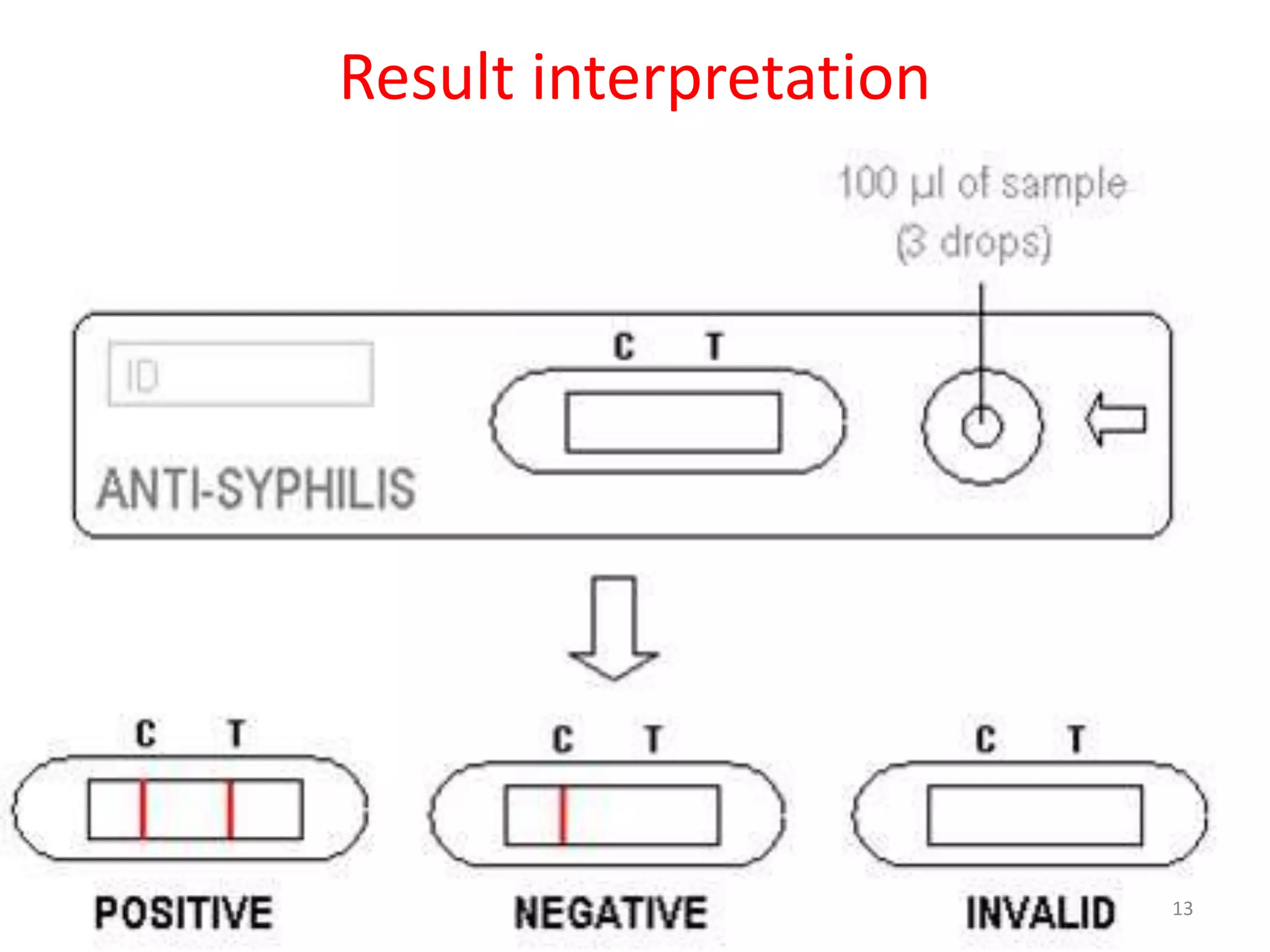
• Control:It contains an antibody that picks up
free latex/gold in order to confirm the test has
operated correctly.
• Test: It contains a specific capture molecule
and only captures those particles onto which
an analyte molecule has been immobilized
10
Procedure
• Take an alcohol swab and disinfect the site of
prick.
• Take a pricker and puncture the area below
finger tip.
• Ooze the blood .
• Take two drops with sucker and dispensed in
sample hole of strip.
• Add buffer to sample.
11
• Wait for 10-15 min
• Observe result and interpret accordingly
12
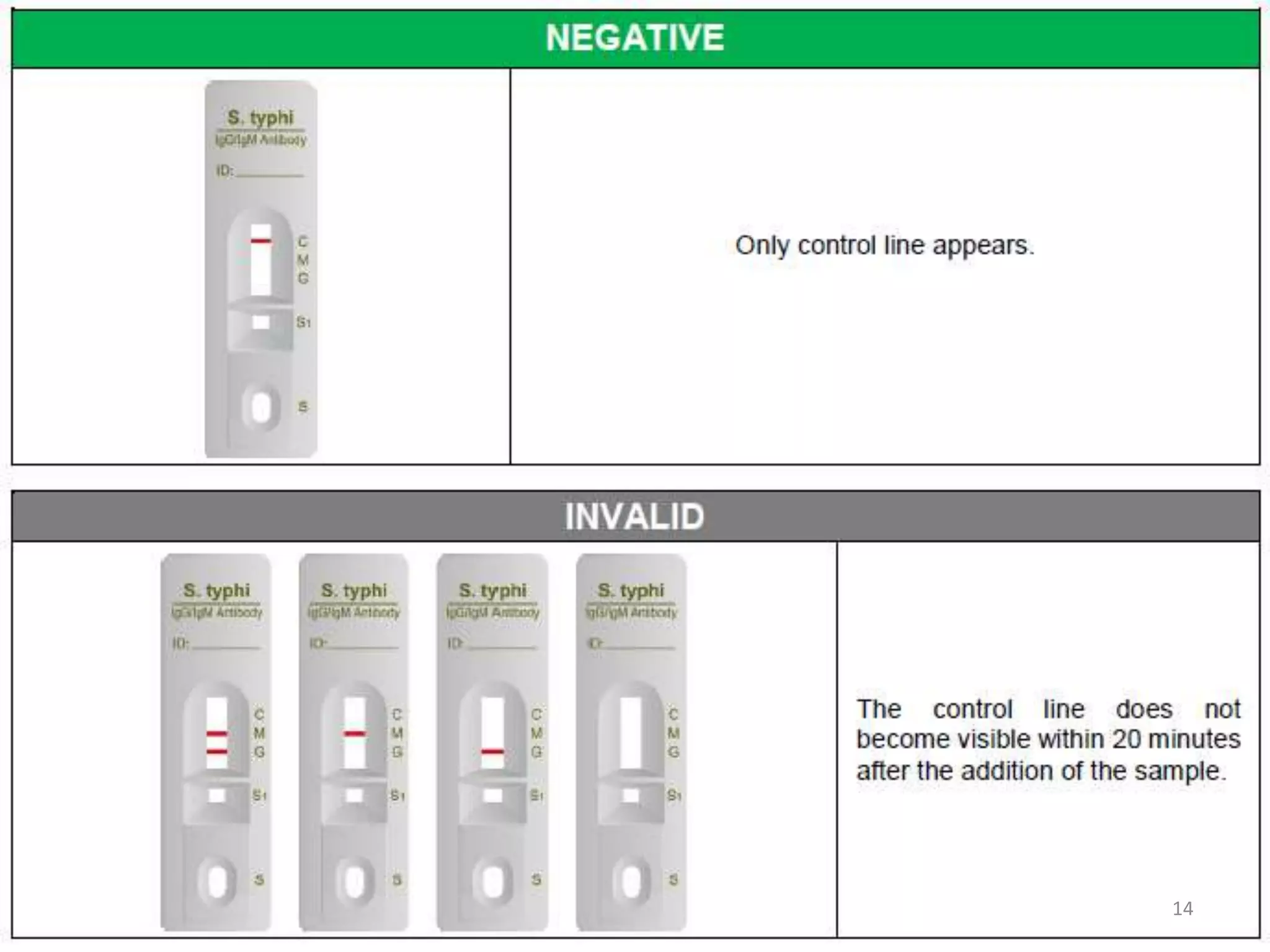
Result interpretation
13
14
Good and Bad of ICTs
• ICTs are a promising tool for reliable level of
diagnostic performance.
• Simple
• Rapid assays that can be completed in 10-15
min.
• They reduce the need for trained examiners
and costly equipment.
• It can be used under harsh field conditions.
15
• ICT assays are not as sensitive as other
immunoassays
• Note that the results should be confirmed by
other reference tests
16
Test names
• Typhidot
• Pregnancy
• HBs Ag
• HCV Ab
• HIV
• Parasites
17
18

Immunochromatographic technique (ICT)

  • 1.
  • 2.
    Outlines • Introduction • Principle •Components • Procedure • Result interpretation • Test names 2
  • 3.
    Introduction • Lateral flowtests also known as lateral flow immunochromatographic assays, are simple devices intended to detect the presence (or absence) of a target analyte in sample (matrix) without the need for specialized and costly equipment 3
  • 4.
    Principal of immunochromatography kit •Principal of immunochromatography is the same as ELISA sandwich method, only difference is in that immunological reaction is carried out on the chromato- graphic paper by capillary action. 4
  • 5.
    • For thissystem, two kinds of specific antibodies against antigen are used. • One of the antibodies is immobilized on the chromatographic paper • other is labeled with colloidal gold and infiltrated into sample pad • An imunochromatographic unit is completed by attaching the sample pad at the end of the membrane. 5
  • 6.
    • Liquid sampleis dropped on the sample pad • The antigen in the sample forms an immunocomplex with the antibody labeled with colloidal gold. • Its complex moves along with the liquid sample • and makes a contact with the antibody immobilized on the membrane • followed by forming an immuno- complex with the immobilized antibody, 6
  • 7.
    • Resulting ingenerating a colored red purple line. • Appearance of red purple line on the membrane indicates the presence of antigen of interest in the sample • Liquid of the sample migrates through the membrane very fast, it makes it possible to detect the presence or absence of antigen within 15 minutes 7
  • 8.
  • 9.
    Sample pad: Actsas a sponge and holds an excess of sample fluid. Once soaked, the fluid migrates to the second element Conjugate pad:A dried format of bio-active particles in a salt-sugar matrix that contains everything to guarantee an optimized chemical reaction between the target molecule (e.g., an antigen) and its chemical partner (e.g., antibody) that has been immobilized on the particle's surface 9
  • 10.
    • Control:It containsan antibody that picks up free latex/gold in order to confirm the test has operated correctly. • Test: It contains a specific capture molecule and only captures those particles onto which an analyte molecule has been immobilized 10
  • 11.
    Procedure • Take analcohol swab and disinfect the site of prick. • Take a pricker and puncture the area below finger tip. • Ooze the blood . • Take two drops with sucker and dispensed in sample hole of strip. • Add buffer to sample. 11
  • 12.
    • Wait for10-15 min • Observe result and interpret accordingly 12
  • 13.
  • 14.
  • 15.
    Good and Badof ICTs • ICTs are a promising tool for reliable level of diagnostic performance. • Simple • Rapid assays that can be completed in 10-15 min. • They reduce the need for trained examiners and costly equipment. • It can be used under harsh field conditions. 15
  • 16.
    • ICT assaysare not as sensitive as other immunoassays • Note that the results should be confirmed by other reference tests 16
  • 17.
    Test names • Typhidot •Pregnancy • HBs Ag • HCV Ab • HIV • Parasites 17
  • 18.