Morphology
and
classification of
viruses
Dr. Muna M. A. Yousif
M.D Clinical Microbiology
Overview
• Viruses are obligate intracellular organisms as they
can not synthesis their own energy. Can not be
cultured on artificial media only in cell cultures.
• Viruses are measured in nanometers (one billionth of
a meter) and range in size from 20 to 300nm (0.02 to
0.3μm) in diameter.
• Viruses cannot be seen with a light microscope
because the resolution of a light microscope is limited
to about 200nm, so a scanning electron microscope is
used to view them.
• Virion is the complete infective form of a virus outside
a host cell, with a core of RNA or DNA and a capsid.
Comparison of viruses
and bacteria
Property Viruses Cells
Type of nucleic acid DNA or RNA Both DNA and RNA
Proteins Few Many
Lipoprotein membrane In enveloped
viruses only
Present
Ribosomes Absent Present
Mitochondria Absent In eukaryotic cells
Enzymes None or few Many
Multiplication by binary
fission or mitosis
No Yes
Structure of viruses
• The basic structure of the virus or the core is composed of
genetic material (nucleic acids made of either DNA or RNA).
• The DNA or RNA maybe linear or circular, single stranded or
double stranded.
• Surrounding the nucleic acids is an outer coat made of protein
(capsid).
• The capsid is made of units called capsomers
• The arrangement of capsomers determines the architecture of
the virus or the nucleocapsid (made of the capsid and the
nucleic acid).
• Capsomer arrangement maybe:
1. Icosahedral
2. Helical
3. Complex
Icosahedral
• Looks like a sphere but it actually has 20 triangles
and 12 coroners fused together in a spherical
shape.
• Examples of viruses with an icosahedral structure
are the poliovirus, rhinovirus, and adenovirus
Helical
• The virus particle is elongated or pleomorphic (not
spherical) and the nucleic acid is spiral.
• Examples of viruses with a helical nucleocapsid are
influenza and measles viruses.
Complex
• These virus structures have a combination of
icosahedral and helical shape
• The Poxvirus one of the largest viruses in size has a
complex structure with a unique outer wall and
capsid.
Structrure of viruses
cont.’d
• The nucleocapsid of many viruses is surrounded by
an envelope
• Viruses with no envelopes are called naked viruses
• The outer layer of the virus envelope may contain
surface spikes or projections called glycoproteins
• The envelope of the virus is derived from the host
cell membrane when the virus is exiting the cell via
budding, and the infectivity of these viruses is mostly
dependent on the envelope.
• Examples of enveloped viruses are the influenza
virus, Hepatitis C and HIV.
Viral structure
Comparison of enveloped
and non-enveloped viruses
Nomenclature
• Family name ends in –viridae
• Genus name ends in –virus
• Example:
• Family: Herpesviridae
• Genus: Varicella virus
• Common name: Chickenpox virus
• Disease: Chickenpox
Viral growth curve
• One virion replicates inside an infected cell to give
hundreds of virions in approximately 10 hours.
• In this way viruses can spread rapidly from one cell
to another.
• First the virus disappears (but its nucleic acid
continues to function and to accumulate within
one cell)
• The time during which no virus is found inside the
cell is known as the eclipse period
• The eclipse period ends with appearance of the
virus
Viral growth curve cont.’d
Viral replication
1. Adsorption
2. Penetration
3. Uncoating
4. Viral genome replication
5. Assembly and release
Steps in Viral Replication
1. Attachment. This is the first step in viral replication. Surface
proteins of the virus interact with specific receptors on the
target cell surface
2. Penetration. Enveloped viruses (e.g., HIV, influenza virus)
penetrate cells through fusion of the viral envelope with
the host cell membrane. Non-enveloped viruses penetrate
cells by translocation of the virion across the host cell
membrane or receptor mediated endocytosis of the virion
with accumulation of viruses in cytoplasmic vesicles.
3. Uncoating (disassembly). The viral genome is uncoated
by removing the capsid proteins, allowing the genome
(nucleic acids)to be available for transcription and viral
multiplication.
Steps of viral replication
cont.’d
4. Genome replication. Viruses must use host cellular
machinery to replicate and make functional and structural
proteins. The first step in viral gene expression is mRNA
synthesis. Different viruses follow different pathway
depending on the nature of their nucleic acids and the
part of the cell in which they replicate
• DNA viruses generally replicate in the nucleus and use
host cell DNA- dependent RNA polymerase to synthesis
their mRNA
• Most RNA viruses replicate in the cytoplasm where they
do not have access to the host cell DNA- dependent
RNA polymerase. They therefore carry their own
polymerase within the virus particle
Steps of viral replication
cont.’d
5. Assembly and Release. Progeny virus particles are
assembled by packaging the viral nucleic acid
within the capsid proteins. Virus particles are then
released from the cell by either of two processes
6. Non-enveloped viruses are release by rupture of the
cell membrane and release of the mature particles
7. Enveloped viruses are released by budding through
the outer cell membrane (except herpesviruses
which acquires their envelope from the nuclear
membrane rather than from the outer cell
membrane)
Overview
• Classification of viruses is based on chemical and
structural criteria.
• Two important components of viruses used in
classification are:
1. Nucleic acids (DNA or RNA)
2. Capsid (size, symmetry) and whether it is
enveloped or non-enveloped
Classification of DNA
viruses
Virus family Envelope
present
Capsid
symmetry
Size
(nm)
DNA
structure
Medically important
virus
Parvovirdae No Icosahedral 22 SS, linear Parvovirus B19 virus
Polyomaviridae No Icosahedral 45 DS, circular JC, BK virus
Papillomavirdae No Icosahedral 55 DS, circular Human papilloma
virus
Adenoviridae No Icosahedral 75 DS, linear Adenovirus
Hepadnaviridae Yes Icosahedral 42 DS, incomplete
circular
Hepatitis B virus
Herpesviridae Yes Icosahedral 100 DS, linear HSV, VZV, CMV, EBV
Poxviridae Yes Complex 250X40
0
DS, linear Smallpox virus,
Molluscum
contagiosum virus
DNA viruses
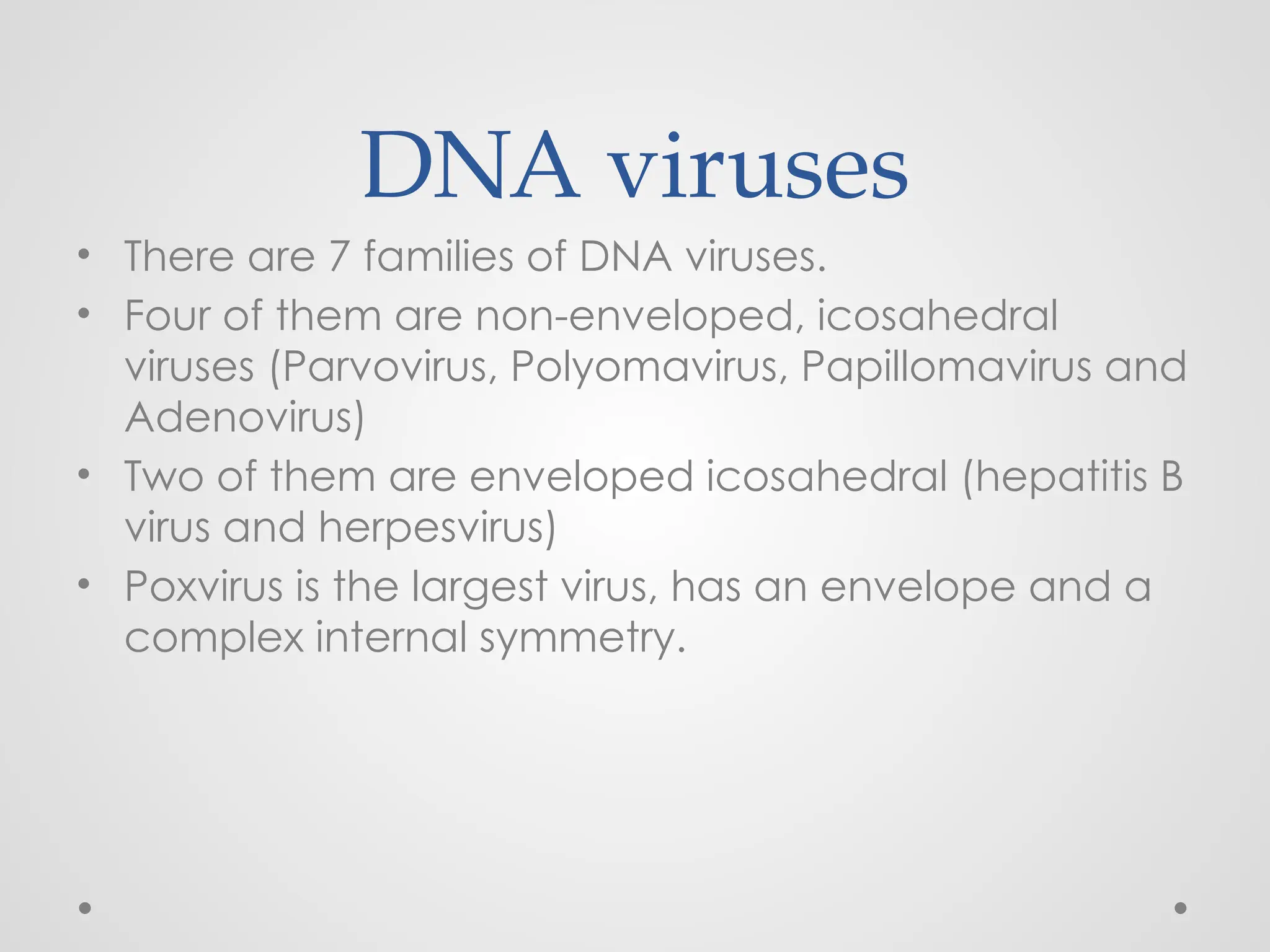
• There are 7 families of DNA viruses.
• Four of them are non-enveloped, icosahedral
viruses (Parvovirus, Polyomavirus, Papillomavirus and
Adenovirus)
• Two of them are enveloped icosahedral (hepatitis B
virus and herpesvirus)
• Poxvirus is the largest virus, has an envelope and a
complex internal symmetry.
Non-enveloped DNA
viruses
1. Parvovirus
2. Polyomavirus
3. Papillomavirus
4. Adenovirus
Enveloped DNA viruses
1. Hepadnaviruses
2. Herpesviruses
RNA viruses
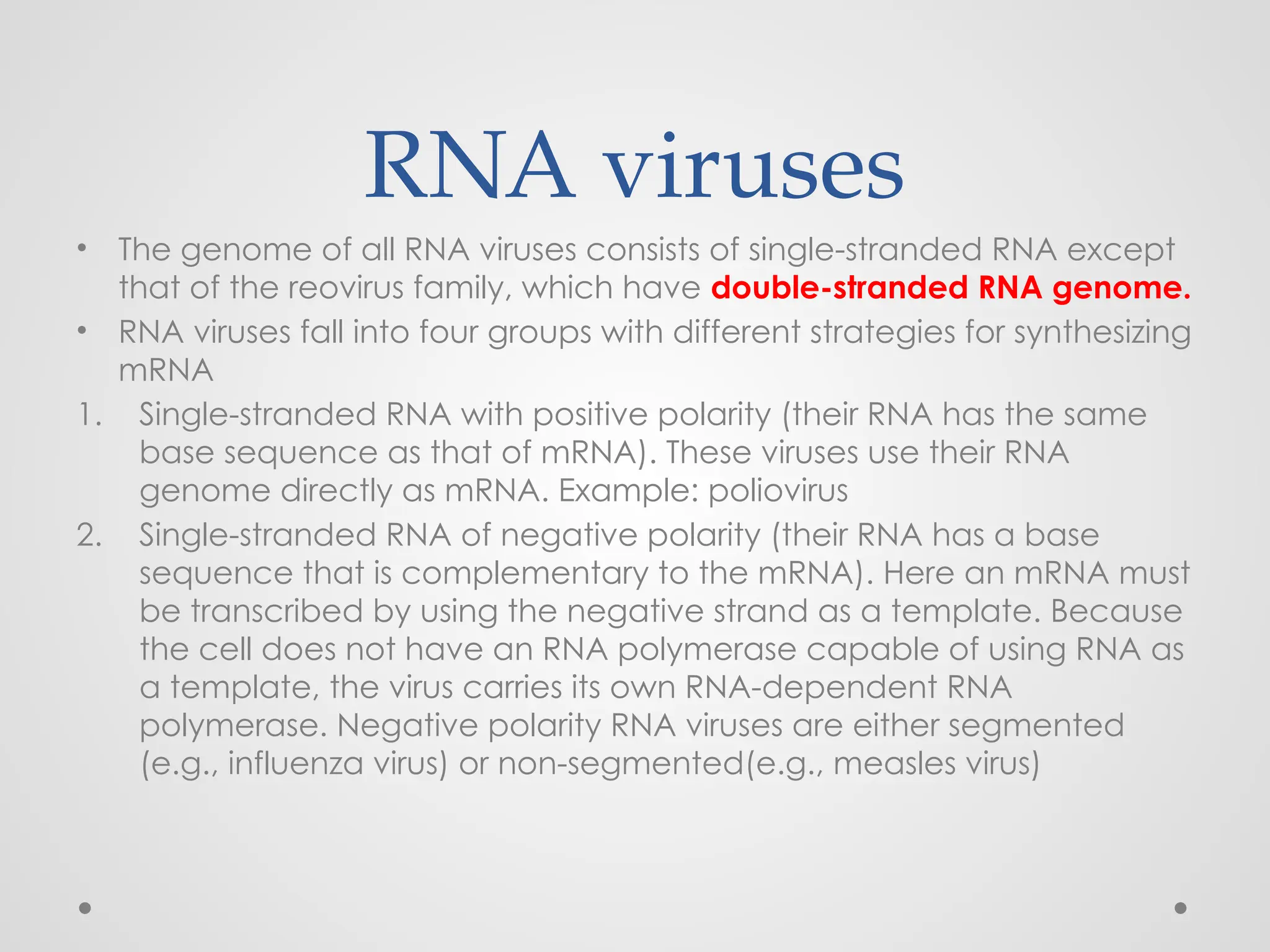
• The genome of all RNA viruses consists of single-stranded RNA except
that of the reovirus family, which have double-stranded RNA genome.
• RNA viruses fall into four groups with different strategies for synthesizing
mRNA
1. Single-stranded RNA with positive polarity (their RNA has the same
base sequence as that of mRNA). These viruses use their RNA
genome directly as mRNA. Example: poliovirus
2. Single-stranded RNA of negative polarity (their RNA has a base
sequence that is complementary to the mRNA). Here an mRNA must
be transcribed by using the negative strand as a template. Because
the cell does not have an RNA polymerase capable of using RNA as
a template, the virus carries its own RNA-dependent RNA
polymerase. Negative polarity RNA viruses are either segmented
(e.g., influenza virus) or non-segmented(e.g., measles virus)
3. RNA viruses with double-stranded RNA as its
genome (e.g., rotavirus). Because the cell has no
enzyme capable of transcribing their RNA into mRNA,
the virus carries its own polymerase.
4. Single-stranded RNA of positive polarity that is
transcribed into double-stranded DNA by an RNA-
dependent DNA polymerase (reverse transcriptase)
which is carried by the virus. This DNA copy is then
transcribed into viral mRNA by the regular host cell
RNA polymerase. Example retroviruses (HIV)
Summary of classification
of RNA viruses
Virus family Envel
ope
prese
nt
Capsid symmetry Size
(nm)
RNA structure Medically
important
virus
Picornaviridae No Icosahedral 28 SS linear, nonsegmented,,
+ve polarity
Poliovirus,
rhinovirus,
HAV
Hepeviridae No Icosahedral 30 SS linear, nonsegmented,,
+ve polarity
Hepatits E virus
Calcivirdae No Icosahedral 38 SS linear, nonsegmented,,
+ve polarity
Norwalk virus
Reoviridae No Icosahedral 75 DS linear, 10 or 11
segments
Rotavirus
Flaviviridae Yes Icosahedral 45 SS linear, nonsegmented,,
+ve polarity
Yellow fever
virus, West Nile
virus, dengue
virus
Togaviridae Yes Icosahedral 60 SS linear, nonsegmented,,
+ve polarity
Rubella virus
Retroviridae Yes Icosahedral 100 SS linear, nonsegmented,,
+ve polarity
HIV, human T-
cell leukaemia
virus
Classification of RNA
viruses cont.’d
Virus family Envelope
present
Capsid
symmetry
Size
(nm)
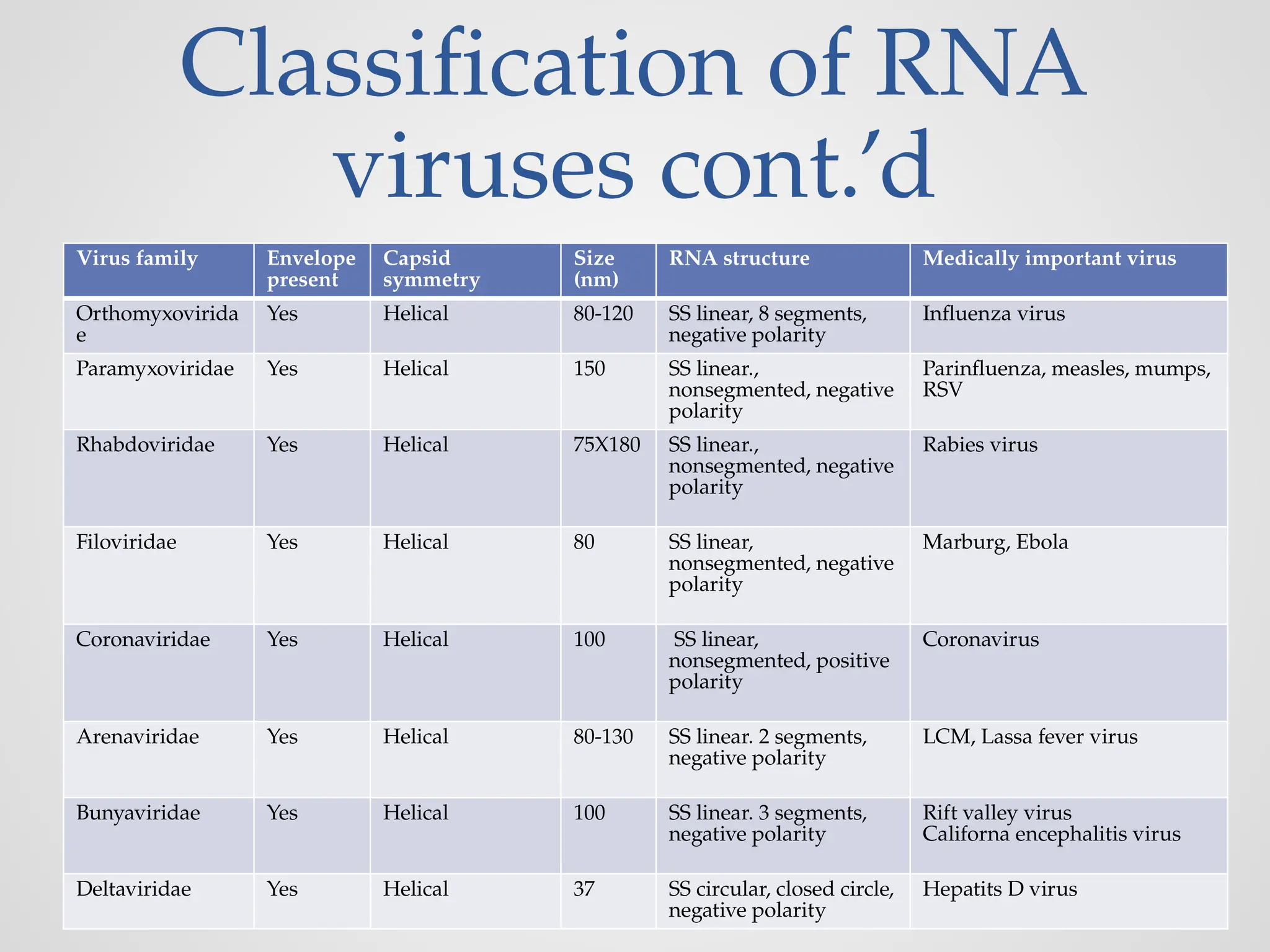
RNA structure Medically important virus
Orthomyxovirida
e
Yes Helical 80-120 SS linear, 8 segments,
negative polarity
Influenza virus
Paramyxoviridae Yes Helical 150 SS linear.,
nonsegmented, negative
polarity
Parinfluenza, measles, mumps,
RSV
Rhabdoviridae Yes Helical 75X180 SS linear.,
nonsegmented, negative
polarity
Rabies virus
Filoviridae Yes Helical 80 SS linear,
nonsegmented, negative
polarity
Marburg, Ebola
Coronaviridae Yes Helical 100 SS linear,
nonsegmented, positive
polarity
Coronavirus
Arenaviridae Yes Helical 80-130 SS linear. 2 segments,
negative polarity
LCM, Lassa fever virus
Bunyaviridae Yes Helical 100 SS linear. 3 segments,
negative polarity
Rift valley virus
Californa encephalitis virus
Deltaviridae Yes Helical 37 SS circular, closed circle,
negative polarity
Hepatits D virus
RNA viruses
• There are 15 families of RNA viruses.
• 4 are non-enveloped, icosahedral RNA viruses
(picornavirus, hepevirus, calcivirus and reovirus)
• 3 are enveloped icosahedral viruses (retrovirus,
flavivirus and togavirus)
• The remaining 8 are enveloped helical RNA viruses
(orthomyxoviruses, paramyxoviruses, rhabdovirus,
filovirus, coronavirus, renavirus, bunyavirus and
deltavirus)
Non-enveloped RNA
viruses
1. Picornavirus
2. Hepevirus
3. Calcivirus
4. Reovirus
Enveloped RNA viruses
1. Flavivirus (Icosahedral)
2. Togavirus (Icosahedral)
3. Retrovirus (Icosahedral)
4. Orthomyxovirus (Helical)
5. Paramyxovirus`(Helical)
6. Rhabdovirus (Helical)
7. Filovirus (Helical)
8. Coronavirus (Helical)
9. Arenavirus (Helical)
10. Bunyavirus (Helical)
11. Deltavirus (Helical)
•
THANK YOU

Classification of viruses D.pptx .........

  • 1.
    Morphology and classification of viruses Dr. MunaM. A. Yousif M.D Clinical Microbiology
  • 2.
    Overview • Viruses areobligate intracellular organisms as they can not synthesis their own energy. Can not be cultured on artificial media only in cell cultures. • Viruses are measured in nanometers (one billionth of a meter) and range in size from 20 to 300nm (0.02 to 0.3μm) in diameter. • Viruses cannot be seen with a light microscope because the resolution of a light microscope is limited to about 200nm, so a scanning electron microscope is used to view them. • Virion is the complete infective form of a virus outside a host cell, with a core of RNA or DNA and a capsid.
  • 3.
    Comparison of viruses andbacteria Property Viruses Cells Type of nucleic acid DNA or RNA Both DNA and RNA Proteins Few Many Lipoprotein membrane In enveloped viruses only Present Ribosomes Absent Present Mitochondria Absent In eukaryotic cells Enzymes None or few Many Multiplication by binary fission or mitosis No Yes
  • 4.
    Structure of viruses •The basic structure of the virus or the core is composed of genetic material (nucleic acids made of either DNA or RNA). • The DNA or RNA maybe linear or circular, single stranded or double stranded. • Surrounding the nucleic acids is an outer coat made of protein (capsid). • The capsid is made of units called capsomers • The arrangement of capsomers determines the architecture of the virus or the nucleocapsid (made of the capsid and the nucleic acid). • Capsomer arrangement maybe: 1. Icosahedral 2. Helical 3. Complex
  • 5.
    Icosahedral • Looks likea sphere but it actually has 20 triangles and 12 coroners fused together in a spherical shape. • Examples of viruses with an icosahedral structure are the poliovirus, rhinovirus, and adenovirus
  • 6.
    Helical • The virusparticle is elongated or pleomorphic (not spherical) and the nucleic acid is spiral. • Examples of viruses with a helical nucleocapsid are influenza and measles viruses.
  • 7.
    Complex • These virusstructures have a combination of icosahedral and helical shape • The Poxvirus one of the largest viruses in size has a complex structure with a unique outer wall and capsid.
  • 8.
    Structrure of viruses cont.’d •The nucleocapsid of many viruses is surrounded by an envelope • Viruses with no envelopes are called naked viruses • The outer layer of the virus envelope may contain surface spikes or projections called glycoproteins • The envelope of the virus is derived from the host cell membrane when the virus is exiting the cell via budding, and the infectivity of these viruses is mostly dependent on the envelope. • Examples of enveloped viruses are the influenza virus, Hepatitis C and HIV.
  • 9.
  • 10.
    Comparison of enveloped andnon-enveloped viruses
  • 11.
    Nomenclature • Family nameends in –viridae • Genus name ends in –virus • Example: • Family: Herpesviridae • Genus: Varicella virus • Common name: Chickenpox virus • Disease: Chickenpox
  • 12.
    Viral growth curve •One virion replicates inside an infected cell to give hundreds of virions in approximately 10 hours. • In this way viruses can spread rapidly from one cell to another. • First the virus disappears (but its nucleic acid continues to function and to accumulate within one cell) • The time during which no virus is found inside the cell is known as the eclipse period • The eclipse period ends with appearance of the virus
  • 13.
  • 14.
    Viral replication 1. Adsorption 2.Penetration 3. Uncoating 4. Viral genome replication 5. Assembly and release
  • 15.
    Steps in ViralReplication 1. Attachment. This is the first step in viral replication. Surface proteins of the virus interact with specific receptors on the target cell surface 2. Penetration. Enveloped viruses (e.g., HIV, influenza virus) penetrate cells through fusion of the viral envelope with the host cell membrane. Non-enveloped viruses penetrate cells by translocation of the virion across the host cell membrane or receptor mediated endocytosis of the virion with accumulation of viruses in cytoplasmic vesicles. 3. Uncoating (disassembly). The viral genome is uncoated by removing the capsid proteins, allowing the genome (nucleic acids)to be available for transcription and viral multiplication.
  • 16.
    Steps of viralreplication cont.’d 4. Genome replication. Viruses must use host cellular machinery to replicate and make functional and structural proteins. The first step in viral gene expression is mRNA synthesis. Different viruses follow different pathway depending on the nature of their nucleic acids and the part of the cell in which they replicate • DNA viruses generally replicate in the nucleus and use host cell DNA- dependent RNA polymerase to synthesis their mRNA • Most RNA viruses replicate in the cytoplasm where they do not have access to the host cell DNA- dependent RNA polymerase. They therefore carry their own polymerase within the virus particle
  • 17.
    Steps of viralreplication cont.’d 5. Assembly and Release. Progeny virus particles are assembled by packaging the viral nucleic acid within the capsid proteins. Virus particles are then released from the cell by either of two processes 6. Non-enveloped viruses are release by rupture of the cell membrane and release of the mature particles 7. Enveloped viruses are released by budding through the outer cell membrane (except herpesviruses which acquires their envelope from the nuclear membrane rather than from the outer cell membrane)
  • 18.
    Overview • Classification ofviruses is based on chemical and structural criteria. • Two important components of viruses used in classification are: 1. Nucleic acids (DNA or RNA) 2. Capsid (size, symmetry) and whether it is enveloped or non-enveloped
  • 19.
    Classification of DNA viruses Virusfamily Envelope present Capsid symmetry Size (nm) DNA structure Medically important virus Parvovirdae No Icosahedral 22 SS, linear Parvovirus B19 virus Polyomaviridae No Icosahedral 45 DS, circular JC, BK virus Papillomavirdae No Icosahedral 55 DS, circular Human papilloma virus Adenoviridae No Icosahedral 75 DS, linear Adenovirus Hepadnaviridae Yes Icosahedral 42 DS, incomplete circular Hepatitis B virus Herpesviridae Yes Icosahedral 100 DS, linear HSV, VZV, CMV, EBV Poxviridae Yes Complex 250X40 0 DS, linear Smallpox virus, Molluscum contagiosum virus
  • 20.
    DNA viruses • Thereare 7 families of DNA viruses. • Four of them are non-enveloped, icosahedral viruses (Parvovirus, Polyomavirus, Papillomavirus and Adenovirus) • Two of them are enveloped icosahedral (hepatitis B virus and herpesvirus) • Poxvirus is the largest virus, has an envelope and a complex internal symmetry.
  • 21.
    Non-enveloped DNA viruses 1. Parvovirus 2.Polyomavirus 3. Papillomavirus 4. Adenovirus
  • 22.
    Enveloped DNA viruses 1.Hepadnaviruses 2. Herpesviruses
  • 23.
    RNA viruses • Thegenome of all RNA viruses consists of single-stranded RNA except that of the reovirus family, which have double-stranded RNA genome. • RNA viruses fall into four groups with different strategies for synthesizing mRNA 1. Single-stranded RNA with positive polarity (their RNA has the same base sequence as that of mRNA). These viruses use their RNA genome directly as mRNA. Example: poliovirus 2. Single-stranded RNA of negative polarity (their RNA has a base sequence that is complementary to the mRNA). Here an mRNA must be transcribed by using the negative strand as a template. Because the cell does not have an RNA polymerase capable of using RNA as a template, the virus carries its own RNA-dependent RNA polymerase. Negative polarity RNA viruses are either segmented (e.g., influenza virus) or non-segmented(e.g., measles virus)
  • 24.
    3. RNA viruseswith double-stranded RNA as its genome (e.g., rotavirus). Because the cell has no enzyme capable of transcribing their RNA into mRNA, the virus carries its own polymerase. 4. Single-stranded RNA of positive polarity that is transcribed into double-stranded DNA by an RNA- dependent DNA polymerase (reverse transcriptase) which is carried by the virus. This DNA copy is then transcribed into viral mRNA by the regular host cell RNA polymerase. Example retroviruses (HIV)
  • 25.
    Summary of classification ofRNA viruses Virus family Envel ope prese nt Capsid symmetry Size (nm) RNA structure Medically important virus Picornaviridae No Icosahedral 28 SS linear, nonsegmented,, +ve polarity Poliovirus, rhinovirus, HAV Hepeviridae No Icosahedral 30 SS linear, nonsegmented,, +ve polarity Hepatits E virus Calcivirdae No Icosahedral 38 SS linear, nonsegmented,, +ve polarity Norwalk virus Reoviridae No Icosahedral 75 DS linear, 10 or 11 segments Rotavirus Flaviviridae Yes Icosahedral 45 SS linear, nonsegmented,, +ve polarity Yellow fever virus, West Nile virus, dengue virus Togaviridae Yes Icosahedral 60 SS linear, nonsegmented,, +ve polarity Rubella virus Retroviridae Yes Icosahedral 100 SS linear, nonsegmented,, +ve polarity HIV, human T- cell leukaemia virus
  • 26.
    Classification of RNA virusescont.’d Virus family Envelope present Capsid symmetry Size (nm) RNA structure Medically important virus Orthomyxovirida e Yes Helical 80-120 SS linear, 8 segments, negative polarity Influenza virus Paramyxoviridae Yes Helical 150 SS linear., nonsegmented, negative polarity Parinfluenza, measles, mumps, RSV Rhabdoviridae Yes Helical 75X180 SS linear., nonsegmented, negative polarity Rabies virus Filoviridae Yes Helical 80 SS linear, nonsegmented, negative polarity Marburg, Ebola Coronaviridae Yes Helical 100 SS linear, nonsegmented, positive polarity Coronavirus Arenaviridae Yes Helical 80-130 SS linear. 2 segments, negative polarity LCM, Lassa fever virus Bunyaviridae Yes Helical 100 SS linear. 3 segments, negative polarity Rift valley virus Californa encephalitis virus Deltaviridae Yes Helical 37 SS circular, closed circle, negative polarity Hepatits D virus
  • 27.
    RNA viruses • Thereare 15 families of RNA viruses. • 4 are non-enveloped, icosahedral RNA viruses (picornavirus, hepevirus, calcivirus and reovirus) • 3 are enveloped icosahedral viruses (retrovirus, flavivirus and togavirus) • The remaining 8 are enveloped helical RNA viruses (orthomyxoviruses, paramyxoviruses, rhabdovirus, filovirus, coronavirus, renavirus, bunyavirus and deltavirus)
  • 28.
    Non-enveloped RNA viruses 1. Picornavirus 2.Hepevirus 3. Calcivirus 4. Reovirus
  • 29.
    Enveloped RNA viruses 1.Flavivirus (Icosahedral) 2. Togavirus (Icosahedral) 3. Retrovirus (Icosahedral) 4. Orthomyxovirus (Helical) 5. Paramyxovirus`(Helical) 6. Rhabdovirus (Helical) 7. Filovirus (Helical) 8. Coronavirus (Helical) 9. Arenavirus (Helical) 10. Bunyavirus (Helical) 11. Deltavirus (Helical)
  • 30.