INTRODUCTION OF
ROM – Read Only
Memory
http://alltypeim.blogspot.in/
ROM
 Concept
 Characteristics of the ROM BIOS
 ROM Types
 ROM Internal Structure
 ROM Implementation
 ROM Implementation of a Moore Machine
 ROM Implementation of a Mealy Machine
 ROM Array Layout
 Row Decoders
 Complete ROM Layout
 Summary http://alltypeim.blogspot.in/
Concept
Is read-only memory.
Do not lose data when power is lost.
ROM memory is used to produce chips with
integrated CMOS BIOS program
http://alltypeim.blogspot.in/
Characteristics of the ROM BIOS
BIOS ROM containing the software configuration
and system diagnostics, and routine input / output
low level that DOS uses.
These programs are encoded in ROM and is called
firmware.
An important feature of the ROM BIOS is
detecting new hardware in the computer and
reconfigure the operating system as device driver.
http://alltypeim.blogspot.in/
ROM Types
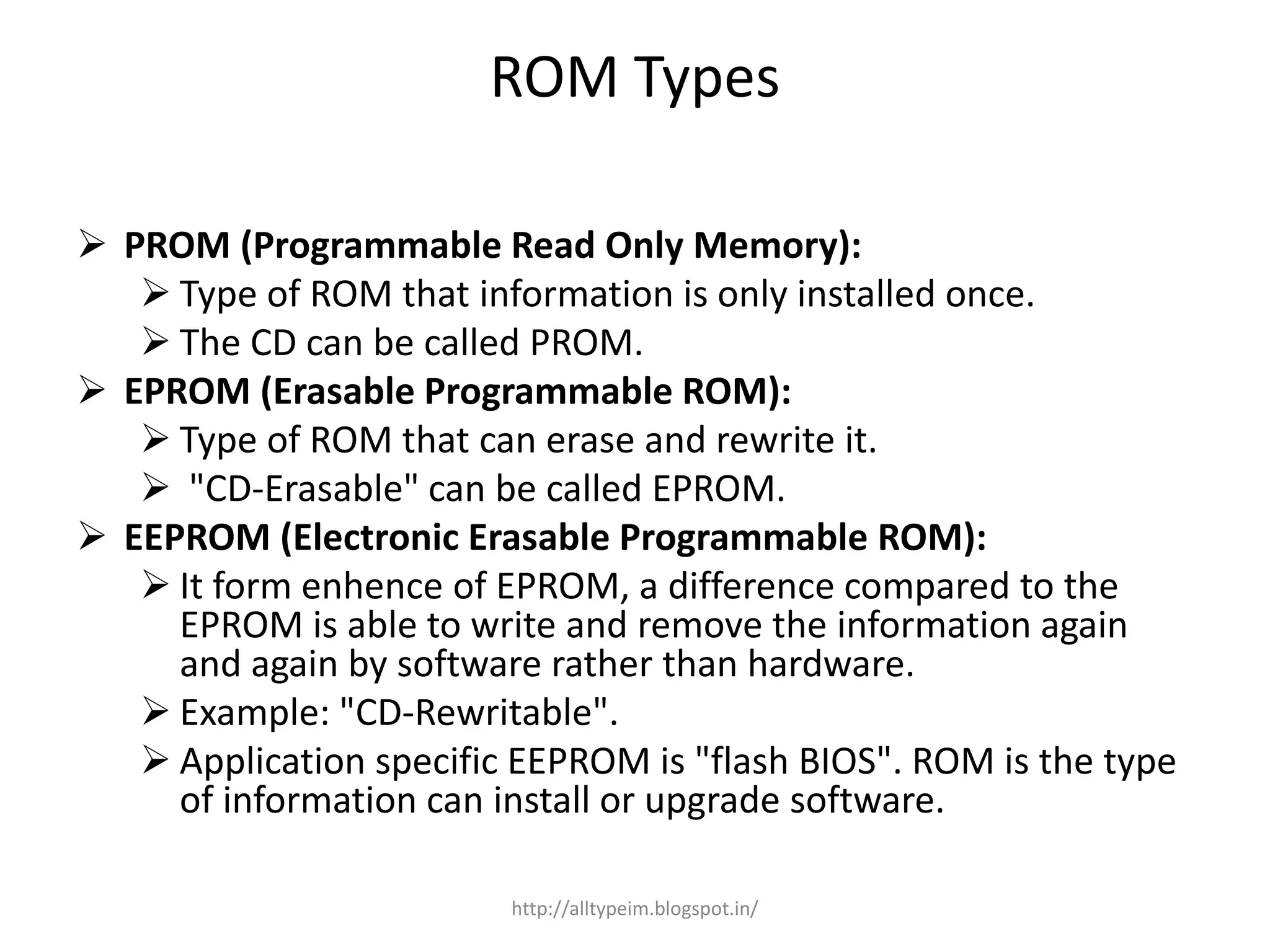
 PROM (Programmable Read Only Memory):
 Type of ROM that information is only installed once.
 The CD can be called PROM.
 EPROM (Erasable Programmable ROM):
 Type of ROM that can erase and rewrite it.
 "CD-Erasable" can be called EPROM.
 EEPROM (Electronic Erasable Programmable ROM):
 It form enhence of EPROM, a difference compared to the
EPROM is able to write and remove the information again
and again by software rather than hardware.
 Example: "CD-Rewritable".
 Application specific EEPROM is "flash BIOS". ROM is the type
of information can install or upgrade software.
http://alltypeim.blogspot.in/
ROM Internal Structure
...
n Inputs
Lines
n bit
decoder
...
m Outputs Lines
.
.
.
Memory Array
2n words x m bits
http://alltypeim.blogspot.in/
ROM Implementation
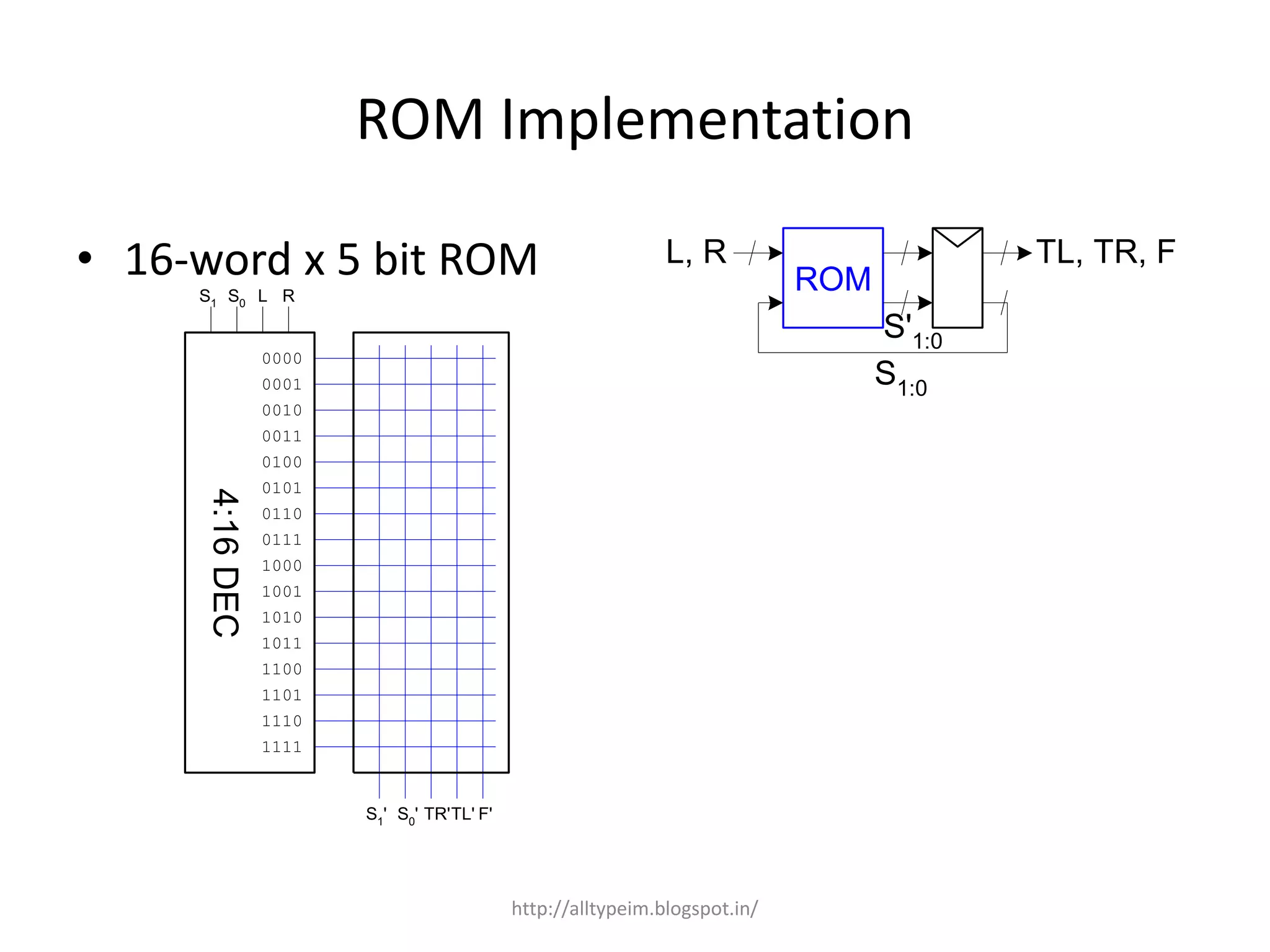
• 16-word x 5 bit ROM ROM
L, R
S1:0
TL, TR, F
S'1:0
S1
' S0
' TR'TL' F'
0000
0001
0010
0011
0100
0101
0110
0111
1000
1001
1010
1011
1100
1101
1110
1111
4:16DEC
S1 S0 L R
http://alltypeim.blogspot.in/
ROM Implementation
• 16-word x 5 bit ROM ROM
L, R
S1:0
TL, TR, F
S'1:0
S1
' S0
' TR'TL' F'
0000
0001
0010
0011
0100
0101
0110
0111
1000
1001
1010
1011
1100
1101
1110
1111
4:16DEC
S1 S0 L R
http://alltypeim.blogspot.in/
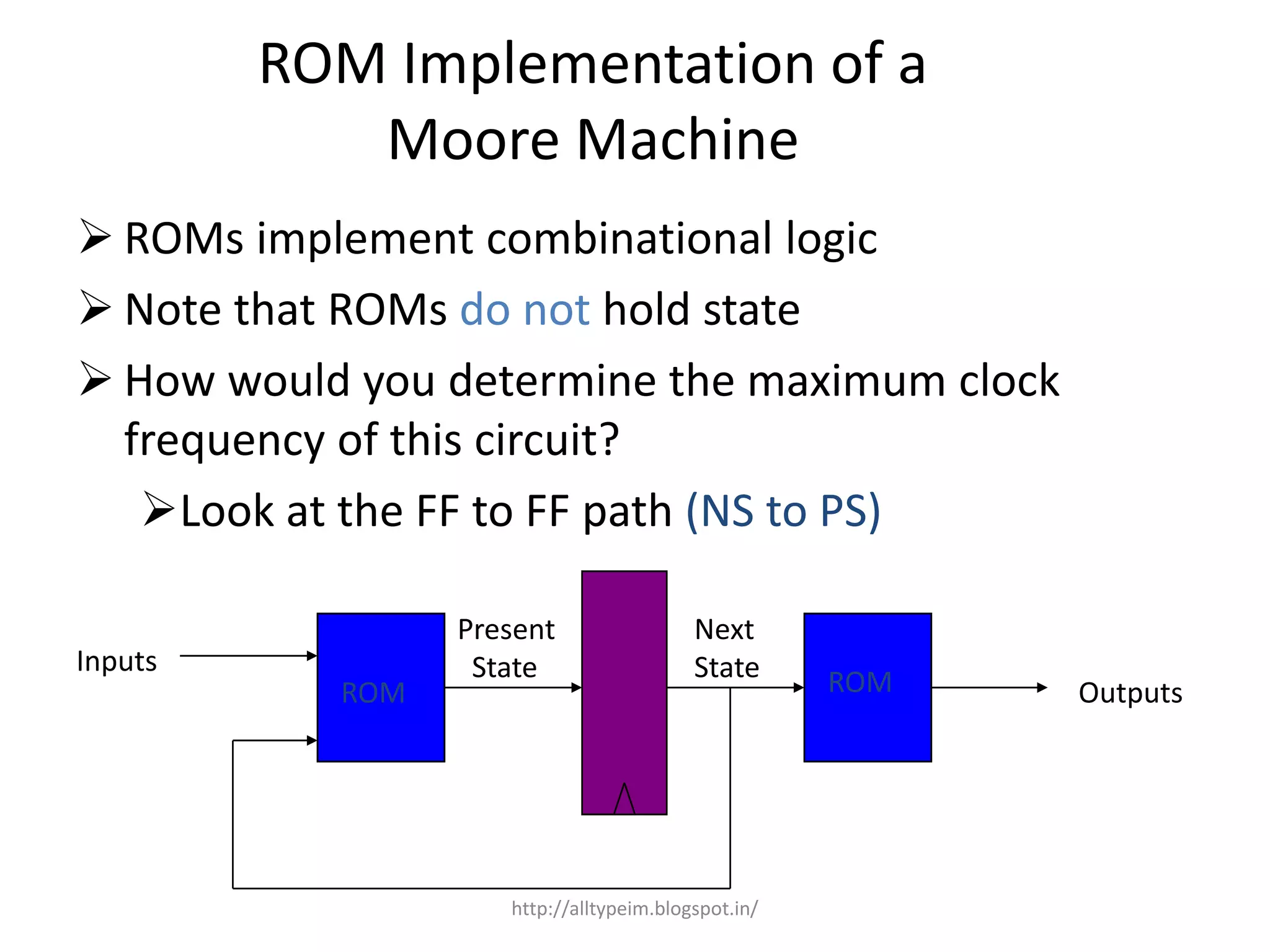
ROM Implementation of a
Moore Machine
 ROMs implement combinational logic
 Note that ROMs do not hold state
 How would you determine the maximum clock
frequency of this circuit?
Look at the FF to FF path (NS to PS)
ROM ROM
Present
State
Next
State
Outputs
Inputs
http://alltypeim.blogspot.in/
ROM Implementation of a Mealy
Machine
 ROMs implement combinational logic
 Note that ROMs do not hold state
 How would you determine the maximum clock frequency of this
circuit?
 Look at the FF to FF path (NS to PS)
ROM
ROMPresent
State
Next
State
Outputs
Inputs
http://alltypeim.blogspot.in/
ROM Array Layout
Unit cell is 12 x 8 l (about 1/10 size of SRAM)
Unit
Cell
http://alltypeim.blogspot.in/
Row Decoders
ROM row decoders must pitch-match with
ROM
Only a single track per word!
http://alltypeim.blogspot.in/
Complete ROM Layout
http://alltypeim.blogspot.in/
Summary
 ROMs provide stable storage for data
 ROMs have address inputs and data outputs
ROMs directly implement truth tables
 ROMs can be used effectively in Mealy and Moore machines
to implement combinational logic
 In normal use ROMs are read-only
They are only read, not written
 ROMs are often used by computers to store critical
information
Unlike SRAM, they maintain their storage after the power is
turned off
http://alltypeim.blogspot.in/

Rom

  • 1.
    INTRODUCTION OF ROM –Read Only Memory http://alltypeim.blogspot.in/
  • 2.
    ROM  Concept  Characteristicsof the ROM BIOS  ROM Types  ROM Internal Structure  ROM Implementation  ROM Implementation of a Moore Machine  ROM Implementation of a Mealy Machine  ROM Array Layout  Row Decoders  Complete ROM Layout  Summary http://alltypeim.blogspot.in/
  • 3.
    Concept Is read-only memory. Donot lose data when power is lost. ROM memory is used to produce chips with integrated CMOS BIOS program http://alltypeim.blogspot.in/
  • 4.
    Characteristics of theROM BIOS BIOS ROM containing the software configuration and system diagnostics, and routine input / output low level that DOS uses. These programs are encoded in ROM and is called firmware. An important feature of the ROM BIOS is detecting new hardware in the computer and reconfigure the operating system as device driver. http://alltypeim.blogspot.in/
  • 5.
    ROM Types  PROM(Programmable Read Only Memory):  Type of ROM that information is only installed once.  The CD can be called PROM.  EPROM (Erasable Programmable ROM):  Type of ROM that can erase and rewrite it.  "CD-Erasable" can be called EPROM.  EEPROM (Electronic Erasable Programmable ROM):  It form enhence of EPROM, a difference compared to the EPROM is able to write and remove the information again and again by software rather than hardware.  Example: "CD-Rewritable".  Application specific EEPROM is "flash BIOS". ROM is the type of information can install or upgrade software. http://alltypeim.blogspot.in/
  • 6.
    ROM Internal Structure ... nInputs Lines n bit decoder ... m Outputs Lines . . . Memory Array 2n words x m bits http://alltypeim.blogspot.in/
  • 7.
    ROM Implementation • 16-wordx 5 bit ROM ROM L, R S1:0 TL, TR, F S'1:0 S1 ' S0 ' TR'TL' F' 0000 0001 0010 0011 0100 0101 0110 0111 1000 1001 1010 1011 1100 1101 1110 1111 4:16DEC S1 S0 L R http://alltypeim.blogspot.in/
  • 8.
    ROM Implementation • 16-wordx 5 bit ROM ROM L, R S1:0 TL, TR, F S'1:0 S1 ' S0 ' TR'TL' F' 0000 0001 0010 0011 0100 0101 0110 0111 1000 1001 1010 1011 1100 1101 1110 1111 4:16DEC S1 S0 L R http://alltypeim.blogspot.in/
  • 9.
    ROM Implementation ofa Moore Machine  ROMs implement combinational logic  Note that ROMs do not hold state  How would you determine the maximum clock frequency of this circuit? Look at the FF to FF path (NS to PS) ROM ROM Present State Next State Outputs Inputs http://alltypeim.blogspot.in/
  • 10.
    ROM Implementation ofa Mealy Machine  ROMs implement combinational logic  Note that ROMs do not hold state  How would you determine the maximum clock frequency of this circuit?  Look at the FF to FF path (NS to PS) ROM ROMPresent State Next State Outputs Inputs http://alltypeim.blogspot.in/
  • 11.
    ROM Array Layout Unitcell is 12 x 8 l (about 1/10 size of SRAM) Unit Cell http://alltypeim.blogspot.in/
  • 12.
    Row Decoders ROM rowdecoders must pitch-match with ROM Only a single track per word! http://alltypeim.blogspot.in/
  • 13.
  • 14.
    Summary  ROMs providestable storage for data  ROMs have address inputs and data outputs ROMs directly implement truth tables  ROMs can be used effectively in Mealy and Moore machines to implement combinational logic  In normal use ROMs are read-only They are only read, not written  ROMs are often used by computers to store critical information Unlike SRAM, they maintain their storage after the power is turned off http://alltypeim.blogspot.in/