Four Functions of a Computer
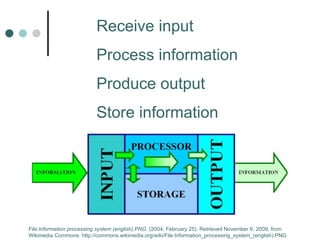
Receive input Process information Produce output Store information File:Information processing system (english).PNG . (2004, February 25). Retrieved November 6, 2009, from Wikimedia Commons: http://commons.wikimedia.org/wiki/File:Information_processing_system_(english).PNG
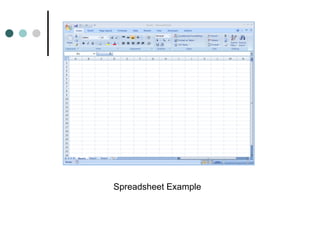
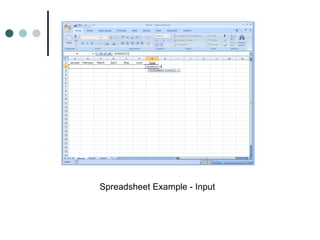
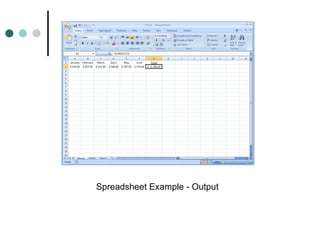
Spreadsheet Example
Spreadsheet Example - Input
Spreadsheet Example - Output
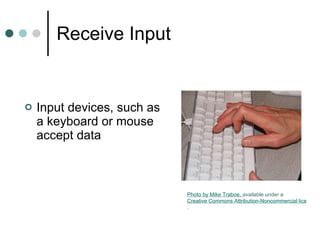
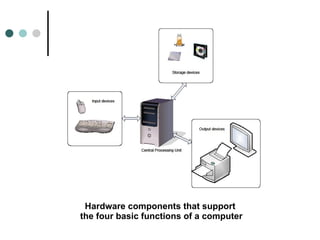
Receive Input Input devices, such as a keyboard or mouse accept data Photo by Mike Traboe ,  available under a  Creative Commons Attribution-Noncommercial license .
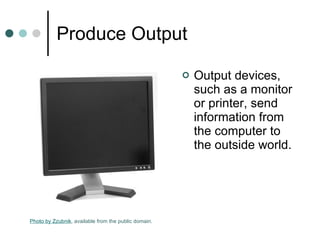
Produce Output Output devices, such as a monitor or printer, send information from the computer to the outside world. Photo by Zzubnik , available from the public domain.
Process Information The central processing unit (CPU) interprets and executes program instructions to process information, perform arithmetic calculations, and make logic-based decisions. Store Information Memory (RAM) holds data temporarily for use by the CPU and secondary storage devices, such as a hard drive, CD, DVD, or USB flash drives store data for long-term retrieval.
Hardware components that support  the four basic functions of a computer

Four Functions Of A Computer

  • 1.
  • 2.
    Receive input Processinformation Produce output Store information File:Information processing system (english).PNG . (2004, February 25). Retrieved November 6, 2009, from Wikimedia Commons: http://commons.wikimedia.org/wiki/File:Information_processing_system_(english).PNG
  • 3.
  • 4.
  • 5.
  • 6.
    Receive Input Inputdevices, such as a keyboard or mouse accept data Photo by Mike Traboe , available under a Creative Commons Attribution-Noncommercial license .
  • 7.
    Produce Output Outputdevices, such as a monitor or printer, send information from the computer to the outside world. Photo by Zzubnik , available from the public domain.
  • 8.
    Process Information Thecentral processing unit (CPU) interprets and executes program instructions to process information, perform arithmetic calculations, and make logic-based decisions. Store Information Memory (RAM) holds data temporarily for use by the CPU and secondary storage devices, such as a hard drive, CD, DVD, or USB flash drives store data for long-term retrieval.
  • 9.
    Hardware components thatsupport the four basic functions of a computer