1
Real-Time
Operating Systems
Praveen Varma
www.carrertime.in
2
Contents
– Introduction
– Characteristic of RTOS
– Real-Time task scheduling
• Clock-driven
• Event-driven
– Scheduling of real-time task on a uniprocessor
• Rate Monotonic Analysis (RMA)
• Earliest Deadline First (EDF)
• Scheduling with limited priority levels
– Features of RTOS
– Commercial real-time operating systems
• RT Linux, PSOS, VRTX, WinCE
3
Real Time System
• A system is said to be Real Time if it is
required to complete it’s work & deliver it’s
services on time.
4
Types of RTS:
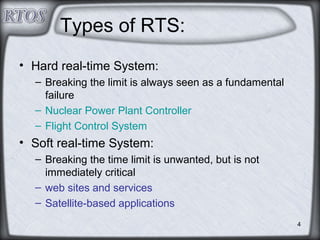
• Hard real-time System:
– Breaking the limit is always seen as a fundamental
failure
– Nuclear Power Plant Controller
– Flight Control System
• Soft real-time System:
– Breaking the time limit is unwanted, but is not
immediately critical
– web sites and services
– Satellite-based applications
5
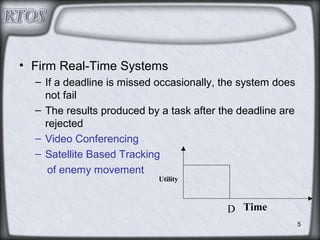
• Firm Real-Time Systems
– If a deadline is missed occasionally, the system does
not fail
– The results produced by a task after the deadline are
rejected
– Video Conferencing
– Satellite Based Tracking
of enemy movement
Utility
D Time
6
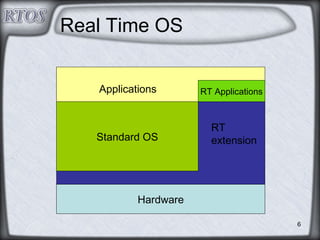
Real Time OS
Hardware
Standard OS
RT Applications
RT
extension
Applications
7
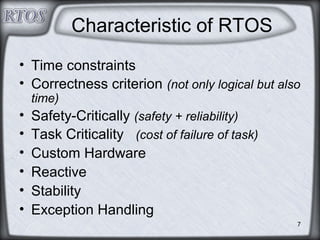
Characteristic of RTOS
• Time constraints
• Correctness criterion (not only logical but also
time)
• Safety-Critically (safety + reliability)
• Task Criticality (cost of failure of task)
• Custom Hardware
• Reactive
• Stability
• Exception Handling
8
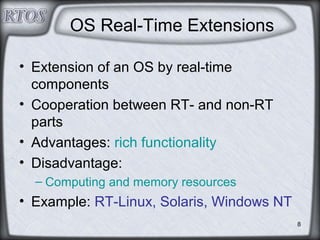
OS Real-Time Extensions
• Extension of an OS by real-time
components
• Cooperation between RT- and non-RT
parts
• Advantages: rich functionality
• Disadvantage:
– Computing and memory resources
• Example: RT-Linux, Solaris, Windows NT
9
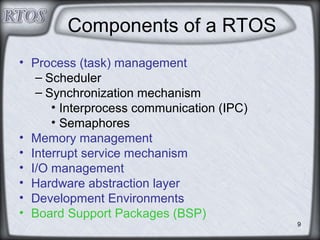
Components of a RTOS
• Process (task) management
– Scheduler
– Synchronization mechanism
• Interprocess communication (IPC)
• Semaphores
• Memory management
• Interrupt service mechanism
• I/O management
• Hardware abstraction layer
• Development Environments
• Board Support Packages (BSP)
10
Real-Time Task Scheduling
• Scheduling of tasks is the primary means
by which the operating system meets task
deadlines.
• So, scheduling is an important problem.
• Lot of work has been done in developing
appropriate schedulers for real-time tasks
– Scheduling on uniprocessors
– Scheduling on multiprocessors and distributed
systems
11
Real Time Task Scheduling
1.Clock Driven:
- Table-driven & Cyclic
2. Event Driven:
- Simple Priority Based
- Rate Monotonic Analysis (RMA)
- Earliest Deadline First (EDF)
3. Hybrid:
- Round-robin
12
Clock-driven Scheduling
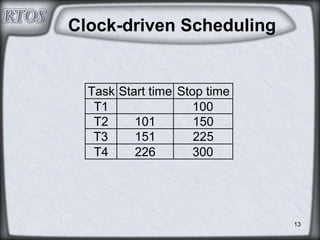
• Table-driven scheduling
• Decision regarding which job to run next is made
at specific time instants
– Timers are used to trigger the decision point
– The job-list along with information regarding
which task to be run for how long are stored in
a table
13
Clock-driven Scheduling
Task Start time Stop time
T1 100
T2 101 150
T3 151 225
T4 226 300
14
Clock-Driven Scheduling
• The scheduler develops a permanent schedule
for a period (P1,P2,...,Pn) and stores in a table.
• Round robin scheduling is an example of clock-
driven scheduling
• Clock-driven schedulers are
– Simple: used in low cost applications
– Efficient: very little runtime overhead
– Inflexible: Very difficult to accommodate dynamically
changing task set or task characteristics.
15
Priority-based Schedulers
• These are also called event-driven schedulers
– Scheduling decisions are made when certain events
occur
• Tasks becoming ready
• Tasks completing execution
• These are called preemptive schedulers
– When a higher priority task becomes ready it
preempts the executing lower priority task
• These are greedy schedulers:
– They never keep the processor idle if a task is ready.
16
Priority-based Schedulers
• Static priority schedulers:
– The task priorities once assigned by the
programmers, do not change during runtime
– RMA (Rate Monotonic Algorithm) is the optimal static
priority scheduling algorithm
• Dynamic priority
– The task priorities can change during runtime based
on the relative urgency of completion of tasks
– EDF (Earliest Deadline First) is the optimal
uniprocessor scheduling algorithm
17
Priority-based Schedulers
• First let us consider the simplest scenario:
– Uni-processor
– Independent tasks
• Tasks do not share resources
• There is no precedence ordering among the tasks
18
Priority-based Scheduling
• Independent tasks executed on a
uniprocessor
– Two algorithms pretty much summarise the
important results in this scenario
• EDF (Earliest Deadline First)
• RMA (Rate Monotonic Analysis )
19
EDF
• EDF is the optimal uniprocessor scheduling
algorithm
– If EDF cannot feasibly schedule a set of tasks, there
exists no other scheduling algorithms to do that.
• Can schedule both periodic and aperiodic tasks
• Schedulability check:
– Sum of utilization due to tasks is less than one.
20
EDF
• EDF is
– Simple
– Optimal
• But, is rarely used
– No commercially available operating system
directly supports EDF scheduling
– Let us examine the disadvantages of EDF
21
Disadvantages of EDF
• Transient overload handling
– EDF has very poor, overload handling
capability
– When a low-criticality task becomes delayed it
can make even the most critical task miss its
deadline
– In fact, it is extremely difficult to predict which
task would miss its deadline when a task
takes more time
22
Disadvantages of EDF
• Runtime efficiency
– EDF is not very efficient
– Inorder to implement EDF the tasks need to
be maintained sorted in a priority queue
based on their deadline
– The complexity of maintaining a priority queue
is (log n), where n is the number of tasks
23
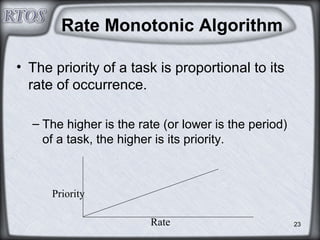
Rate Monotonic Algorithm
• The priority of a task is proportional to its
rate of occurrence.
– The higher is the rate (or lower is the period)
of a task, the higher is its priority.
Rate
Priority
24
RMA
• RMA has been shown to be the optimal
uniprocessor static priority scheduling
algorithm
– If RMA cannot schedule a set of periodic
tasks, no other scheduling algorithm can.
25
Hybrid Schedulers
• Time-Sliced Round-Robin Scheduling:
- Are very commonly used in traditional OS.
- Is a preemptive scheduling method.
- Here ready tasks are held in a circular queue.
- once a task is taken from queue then it runs for a time
slice & if does not complete then it inserted back in to
the queue.
- Here all tasks are equal with identical time slice.
It can be extended by putting larger time slice to the higher
priority tasks.
26
Resource sharing
• So far, the only resource that we
considered is CPU.
• However, tasks may need to share
resources such as files, memory, data
structures.
– These are nonpreemptable resources
– Called critical sections in the operating
systems literature
27
Critical Sections
• The traditional operating system solution
to share critical sections
– Is through the use of semaphores.
• However, in real-time systems this
solution does not work well, it gives rise to:
– Priority inversion
– Unbounded priority inversion
28
Features of RTOS
• Clock and Timer Support
- most important issue
- hard real time application support timer service
with resolution of few microseconds.
• Real-Time Priority Levels
- it must support static (or real-time) priority
level.
- where traditional OS dynamically changes the
priority levels of tasks to maximize the
system throughput.
29
Features of RTOS
• Fast Task Preemption
– When a high priority task arrives, an low priority task
should preempt.
– the waiting time of the high priority task to start
execution is expressed as task preemption time.
• Predictable and Fast Interrupt Latency
- interrupt latency is the time delay between the
occurrence of an interrupt and the running of
the corresponding Interrupt Service Routing
(ISR).
- upper bound on interrupt latency must be
bounded
30
Features of RTOS
• Support for Resource sharing Among Real
Time Tasks
- the resource to be shared between the real
time task using Priority Ceiling Protocol (PCP)
• Requirements on Memory Management
- real time OS requires to provide virtual memory
support for heavy real time tasks.
- embedded real time OS usually don't support
virtual memory
31
Features of RTOS
• Support for Asynchronous I/O
- asynchronous I/O means non-blocking I/O.
- where as traditional read() or write() system
call performs synchronous I/O.
- in asynchronous I/O, system call will return
immediately once the I/O request has been
passed down to the hardware or queued in
the OS, typically before the physical I/O
operation has even begun.
32
Commercial Real-Time
Operating Systems
• Criteria for comparing RTOS:
– Scheduling policy supported
– Memory locking and other support
– Timers
– Interrupt handling
– File system support
– Device interfacing
• Embedded systems have small memories
– The operating system size is important
– Obviously, OS with large footprint cannot be used in
embedded applications
– Power saving features are desirable
33
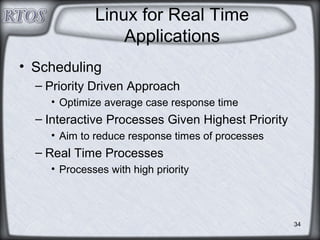
Other RTOS issues
• Interrupt Latency should be very small
– Kernel has to respond to real time events
– Interrupts should be disabled for minimum
possible time
• For embedded applications Kernel Size
should be small
– Should fit in ROM
• Sophisticated features can be removed
– No Virtual Memory
34
Linux for Real Time
Applications
• Scheduling
– Priority Driven Approach
• Optimize average case response time
– Interactive Processes Given Highest Priority
• Aim to reduce response times of processes
– Real Time Processes
• Processes with high priority
35
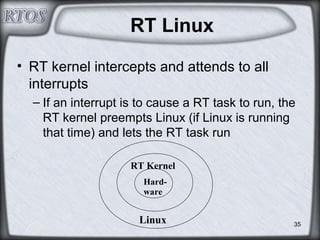
RT Linux
• RT kernel intercepts and attends to all
interrupts
– If an interrupt is to cause a RT task to run, the
RT kernel preempts Linux (if Linux is running
that time) and lets the RT task run
Hard-
ware
RT Kernel
Linux
36
References:
1. Real-Time Systems Theory and Practice
Rajib Mall
2. Real-Time Systems,
Jane W.S. Liu
3. Real-Time Operating System,
Frank Kolnick
37
questions
38

Real-Time Operating Systems

  • 1.
  • 2.
    2 Contents – Introduction – Characteristicof RTOS – Real-Time task scheduling • Clock-driven • Event-driven – Scheduling of real-time task on a uniprocessor • Rate Monotonic Analysis (RMA) • Earliest Deadline First (EDF) • Scheduling with limited priority levels – Features of RTOS – Commercial real-time operating systems • RT Linux, PSOS, VRTX, WinCE
  • 3.
    3 Real Time System •A system is said to be Real Time if it is required to complete it’s work & deliver it’s services on time.
  • 4.
    4 Types of RTS: •Hard real-time System: – Breaking the limit is always seen as a fundamental failure – Nuclear Power Plant Controller – Flight Control System • Soft real-time System: – Breaking the time limit is unwanted, but is not immediately critical – web sites and services – Satellite-based applications
  • 5.
    5 • Firm Real-TimeSystems – If a deadline is missed occasionally, the system does not fail – The results produced by a task after the deadline are rejected – Video Conferencing – Satellite Based Tracking of enemy movement Utility D Time
  • 6.
    6 Real Time OS Hardware StandardOS RT Applications RT extension Applications
  • 7.
    7 Characteristic of RTOS •Time constraints • Correctness criterion (not only logical but also time) • Safety-Critically (safety + reliability) • Task Criticality (cost of failure of task) • Custom Hardware • Reactive • Stability • Exception Handling
  • 8.
    8 OS Real-Time Extensions •Extension of an OS by real-time components • Cooperation between RT- and non-RT parts • Advantages: rich functionality • Disadvantage: – Computing and memory resources • Example: RT-Linux, Solaris, Windows NT
  • 9.
    9 Components of aRTOS • Process (task) management – Scheduler – Synchronization mechanism • Interprocess communication (IPC) • Semaphores • Memory management • Interrupt service mechanism • I/O management • Hardware abstraction layer • Development Environments • Board Support Packages (BSP)
  • 10.
    10 Real-Time Task Scheduling •Scheduling of tasks is the primary means by which the operating system meets task deadlines. • So, scheduling is an important problem. • Lot of work has been done in developing appropriate schedulers for real-time tasks – Scheduling on uniprocessors – Scheduling on multiprocessors and distributed systems
  • 11.
    11 Real Time TaskScheduling 1.Clock Driven: - Table-driven & Cyclic 2. Event Driven: - Simple Priority Based - Rate Monotonic Analysis (RMA) - Earliest Deadline First (EDF) 3. Hybrid: - Round-robin
  • 12.
    12 Clock-driven Scheduling • Table-drivenscheduling • Decision regarding which job to run next is made at specific time instants – Timers are used to trigger the decision point – The job-list along with information regarding which task to be run for how long are stored in a table
  • 13.
    13 Clock-driven Scheduling Task Starttime Stop time T1 100 T2 101 150 T3 151 225 T4 226 300
  • 14.
    14 Clock-Driven Scheduling • Thescheduler develops a permanent schedule for a period (P1,P2,...,Pn) and stores in a table. • Round robin scheduling is an example of clock- driven scheduling • Clock-driven schedulers are – Simple: used in low cost applications – Efficient: very little runtime overhead – Inflexible: Very difficult to accommodate dynamically changing task set or task characteristics.
  • 15.
    15 Priority-based Schedulers • Theseare also called event-driven schedulers – Scheduling decisions are made when certain events occur • Tasks becoming ready • Tasks completing execution • These are called preemptive schedulers – When a higher priority task becomes ready it preempts the executing lower priority task • These are greedy schedulers: – They never keep the processor idle if a task is ready.
  • 16.
    16 Priority-based Schedulers • Staticpriority schedulers: – The task priorities once assigned by the programmers, do not change during runtime – RMA (Rate Monotonic Algorithm) is the optimal static priority scheduling algorithm • Dynamic priority – The task priorities can change during runtime based on the relative urgency of completion of tasks – EDF (Earliest Deadline First) is the optimal uniprocessor scheduling algorithm
  • 17.
    17 Priority-based Schedulers • Firstlet us consider the simplest scenario: – Uni-processor – Independent tasks • Tasks do not share resources • There is no precedence ordering among the tasks
  • 18.
    18 Priority-based Scheduling • Independenttasks executed on a uniprocessor – Two algorithms pretty much summarise the important results in this scenario • EDF (Earliest Deadline First) • RMA (Rate Monotonic Analysis )
  • 19.
    19 EDF • EDF isthe optimal uniprocessor scheduling algorithm – If EDF cannot feasibly schedule a set of tasks, there exists no other scheduling algorithms to do that. • Can schedule both periodic and aperiodic tasks • Schedulability check: – Sum of utilization due to tasks is less than one.
  • 20.
    20 EDF • EDF is –Simple – Optimal • But, is rarely used – No commercially available operating system directly supports EDF scheduling – Let us examine the disadvantages of EDF
  • 21.
    21 Disadvantages of EDF •Transient overload handling – EDF has very poor, overload handling capability – When a low-criticality task becomes delayed it can make even the most critical task miss its deadline – In fact, it is extremely difficult to predict which task would miss its deadline when a task takes more time
  • 22.
    22 Disadvantages of EDF •Runtime efficiency – EDF is not very efficient – Inorder to implement EDF the tasks need to be maintained sorted in a priority queue based on their deadline – The complexity of maintaining a priority queue is (log n), where n is the number of tasks
  • 23.
    23 Rate Monotonic Algorithm •The priority of a task is proportional to its rate of occurrence. – The higher is the rate (or lower is the period) of a task, the higher is its priority. Rate Priority
  • 24.
    24 RMA • RMA hasbeen shown to be the optimal uniprocessor static priority scheduling algorithm – If RMA cannot schedule a set of periodic tasks, no other scheduling algorithm can.
  • 25.
    25 Hybrid Schedulers • Time-SlicedRound-Robin Scheduling: - Are very commonly used in traditional OS. - Is a preemptive scheduling method. - Here ready tasks are held in a circular queue. - once a task is taken from queue then it runs for a time slice & if does not complete then it inserted back in to the queue. - Here all tasks are equal with identical time slice. It can be extended by putting larger time slice to the higher priority tasks.
  • 26.
    26 Resource sharing • Sofar, the only resource that we considered is CPU. • However, tasks may need to share resources such as files, memory, data structures. – These are nonpreemptable resources – Called critical sections in the operating systems literature
  • 27.
    27 Critical Sections • Thetraditional operating system solution to share critical sections – Is through the use of semaphores. • However, in real-time systems this solution does not work well, it gives rise to: – Priority inversion – Unbounded priority inversion
  • 28.
    28 Features of RTOS •Clock and Timer Support - most important issue - hard real time application support timer service with resolution of few microseconds. • Real-Time Priority Levels - it must support static (or real-time) priority level. - where traditional OS dynamically changes the priority levels of tasks to maximize the system throughput.
  • 29.
    29 Features of RTOS •Fast Task Preemption – When a high priority task arrives, an low priority task should preempt. – the waiting time of the high priority task to start execution is expressed as task preemption time. • Predictable and Fast Interrupt Latency - interrupt latency is the time delay between the occurrence of an interrupt and the running of the corresponding Interrupt Service Routing (ISR). - upper bound on interrupt latency must be bounded
  • 30.
    30 Features of RTOS •Support for Resource sharing Among Real Time Tasks - the resource to be shared between the real time task using Priority Ceiling Protocol (PCP) • Requirements on Memory Management - real time OS requires to provide virtual memory support for heavy real time tasks. - embedded real time OS usually don't support virtual memory
  • 31.
    31 Features of RTOS •Support for Asynchronous I/O - asynchronous I/O means non-blocking I/O. - where as traditional read() or write() system call performs synchronous I/O. - in asynchronous I/O, system call will return immediately once the I/O request has been passed down to the hardware or queued in the OS, typically before the physical I/O operation has even begun.
  • 32.
    32 Commercial Real-Time Operating Systems •Criteria for comparing RTOS: – Scheduling policy supported – Memory locking and other support – Timers – Interrupt handling – File system support – Device interfacing • Embedded systems have small memories – The operating system size is important – Obviously, OS with large footprint cannot be used in embedded applications – Power saving features are desirable
  • 33.
    33 Other RTOS issues •Interrupt Latency should be very small – Kernel has to respond to real time events – Interrupts should be disabled for minimum possible time • For embedded applications Kernel Size should be small – Should fit in ROM • Sophisticated features can be removed – No Virtual Memory
  • 34.
    34 Linux for RealTime Applications • Scheduling – Priority Driven Approach • Optimize average case response time – Interactive Processes Given Highest Priority • Aim to reduce response times of processes – Real Time Processes • Processes with high priority


  • 35.
    35 RT Linux • RTkernel intercepts and attends to all interrupts – If an interrupt is to cause a RT task to run, the RT kernel preempts Linux (if Linux is running that time) and lets the RT task run Hard- ware RT Kernel Linux
  • 36.
    36 References: 1. Real-Time SystemsTheory and Practice Rajib Mall 2. Real-Time Systems, Jane W.S. Liu 3. Real-Time Operating System, Frank Kolnick
  • 37.
  • 38.