SEMICONDUCTOR
MEMORIES
(RAM &ROM)
PRESENTED BY:
SUHAIB AALAM (32)
MUMIN KITAB (41)
SEMICONDUCTOR
MEMORIES
01 • INTRODUCTION
• ROLE IN PCs
• CLASSIFICATION
RAM
02 • UNDERSTANDING
RAM
• TYPES OF RAMS
• DEMERITS OF DRAM
ROM
03 • UNDERSTANDING
ROM
• TYPES OF ROMS’
• IMPLEMENTATION
OF ROM
TABLE OF CONTENTS
Semiconductor Memory
● Semiconductor Memory is a digital
electronics semiconductor device used for
digital data storage , such as computer
memory .
It typically refers to MOS memory , where data is
stored within metal-oxide-semiconductor
memory cells on a silicon integrated circuit.
Role of semiconductor memory in PCs
● When we turn on the PC , the PC loads data
from ROM and performs a power on self test
(POST) , to make sure all the necessary
componants are functioning properly or not .
● The PC loads the basic input/output system
(BIOS) from the ROM , which provides the
most basic information about boot sequence
.
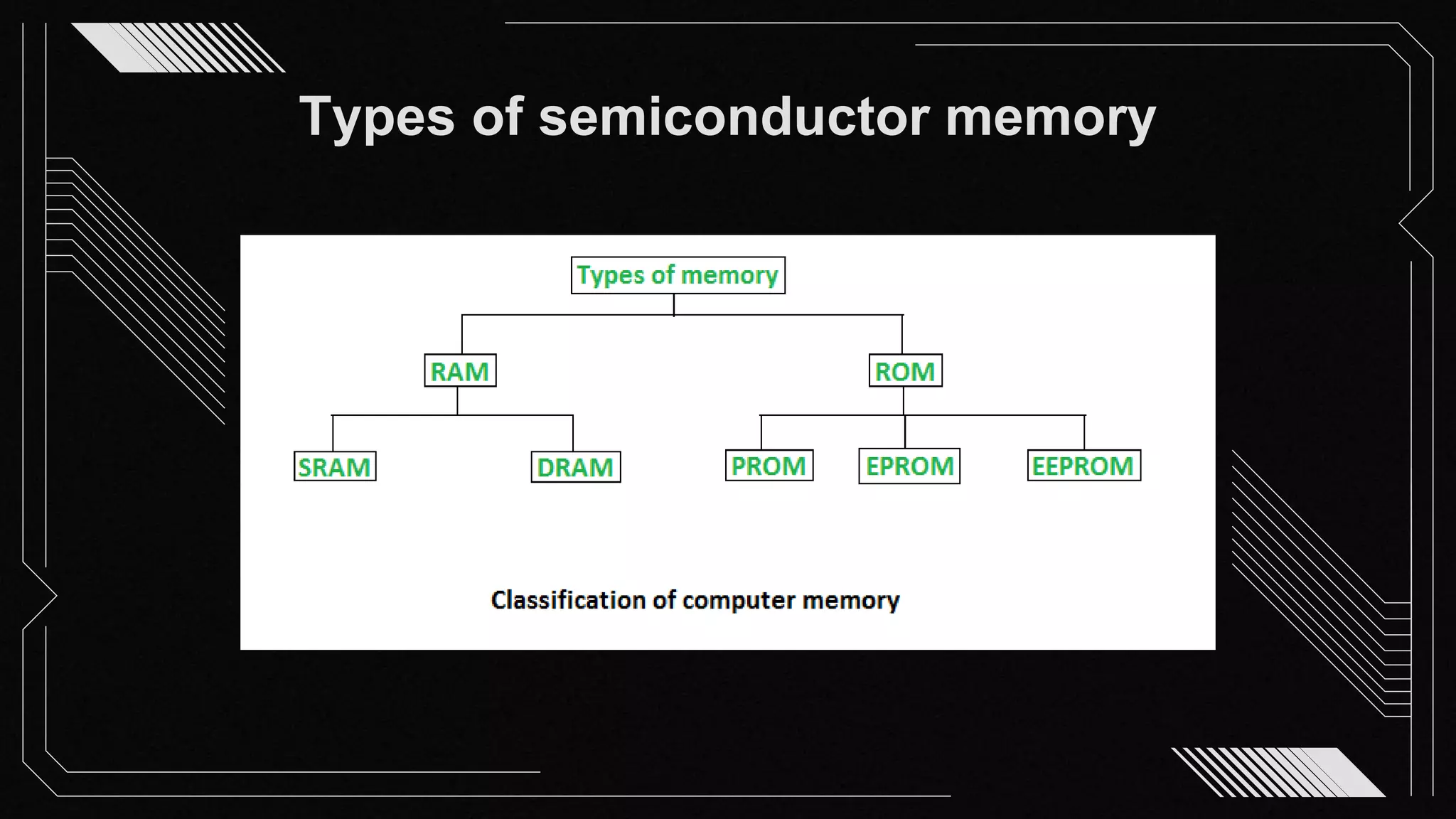
Types of semiconductor memory
RAM (random access memory)
● It is a volatile memory , i.e all the stored data gets
vanished when powered off.
● It needs to be fast as it has to communicate with the
processor.
● This allows the CPU to have immediate access to the
OS , which enhances the overall system
performance.
● Generally , the critical componants of OS are
maintained in RAM.
Types of RAM
● D-RAM
● S-RAM
DRAM
● Dynamic RAM is a form of random access memory
which uses capacitor to store each bit of data .
● But these capacitors do not hold their charge
indefinitely and therefore the data needs to be
refreshed periodically and hence is known as
Dynamic RAM.
Disadvantages of DRAM
● Complex manufacturing process
● Data requires refreshing
● Volatile memory
● Relatively slow operational speed
SRAM
● It stands for Static random access memory
● Unlike the DRAM , it does not need to be
refreshed dynamically .
● This is able to support faster read and write
than DRAM .
ROM
● A ROM(Read-only memory) is a sort of
semiconductor memory technology applied
where the data is written once and then not
changed. This type of memory is used where
data requires ta be stored permanently, even
when the power is switched
● Unlike RAM, in ROM, the binary information is
stored permanently
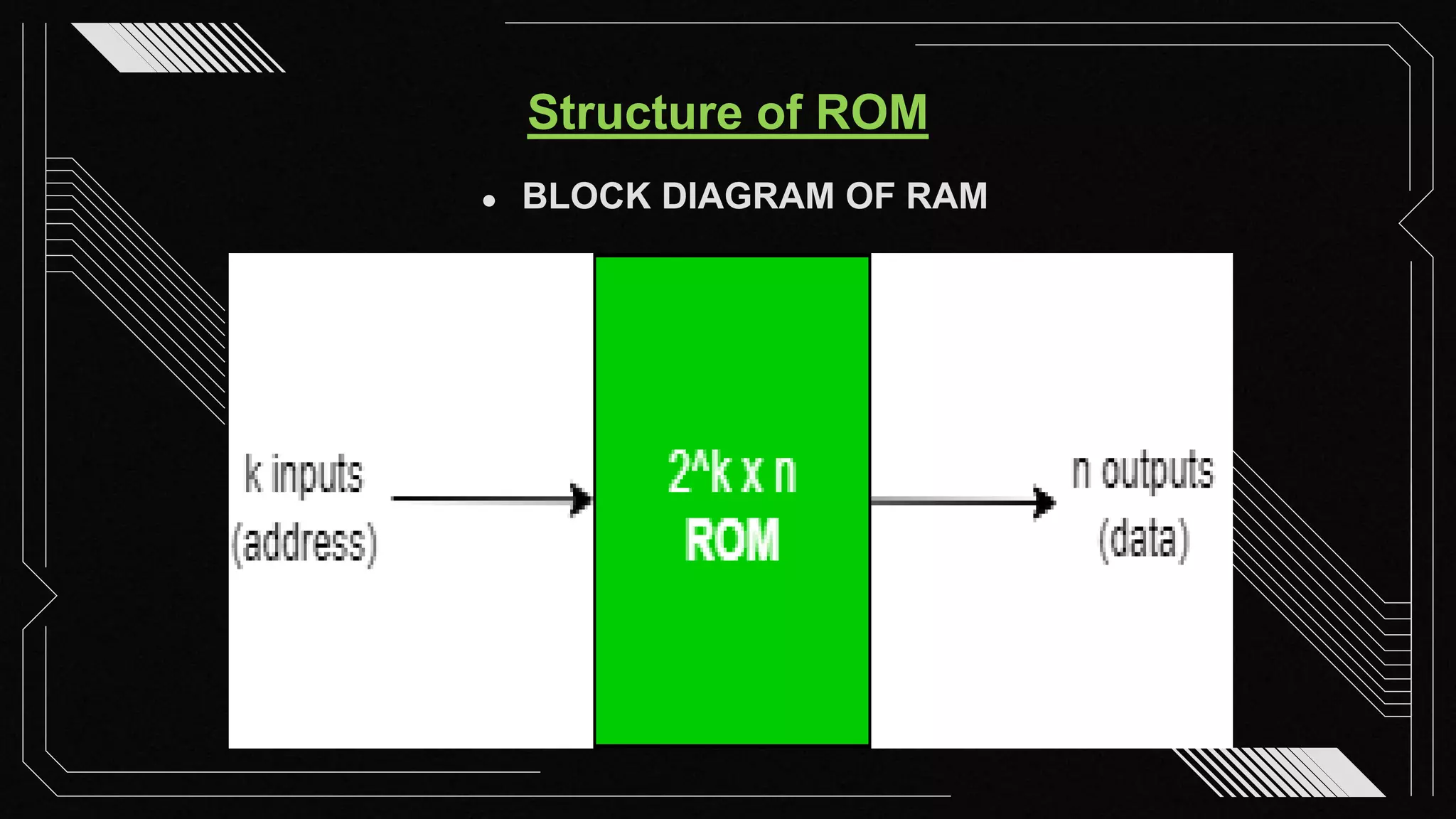
Structure of ROM
● BLOCK DIAGRAM OF RAM
Block Structure:
•It consists of k input lines and n output lines .
•The k input lines is used to take the input address from
where we want to access the content of the ROM .
•Since each of the k input lines can be either 0 or 1, so
there are 2 ^K total addresses which can be referred to by
these input lines and each of these addresses contain n bit
information, which is given out as the output of the ROM.
•Such a ROM is specified as 2^Kxn ROM .
INTERNAL STRUCTURE OF ROM:
•It consists of two basic components – Decoder and OR
gates .
•A Decoder is a combinational circuit which is used to
decode any encoded form ( such as binary, BCD ) to a
more known form ( such as decimal form ) .
•In ROM, the input to a decoder will be in binary form and
the output will represent its decimal equivalent .
•The Decoder is represented as l x 2 ^K , that is, it has l
inputs and has 2^K outputs, which implies that it will
take l-bit binary number and decode it into one of the
2 decimal number .
•All the OR gates present in the ROM will have outputs of
the decoder as their input .
CLASSIFICATION RAMS
1. Masked Read Only Memory
(MROM)
2. Programmable Read Only Memory
(PROM)
3. Erasable and Programmable
Read Only Memory (EPROM)
4. Electrically Erasable and Programmable
Read Only Memory (EEPROM)
Masked Read Only Memory (MROM):
● These were the first set of ROMs developed which are
hard-wired and read-only in nature. MROM is
programmed by the manufacturer during fabrication
after which the contents of the memory can never be
changed.
● Uses – They are used in network operating systems,
server operating systems, storing of fonts for laser
printers, sound data in electronic musical instruments
.
Programmable Read Only Memory (PROM)
● PROMs in the market are blank ROMs and contain no pre-
recorded instructions like those of MROMs. These allow the
user to program it only once, using PROM programmers,
after which their contents can never be changed.
● They have several different applications, including cell
phones, video game consoles, RFID tags, medical devices,
and other electronics.
Erasable and Programmable Read Only
Memory (EPROM)
● These devices comprise of an array of transistors
characterized by floating-gates, which are programmed one-
by-one with the help of high-voltage pulses. However, such a
programmed EPROM can be erased by exposing them to
strong ultra-violet (UV) light for certain duration, after which
they can be programmed once again.
● Uses – Before the advent of EEPROMs, some micro-
controllers, like some versions of Intel 8048, the Freescale
68HC11 used EPROM to store their program .
Electrically Erasable and Programmable Read Only Memory
(EEPROM)
● It stands for Electrically Erasable
Programmable Read-Only Memory . It is
similar to EPROM, except that in this, the
EEPROM is returned to its initial state by
application of an electrical signal, in place of
ultraviolet light . Thus, it provides the ease of
erasing, as this can be done, even if the
memory is positioned in the computer. It
erases or writes one byte of data at a time
● .Uses – It is used for storing the computer
system BIOS.
THANK YOU

SEMICONDUCTOR MEMORIES(RAM &ROM).pptx

  • 1.
  • 2.
    SEMICONDUCTOR MEMORIES 01 • INTRODUCTION •ROLE IN PCs • CLASSIFICATION RAM 02 • UNDERSTANDING RAM • TYPES OF RAMS • DEMERITS OF DRAM ROM 03 • UNDERSTANDING ROM • TYPES OF ROMS’ • IMPLEMENTATION OF ROM TABLE OF CONTENTS
  • 3.
    Semiconductor Memory ● SemiconductorMemory is a digital electronics semiconductor device used for digital data storage , such as computer memory . It typically refers to MOS memory , where data is stored within metal-oxide-semiconductor memory cells on a silicon integrated circuit.
  • 4.
    Role of semiconductormemory in PCs ● When we turn on the PC , the PC loads data from ROM and performs a power on self test (POST) , to make sure all the necessary componants are functioning properly or not . ● The PC loads the basic input/output system (BIOS) from the ROM , which provides the most basic information about boot sequence .
  • 5.
  • 6.
    RAM (random accessmemory) ● It is a volatile memory , i.e all the stored data gets vanished when powered off. ● It needs to be fast as it has to communicate with the processor. ● This allows the CPU to have immediate access to the OS , which enhances the overall system performance. ● Generally , the critical componants of OS are maintained in RAM.
  • 7.
    Types of RAM ●D-RAM ● S-RAM
  • 8.
    DRAM ● Dynamic RAMis a form of random access memory which uses capacitor to store each bit of data . ● But these capacitors do not hold their charge indefinitely and therefore the data needs to be refreshed periodically and hence is known as Dynamic RAM.
  • 9.
    Disadvantages of DRAM ●Complex manufacturing process ● Data requires refreshing ● Volatile memory ● Relatively slow operational speed
  • 10.
    SRAM ● It standsfor Static random access memory ● Unlike the DRAM , it does not need to be refreshed dynamically . ● This is able to support faster read and write than DRAM .
  • 11.
    ROM ● A ROM(Read-onlymemory) is a sort of semiconductor memory technology applied where the data is written once and then not changed. This type of memory is used where data requires ta be stored permanently, even when the power is switched ● Unlike RAM, in ROM, the binary information is stored permanently
  • 12.
    Structure of ROM ●BLOCK DIAGRAM OF RAM
  • 13.
    Block Structure: •It consistsof k input lines and n output lines . •The k input lines is used to take the input address from where we want to access the content of the ROM . •Since each of the k input lines can be either 0 or 1, so there are 2 ^K total addresses which can be referred to by these input lines and each of these addresses contain n bit information, which is given out as the output of the ROM. •Such a ROM is specified as 2^Kxn ROM .
  • 14.
    INTERNAL STRUCTURE OFROM: •It consists of two basic components – Decoder and OR gates . •A Decoder is a combinational circuit which is used to decode any encoded form ( such as binary, BCD ) to a more known form ( such as decimal form ) . •In ROM, the input to a decoder will be in binary form and the output will represent its decimal equivalent . •The Decoder is represented as l x 2 ^K , that is, it has l inputs and has 2^K outputs, which implies that it will take l-bit binary number and decode it into one of the 2 decimal number . •All the OR gates present in the ROM will have outputs of the decoder as their input .
  • 15.
    CLASSIFICATION RAMS 1. MaskedRead Only Memory (MROM) 2. Programmable Read Only Memory (PROM) 3. Erasable and Programmable Read Only Memory (EPROM) 4. Electrically Erasable and Programmable Read Only Memory (EEPROM)
  • 16.
    Masked Read OnlyMemory (MROM): ● These were the first set of ROMs developed which are hard-wired and read-only in nature. MROM is programmed by the manufacturer during fabrication after which the contents of the memory can never be changed. ● Uses – They are used in network operating systems, server operating systems, storing of fonts for laser printers, sound data in electronic musical instruments .
  • 17.
    Programmable Read OnlyMemory (PROM) ● PROMs in the market are blank ROMs and contain no pre- recorded instructions like those of MROMs. These allow the user to program it only once, using PROM programmers, after which their contents can never be changed. ● They have several different applications, including cell phones, video game consoles, RFID tags, medical devices, and other electronics.
  • 18.
    Erasable and ProgrammableRead Only Memory (EPROM) ● These devices comprise of an array of transistors characterized by floating-gates, which are programmed one- by-one with the help of high-voltage pulses. However, such a programmed EPROM can be erased by exposing them to strong ultra-violet (UV) light for certain duration, after which they can be programmed once again. ● Uses – Before the advent of EEPROMs, some micro- controllers, like some versions of Intel 8048, the Freescale 68HC11 used EPROM to store their program .
  • 19.
    Electrically Erasable andProgrammable Read Only Memory (EEPROM) ● It stands for Electrically Erasable Programmable Read-Only Memory . It is similar to EPROM, except that in this, the EEPROM is returned to its initial state by application of an electrical signal, in place of ultraviolet light . Thus, it provides the ease of erasing, as this can be done, even if the memory is positioned in the computer. It erases or writes one byte of data at a time ● .Uses – It is used for storing the computer system BIOS.
  • 20.