by 
G.Vanitha
INTRODUTION 
A biofertilizer is a substance which contains living 
microorganisms, when applied to seed, plant surfaces, 
or soil, colonizes the rhizosphere or the interior of the 
plant and promotes growth by increasing the supply or 
availability of primary nutrients to the host plant. 
Bio-fertilizers add nutrients through the natural 
processes of nitrogen fixation, solubilizing 
phosphorus, and stimulating plant growth through the 
synthesis of growth-promoting substances.
What is Bio fertilizer? 
Biofertilizers are natural fertilizers that are microbial 
inoculants of bacteria, algae and fungi (separately or 
in combination). 
which may help biological nitrogen fixation for the 
benefit of plants. 
They help build up the soil micro-flora and there by the 
soil health. 
Biofertilizer also include organic fertilizers(manure, 
etc.) 
Use of bio-fertilizer is recommended for improving the 
soil fertility in organic farming
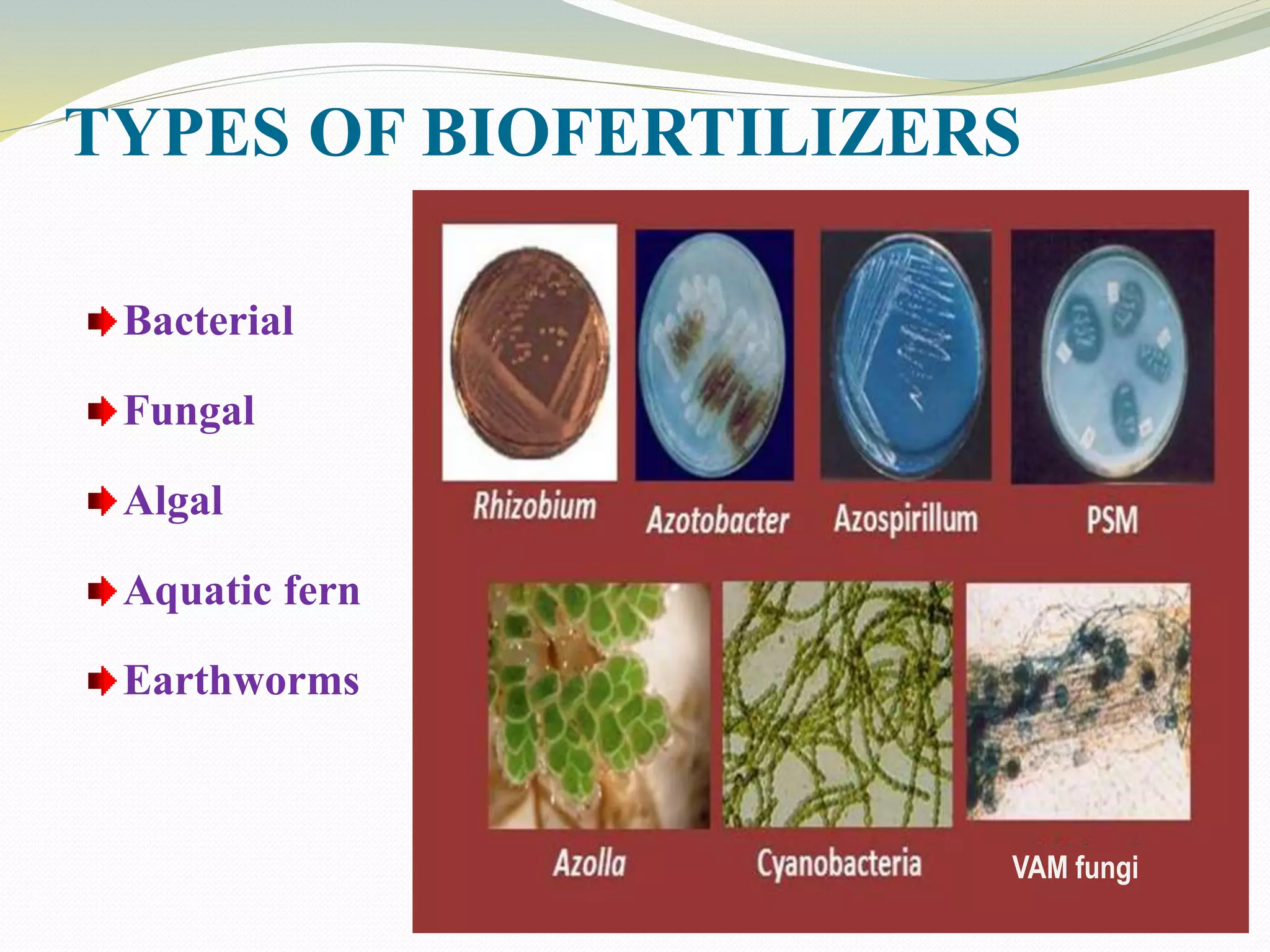
TYPES OF BIOFERTILIZERS 
Bacterial 
Fungal 
Algal 
Aquatic fern 
Earthworms 
VAM fungi
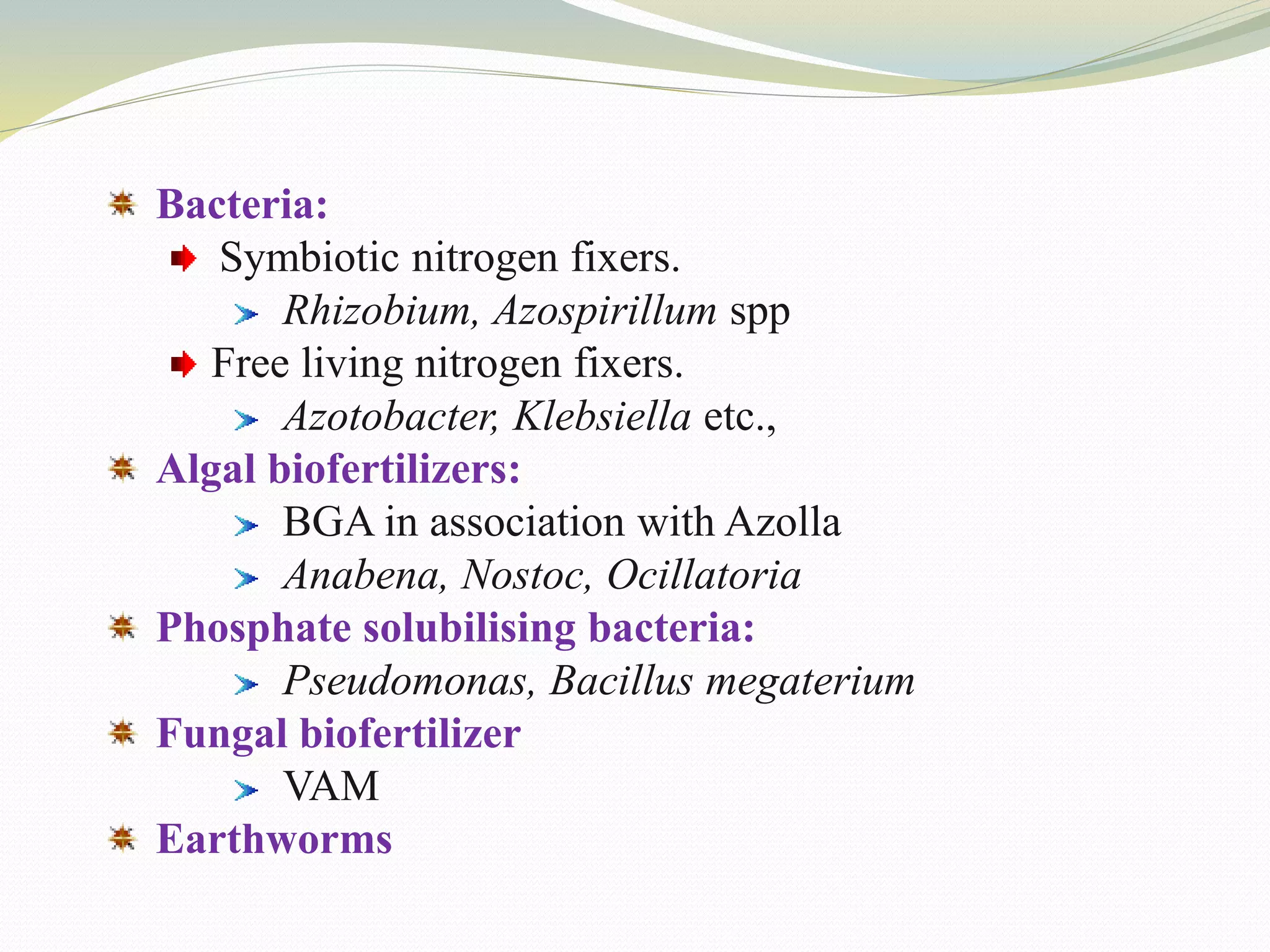
Bacteria: 
Symbiotic nitrogen fixers. 
Rhizobium, Azospirillum spp 
Free living nitrogen fixers. 
Azotobacter, Klebsiella etc., 
Algal biofertilizers: 
BGA in association with Azolla 
Anabena, Nostoc, Ocillatoria 
Phosphate solubilising bacteria: 
Pseudomonas, Bacillus megaterium 
Fungal biofertilizer 
VAM 
Earthworms
Bacterial biofertilizers 
The live cells of bacteria used as a biofertilizers 
These microbes contains unique gene called as Nif-Gene 
which make them capable of fixing nitrogen. 
The nitrogen fixing bacteria work under two conditions, 
Symbiotically 
Free living bacteria (non-symbiotic). 
The symbiotic bacteria make an association with crop plants 
through forming nodules in their roots. 
The free living bacteria do not form any association but live 
freely and fix atmospheric nitrogen.
Symbiotic nitrogen fixers. 
Most important symbiotic Nitrogen fixing bacteria is 
Rhizobium and Azospirillum. 
Rhizobium: 
 Rhizobium lives in the root hairs of the legumes by 
forming nodules 
 Plant root supply essential minerals and newly synthesized 
substance to the bacteria 
 The name Rhizobium was established by 
Frank in 1889. 
 This genus has seven distinct species based 
on "Cross Inoculation Group Concept".
 More than twenty cross-inoculations groups have been 
established. 
 A new classification has been established for Rhizobium. 
 That is 'slow growing rhizobia' known as Bradyrhizobium 
and the other group is 'fast growing rhizobia' called 
Rhizobium. 
 Rhizobium can fix 50-300 kg/ha 
Rhizobium
Azospirillum: 
It mainly present in cereal plants. 
inhabits both root cells as well as 
surrounding of roots 
forming symbiotic relation and increasing 
nitrogen fixing potential of the cereal plant. 
Azospirillum is recognized as a dominant soil microbe 
nitrogen in the range of 20- 40 kg/ha in the rhizosphere in 
non-leguminous plants such as cereals, millets, Oilseeds, 
cotton etc. 
Considerable quantity of nitrogen fertilizer up to 25-30 % 
can be saved by the use of Azospirillum inoculant. 
These species have been commercially exploited for the use 
as nitrogen supplying Bio-Fertilizers.
Free living bacteria 
Large number of free living or non -symbiotic bacteria (does 
not form nodules but makes association by living in the 
rhizosphere) present in soil. 
Commonly used free living bacteria are 
Azotobacter 
Klebsiella 
it will not associated with plant. 
Azotobacter is a biofertilizer which provides the required 
amount of nitrogen to the plant from the soil.
Azotobactor 
Azotobactor is a heterotrophic free living nitrogen fixing 
bacteria present in alkaline and neutral soils. 
Azotobactor is the most commonly occurring species in 
arable soils of India. 
Apart from its ability to fix atmospheric nitrogen in soils, it 
can also synthesize growth promoting substances such as 
auxins and gibberellins and also to some extent the 
vitamins.
Many strains of Azotobactor also exhibit fungicidal 
properties against certain species of fungus. 
Response of Azotobactor has been seen in rice, maize, 
cotton, sugarcane, pearl millet, vegetable and some 
plantation crops. 
It improves seed germination and plant growth. 
Azotobacter is heaviest breathing organism and requires a 
large amount of organic carbon for its growth.
Mass production 
isolated bacterial cultures were subculture in to nutrient 
broth 
The cultures were grown under shaking condition at 30±2°C 
The culture incubated until it reaches maximum cell 
population of 10¹º to 10¹¹ 
Under optimum condition this population level could be 
attained within 4-5 days for Rhizobium 5-7 days for 
Azospirillum and 6-7 days for Azotobacter. 
The culture obtained in the flask is called Starter culture 
For large scale production , inoculum from starter culture is 
transferred in to large flasks / fermentor and grown until 
required level of cell count is reached
prepare appropriate media for specific to bacterial 
inoculant in required quantity 
Inoculated with specific bacterial strain for aseptic condition 
Incubated at 30±2ºC for 5-7 days in rotary shaker 
Observe growth of the culture and estimate the population 
( starter culture) 
The above the media is prepared in large quantities in fermentor
Sterilized and cooled well 
Media in a fermentor is inoculated with the log phase of culture 
grown in large flask (usually 1-2 % of inoculum is sufficient) 
cells are grown in fermentor by providing aeration & continuous 
stirring 
Broth is checked for the population of inoculated organisms 
Cells are harvested with the population load of 109 cells/ml
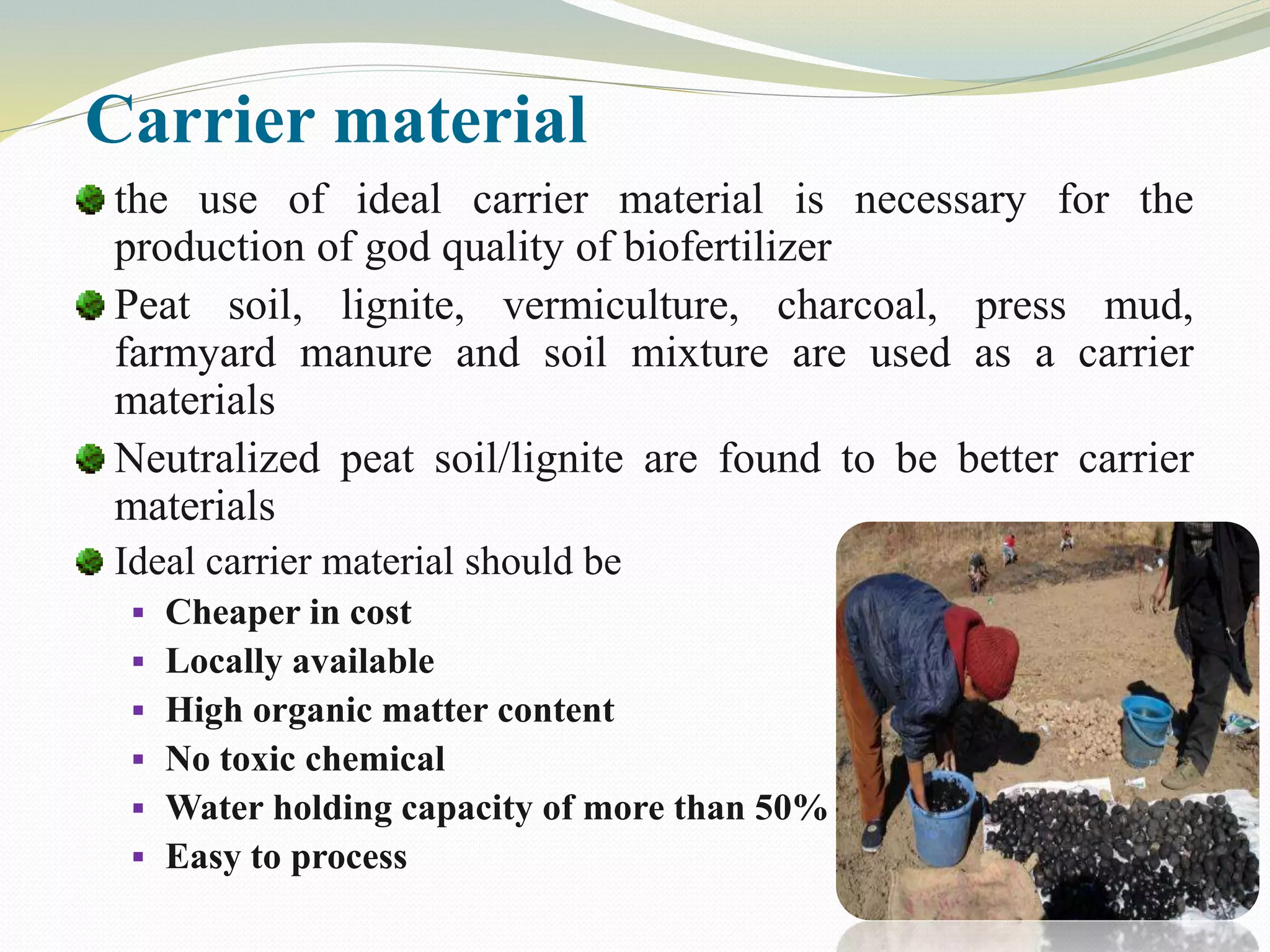
Carrier material 
the use of ideal carrier material is necessary for the 
production of god quality of biofertilizer 
Peat soil, lignite, vermiculture, charcoal, press mud, 
farmyard manure and soil mixture are used as a carrier 
materials 
Neutralized peat soil/lignite are found to be better carrier 
materials 
Ideal carrier material should be 
 Cheaper in cost 
 Locally available 
 High organic matter content 
 No toxic chemical 
 Water holding capacity of more than 50% 
 Easy to process
Preparation of inoculants packet 
Neutralized and sterilized carrier material is spread in a 
clean, dry, sterile metallic or plastic 
 Bacterial culture drawn from the fermentor is added to the 
sterilized carrier and mixed well by manual or mechanical 
mixer 
 Inoculants are packed in a polythene bags sealed with 
electric sealer
Specification of the polythene bags 
 Polythene bags should be of low density grade 
 Thickness of bag should be around 50-75 micron 
 Packet should be marked with the 
 Name of the manufacture 
 Name of the product 
 Strain number 
 The crops to which recommended 
 Method of inoculation 
 Date of manufacture 
 Batch number 
 Date of expiry 
 Price 
 Full address 
 storage instruction
Vesicular Arbuscular Mycorrhiza 
(VAM) 
The term mycorrhiza was taken from 
Greek language meaning 
'fungus root'. term was 
coined by Frank in 1885 
The mycorrhiza is a mutualistic association between fungal 
mycelia and plant roots. 
VAM is an endotrophic (live inside) mycorrhiza formed by 
aseptated phycomycetous fungi. 
VAM help in nutrient transfer mainly of phosphorus, zinc 
and sulfur.
Mycorrhizae is the symbiotic association between plant 
roots and soil fungus of the 7 types of mycorrhizae, 
VAM plays a great role in inducing plant growth. 
VAM are symbiotic entophytic soil fungi, which colonize 
the roots of approximately 80% plants. 
The VAM hyphae also help is retaining moisture around the 
root zone of plants 
It increases the resistance to root borne or soil borne 
pathogens and Nematodes.
They also mobilize different nutrients like Cu(copper), 
K(potassium), Al(aluminum), Mn(manganese), Fe 
(iron)and Mg (magnesium) from the soil to the plant roots. 
They posses vesicles (sac like structure) for storage of 
nutrients and arbuscular for funneling them into root 
system. 
Morphology 
External hyphae 
 Arbuscles 
Vesicles 
External hyphae vesicles 
Arbuscles
Mechanism of Action 
The VAM forms an association with plant roots. 
It penetrates in the root cortex and spreads around the 
roots of the plant. 
As the name indicates, they posses sac like structure called 
vesicules which stores phosphorus as phospholipids. 
The other structure called arbuscule helps bringing the 
distant nutrients to the vesicules and root.
Mass production 
VAM spores isolated 
Spores mixed with sterilized soil 
Soil filled in pots 
Host plant transplanted in pots 
Kept 3-4 months in green house
Soil in the pot along with roots of host 
plant is macerated 
Dried till it attains 5% moisture 
Dried soil inoculants used for field application
Uses of VAM 
Enhances the feeding areas of the plant root is as the 
hyphae spreads around the roots. 
Mobilizes the nutrients from distantance to root. 
Stores the nutrients (sp. phosphorus). 
Removes the toxic chemicals (example : phenolics) which 
otherwise hinder nutrient availability. 
Provide protection against other fungi and nematodes 
It increase growth rate in plants (citrus, maize, wheat, etc.) 
It reduces sensitivity of crop towards high level of salts 
and heavy metals
Algae as a biofertilizer 
Another group of free living nitrogen fixers are cyanobacteria. 
Commonly called as Blue green algae. 
More than 100 species of BGA can fix nitrogen. 
Nitrogen fixation takes place in specialized cells called 
‘Heterocyst’ 
BGA very common in rice field. 
Unlike Azotobacter BGA are not inhibited by the presence of 
chemical fertilizers. 
No chemical fertilizers added, inoculation of the algae can 
result in 10-14% increase in crop yields.
They are easy to produce 
Usually they are mass produced in cement tanks filled with 
fresh water. 
Not require any processing 
Quite and cheap 
Cost of 10kg may be Rs.30-40 only 
Beneficial in certain crops like vegetables, cotton, 
sugarcane. 
Eg. of some algal biofertilizers are 
 Anabena 
 Nostoc 
 Oscillatoria
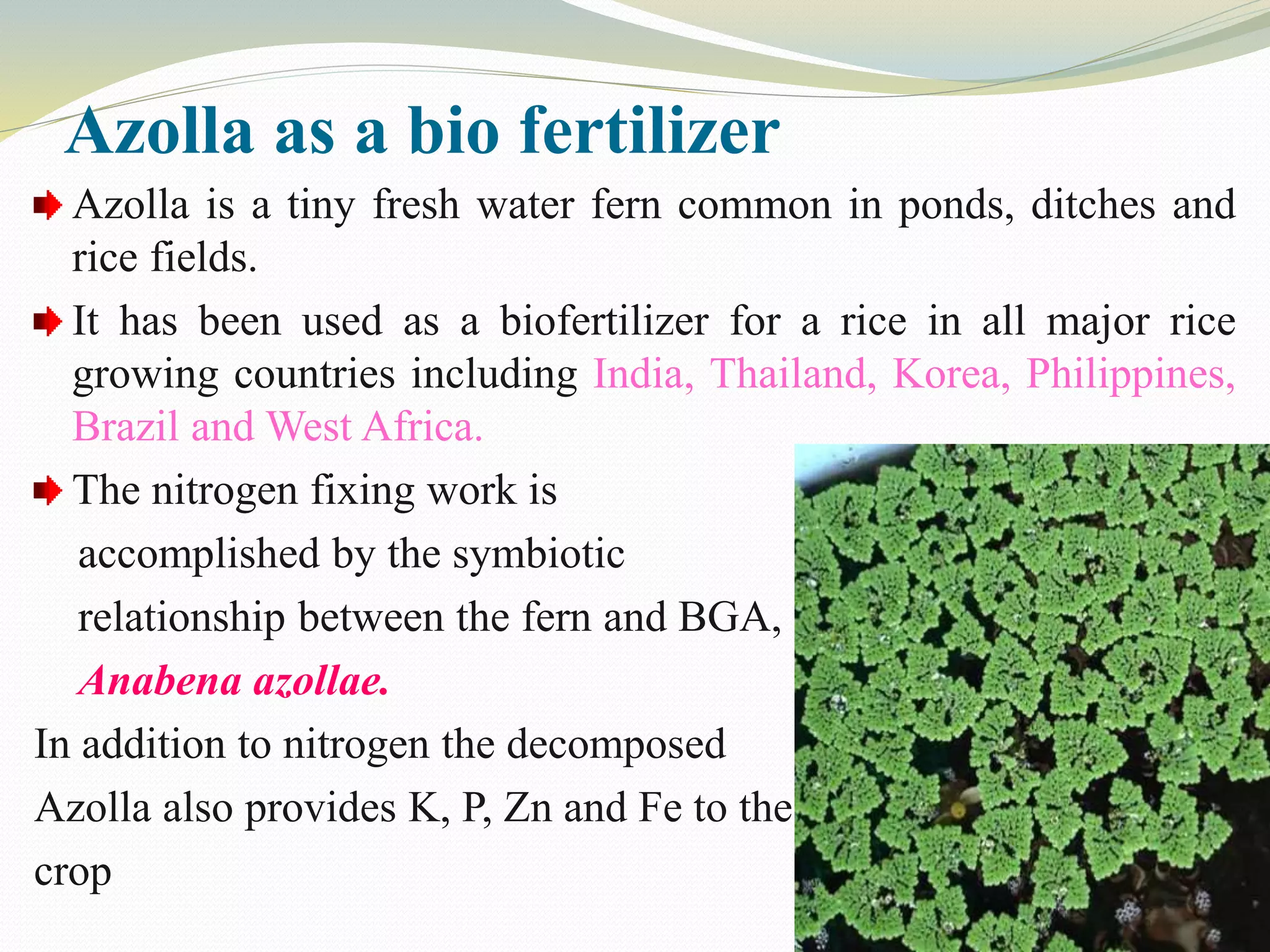
Azolla as a bio fertilizer 
Azolla is a tiny fresh water fern common in ponds, ditches and 
rice fields. 
It has been used as a biofertilizer for a rice in all major rice 
growing countries including India, Thailand, Korea, Philippines, 
Brazil and West Africa. 
The nitrogen fixing work is 
accomplished by the symbiotic 
relationship between the fern and BGA, 
Anabena azollae. 
In addition to nitrogen the decomposed 
Azolla also provides K, P, Zn and Fe to the 
crop
Azolla biomass gets doubled within 5-7 days by vegetative 
methods. 
fix 40-80 kg nitrogen / ha / year. 
good manure for flooded rice. 
Increase of crop yield up to 15-20% has been observed while 
fertilizing the rice with Azolla 
Hybrids are growing faster 
Tolerant to heat and cold 
Fix 4-5% more nitrogen
Bio - fertilizers application methods 
There are three ways of using these N-fixing/P.S.M. bacteria. 
Seed treatment 
Root dipping 
Soil applications
Seed Treatment 
Seed treatment is a most common method adopted for all 
types of inoculant. The seed treatment is effective and 
economic. 
Seed treatment with Rhizobium, Azotobacter, Azospirillum 
along with P.S.M. 
seed treatment can be done with any of two or more 
bacteria. 
no side effect. 
important things has the seeds must be coated first with 
Rhizobium or Azotobacter or Azospirillum when each seeds 
get a layer of above bacteria then the P.S.M. inoculant has to 
be treated on outer layer of the seeds.
This method will provide maximum number of population 
of each bacteria required for better results. 
Mixing the any of two bacteria and the treatment of seed 
will not provide maximum number of bacteria of 
individuals.
Root dipping 
Application of Azospirillum with the paddy/vegetable plants 
this method is needed. 
The required quantity of Azospirillum has to be mixed with 
5-10 ltr of water at one corner of the field and all the plants 
have to kept for minimum ½ an hour before sowing .
Soil application 
P.S.M. has to be used as a soil application use 2 kgs of 
P.S.M. per acre. Mix P.S.M. with 400 to 600 kgs of 
Cowdung along with ½ bag of rock phosphate if available. 
The mixture of P.S.M., Cowdung and rock phosphate have 
to be kept under any tree shade or celling for over night and 
maintain 50% moisture. 
Use the mixture as a soil application in rows or during 
leveling of soil.
Precautions 
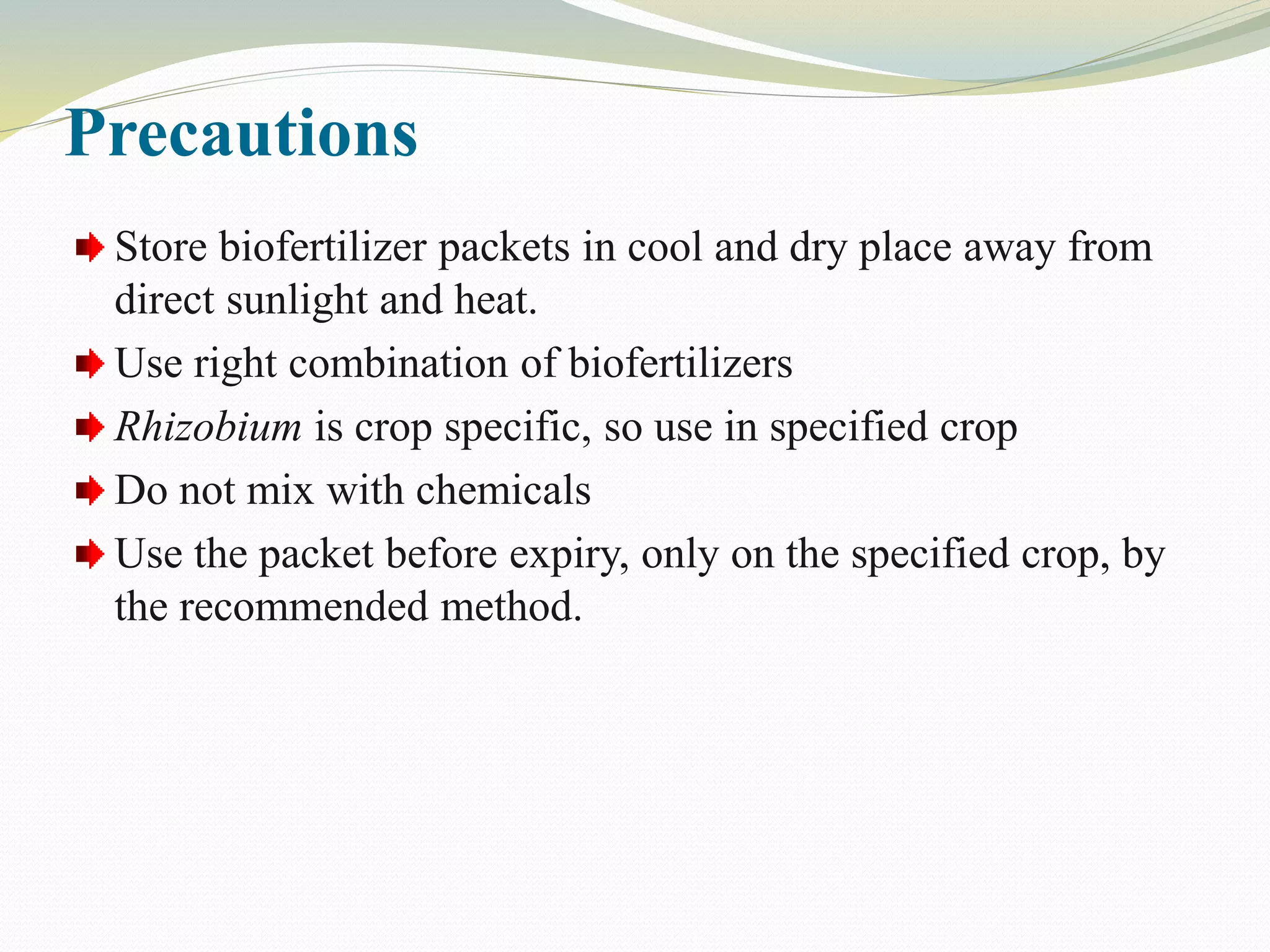
Store biofertilizer packets in cool and dry place away from 
direct sunlight and heat. 
Use right combination of biofertilizers 
Rhizobium is crop specific, so use in specified crop 
Do not mix with chemicals 
Use the packet before expiry, only on the specified crop, by 
the recommended method.
Advantage of biofertilizers 
Renewable source of nutrients 
Sustain soil health 
Supplement chemical fertilizers. 
Replace 25-30% chemical fertilizers 
Increase the grain yields by 10-40%. 
Decompose plant residues, and stabilize C:N ratio of soil 
Improve texture, structure and water holding capacity of soil 
No adverse effect on plant growth and soil fertility.
Stimulates plant growth by secreting growth hormones. 
Secrete fungistatic and antibiotic like substances 
Solubilize and mobilize nutrients 
Eco-friendly, non-pollutants and cost effective method
Disadvantages 
Biofertilizers require special care for long-term storage 
because they are alive. 
must be used before their expiry date. 
If other microorganisms contaminate the carrier medium or 
if growers use the wrong strain, they are not as effective. 
Biofertilizers lose their effectiveness if the soil is too hot or 
dry.
THANK YOU

Biofertilizer

  • 1.
  • 2.
    INTRODUTION A biofertilizeris a substance which contains living microorganisms, when applied to seed, plant surfaces, or soil, colonizes the rhizosphere or the interior of the plant and promotes growth by increasing the supply or availability of primary nutrients to the host plant. Bio-fertilizers add nutrients through the natural processes of nitrogen fixation, solubilizing phosphorus, and stimulating plant growth through the synthesis of growth-promoting substances.
  • 3.
    What is Biofertilizer? Biofertilizers are natural fertilizers that are microbial inoculants of bacteria, algae and fungi (separately or in combination). which may help biological nitrogen fixation for the benefit of plants. They help build up the soil micro-flora and there by the soil health. Biofertilizer also include organic fertilizers(manure, etc.) Use of bio-fertilizer is recommended for improving the soil fertility in organic farming
  • 4.
    TYPES OF BIOFERTILIZERS Bacterial Fungal Algal Aquatic fern Earthworms VAM fungi
  • 5.
    Bacteria: Symbiotic nitrogenfixers. Rhizobium, Azospirillum spp Free living nitrogen fixers. Azotobacter, Klebsiella etc., Algal biofertilizers: BGA in association with Azolla Anabena, Nostoc, Ocillatoria Phosphate solubilising bacteria: Pseudomonas, Bacillus megaterium Fungal biofertilizer VAM Earthworms
  • 6.
    Bacterial biofertilizers Thelive cells of bacteria used as a biofertilizers These microbes contains unique gene called as Nif-Gene which make them capable of fixing nitrogen. The nitrogen fixing bacteria work under two conditions, Symbiotically Free living bacteria (non-symbiotic). The symbiotic bacteria make an association with crop plants through forming nodules in their roots. The free living bacteria do not form any association but live freely and fix atmospheric nitrogen.
  • 7.
    Symbiotic nitrogen fixers. Most important symbiotic Nitrogen fixing bacteria is Rhizobium and Azospirillum. Rhizobium:  Rhizobium lives in the root hairs of the legumes by forming nodules  Plant root supply essential minerals and newly synthesized substance to the bacteria  The name Rhizobium was established by Frank in 1889.  This genus has seven distinct species based on "Cross Inoculation Group Concept".
  • 8.
     More thantwenty cross-inoculations groups have been established.  A new classification has been established for Rhizobium.  That is 'slow growing rhizobia' known as Bradyrhizobium and the other group is 'fast growing rhizobia' called Rhizobium.  Rhizobium can fix 50-300 kg/ha Rhizobium
  • 9.
    Azospirillum: It mainlypresent in cereal plants. inhabits both root cells as well as surrounding of roots forming symbiotic relation and increasing nitrogen fixing potential of the cereal plant. Azospirillum is recognized as a dominant soil microbe nitrogen in the range of 20- 40 kg/ha in the rhizosphere in non-leguminous plants such as cereals, millets, Oilseeds, cotton etc. Considerable quantity of nitrogen fertilizer up to 25-30 % can be saved by the use of Azospirillum inoculant. These species have been commercially exploited for the use as nitrogen supplying Bio-Fertilizers.
  • 10.
    Free living bacteria Large number of free living or non -symbiotic bacteria (does not form nodules but makes association by living in the rhizosphere) present in soil. Commonly used free living bacteria are Azotobacter Klebsiella it will not associated with plant. Azotobacter is a biofertilizer which provides the required amount of nitrogen to the plant from the soil.
  • 11.
    Azotobactor Azotobactor isa heterotrophic free living nitrogen fixing bacteria present in alkaline and neutral soils. Azotobactor is the most commonly occurring species in arable soils of India. Apart from its ability to fix atmospheric nitrogen in soils, it can also synthesize growth promoting substances such as auxins and gibberellins and also to some extent the vitamins.
  • 12.
    Many strains ofAzotobactor also exhibit fungicidal properties against certain species of fungus. Response of Azotobactor has been seen in rice, maize, cotton, sugarcane, pearl millet, vegetable and some plantation crops. It improves seed germination and plant growth. Azotobacter is heaviest breathing organism and requires a large amount of organic carbon for its growth.
  • 13.
    Mass production isolatedbacterial cultures were subculture in to nutrient broth The cultures were grown under shaking condition at 30±2°C The culture incubated until it reaches maximum cell population of 10¹º to 10¹¹ Under optimum condition this population level could be attained within 4-5 days for Rhizobium 5-7 days for Azospirillum and 6-7 days for Azotobacter. The culture obtained in the flask is called Starter culture For large scale production , inoculum from starter culture is transferred in to large flasks / fermentor and grown until required level of cell count is reached
  • 14.
    prepare appropriate mediafor specific to bacterial inoculant in required quantity Inoculated with specific bacterial strain for aseptic condition Incubated at 30±2ºC for 5-7 days in rotary shaker Observe growth of the culture and estimate the population ( starter culture) The above the media is prepared in large quantities in fermentor
  • 15.
    Sterilized and cooledwell Media in a fermentor is inoculated with the log phase of culture grown in large flask (usually 1-2 % of inoculum is sufficient) cells are grown in fermentor by providing aeration & continuous stirring Broth is checked for the population of inoculated organisms Cells are harvested with the population load of 109 cells/ml
  • 16.
    Carrier material theuse of ideal carrier material is necessary for the production of god quality of biofertilizer Peat soil, lignite, vermiculture, charcoal, press mud, farmyard manure and soil mixture are used as a carrier materials Neutralized peat soil/lignite are found to be better carrier materials Ideal carrier material should be  Cheaper in cost  Locally available  High organic matter content  No toxic chemical  Water holding capacity of more than 50%  Easy to process
  • 17.
    Preparation of inoculantspacket Neutralized and sterilized carrier material is spread in a clean, dry, sterile metallic or plastic  Bacterial culture drawn from the fermentor is added to the sterilized carrier and mixed well by manual or mechanical mixer  Inoculants are packed in a polythene bags sealed with electric sealer
  • 18.
    Specification of thepolythene bags  Polythene bags should be of low density grade  Thickness of bag should be around 50-75 micron  Packet should be marked with the  Name of the manufacture  Name of the product  Strain number  The crops to which recommended  Method of inoculation  Date of manufacture  Batch number  Date of expiry  Price  Full address  storage instruction
  • 19.
    Vesicular Arbuscular Mycorrhiza (VAM) The term mycorrhiza was taken from Greek language meaning 'fungus root'. term was coined by Frank in 1885 The mycorrhiza is a mutualistic association between fungal mycelia and plant roots. VAM is an endotrophic (live inside) mycorrhiza formed by aseptated phycomycetous fungi. VAM help in nutrient transfer mainly of phosphorus, zinc and sulfur.
  • 20.
    Mycorrhizae is thesymbiotic association between plant roots and soil fungus of the 7 types of mycorrhizae, VAM plays a great role in inducing plant growth. VAM are symbiotic entophytic soil fungi, which colonize the roots of approximately 80% plants. The VAM hyphae also help is retaining moisture around the root zone of plants It increases the resistance to root borne or soil borne pathogens and Nematodes.
  • 21.
    They also mobilizedifferent nutrients like Cu(copper), K(potassium), Al(aluminum), Mn(manganese), Fe (iron)and Mg (magnesium) from the soil to the plant roots. They posses vesicles (sac like structure) for storage of nutrients and arbuscular for funneling them into root system. Morphology External hyphae  Arbuscles Vesicles External hyphae vesicles Arbuscles
  • 22.
    Mechanism of Action The VAM forms an association with plant roots. It penetrates in the root cortex and spreads around the roots of the plant. As the name indicates, they posses sac like structure called vesicules which stores phosphorus as phospholipids. The other structure called arbuscule helps bringing the distant nutrients to the vesicules and root.
  • 23.
    Mass production VAMspores isolated Spores mixed with sterilized soil Soil filled in pots Host plant transplanted in pots Kept 3-4 months in green house
  • 24.
    Soil in thepot along with roots of host plant is macerated Dried till it attains 5% moisture Dried soil inoculants used for field application
  • 25.
    Uses of VAM Enhances the feeding areas of the plant root is as the hyphae spreads around the roots. Mobilizes the nutrients from distantance to root. Stores the nutrients (sp. phosphorus). Removes the toxic chemicals (example : phenolics) which otherwise hinder nutrient availability. Provide protection against other fungi and nematodes It increase growth rate in plants (citrus, maize, wheat, etc.) It reduces sensitivity of crop towards high level of salts and heavy metals
  • 26.
    Algae as abiofertilizer Another group of free living nitrogen fixers are cyanobacteria. Commonly called as Blue green algae. More than 100 species of BGA can fix nitrogen. Nitrogen fixation takes place in specialized cells called ‘Heterocyst’ BGA very common in rice field. Unlike Azotobacter BGA are not inhibited by the presence of chemical fertilizers. No chemical fertilizers added, inoculation of the algae can result in 10-14% increase in crop yields.
  • 27.
    They are easyto produce Usually they are mass produced in cement tanks filled with fresh water. Not require any processing Quite and cheap Cost of 10kg may be Rs.30-40 only Beneficial in certain crops like vegetables, cotton, sugarcane. Eg. of some algal biofertilizers are  Anabena  Nostoc  Oscillatoria
  • 28.
    Azolla as abio fertilizer Azolla is a tiny fresh water fern common in ponds, ditches and rice fields. It has been used as a biofertilizer for a rice in all major rice growing countries including India, Thailand, Korea, Philippines, Brazil and West Africa. The nitrogen fixing work is accomplished by the symbiotic relationship between the fern and BGA, Anabena azollae. In addition to nitrogen the decomposed Azolla also provides K, P, Zn and Fe to the crop
  • 29.
    Azolla biomass getsdoubled within 5-7 days by vegetative methods. fix 40-80 kg nitrogen / ha / year. good manure for flooded rice. Increase of crop yield up to 15-20% has been observed while fertilizing the rice with Azolla Hybrids are growing faster Tolerant to heat and cold Fix 4-5% more nitrogen
  • 30.
    Bio - fertilizersapplication methods There are three ways of using these N-fixing/P.S.M. bacteria. Seed treatment Root dipping Soil applications
  • 31.
    Seed Treatment Seedtreatment is a most common method adopted for all types of inoculant. The seed treatment is effective and economic. Seed treatment with Rhizobium, Azotobacter, Azospirillum along with P.S.M. seed treatment can be done with any of two or more bacteria. no side effect. important things has the seeds must be coated first with Rhizobium or Azotobacter or Azospirillum when each seeds get a layer of above bacteria then the P.S.M. inoculant has to be treated on outer layer of the seeds.
  • 32.
    This method willprovide maximum number of population of each bacteria required for better results. Mixing the any of two bacteria and the treatment of seed will not provide maximum number of bacteria of individuals.
  • 33.
    Root dipping Applicationof Azospirillum with the paddy/vegetable plants this method is needed. The required quantity of Azospirillum has to be mixed with 5-10 ltr of water at one corner of the field and all the plants have to kept for minimum ½ an hour before sowing .
  • 34.
    Soil application P.S.M.has to be used as a soil application use 2 kgs of P.S.M. per acre. Mix P.S.M. with 400 to 600 kgs of Cowdung along with ½ bag of rock phosphate if available. The mixture of P.S.M., Cowdung and rock phosphate have to be kept under any tree shade or celling for over night and maintain 50% moisture. Use the mixture as a soil application in rows or during leveling of soil.
  • 35.
    Precautions Store biofertilizerpackets in cool and dry place away from direct sunlight and heat. Use right combination of biofertilizers Rhizobium is crop specific, so use in specified crop Do not mix with chemicals Use the packet before expiry, only on the specified crop, by the recommended method.
  • 36.
    Advantage of biofertilizers Renewable source of nutrients Sustain soil health Supplement chemical fertilizers. Replace 25-30% chemical fertilizers Increase the grain yields by 10-40%. Decompose plant residues, and stabilize C:N ratio of soil Improve texture, structure and water holding capacity of soil No adverse effect on plant growth and soil fertility.
  • 37.
    Stimulates plant growthby secreting growth hormones. Secrete fungistatic and antibiotic like substances Solubilize and mobilize nutrients Eco-friendly, non-pollutants and cost effective method
  • 38.
    Disadvantages Biofertilizers requirespecial care for long-term storage because they are alive. must be used before their expiry date. If other microorganisms contaminate the carrier medium or if growers use the wrong strain, they are not as effective. Biofertilizers lose their effectiveness if the soil is too hot or dry.
  • 39.