INTRODUCTION
Multifarious advantages of biofertilizers leads to its
wide applicability in sustainable agriculture.
Biofertilizer technology is not a new concept.
It involves inoculation of beneficial microorganisms
that help nutrient acquisition by plants through fixation of
nitrogen, solubilization and mobilization of other
nutrients.
The role of biofertilizers assumes special
significance due to increased cost of chemical
fertilizers and their ill effects on soil health
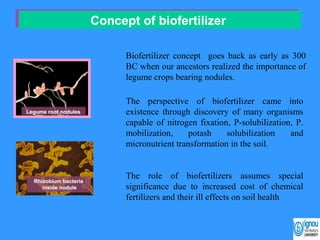
Legume root nodulesLegume root nodules
Rhizobium bacteria
inside nodule
Rhizobium bacteria
inside nodule
Concept of biofertilizerConcept of biofertilizer
Biofertilizer concept goes back as early as 300
BC when our ancestors realized the importance of
legume crops bearing nodules.
The perspective of biofertilizer came into
existence through discovery of many organisms
capable of nitrogen fixation, P-solubilization, P.
mobilization, potash solubilization and
micronutrient transformation in the soil.
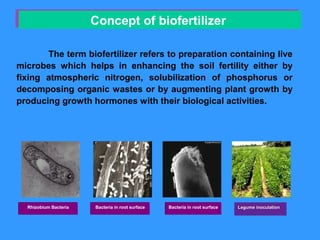
The term biofertilizer refers to preparation containing live
microbes which helps in enhancing the soil fertility either by
fixing atmospheric nitrogen, solubilization of phosphorus or
decomposing organic wastes or by augmenting plant growth by
producing growth hormones with their biological activities.
Bacteria in root surfaceBacteria in root surface Bacteria in root surfaceBacteria in root surface Legume inoculationLegume inoculationRhizobium BacteriaRhizobium Bacteria
Concept of biofertilizerConcept of biofertilizer
Advantages of Biofertilizers
Concept of biofertilizerConcept of biofertilizer
Renewable source of nutrients
Sustain soil health
Supplement chemical fertilizers.
Replace 25-30% chemical fertilizers
Increase the grain yields by 10-40%.
Decompose plant residues, and stabilize C:N ratio of soil
Improve texture, structure and water holding capacity of soil
No adverse effect on plant growth and soil fertility.
Stimulates plant growth by secreting growth hormones.
Secrete fungistatic and antibiotic like substances
Solubilize and mobilize nutrients
Eco-friendly, non-pollutants and cost effective method
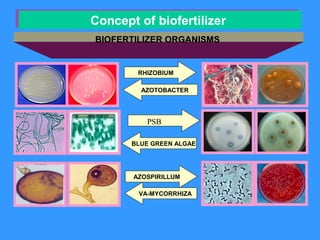
BIOFERTILIZER ORGANISMS
Concept of biofertilizerConcept of biofertilizer
RHIZOBIUM
AZOSPIRILLUM
VA-MYCORRHIZA
BLUE GREEN ALGAE
AZOTOBACTER
PSB
Role of Bio-Fertilizer in Organic AgricultureRole of Bio-Fertilizer in Organic Agriculture
 Conventional fertilizers contain compost; household wastes and
green manure. Those are not as effective as chemical fertilizers.
So, farmers often try to use chemical fertilizers in the field for
crop development.
But obviously the chemical fertilizers are not environment
friendly. They are responsible for water, air and soil pollution and
can spread cancer causing agents. Moreover, they may destroy the
fertility of the soil in a long run.
Scientists have developed Biofertilizers to prevent pollution and
to make this world healthy for everybody in a natural way.
Role of Bio-Fertilizer in Organic AgricultureRole of Bio-Fertilizer in Organic Agriculture
Bio-fertilizer contains microorganisms which promote the
adequate supply of nutrients to the host plants and ensure their
proper development of growth and regulation in their physiology.
 Living microorganisms are used in the preparation of bio-
fertilizers. Only those microorganisms are used which have
specific functions to enhance plant growth and reproduction.
There are different types of microorganisms which are used in
the bio-fertilizers.
Bio-fertilizer being essential components of Organic farming
play vital role in maintaining long term soil fertility and
sustainability.
Promoting Bio-fertilizers in Indian AgriculturePromoting Bio-fertilizers in Indian Agriculture
 The green revolution brought impressive gains in food production
but with insufficient concern for sustainability.
In India the availability and affordability of fossil fuel based
chemical fertilizers at the farm level have been ensured only through
imports and subsidies.
 Dependence on chemical fertilizers for future agricultural growth
would mean further loss in soil quality, possibilities of water
contamination and unsustainable burden on the fiscal system.
The Government of India has been trying to promote an improved
practice involving use of bio- fertilizers along with fertilizers.
Promoting Bio-fertilizers in Indian AgriculturePromoting Bio-fertilizers in Indian Agriculture
These inputs have multiple beneficial impacts on the soil and can
be relatively cheap and convenient for use.
Consistent with current outlook, the government aims not only to
encourage their use in agriculture but also to promote private
initiative and commercial viability of production.
Considering the social benefits promised the government has
ample grounds to intervene to set up an effective market for the new
product while encouraging private players.
But the policy and the instruments of intervention need to be
designed with care.
WE SUM UP THAT…….WE SUM UP THAT…….
Biofertilizers have important environmental and long-term
implications, negating the adverse effects of chemicals.
At the farm level, the gains from increased use of then
technology can spill over to other farms and sectors through
lesser water pollution than chemical fertilizers and even to an
extent organic manures can create.
It is a good practice to promote biofertilizer as an input
conjunctive to other forms of fertilizers, but keeping in view
the protection given to chemicals, there is some ground for
subsidizing the former to encourage their use
Bio fertilizers

Bio fertilizers

  • 2.
    INTRODUCTION Multifarious advantages ofbiofertilizers leads to its wide applicability in sustainable agriculture. Biofertilizer technology is not a new concept. It involves inoculation of beneficial microorganisms that help nutrient acquisition by plants through fixation of nitrogen, solubilization and mobilization of other nutrients.
  • 3.
    The role ofbiofertilizers assumes special significance due to increased cost of chemical fertilizers and their ill effects on soil health Legume root nodulesLegume root nodules Rhizobium bacteria inside nodule Rhizobium bacteria inside nodule Concept of biofertilizerConcept of biofertilizer Biofertilizer concept goes back as early as 300 BC when our ancestors realized the importance of legume crops bearing nodules. The perspective of biofertilizer came into existence through discovery of many organisms capable of nitrogen fixation, P-solubilization, P. mobilization, potash solubilization and micronutrient transformation in the soil.
  • 4.
    The term biofertilizerrefers to preparation containing live microbes which helps in enhancing the soil fertility either by fixing atmospheric nitrogen, solubilization of phosphorus or decomposing organic wastes or by augmenting plant growth by producing growth hormones with their biological activities. Bacteria in root surfaceBacteria in root surface Bacteria in root surfaceBacteria in root surface Legume inoculationLegume inoculationRhizobium BacteriaRhizobium Bacteria Concept of biofertilizerConcept of biofertilizer
  • 5.
    Advantages of Biofertilizers Conceptof biofertilizerConcept of biofertilizer Renewable source of nutrients Sustain soil health Supplement chemical fertilizers. Replace 25-30% chemical fertilizers Increase the grain yields by 10-40%. Decompose plant residues, and stabilize C:N ratio of soil Improve texture, structure and water holding capacity of soil No adverse effect on plant growth and soil fertility. Stimulates plant growth by secreting growth hormones. Secrete fungistatic and antibiotic like substances Solubilize and mobilize nutrients Eco-friendly, non-pollutants and cost effective method
  • 6.
    BIOFERTILIZER ORGANISMS Concept ofbiofertilizerConcept of biofertilizer RHIZOBIUM AZOSPIRILLUM VA-MYCORRHIZA BLUE GREEN ALGAE AZOTOBACTER PSB
  • 7.
    Role of Bio-Fertilizerin Organic AgricultureRole of Bio-Fertilizer in Organic Agriculture  Conventional fertilizers contain compost; household wastes and green manure. Those are not as effective as chemical fertilizers. So, farmers often try to use chemical fertilizers in the field for crop development. But obviously the chemical fertilizers are not environment friendly. They are responsible for water, air and soil pollution and can spread cancer causing agents. Moreover, they may destroy the fertility of the soil in a long run. Scientists have developed Biofertilizers to prevent pollution and to make this world healthy for everybody in a natural way.
  • 8.
    Role of Bio-Fertilizerin Organic AgricultureRole of Bio-Fertilizer in Organic Agriculture Bio-fertilizer contains microorganisms which promote the adequate supply of nutrients to the host plants and ensure their proper development of growth and regulation in their physiology.  Living microorganisms are used in the preparation of bio- fertilizers. Only those microorganisms are used which have specific functions to enhance plant growth and reproduction. There are different types of microorganisms which are used in the bio-fertilizers. Bio-fertilizer being essential components of Organic farming play vital role in maintaining long term soil fertility and sustainability.
  • 9.
    Promoting Bio-fertilizers inIndian AgriculturePromoting Bio-fertilizers in Indian Agriculture  The green revolution brought impressive gains in food production but with insufficient concern for sustainability. In India the availability and affordability of fossil fuel based chemical fertilizers at the farm level have been ensured only through imports and subsidies.  Dependence on chemical fertilizers for future agricultural growth would mean further loss in soil quality, possibilities of water contamination and unsustainable burden on the fiscal system. The Government of India has been trying to promote an improved practice involving use of bio- fertilizers along with fertilizers.
  • 10.
    Promoting Bio-fertilizers inIndian AgriculturePromoting Bio-fertilizers in Indian Agriculture These inputs have multiple beneficial impacts on the soil and can be relatively cheap and convenient for use. Consistent with current outlook, the government aims not only to encourage their use in agriculture but also to promote private initiative and commercial viability of production. Considering the social benefits promised the government has ample grounds to intervene to set up an effective market for the new product while encouraging private players. But the policy and the instruments of intervention need to be designed with care.
  • 11.
    WE SUM UPTHAT…….WE SUM UP THAT……. Biofertilizers have important environmental and long-term implications, negating the adverse effects of chemicals. At the farm level, the gains from increased use of then technology can spill over to other farms and sectors through lesser water pollution than chemical fertilizers and even to an extent organic manures can create. It is a good practice to promote biofertilizer as an input conjunctive to other forms of fertilizers, but keeping in view the protection given to chemicals, there is some ground for subsidizing the former to encourage their use