SUBMITTEDTO
THEGUIDE
DR.S.VISWANATHAN,PH.D
HEADOF THEDEPARTMENT
SRIPARAMAKALYANICOLLEGE
ALWARKURICHI.
SUBMITTEDBY
G.PETCHIAMMAL
REG.NO :20211231516118
II M.SC,MICROBIOLOGY
DATE: 07.10.2022
SRI PARAMAKALYANI COLLEGE
(REACCREDITED WITH A GRADE WITH A+ CGPA OF 3.39 THE III CYCLE BY NACC AFFILIATED TO
MANONMANIAM SUNDARANAR UNIVERSITY,THIRUNELVELI)
ALWARKURICHI - 627 412 ,TAMILNADU INDIA.
POST GRADUATE & RESEARCH CENTER – DEPARTMENT OF
MICROBIOLOGY (GOVERNMENT AIDED)
III SEM - CORE
ENVIRONMENTAL & AGRICULTURAL MICROBIOLOGY
UNIT IV - BIOFERTILIZER - AZOSPIRILLUM
6 CONTENT
① INTRODUCTION
② CHARACTERISTICS OF AZOSPIRILLUM
③ CLASSIFICATION
④ EFFECTS
⑤ PRODUCTION
⑥ MODE OF ACTION
⑦ BENEFITS
⑧ FIELD APPLICATIONS
⑨ REFERENCE
INTRODUCTION
INTRODUCTION
INTRODUCTION
• Azospirillum was First isolated by Beijerinck (1922) in Brazil from the roots of Paspalum and named it as Azotobacter
paspali and later named as Spirillum lipoferum.
• Dobereiner and Day (1976) reported the nitrogen fixing potential of some age grasses due to the activity of S. lipoferum in
their roots.
• Taxonomy was re-examined and Tarrand et al. (1978) designated this organism as Azospirillum.
• An aerobic or micro aerophilic , Gram negative rod.
• Non sporeformer and inhibiting the plant roots both externally and internally.
• Being a micro aerophilic organism, it can be isolated on a semi solid malate medium by enrichment procedures.
• It is used as BIOFERTILIZER.
• Azospirillum fixes nitrogen from 10 to 40 kg/ha.
"Azo" comes from French word , Means "Nitrogen"
Spirillum - shape of bacteria.
• Azospirillum species are Free living in soil & plant-associated diazotrophs
• Association with the roots of cereal crops, grasses and tuber plants.
• subclass of Alphaproteobacteria.
Martinus Willem Beijernick
• Dutch microbiologist & botanist.
• Founder of Environmental microbiology and virology.
• German chemist
• Coined the term " Associative symbiosis".
Johann Wolfgang Dobereiner
Johann Wolfgang Döbereiner
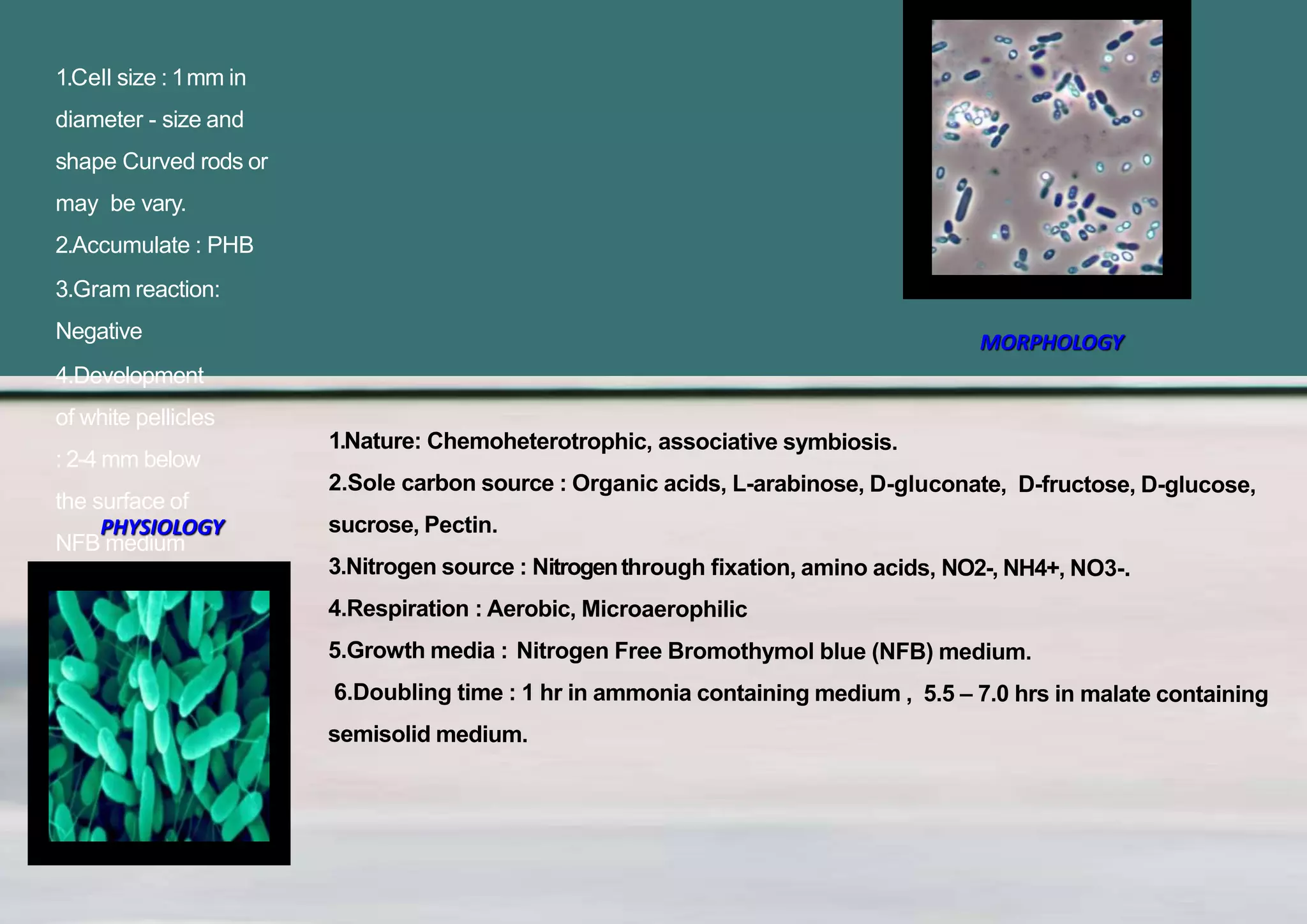
1.Cell size : 1mm in
diameter - size and
shape Curved rods or
may be vary.
2.Accumulate : PHB
3.Gram reaction:
Negative
4.Development
of white pellicles
: 2-4 mm below
the surface of
NFB medium
MORPHOLOGY
PHYSIOLOGY
CLASSIFICATION
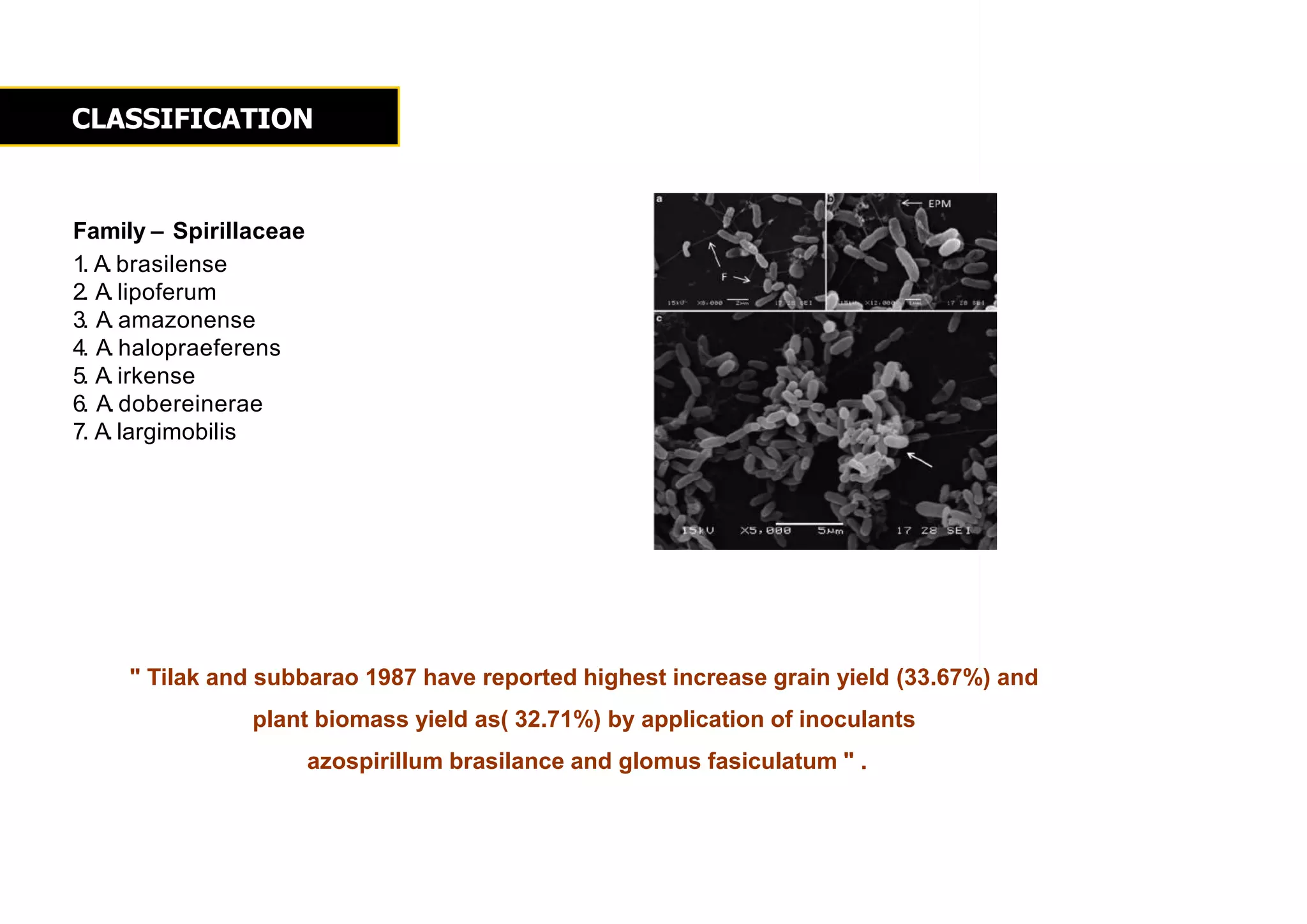
Family – Spirillaceae
1. A. brasilense
2. A. lipoferum
3. A. amazonense
4. A. halopraeferens
5. A. irkense
6. A. dobereinerae
7. A. largimobilis
" Tilak and subbarao 1987 have reported highest increase grain yield (33.67%) and
plant biomass yield as( 32.71%) by application of inoculants
azospirillum brasilance and glomus fasiculatum " .
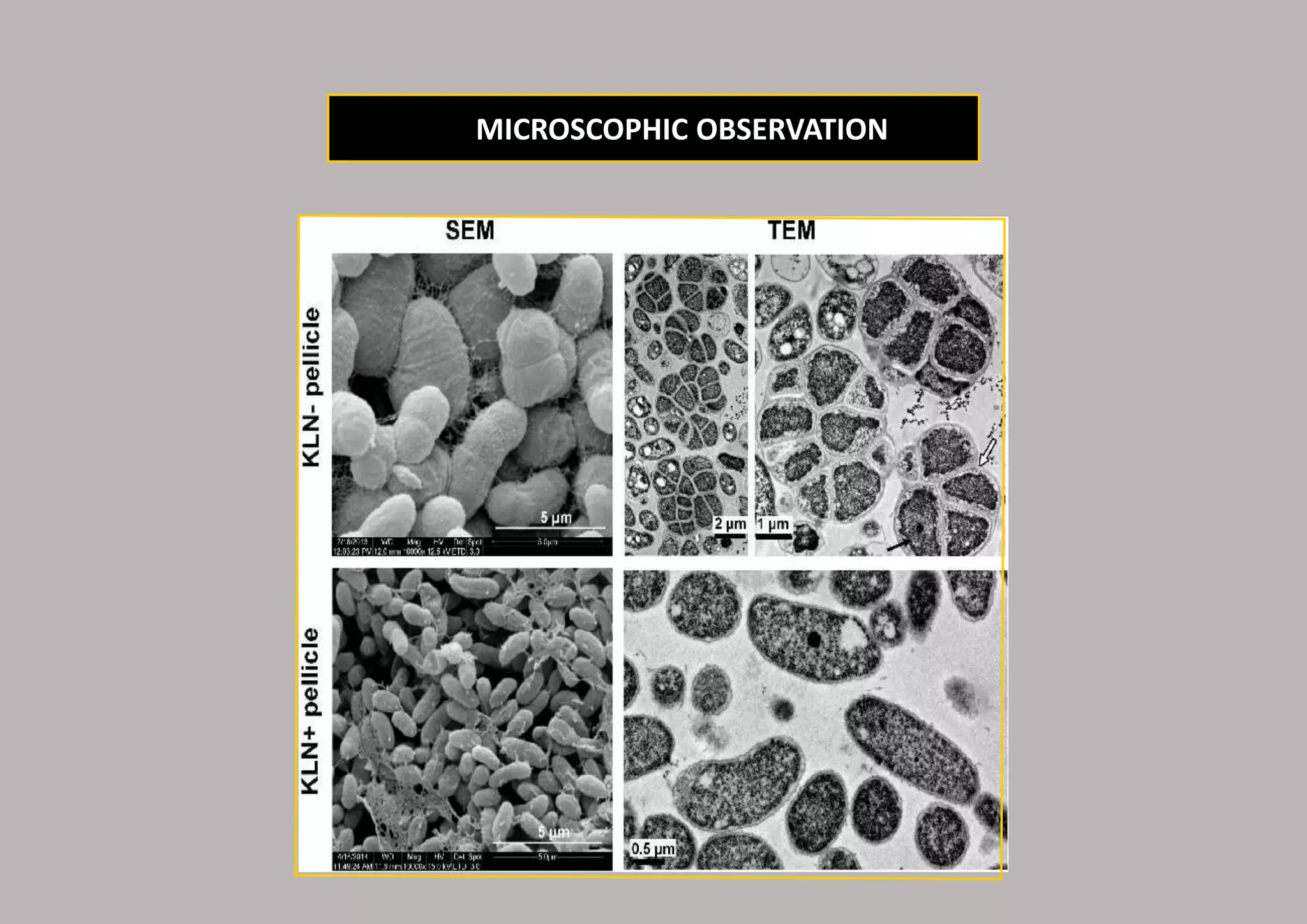
MICROSCOPHIC OBSERVATION
ORGIN AND CHARACTERISTIC
ASOPIRILLUM SPP
ORIGIN AND CHARACTERISTIC OF AZOSPIRILLUM
Seed
EFFECTS OF AZOSPIRILLUM
PRODUCTION
① Isolation of Azospirillum
② Confirmation of Azospirillum
③ Making the starter culture
④ Mass culture
⑤ Carrier based inoculant
ISOLATION OF AZOSPIRILLUM
Pellicle formation in semisolid media
Pure colonies in solid NFB media
Antibiotic resistance against common
antibiotics
RESULT
Figure 1
Figure 2
Figure 3
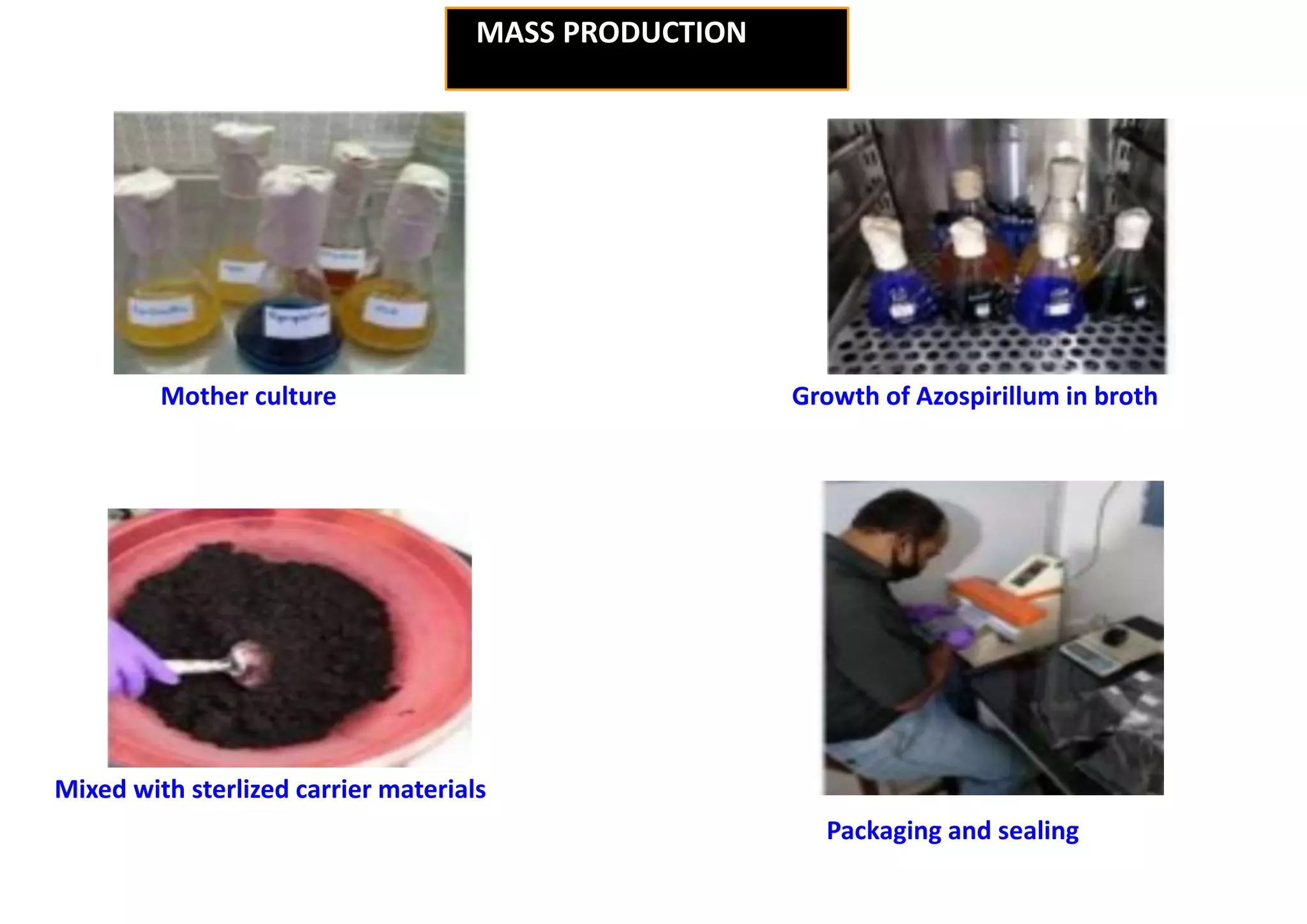
Mother culture
Mixed with sterlized carrier materials
Growth of Azospirillum in broth
Packaging and sealing
MASS PRODUCTION
Why we use NFB Media?
① It is used to isolate diazotrophs.
② Nitrogen fixation by diazotroph bacteria is a H+
consumer process and also ammonia is subsequently
produced, the color of the NFB medium should be
changed from green to blue (due to the presence of
Bromothymol biue pH indicator).
③ The production of yellow color by bacteria in this medium
Indicates a decrease in pH, It indicate ability of nitrogen
fixation.
① Azospirillum Medium with 0.17% Agar is used for cultivation of Azospirillum species.
② Malic acid is used as the carbon source.
③ Azospirillum species grow well in presence of Malic acid and are not overgrown by
other nitrogen fixers.
④ Dipotassium phosphate provides buffering effect and other inorganic salt ingredients
provide necessary growth nutrients.
⑤ Agar at 0.17% concentrations provides microaerophillic conditions necessary for
nitrogen fixation by Azospirillum species.
AZOSPIRILLUM MEDIUM
MODE OF ACTION
The Benefits
① Promotes plant growth.
② Increased mineral and water uptake, root development,
vegetative growth and crop yield.
③ Inoculation reduced the use of chemical fertilizers (20-
50%, 20-40 kg N/ha).
④ Increases cost benefit ratio.
⑤ Reduces pathogen damage.
⑥ Inhibit germination of parasitic weeds.
⑦ Restoration of arid zone, margine mangrove
ecosystem.
⑧ Reduces humic acid toxicity in compost.
⑨ - Recommended for rice, millets, maize, wheat,
sorghum, sugarcane and co-inoculant for legumes..
APPLICATIONS
① Seed treatment
② Soil treatment
③ Root dip treatment
INTRODUCTION
SEED TREATMENT
• In this method 400gm of Azospirillum biofertilizer is suspended in 500mL of water to make slurry
and mixed with 10 -12kg of seed until seeds are uniformly coated.
• The treated seeds are dried in shade and sown immediately.
INTRODUCTION
INTRODUCTION
ROOT DIP TREATMENT
• In transplanted rice, Azospirillum is generally used as root dip treatment.
• In this method a small size bed is prepared in a corner of the paddy field.
• To transplant one bigha of land, 500gm Azospirillum biofertilizer is mixed
with 10-15kg compost and just sufficient quantity of water in the bed.
• Uprooted rice seedlings are dipped in the bed for 8-12 hours before
transplanting.
INTRODUCTION
INTRODUCTION
SOIL TREATMENT
• For soil treatment depending upon the crops the required quantity of biofertilizers
is mixed with compost and broadcast evenly in the field.
• In case of integrated nutrient management (INM), to supplement phosphatic and
potassic fertilizers, phosphate solubilizing bacteria and potash solubilizing bacteria
can be used along with Azospirillum.
CROP APPLICATION
CROP APPLICATION BIOFERTILIZER
REFERENCE
• https://www.sciencedirect.com/science/article/pii/B9780128214060000187
• Text book of ENVIRONMENTAL AND AGRICULTURAL MICROBIOLOGY Author name :
Ragur Tim bhatt, pg.no : 342 -351.
• https://pubmed.ncbi.nlm.nih.gov/10978548/
.
SKILLS
GAINED BY
SEMINAR
Communication
skill
Confidence level
Innovative skills
Gained subject
knowledge
presentation
skil
THANKS TO
THE RESPECTED CHAIRMAN ,
THE RESPECTED SECRETARY,
THE RESPECTED PRINCIPAL ,
THE HEAD OF THE DEPARTMENT - DEPARTMENT OF
MICROBIOLOGY ,
THE STAFF MEMBERS - DEPARTMENT OF MICROBIOLOGY.

AZOSPIRILLUM

  • 1.
    SUBMITTEDTO THEGUIDE DR.S.VISWANATHAN,PH.D HEADOF THEDEPARTMENT SRIPARAMAKALYANICOLLEGE ALWARKURICHI. SUBMITTEDBY G.PETCHIAMMAL REG.NO :20211231516118 IIM.SC,MICROBIOLOGY DATE: 07.10.2022 SRI PARAMAKALYANI COLLEGE (REACCREDITED WITH A GRADE WITH A+ CGPA OF 3.39 THE III CYCLE BY NACC AFFILIATED TO MANONMANIAM SUNDARANAR UNIVERSITY,THIRUNELVELI) ALWARKURICHI - 627 412 ,TAMILNADU INDIA. POST GRADUATE & RESEARCH CENTER – DEPARTMENT OF MICROBIOLOGY (GOVERNMENT AIDED) III SEM - CORE ENVIRONMENTAL & AGRICULTURAL MICROBIOLOGY UNIT IV - BIOFERTILIZER - AZOSPIRILLUM
  • 2.
    6 CONTENT ① INTRODUCTION ②CHARACTERISTICS OF AZOSPIRILLUM ③ CLASSIFICATION ④ EFFECTS ⑤ PRODUCTION ⑥ MODE OF ACTION ⑦ BENEFITS ⑧ FIELD APPLICATIONS ⑨ REFERENCE
  • 3.
    INTRODUCTION INTRODUCTION INTRODUCTION • Azospirillum wasFirst isolated by Beijerinck (1922) in Brazil from the roots of Paspalum and named it as Azotobacter paspali and later named as Spirillum lipoferum. • Dobereiner and Day (1976) reported the nitrogen fixing potential of some age grasses due to the activity of S. lipoferum in their roots. • Taxonomy was re-examined and Tarrand et al. (1978) designated this organism as Azospirillum. • An aerobic or micro aerophilic , Gram negative rod. • Non sporeformer and inhibiting the plant roots both externally and internally. • Being a micro aerophilic organism, it can be isolated on a semi solid malate medium by enrichment procedures. • It is used as BIOFERTILIZER. • Azospirillum fixes nitrogen from 10 to 40 kg/ha. "Azo" comes from French word , Means "Nitrogen" Spirillum - shape of bacteria. • Azospirillum species are Free living in soil & plant-associated diazotrophs • Association with the roots of cereal crops, grasses and tuber plants. • subclass of Alphaproteobacteria.
  • 4.
    Martinus Willem Beijernick •Dutch microbiologist & botanist. • Founder of Environmental microbiology and virology. • German chemist • Coined the term " Associative symbiosis". Johann Wolfgang Dobereiner Johann Wolfgang Döbereiner
  • 5.
    1.Cell size :1mm in diameter - size and shape Curved rods or may be vary. 2.Accumulate : PHB 3.Gram reaction: Negative 4.Development of white pellicles : 2-4 mm below the surface of NFB medium MORPHOLOGY PHYSIOLOGY
  • 6.
    CLASSIFICATION Family – Spirillaceae 1.A. brasilense 2. A. lipoferum 3. A. amazonense 4. A. halopraeferens 5. A. irkense 6. A. dobereinerae 7. A. largimobilis " Tilak and subbarao 1987 have reported highest increase grain yield (33.67%) and plant biomass yield as( 32.71%) by application of inoculants azospirillum brasilance and glomus fasiculatum " .
  • 7.
  • 8.
    ORGIN AND CHARACTERISTIC ASOPIRILLUMSPP ORIGIN AND CHARACTERISTIC OF AZOSPIRILLUM
  • 9.
  • 10.
    PRODUCTION ① Isolation ofAzospirillum ② Confirmation of Azospirillum ③ Making the starter culture ④ Mass culture ⑤ Carrier based inoculant
  • 11.
  • 13.
    Pellicle formation insemisolid media Pure colonies in solid NFB media Antibiotic resistance against common antibiotics RESULT Figure 1 Figure 2 Figure 3
  • 14.
    Mother culture Mixed withsterlized carrier materials Growth of Azospirillum in broth Packaging and sealing MASS PRODUCTION
  • 15.
    Why we useNFB Media? ① It is used to isolate diazotrophs. ② Nitrogen fixation by diazotroph bacteria is a H+ consumer process and also ammonia is subsequently produced, the color of the NFB medium should be changed from green to blue (due to the presence of Bromothymol biue pH indicator). ③ The production of yellow color by bacteria in this medium Indicates a decrease in pH, It indicate ability of nitrogen fixation.
  • 16.
    ① Azospirillum Mediumwith 0.17% Agar is used for cultivation of Azospirillum species. ② Malic acid is used as the carbon source. ③ Azospirillum species grow well in presence of Malic acid and are not overgrown by other nitrogen fixers. ④ Dipotassium phosphate provides buffering effect and other inorganic salt ingredients provide necessary growth nutrients. ⑤ Agar at 0.17% concentrations provides microaerophillic conditions necessary for nitrogen fixation by Azospirillum species. AZOSPIRILLUM MEDIUM
  • 17.
  • 18.
    The Benefits ① Promotesplant growth. ② Increased mineral and water uptake, root development, vegetative growth and crop yield. ③ Inoculation reduced the use of chemical fertilizers (20- 50%, 20-40 kg N/ha). ④ Increases cost benefit ratio. ⑤ Reduces pathogen damage. ⑥ Inhibit germination of parasitic weeds. ⑦ Restoration of arid zone, margine mangrove ecosystem. ⑧ Reduces humic acid toxicity in compost. ⑨ - Recommended for rice, millets, maize, wheat, sorghum, sugarcane and co-inoculant for legumes..
  • 19.
    APPLICATIONS ① Seed treatment ②Soil treatment ③ Root dip treatment
  • 20.
    INTRODUCTION SEED TREATMENT • Inthis method 400gm of Azospirillum biofertilizer is suspended in 500mL of water to make slurry and mixed with 10 -12kg of seed until seeds are uniformly coated. • The treated seeds are dried in shade and sown immediately.
  • 21.
    INTRODUCTION INTRODUCTION ROOT DIP TREATMENT •In transplanted rice, Azospirillum is generally used as root dip treatment. • In this method a small size bed is prepared in a corner of the paddy field. • To transplant one bigha of land, 500gm Azospirillum biofertilizer is mixed with 10-15kg compost and just sufficient quantity of water in the bed. • Uprooted rice seedlings are dipped in the bed for 8-12 hours before transplanting.
  • 22.
    INTRODUCTION INTRODUCTION SOIL TREATMENT • Forsoil treatment depending upon the crops the required quantity of biofertilizers is mixed with compost and broadcast evenly in the field. • In case of integrated nutrient management (INM), to supplement phosphatic and potassic fertilizers, phosphate solubilizing bacteria and potash solubilizing bacteria can be used along with Azospirillum.
  • 23.
  • 24.
    REFERENCE • https://www.sciencedirect.com/science/article/pii/B9780128214060000187 • Textbook of ENVIRONMENTAL AND AGRICULTURAL MICROBIOLOGY Author name : Ragur Tim bhatt, pg.no : 342 -351. • https://pubmed.ncbi.nlm.nih.gov/10978548/
  • 25.
    . SKILLS GAINED BY SEMINAR Communication skill Confidence level Innovativeskills Gained subject knowledge presentation skil
  • 28.
    THANKS TO THE RESPECTEDCHAIRMAN , THE RESPECTED SECRETARY, THE RESPECTED PRINCIPAL , THE HEAD OF THE DEPARTMENT - DEPARTMENT OF MICROBIOLOGY , THE STAFF MEMBERS - DEPARTMENT OF MICROBIOLOGY.