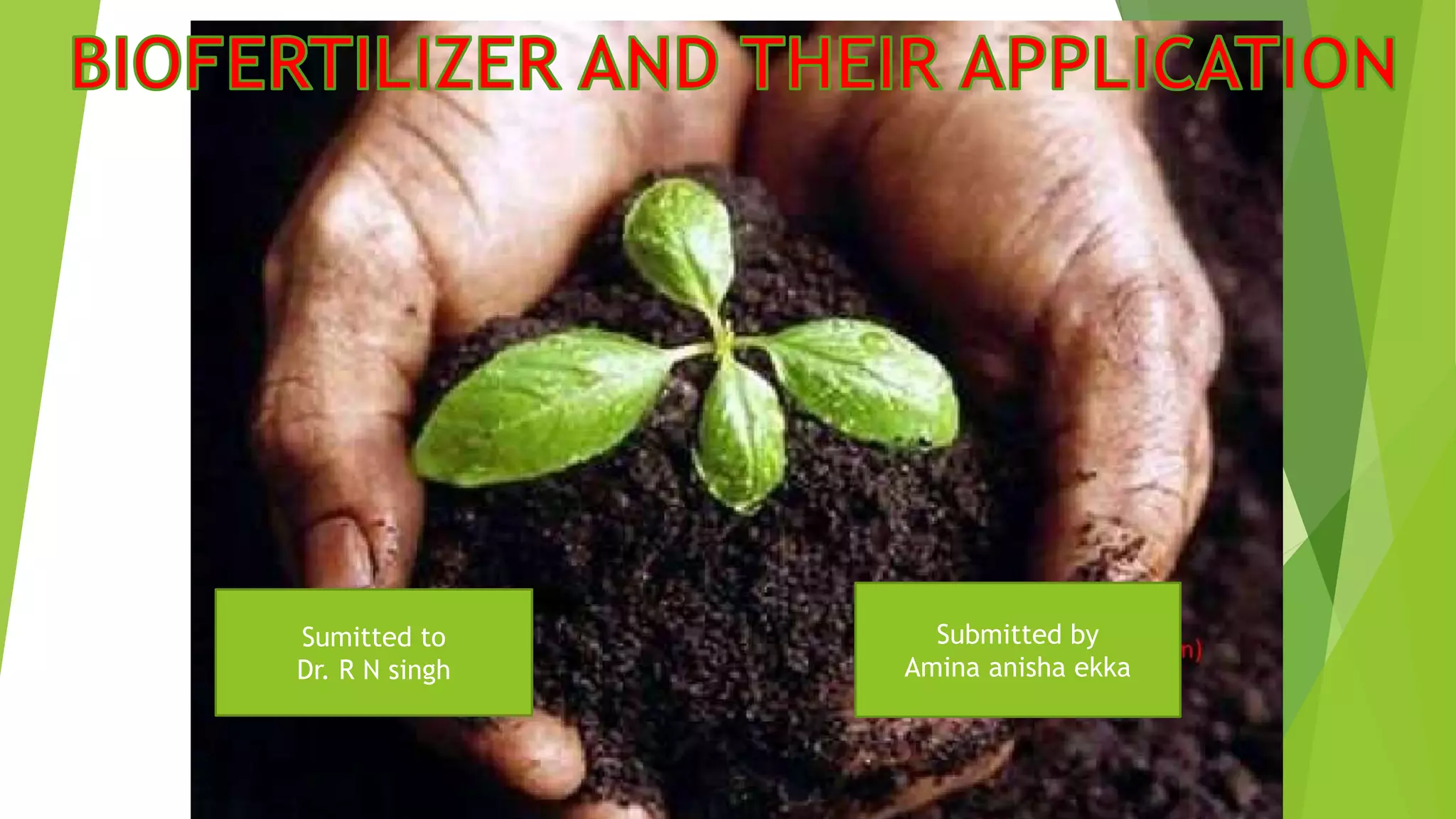
bio
Submitted by
Amina anisha ekka
Sumitted to
Dr. R N singh
INTRODUCTION
 In the last century, chemical fertilizer were used in agriculture. FARMERS
WERE HAPPY OF GETTING INCREASED YIELD IN AGRICULTURE IN THE
BEGINNING.
 But slowly chemical fertilizers started displaying their ill-effects such as:-
 Leaching out
 Polluting water basins
 Destroying micro-organisms and friendly insects
 Making the crop more susceptible to the attack of disease
 Reducing the soil fertility and thus causing irreparable damage to the overall
system.
WHAT IS BIOFERTILIZERS?
Is a large population of a specific or a group of beneficial microorganisms for
enhancing the productivity of soil.
Either by fixing atmospheric nitrogen or by solubilizing soil phosphorus or by
stimulating plant growth through synthesis of growth promoting substance.
Bio fertilizer based on renewable energy sources are cost effective, eco friendly
and can help to economize on the high investment needed for chemical fertilizer.
Types of biofertilizers
Nitrogen
(N2) fixing
Biofertilizers
P Solubilizing
Biofertilizers
P Mobilizing
Biofertilizers
Biofertilizers
for
micronutrients
Plant growth
promoting
Rhizobacteria
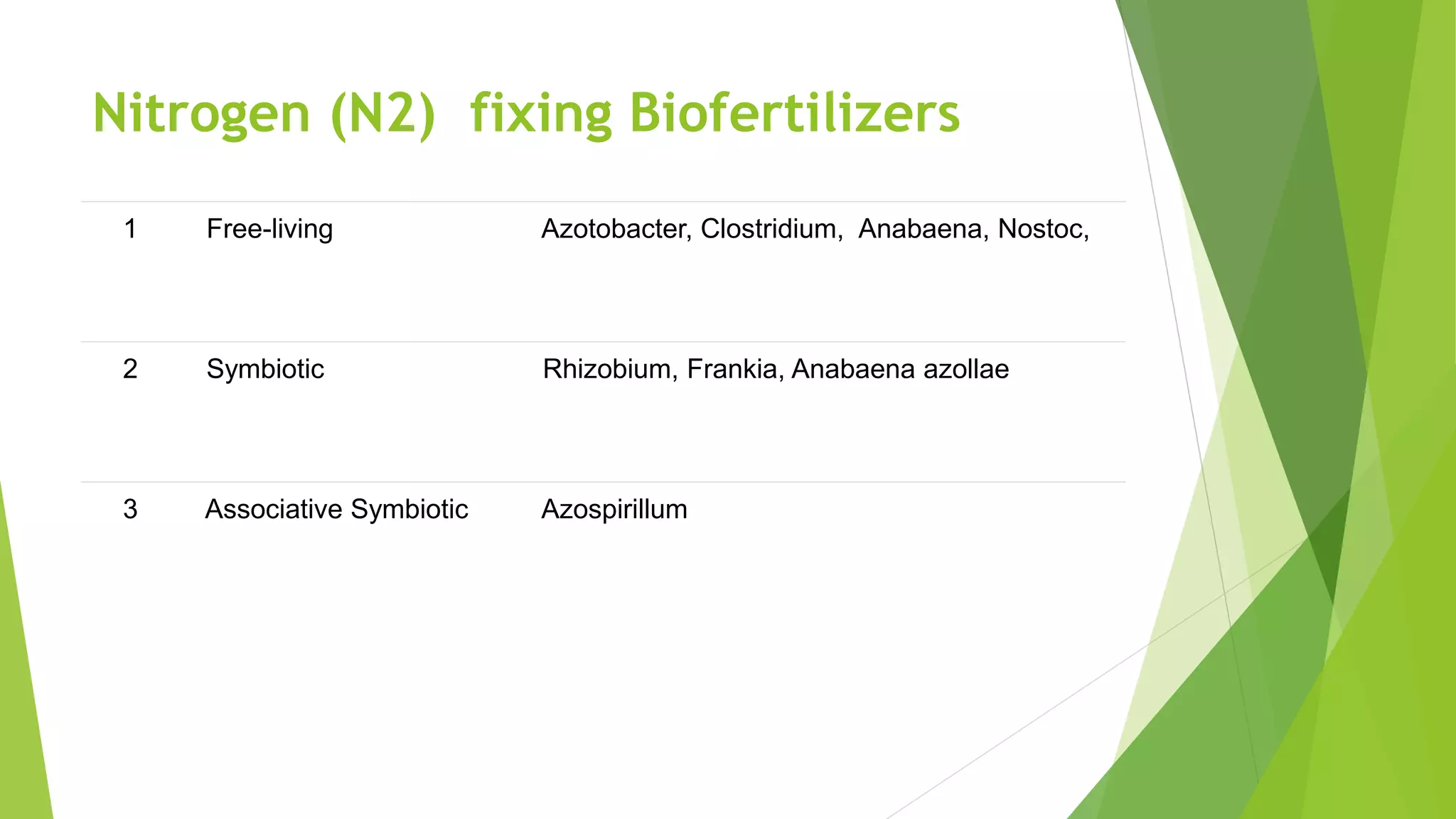
Nitrogen (N2) fixing Biofertilizers
1 Free-living Azotobacter, Clostridium, Anabaena, Nostoc,
2 Symbiotic Rhizobium, Frankia, Anabaena azollae
3 Associative Symbiotic Azospirillum
P Solubilizing Biofertilizers
1 Bacteria Bacillus megaterium var.
phosphaticum
Bacillus circulans,
Pseudomonas striata
2 Fungi Penicillium sp, Aspergillus
awamori
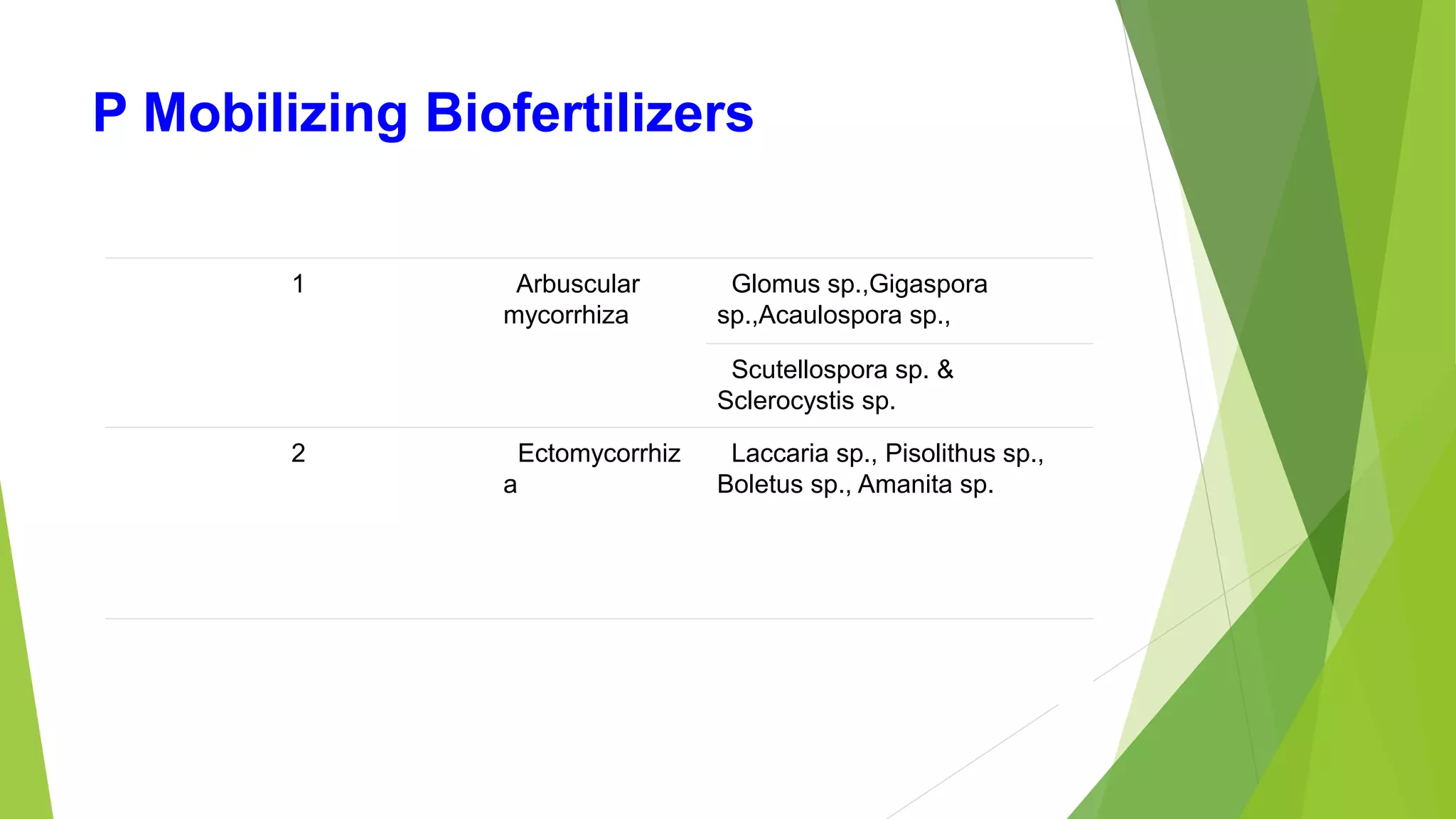
P Mobilizing Biofertilizers
1 Arbuscular
mycorrhiza
Glomus sp.,Gigaspora
sp.,Acaulospora sp.,
Scutellospora sp. &
Sclerocystis sp.
2 Ectomycorrhiz
a
Laccaria sp., Pisolithus sp.,
Boletus sp., Amanita sp.
Biofertilizers for Micro nutrients
Silicate and zinc solubilizers Bacillus
Plant growth promoting Rhizobacteria
Pseudomonas Pseudomonas fluorenscens
BIOFERTILIZER ORGANISMS
RHIZOBIUM
AZOSPIRILLUM
VA-MYCORRHIZA
BLUE GREEN ALGAE
AZOTOBACTER
PSB
NITROGEN FIXING BIOFERTIIZERS
SYMBIOTIC:-Rhizobium
This belongs to bacterial group and the classical example is
symbiotic nitrogen fixation. The bacteria infect the legume root
and form root nodules within which they reduce molecular
nitrogen to ammonia which is reality utilized by the plant to
produce valuable proteins, and other nitrogen containing
compounds. The site of symbiosis is within the root nodules. It
has been estimated that 40-250 kg N / ha / year .
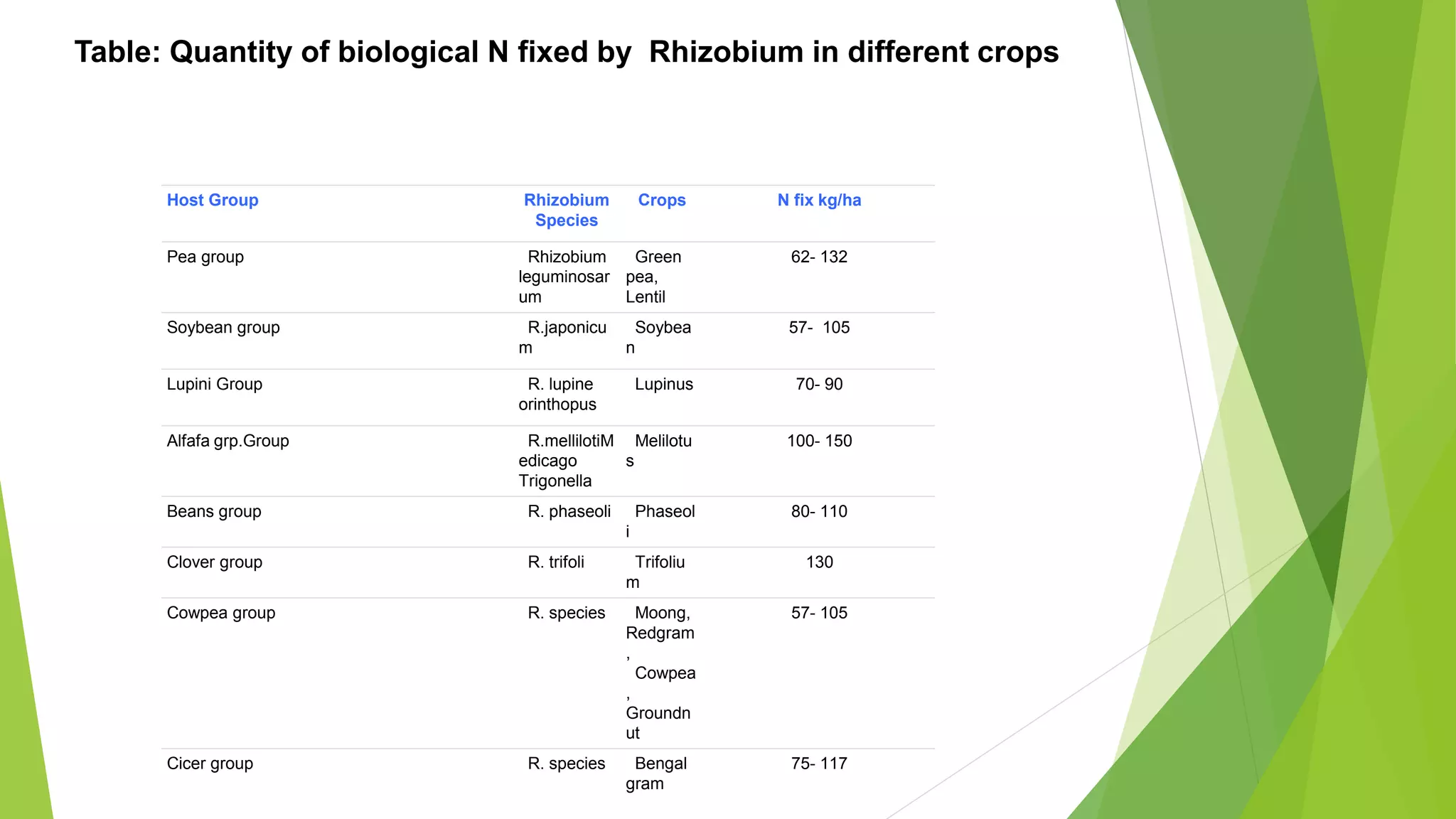
Host Group Rhizobium
Species
Crops N fix kg/ha
Pea group Rhizobium
leguminosar
um
Green
pea,
Lentil
62- 132
Soybean group R.japonicu
m
Soybea
n
57- 105
Lupini Group R. lupine
orinthopus
Lupinus 70- 90
Alfafa grp.Group R.mellilotiM
edicago
Trigonella
Melilotu
s
100- 150
Beans group R. phaseoli Phaseol
i
80- 110
Clover group R. trifoli Trifoliu
m
130
Cowpea group R. species Moong,
Redgram
,
Cowpea
,
Groundn
ut
57- 105
Cicer group R. species Bengal
gram
75- 117
Table: Quantity of biological N fixed by Rhizobium in different crops
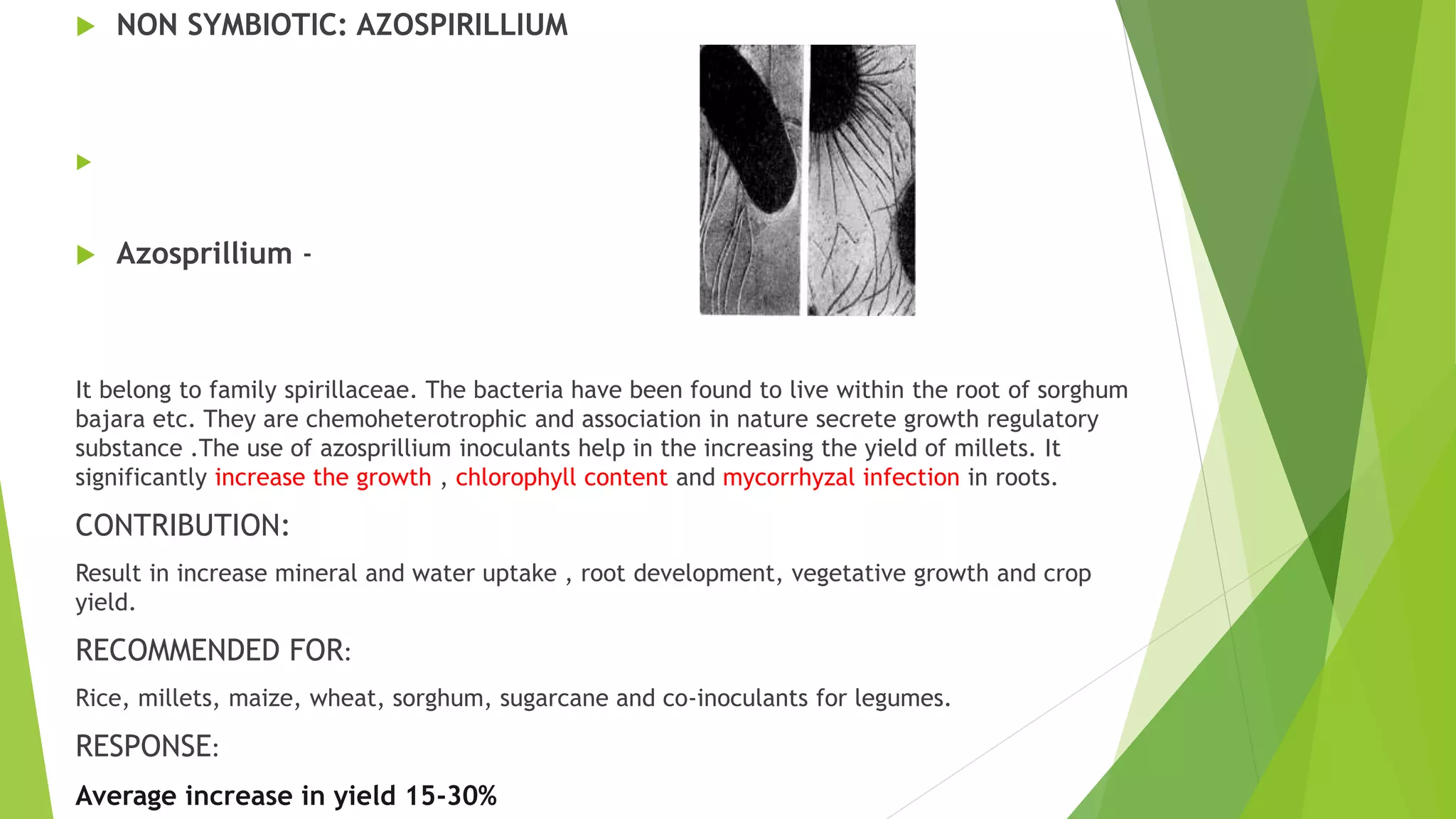
 NON SYMBIOTIC: AZOSPIRILLIUM

 Azosprillium -
It belong to family spirillaceae. The bacteria have been found to live within the root of sorghum
bajara etc. They are chemoheterotrophic and association in nature secrete growth regulatory
substance .The use of azosprillium inoculants help in the increasing the yield of millets. It
significantly increase the growth , chlorophyll content and mycorrhyzal infection in roots.
CONTRIBUTION:
Result in increase mineral and water uptake , root development, vegetative growth and crop
yield.
RECOMMENDED FOR:
Rice, millets, maize, wheat, sorghum, sugarcane and co-inoculants for legumes.
RESPONSE:
Average increase in yield 15-30%
AZOTOBACTER
 It belongs to azotobacteraceae . It produce growth promoting substance
which improve seed germination and growth of extended root system. It
produces polysaccharides which improve soil aggregation. Azotobacter
suppresses the growth of saprophytic and pathogenic. Micro organism near the
root system of crop plants.
 CONTRIBUTION:
 Production of growth promoting substance like vitamins of B groups,
indoleacetic acid and gibberllin acid.
 Biological control of plant disease by suppressing Aspergillus, Fusarium.
 Recommened for:
 Rice, wheat, millets, other cereals, cotton, vegetable, sunflower, mustard
flower
 INCREASE IN YIELD: 20 to 30%
Azolla -
Azolla is a free floating water fern that floats in water and fixes
atmospheric nitrogen in association with nitrogen fixing blue green
alga Anabaenaazollae. Azolla founds consist of sporophyte with a
floating rhizome and small overlapping bi-lobed leaves and roots.
Azolla is considered to be a potential biofertilizer in terms
of nitrogen contribution to rice.
Long before its cultivation as a green manure, Azolla has been used
as a fodder for domesticated animals such as pigs and ducks. In
recent days, Azolla is very much used as a sustainable feed
substitute for livestock especially dairy cattle, poultry, piggery and
fish
Phosphate solubilizing microorganisms (PSM)
AM fungi-
An arbuscular mycorrhiza (AM Fungi) is a type of mycorrhiza in
which the fungus penetrates the cortical cells of the roots of a
vascular plant.
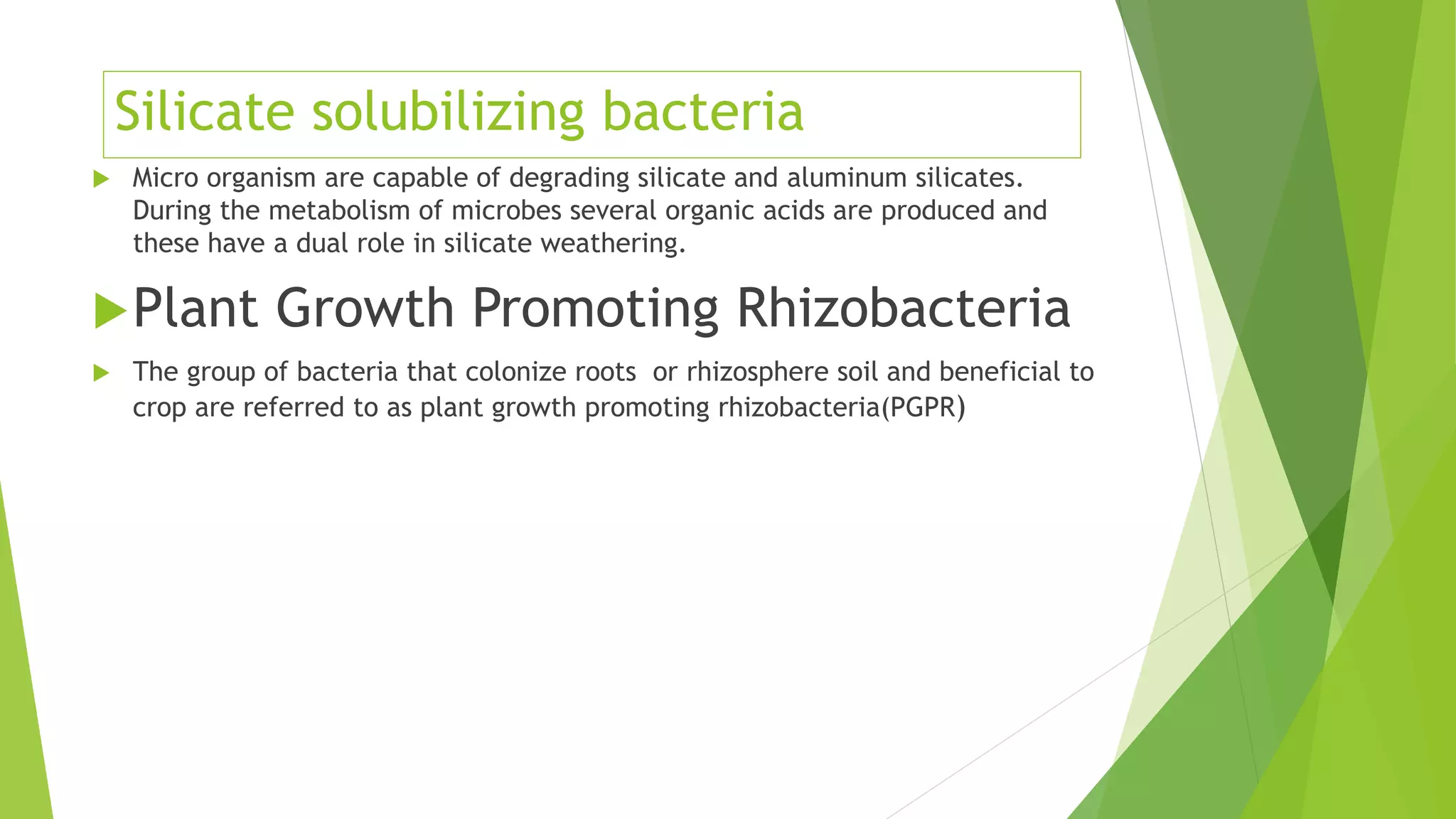
Silicate solubilizing bacteria
 Micro organism are capable of degrading silicate and aluminum silicates.
During the metabolism of microbes several organic acids are produced and
these have a dual role in silicate weathering.
Plant Growth Promoting Rhizobacteria
 The group of bacteria that colonize roots or rhizosphere soil and beneficial to
crop are referred to as plant growth promoting rhizobacteria(PGPR)
Applications of biofertilizers to crop
There are four types of methods for application of bio-fertilizers:
Seed treatment
Set treatment
Seedling treatment
Soil treatment
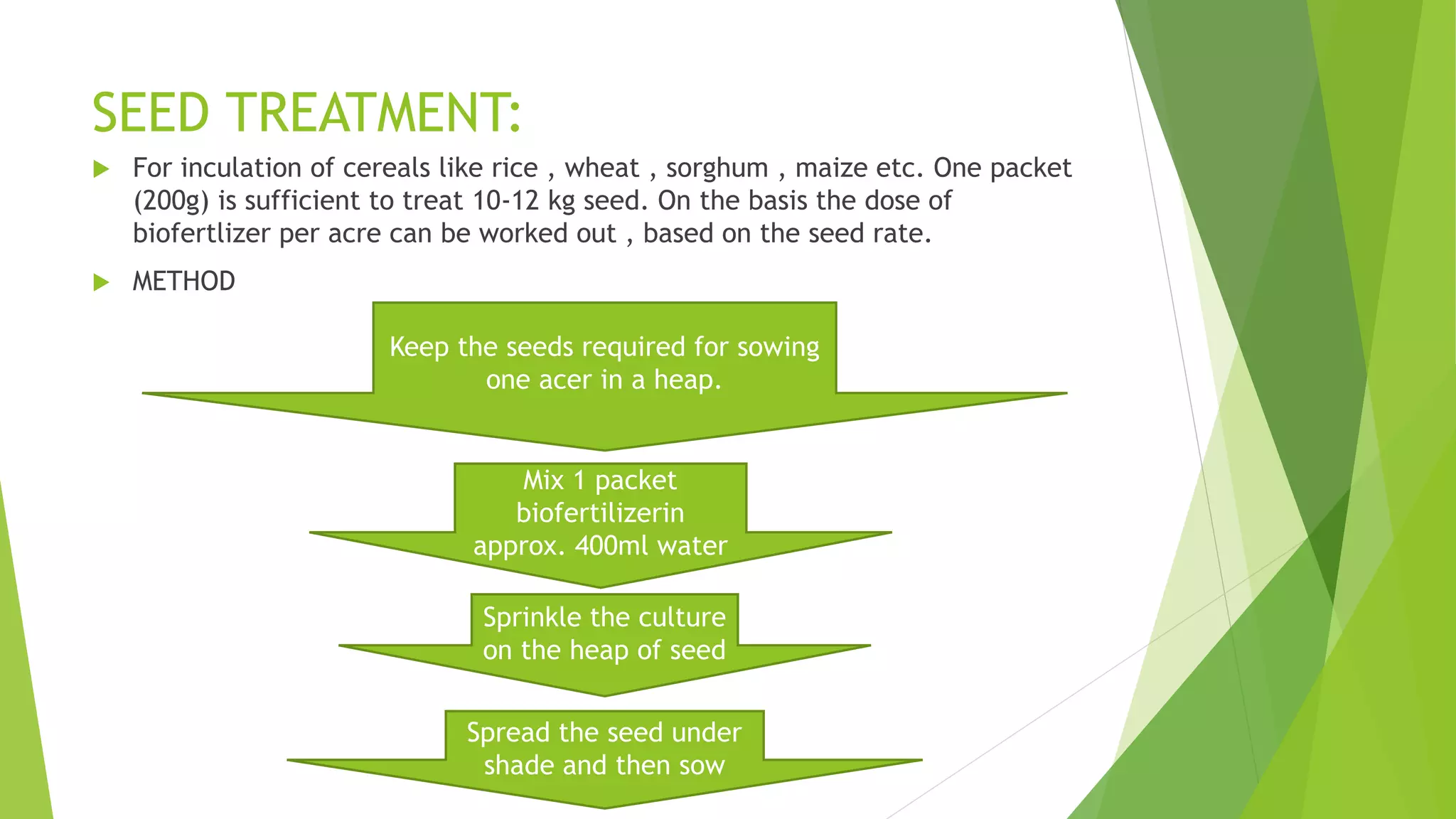
SEED TREATMENT:
 For inculation of cereals like rice , wheat , sorghum , maize etc. One packet
(200g) is sufficient to treat 10-12 kg seed. On the basis the dose of
biofertlizer per acre can be worked out , based on the seed rate.
 METHOD
Keep the seeds required for sowing
one acer in a heap.
Mix 1 packet
biofertilizerin
approx. 400ml water
Sprinkle the culture
on the heap of seed
Spread the seed under
shade and then sow
SET TREATMENT:
This method is recommended generally for treating the sets of
sugarcane , cut pieces of potato and banana suckers
 Method
Prepare culture
1kg of
biofertilizer +
40-50 l of water
Cut pieces are kept
immersed in the
suspension for 30 min.
Bring out cut pieces
and dry them in
shade for some time
before planting
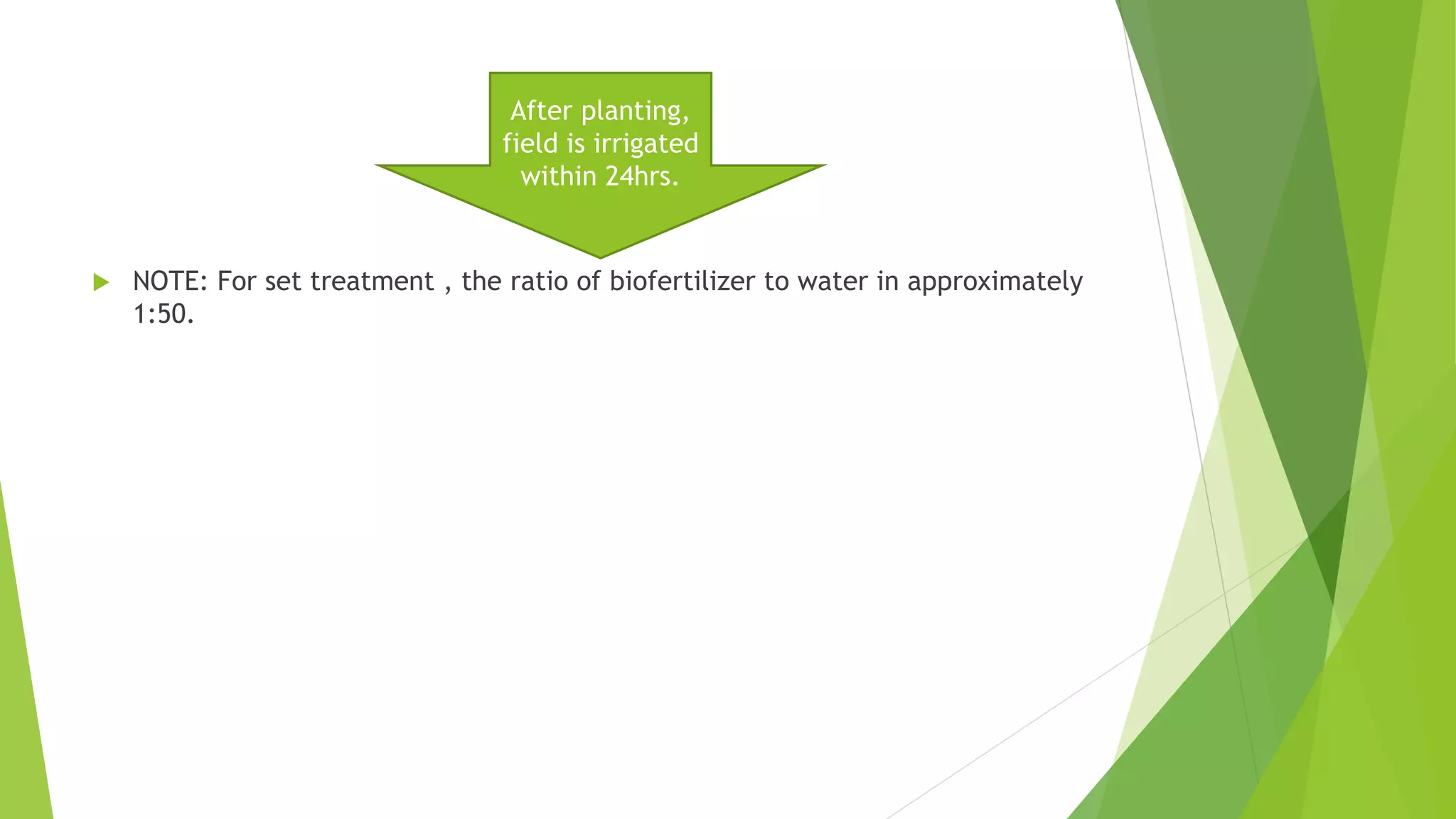
 NOTE: For set treatment , the ratio of biofertilizer to water in approximately
1:50.
After planting,
field is irrigated
within 24hrs.
SEEDLING TREATMENT
This method is recommended for crops like tobacco , tomato , chilly ,
onion etc
 Method
 Note :- the ratio of inoculant and water is 1:10 i.e. 1 kg , biofertilizer in 10
l of water.
1kg
biofertilizer
+ 10-15 l of
water
Make small
bundles of
seedling
Dip the root
portion for 15-
30 min and
transplant
immidiately
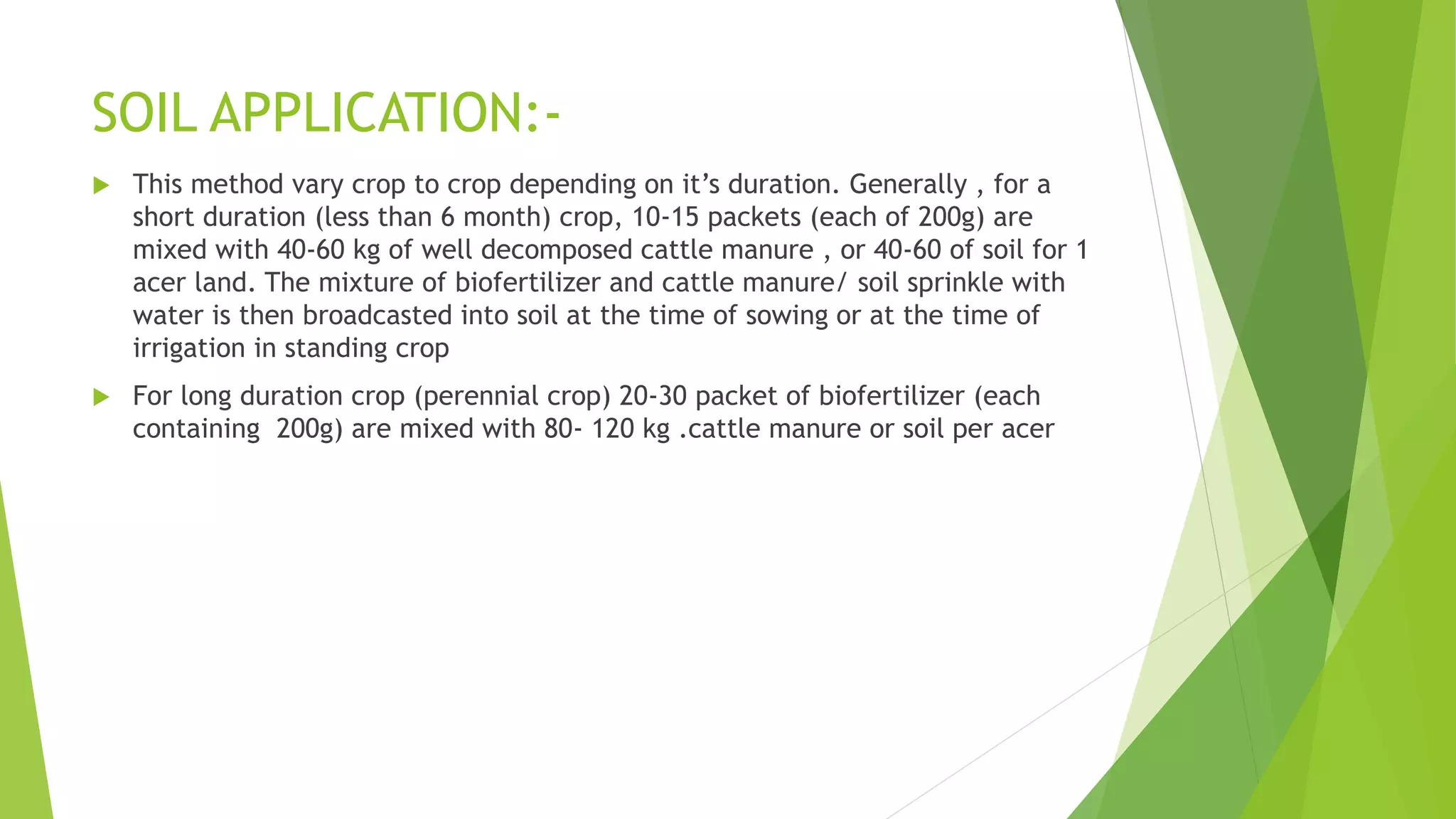
SOIL APPLICATION:-
 This method vary crop to crop depending on it’s duration. Generally , for a
short duration (less than 6 month) crop, 10-15 packets (each of 200g) are
mixed with 40-60 kg of well decomposed cattle manure , or 40-60 of soil for 1
acer land. The mixture of biofertilizer and cattle manure/ soil sprinkle with
water is then broadcasted into soil at the time of sowing or at the time of
irrigation in standing crop
 For long duration crop (perennial crop) 20-30 packet of biofertilizer (each
containing 200g) are mixed with 80- 120 kg .cattle manure or soil per acer
Summary of methods
S.no.soil CROPS METHOD OF
APPLICATION
DOSE/PACKET
S/ACRE
WATER RATIO BF
WATER
1 All crops sown
through seeds
SEED
APPLICATION
200 400 ml 1:2
2 Sets of
sugarcane,
banana etc
SET
APPLICATION
1-2 KG 50 or 100l 1:50
3 Rice, tomato
chilly,
cabbageetc
SEEDLING
METHOD
1KG 1OL 1:10
4 All crops SOIL
APPLICATION
2KG FOR WETTING ***
BENEFITS FROM USING BIO FERTILIZERS
 Increase crop yields by 20-30%.
 Replace chemical nitrogen and phosphorus by 25%
 Stimulate plant growth.
 Activate the soil biologically.
 Restore natural soil fertility
Cost effective.
Supplements to fertilizers.
Eco-friendly.
Reduces the costs towards fertilizers use, especially regarding nitrogen and
phosphorus.
REFERENCE:-
 WWW.krishisewa.com
 Soil Microbiology : N.S.Subba Rao
bio fertilizer and their application

bio fertilizer and their application

  • 1.
    bio Submitted by Amina anishaekka Sumitted to Dr. R N singh
  • 2.
    INTRODUCTION  In thelast century, chemical fertilizer were used in agriculture. FARMERS WERE HAPPY OF GETTING INCREASED YIELD IN AGRICULTURE IN THE BEGINNING.  But slowly chemical fertilizers started displaying their ill-effects such as:-  Leaching out  Polluting water basins  Destroying micro-organisms and friendly insects  Making the crop more susceptible to the attack of disease  Reducing the soil fertility and thus causing irreparable damage to the overall system.
  • 4.
    WHAT IS BIOFERTILIZERS? Isa large population of a specific or a group of beneficial microorganisms for enhancing the productivity of soil. Either by fixing atmospheric nitrogen or by solubilizing soil phosphorus or by stimulating plant growth through synthesis of growth promoting substance. Bio fertilizer based on renewable energy sources are cost effective, eco friendly and can help to economize on the high investment needed for chemical fertilizer.
  • 5.
    Types of biofertilizers Nitrogen (N2)fixing Biofertilizers P Solubilizing Biofertilizers P Mobilizing Biofertilizers Biofertilizers for micronutrients Plant growth promoting Rhizobacteria
  • 6.
    Nitrogen (N2) fixingBiofertilizers 1 Free-living Azotobacter, Clostridium, Anabaena, Nostoc, 2 Symbiotic Rhizobium, Frankia, Anabaena azollae 3 Associative Symbiotic Azospirillum
  • 7.
    P Solubilizing Biofertilizers 1Bacteria Bacillus megaterium var. phosphaticum Bacillus circulans, Pseudomonas striata 2 Fungi Penicillium sp, Aspergillus awamori
  • 8.
    P Mobilizing Biofertilizers 1Arbuscular mycorrhiza Glomus sp.,Gigaspora sp.,Acaulospora sp., Scutellospora sp. & Sclerocystis sp. 2 Ectomycorrhiz a Laccaria sp., Pisolithus sp., Boletus sp., Amanita sp.
  • 9.
    Biofertilizers for Micronutrients Silicate and zinc solubilizers Bacillus
  • 10.
    Plant growth promotingRhizobacteria Pseudomonas Pseudomonas fluorenscens
  • 11.
  • 12.
    NITROGEN FIXING BIOFERTIIZERS SYMBIOTIC:-Rhizobium Thisbelongs to bacterial group and the classical example is symbiotic nitrogen fixation. The bacteria infect the legume root and form root nodules within which they reduce molecular nitrogen to ammonia which is reality utilized by the plant to produce valuable proteins, and other nitrogen containing compounds. The site of symbiosis is within the root nodules. It has been estimated that 40-250 kg N / ha / year .
  • 13.
    Host Group Rhizobium Species CropsN fix kg/ha Pea group Rhizobium leguminosar um Green pea, Lentil 62- 132 Soybean group R.japonicu m Soybea n 57- 105 Lupini Group R. lupine orinthopus Lupinus 70- 90 Alfafa grp.Group R.mellilotiM edicago Trigonella Melilotu s 100- 150 Beans group R. phaseoli Phaseol i 80- 110 Clover group R. trifoli Trifoliu m 130 Cowpea group R. species Moong, Redgram , Cowpea , Groundn ut 57- 105 Cicer group R. species Bengal gram 75- 117 Table: Quantity of biological N fixed by Rhizobium in different crops
  • 14.
     NON SYMBIOTIC:AZOSPIRILLIUM   Azosprillium - It belong to family spirillaceae. The bacteria have been found to live within the root of sorghum bajara etc. They are chemoheterotrophic and association in nature secrete growth regulatory substance .The use of azosprillium inoculants help in the increasing the yield of millets. It significantly increase the growth , chlorophyll content and mycorrhyzal infection in roots. CONTRIBUTION: Result in increase mineral and water uptake , root development, vegetative growth and crop yield. RECOMMENDED FOR: Rice, millets, maize, wheat, sorghum, sugarcane and co-inoculants for legumes. RESPONSE: Average increase in yield 15-30%
  • 15.
    AZOTOBACTER  It belongsto azotobacteraceae . It produce growth promoting substance which improve seed germination and growth of extended root system. It produces polysaccharides which improve soil aggregation. Azotobacter suppresses the growth of saprophytic and pathogenic. Micro organism near the root system of crop plants.  CONTRIBUTION:  Production of growth promoting substance like vitamins of B groups, indoleacetic acid and gibberllin acid.  Biological control of plant disease by suppressing Aspergillus, Fusarium.  Recommened for:  Rice, wheat, millets, other cereals, cotton, vegetable, sunflower, mustard flower  INCREASE IN YIELD: 20 to 30%
  • 16.
    Azolla - Azolla isa free floating water fern that floats in water and fixes atmospheric nitrogen in association with nitrogen fixing blue green alga Anabaenaazollae. Azolla founds consist of sporophyte with a floating rhizome and small overlapping bi-lobed leaves and roots. Azolla is considered to be a potential biofertilizer in terms of nitrogen contribution to rice. Long before its cultivation as a green manure, Azolla has been used as a fodder for domesticated animals such as pigs and ducks. In recent days, Azolla is very much used as a sustainable feed substitute for livestock especially dairy cattle, poultry, piggery and fish Phosphate solubilizing microorganisms (PSM) AM fungi- An arbuscular mycorrhiza (AM Fungi) is a type of mycorrhiza in which the fungus penetrates the cortical cells of the roots of a vascular plant.
  • 17.
    Silicate solubilizing bacteria Micro organism are capable of degrading silicate and aluminum silicates. During the metabolism of microbes several organic acids are produced and these have a dual role in silicate weathering. Plant Growth Promoting Rhizobacteria  The group of bacteria that colonize roots or rhizosphere soil and beneficial to crop are referred to as plant growth promoting rhizobacteria(PGPR)
  • 18.
    Applications of biofertilizersto crop There are four types of methods for application of bio-fertilizers: Seed treatment Set treatment Seedling treatment Soil treatment
  • 19.
    SEED TREATMENT:  Forinculation of cereals like rice , wheat , sorghum , maize etc. One packet (200g) is sufficient to treat 10-12 kg seed. On the basis the dose of biofertlizer per acre can be worked out , based on the seed rate.  METHOD Keep the seeds required for sowing one acer in a heap. Mix 1 packet biofertilizerin approx. 400ml water Sprinkle the culture on the heap of seed Spread the seed under shade and then sow
  • 20.
    SET TREATMENT: This methodis recommended generally for treating the sets of sugarcane , cut pieces of potato and banana suckers  Method Prepare culture 1kg of biofertilizer + 40-50 l of water Cut pieces are kept immersed in the suspension for 30 min. Bring out cut pieces and dry them in shade for some time before planting
  • 21.
     NOTE: Forset treatment , the ratio of biofertilizer to water in approximately 1:50. After planting, field is irrigated within 24hrs.
  • 22.
    SEEDLING TREATMENT This methodis recommended for crops like tobacco , tomato , chilly , onion etc  Method  Note :- the ratio of inoculant and water is 1:10 i.e. 1 kg , biofertilizer in 10 l of water. 1kg biofertilizer + 10-15 l of water Make small bundles of seedling Dip the root portion for 15- 30 min and transplant immidiately
  • 23.
    SOIL APPLICATION:-  Thismethod vary crop to crop depending on it’s duration. Generally , for a short duration (less than 6 month) crop, 10-15 packets (each of 200g) are mixed with 40-60 kg of well decomposed cattle manure , or 40-60 of soil for 1 acer land. The mixture of biofertilizer and cattle manure/ soil sprinkle with water is then broadcasted into soil at the time of sowing or at the time of irrigation in standing crop  For long duration crop (perennial crop) 20-30 packet of biofertilizer (each containing 200g) are mixed with 80- 120 kg .cattle manure or soil per acer
  • 24.
    Summary of methods S.no.soilCROPS METHOD OF APPLICATION DOSE/PACKET S/ACRE WATER RATIO BF WATER 1 All crops sown through seeds SEED APPLICATION 200 400 ml 1:2 2 Sets of sugarcane, banana etc SET APPLICATION 1-2 KG 50 or 100l 1:50 3 Rice, tomato chilly, cabbageetc SEEDLING METHOD 1KG 1OL 1:10 4 All crops SOIL APPLICATION 2KG FOR WETTING ***
  • 25.
    BENEFITS FROM USINGBIO FERTILIZERS  Increase crop yields by 20-30%.  Replace chemical nitrogen and phosphorus by 25%  Stimulate plant growth.  Activate the soil biologically.  Restore natural soil fertility Cost effective. Supplements to fertilizers. Eco-friendly. Reduces the costs towards fertilizers use, especially regarding nitrogen and phosphorus.
  • 26.
    REFERENCE:-  WWW.krishisewa.com  SoilMicrobiology : N.S.Subba Rao