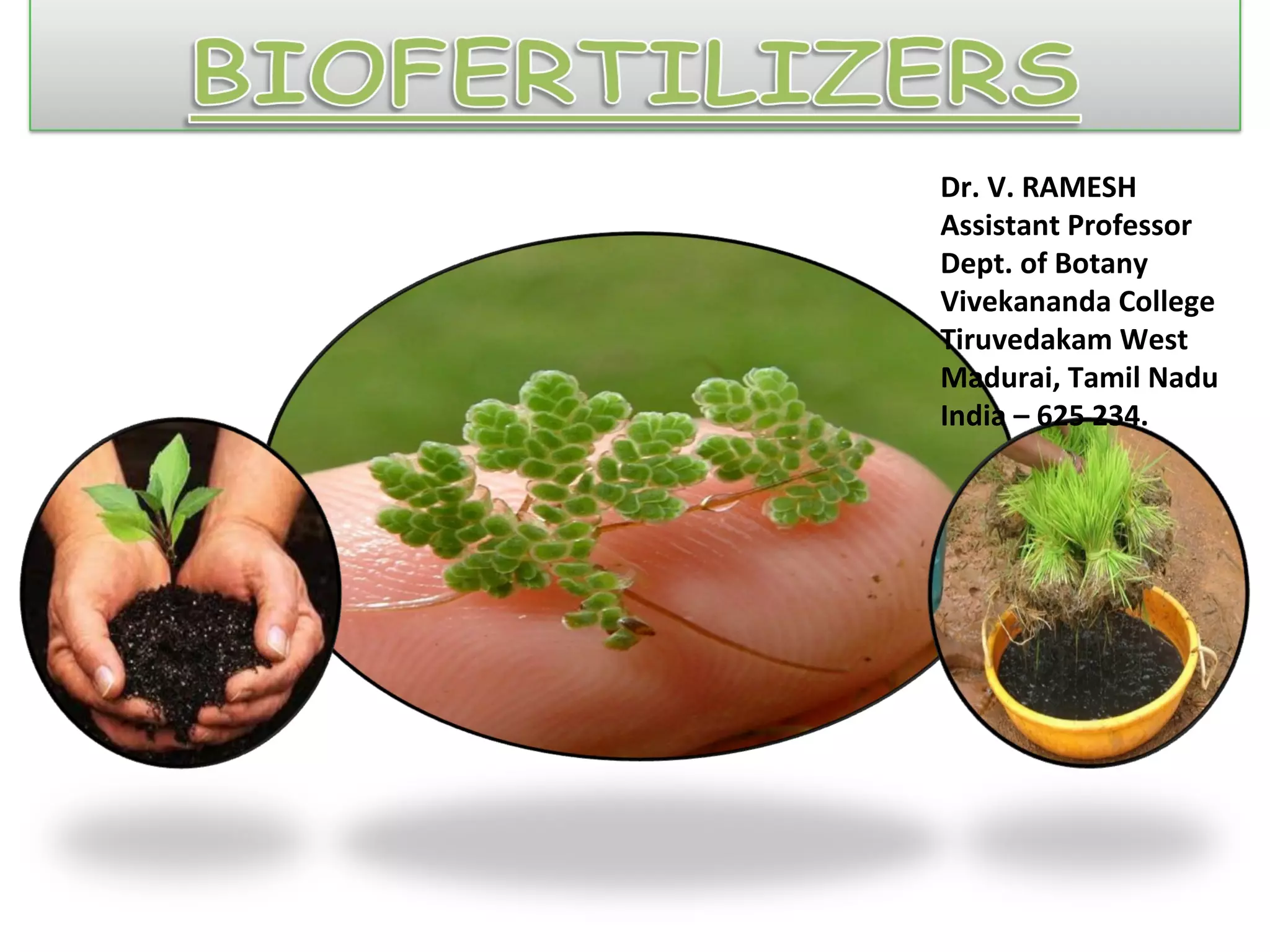
Dr. V. RAMESH
Assistant Professor
Dept. of Botany
Vivekananda College
Tiruvedakam West
Madurai, Tamil Nadu
India – 625 234.
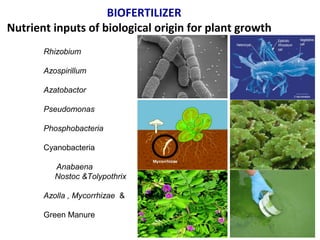
BIOFERTILIZER
Nutrient inputs of biological origin for plant growth
Rhizobium
Azospirillum
Azatobactor
Pseudomonas
Phosphobacteria
Cyanobacteria
Anabaena
Nostoc &Tolypothrix
Azolla , Mycorrhizae &
Green Manure
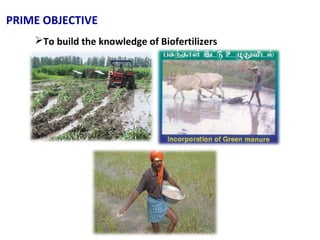
PRIME OBJECTIVE
To build the knowledge of Biofertilizers
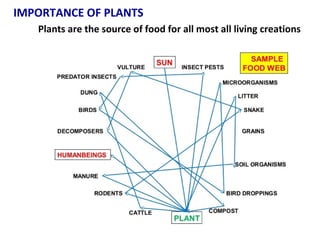
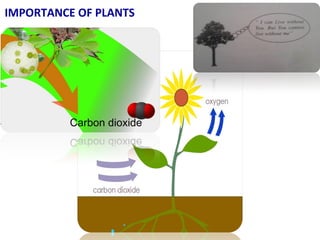
Plants are the source of food for all most all living creations
IMPORTANCE OF PLANTS
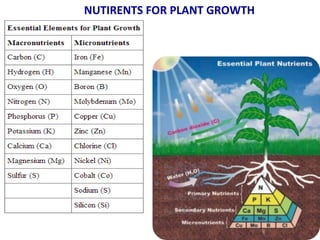
NUTIRENTS FOR PLANT GROWTH
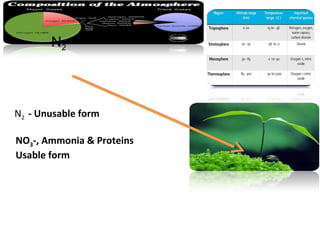
N2
N2 - Unusable form
NO3-, Ammonia & Proteins
Usable form
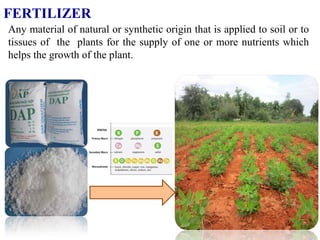
Any material of natural or synthetic origin that is applied to soil or to
tissues of the plants for the supply of one or more nutrients which
helps the growth of the plant.
FERTILIZER
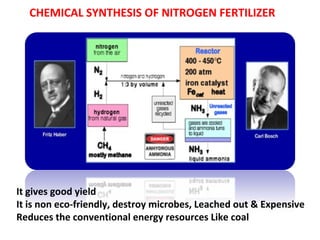
It gives good yield
It is non eco-friendly, destroy microbes, Leached out & Expensive
Reduces the conventional energy resources Like coal
CHEMICAL SYNTHESIS OF NITROGEN FERTILIZER
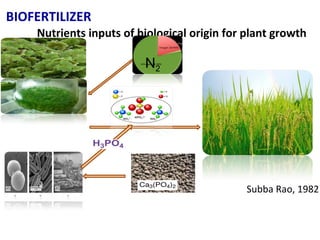
BIOFERTILIZER
Nutrients inputs of biological origin for plant growth
N2
Subba Rao, 1982
Eco-Friendly
Increase soil fertility
Increase the crop yield
Low cost and easy to grow
Farmers can grow BGA & Azolla
 Resistant to plant Pathogens
BENEFITS OF BIOFERTILIZERS
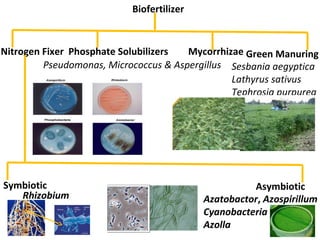
Biofertilizer
Nitrogen Fixer Phosphate Solubilizers Green Manuring
Rhizobium Azatobactor, Azospirillum
Cyanobacteria
Azolla
Pseudomonas, Micrococcus & Aspergillus Sesbania aegyptica
Lathyrus sativus
Tephrosia purpurea
Mycorrhizae
Symbiotic Asymbiotic
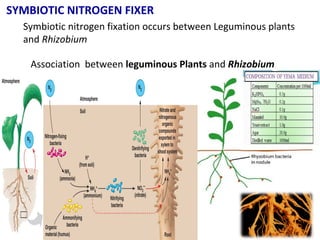
SYMBIOTIC NITROGEN FIXER
Symbiotic nitrogen fixation occurs between Leguminous plants
and Rhizobium
Association between leguminous Plants and Rhizobium
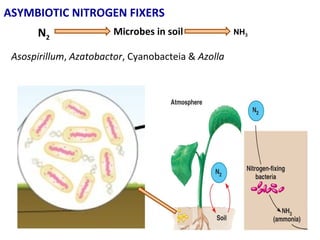
ASYMBIOTIC NITROGEN FIXERS
Microbes in soilN2
NH3
Asospirillum, Azatobactor, Cyanobacteia & Azolla
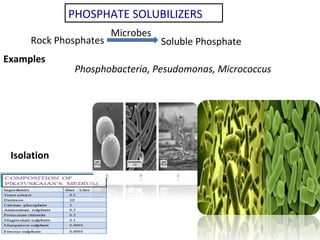
PHOSPHATE SOLUBILIZERS
Rock Phosphates Soluble Phosphate
Microbes
Isolation
Examples
Phosphobacteria, Pesudomonas, Micrococcus
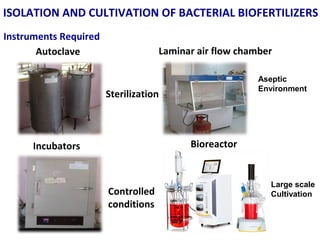
ISOLATION AND CULTIVATION OF BACTERIAL BIOFERTILIZERS
Instruments Required
Incubators
Controlled
conditions
 
Aseptic
Environment
Laminar air flow chamberAutoclave
Sterilization
Bioreactor
Large scale
Cultivation
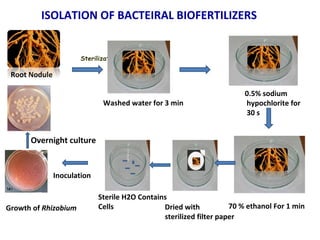
ISOLATION OF BACTEIRAL BIOFERTILIZERS
Root Nodule
Sterilization
70 % ethanol For 1 min
0.5% sodium
hypochlorite for
30 s
Washed water for 3 min
Dried with
sterilized filter paper
Inoculation
Growth of Rhizobium
Sterile H2O Contains
Cells
Overnight culture
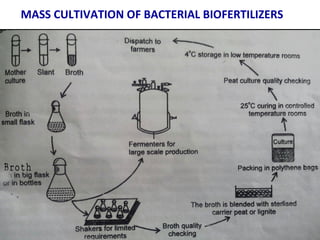
MASS CULTIVATION OF BACTERIAL BIOFERTILIZERS
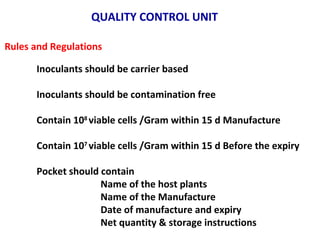
QUALITY CONTROL UNIT
Rules and Regulations
Inoculants should be carrier based
Inoculants should be contamination free
Contain 108
viable cells /Gram within 15 d Manufacture
Contain 107
viable cells /Gram within 15 d Before the expiry
Pocket should contain
Name of the host plants
Name of the Manufacture
Date of manufacture and expiry
Net quantity & storage instructions
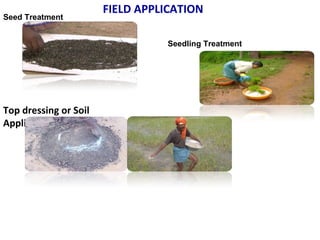
FIELD APPLICATION
Top dressing or Soil
Applications
Seed Treatment
Seedling Treatment
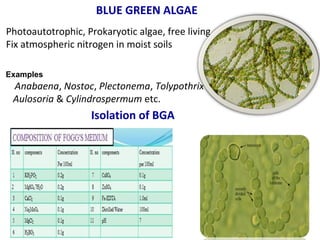
BLUE GREEN ALGAE
Photoautotrophic, Prokaryotic algae, free living
Fix atmospheric nitrogen in moist soils
Examples
Anabaena, Nostoc, Plectonema, Tolypothrix
Aulosoria & Cylindrospermum etc.
Isolation of BGA
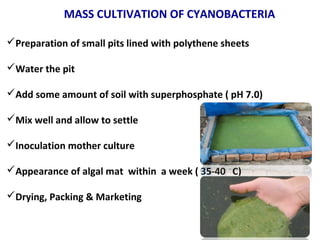
MASS CULTIVATION OF CYANOBACTERIA
Preparation of small pits lined with polythene sheets
Water the pit
Add some amount of soil with superphosphate ( pH 7.0)
Mix well and allow to settle
Inoculation mother culture
Appearance of algal mat within a week ( 35-40 ◦
C)
Drying, Packing & Marketing
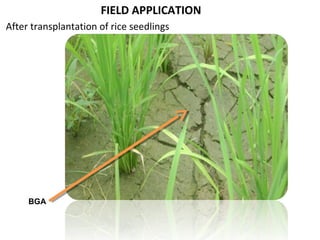
FIELD APPLICATION
After transplantation of rice seedlings
BGA
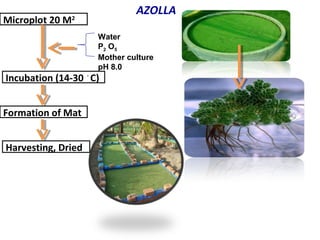
AZOLLA
Microplot 20 M2
Incubation (14-30 ◦
C)
Water
P2 O5
Mother culture
pH 8.0
Formation of Mat
Harvesting, Dried
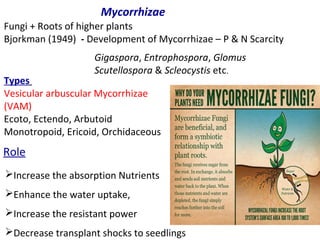
Mycorrhizae
Fungi + Roots of higher plants
Bjorkman (1949) - Development of Mycorrhizae – P & N Scarcity
Types
Vesicular arbuscular Mycorrhizae
(VAM)
Ecoto, Ectendo, Arbutoid
Monotropoid, Ericoid, Orchidaceous
Gigaspora, Entrophospora, Glomus
Scutellospora & Scleocystis etc.
Role
Increase the absorption Nutrients
Enhance the water uptake,
Increase the resistant power
Decrease transplant shocks to seedlings
1
2
3
4
5
6
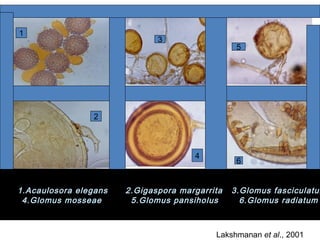
1.Acaulosora elegans 2.Gigaspora margarrita 3.Glomus fasciculatum
4.Glomus mosseae 5.Glomus pansiholus 6.Glomus radiatum
Lakshmanan et al., 2001
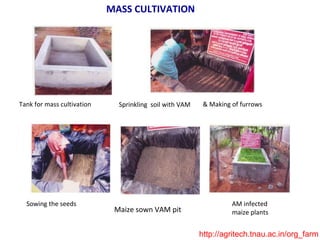
MASS CULTIVATION
Tank for mass cultivation Sprinkling soil with VAM & Making of furrows
Sowing the seeds
Maize sown VAM pit
AM infected
maize plants
http://agritech.tnau.ac.in/org_farm
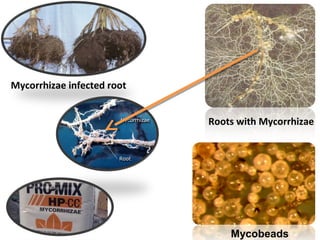
Mycobeads
Roots with Mycorrhizae
Mycorrhizae infected root
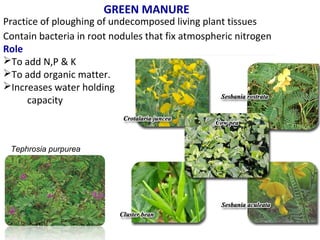
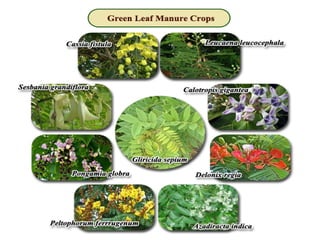
GREEN MANURE
Practice of ploughing of undecomposed living plant tissues
Contain bacteria in root nodules that fix atmospheric nitrogen
Role
To add N,P & K
To add organic matter.
Increases water holding
capacity
Tephrosia purpurea
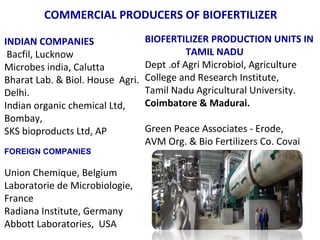
COMMERCIAL PRODUCERS OF BIOFERTILIZER
INDIAN COMPANIES
Bacfil, Lucknow
Microbes india, Calutta
Bharat Lab. & Biol. House Agri.
Delhi.
Indian organic chemical Ltd,
Bombay,
SKS bioproducts Ltd, AP
FOREIGN COMPANIES
Union Chemique, Belgium
Laboratorie de Microbiologie,
France
Radiana Institute, Germany
Abbott Laboratories, USA
BIOFERTILIZER PRODUCTION UNITS IN
TAMIL NADU
Dept .of Agri Microbiol, Agriculture
College and Research Institute,
Tamil Nadu Agricultural University.
Coimbatore & Madurai.
Green Peace Associates - Erode,
AVM Org. & Bio Fertilizers Co. Covai
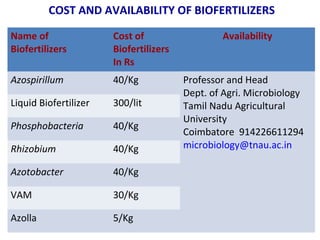
Name of
Biofertilizers
Cost of
Biofertilizers
In Rs
Availability
Azospirillum 40/Kg Professor and Head
Dept. of Agri. Microbiology
Tamil Nadu Agricultural
University
Coimbatore 914226611294
microbiology@tnau.ac.in
Liquid Biofertilizer 300/lit
Phosphobacteria 40/Kg
Rhizobium 40/Kg
Azotobacter 40/Kg
VAM 30/Kg
Azolla 5/Kg
COST AND AVAILABILITY OF BIOFERTILIZERS
MY BELOVED FARMERS…
LET US REVIVE ORGANIC FARMING….
DEDICATED TO…………

Biofertilizer dr.vr

  • 1.
    Dr. V. RAMESH AssistantProfessor Dept. of Botany Vivekananda College Tiruvedakam West Madurai, Tamil Nadu India – 625 234.
  • 2.
    BIOFERTILIZER Nutrient inputs ofbiological origin for plant growth Rhizobium Azospirillum Azatobactor Pseudomonas Phosphobacteria Cyanobacteria Anabaena Nostoc &Tolypothrix Azolla , Mycorrhizae & Green Manure
  • 3.
    PRIME OBJECTIVE To buildthe knowledge of Biofertilizers
  • 4.
    Plants are thesource of food for all most all living creations IMPORTANCE OF PLANTS
  • 5.
  • 6.
  • 7.
    N2 N2 - Unusableform NO3-, Ammonia & Proteins Usable form
  • 8.
    Any material ofnatural or synthetic origin that is applied to soil or to tissues of the plants for the supply of one or more nutrients which helps the growth of the plant. FERTILIZER
  • 9.
    It gives goodyield It is non eco-friendly, destroy microbes, Leached out & Expensive Reduces the conventional energy resources Like coal CHEMICAL SYNTHESIS OF NITROGEN FERTILIZER
  • 10.
    BIOFERTILIZER Nutrients inputs ofbiological origin for plant growth N2 Subba Rao, 1982
  • 11.
    Eco-Friendly Increase soil fertility Increasethe crop yield Low cost and easy to grow Farmers can grow BGA & Azolla  Resistant to plant Pathogens BENEFITS OF BIOFERTILIZERS
  • 12.
    Biofertilizer Nitrogen Fixer PhosphateSolubilizers Green Manuring Rhizobium Azatobactor, Azospirillum Cyanobacteria Azolla Pseudomonas, Micrococcus & Aspergillus Sesbania aegyptica Lathyrus sativus Tephrosia purpurea Mycorrhizae Symbiotic Asymbiotic
  • 13.
    SYMBIOTIC NITROGEN FIXER Symbioticnitrogen fixation occurs between Leguminous plants and Rhizobium Association between leguminous Plants and Rhizobium
  • 14.
    ASYMBIOTIC NITROGEN FIXERS Microbesin soilN2 NH3 Asospirillum, Azatobactor, Cyanobacteia & Azolla
  • 15.
    PHOSPHATE SOLUBILIZERS Rock PhosphatesSoluble Phosphate Microbes Isolation Examples Phosphobacteria, Pesudomonas, Micrococcus
  • 16.
    ISOLATION AND CULTIVATIONOF BACTERIAL BIOFERTILIZERS Instruments Required Incubators Controlled conditions   Aseptic Environment Laminar air flow chamberAutoclave Sterilization Bioreactor Large scale Cultivation
  • 17.
    ISOLATION OF BACTEIRALBIOFERTILIZERS Root Nodule Sterilization 70 % ethanol For 1 min 0.5% sodium hypochlorite for 30 s Washed water for 3 min Dried with sterilized filter paper Inoculation Growth of Rhizobium Sterile H2O Contains Cells Overnight culture
  • 18.
    MASS CULTIVATION OFBACTERIAL BIOFERTILIZERS
  • 19.
    QUALITY CONTROL UNIT Rulesand Regulations Inoculants should be carrier based Inoculants should be contamination free Contain 108 viable cells /Gram within 15 d Manufacture Contain 107 viable cells /Gram within 15 d Before the expiry Pocket should contain Name of the host plants Name of the Manufacture Date of manufacture and expiry Net quantity & storage instructions
  • 20.
    FIELD APPLICATION Top dressingor Soil Applications Seed Treatment Seedling Treatment
  • 21.
    BLUE GREEN ALGAE Photoautotrophic,Prokaryotic algae, free living Fix atmospheric nitrogen in moist soils Examples Anabaena, Nostoc, Plectonema, Tolypothrix Aulosoria & Cylindrospermum etc. Isolation of BGA
  • 22.
    MASS CULTIVATION OFCYANOBACTERIA Preparation of small pits lined with polythene sheets Water the pit Add some amount of soil with superphosphate ( pH 7.0) Mix well and allow to settle Inoculation mother culture Appearance of algal mat within a week ( 35-40 ◦ C) Drying, Packing & Marketing
  • 23.
  • 24.
    AZOLLA Microplot 20 M2 Incubation(14-30 ◦ C) Water P2 O5 Mother culture pH 8.0 Formation of Mat Harvesting, Dried
  • 25.
    Mycorrhizae Fungi + Rootsof higher plants Bjorkman (1949) - Development of Mycorrhizae – P & N Scarcity Types Vesicular arbuscular Mycorrhizae (VAM) Ecoto, Ectendo, Arbutoid Monotropoid, Ericoid, Orchidaceous Gigaspora, Entrophospora, Glomus Scutellospora & Scleocystis etc. Role Increase the absorption Nutrients Enhance the water uptake, Increase the resistant power Decrease transplant shocks to seedlings
  • 26.
    1 2 3 4 5 6 1.Acaulosora elegans 2.Gigasporamargarrita 3.Glomus fasciculatum 4.Glomus mosseae 5.Glomus pansiholus 6.Glomus radiatum Lakshmanan et al., 2001
  • 27.
    MASS CULTIVATION Tank formass cultivation Sprinkling soil with VAM & Making of furrows Sowing the seeds Maize sown VAM pit AM infected maize plants http://agritech.tnau.ac.in/org_farm
  • 28.
  • 29.
    GREEN MANURE Practice ofploughing of undecomposed living plant tissues Contain bacteria in root nodules that fix atmospheric nitrogen Role To add N,P & K To add organic matter. Increases water holding capacity Tephrosia purpurea
  • 31.
    COMMERCIAL PRODUCERS OFBIOFERTILIZER INDIAN COMPANIES Bacfil, Lucknow Microbes india, Calutta Bharat Lab. & Biol. House Agri. Delhi. Indian organic chemical Ltd, Bombay, SKS bioproducts Ltd, AP FOREIGN COMPANIES Union Chemique, Belgium Laboratorie de Microbiologie, France Radiana Institute, Germany Abbott Laboratories, USA BIOFERTILIZER PRODUCTION UNITS IN TAMIL NADU Dept .of Agri Microbiol, Agriculture College and Research Institute, Tamil Nadu Agricultural University. Coimbatore & Madurai. Green Peace Associates - Erode, AVM Org. & Bio Fertilizers Co. Covai
  • 32.
    Name of Biofertilizers Cost of Biofertilizers InRs Availability Azospirillum 40/Kg Professor and Head Dept. of Agri. Microbiology Tamil Nadu Agricultural University Coimbatore 914226611294 microbiology@tnau.ac.in Liquid Biofertilizer 300/lit Phosphobacteria 40/Kg Rhizobium 40/Kg Azotobacter 40/Kg VAM 30/Kg Azolla 5/Kg COST AND AVAILABILITY OF BIOFERTILIZERS
  • 33.
    MY BELOVED FARMERS… LETUS REVIVE ORGANIC FARMING…. DEDICATED TO…………