Observational
Learning
Type of learning 1: When an unnatural association
is made between a response and a stimuli.
(Classical conditioning).
Type of learning 2: When we make behavioral
changes based on experiences that resulted in
rewards or punishments. (Operant conditioning).
How else do we learn behavior?
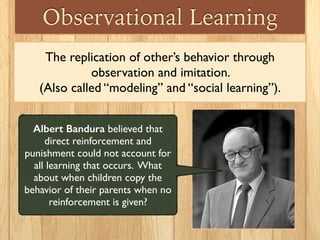
Observational Learning
The replication of other’s behavior through
observation and imitation.
(Also called “modeling” and “social learning”).
Albert Bandura believed that
direct reinforcement and
punishment could not account for
all learning that occurs. What
about when children copy the
behavior of their parents when no
reinforcement is given?
Watch
Interpret
Mimic
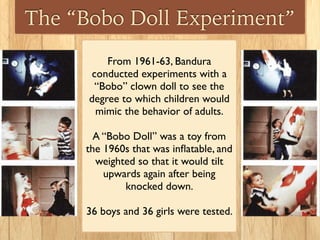
The “Bobo Doll Experiment”
From 1961-63, Bandura
conducted experiments with a
“Bobo” clown doll to see the
degree to which children would
mimic the behavior of adults.
A “Bobo Doll” was a toy from
the 1960s that was inflatable, and
weighted so that it would tilt
upwards again after being
knocked down.
36 boys and 36 girls were tested.
Video 1
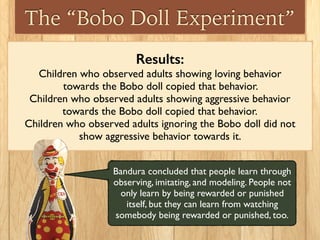
The “Bobo Doll Experiment”
Results:
Children who observed adults showing loving behavior
towards the Bobo doll copied that behavior.
Children who observed adults showing aggressive behavior
towards the Bobo doll copied that behavior.
Children who observed adults ignoring the Bobo doll did not
show aggressive behavior towards it.
Bandura concluded that people learn through
observing, imitating, and modeling. People not
only learn by being rewarded or punished
itself, but they can learn from watching
somebody being rewarded or punished, too.
Cognitive vs. Behavioral
Bandura was one of many psychologists who believed
that the “behavioral” approach was ignoring the ability
of the mind to think for itself.
Behavioral Approach to
Learning:
• Pavlov,Watson, Skinner
• Learning is the result of interacting
with forces in the environment
• Learning happens when external
forces (like stimuli, direct
reinforcement, and punishment)
impact our lives.
Cognitive Approach to
Learning:
• Bandura
• Learning can happen in the mind
without directly interacting with
the environment
• Learning can happen simply from
our own internal thoughts and
expectations.
How Observational Learning Occurs
Attention
To learn anything, you need to be paying attention.
Any kind of distraction can make it difficult for you to
remember what you are learning.
Retention
You must be able to store (or retain) the information
you have learned in your brain. Many factors (like
age and health) can impact memory retention.
Reproduction
You must mimic (or reproduce) the behavior you have
learned from a model.The more you mimic the learned
behavior, the longer you will retain it in your memory.
Motivation
You have to be motivated to mimic a behavior, or else
you will stop practicing it, and eventually forget it.
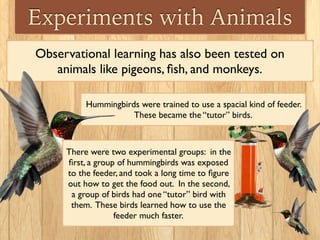
Experiments with Animals
Observational learning has also been tested on
animals like pigeons, fish, and monkeys.
Hummingbirds were trained to use a spacial kind of feeder.
These became the “tutor” birds.
There were two experimental groups: in the
first, a group of hummingbirds was exposed
to the feeder, and took a long time to figure
out how to get the food out. In the second,
a group of birds had one “tutor” bird with
them. These birds learned how to use the
feeder much faster.
Role Models
We don’t model the behavior of all people equally.
Celebrities
Parents
Friends, Peers
At a young age,
parents are the
biggest influence. As
we grow older,
famous people
influence us as well.
However, the best
role models are
always the people you
are most similar to:
for example, your
own age and gender.
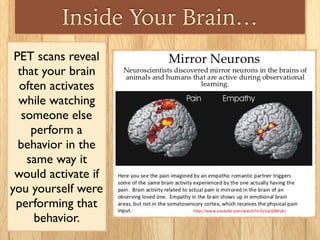
Inside Your Brain…
PET scans reveal
that your brain
often activates
while watching
someone else
perform a
behavior in the
same way it
would activate if
you yourself were
performing that
behavior.
Bandura also recognized
that we can learn by
observing the positive
and negative
consequences that
happen to other people.
For example, if a teacher is giving
positive reinforcement by saying
“good job” to all students who are
reading in class, it might cause a
student who is not reading to pick up
a book and begin.
Or, if we see the punishment that
results from taking drugs, we are less
likely to mimic drug-taking behavior.
Try It!
Try some observational learning for yourself.
See if you and a classmate can learn to do a “secret
handshake” just by watching a video.
You can watch the video again on the psych website!
Video 2

Observational Learning Slides

  • 1.
  • 2.
    Type of learning1: When an unnatural association is made between a response and a stimuli. (Classical conditioning). Type of learning 2: When we make behavioral changes based on experiences that resulted in rewards or punishments. (Operant conditioning). How else do we learn behavior?
  • 3.
    Observational Learning The replicationof other’s behavior through observation and imitation. (Also called “modeling” and “social learning”). Albert Bandura believed that direct reinforcement and punishment could not account for all learning that occurs. What about when children copy the behavior of their parents when no reinforcement is given?
  • 4.
  • 5.
    The “Bobo DollExperiment” From 1961-63, Bandura conducted experiments with a “Bobo” clown doll to see the degree to which children would mimic the behavior of adults. A “Bobo Doll” was a toy from the 1960s that was inflatable, and weighted so that it would tilt upwards again after being knocked down. 36 boys and 36 girls were tested.
  • 6.
  • 7.
    The “Bobo DollExperiment” Results: Children who observed adults showing loving behavior towards the Bobo doll copied that behavior. Children who observed adults showing aggressive behavior towards the Bobo doll copied that behavior. Children who observed adults ignoring the Bobo doll did not show aggressive behavior towards it. Bandura concluded that people learn through observing, imitating, and modeling. People not only learn by being rewarded or punished itself, but they can learn from watching somebody being rewarded or punished, too.
  • 8.
    Cognitive vs. Behavioral Bandurawas one of many psychologists who believed that the “behavioral” approach was ignoring the ability of the mind to think for itself. Behavioral Approach to Learning: • Pavlov,Watson, Skinner • Learning is the result of interacting with forces in the environment • Learning happens when external forces (like stimuli, direct reinforcement, and punishment) impact our lives. Cognitive Approach to Learning: • Bandura • Learning can happen in the mind without directly interacting with the environment • Learning can happen simply from our own internal thoughts and expectations.
  • 9.
    How Observational LearningOccurs Attention To learn anything, you need to be paying attention. Any kind of distraction can make it difficult for you to remember what you are learning. Retention You must be able to store (or retain) the information you have learned in your brain. Many factors (like age and health) can impact memory retention. Reproduction You must mimic (or reproduce) the behavior you have learned from a model.The more you mimic the learned behavior, the longer you will retain it in your memory. Motivation You have to be motivated to mimic a behavior, or else you will stop practicing it, and eventually forget it.
  • 10.
    Experiments with Animals Observationallearning has also been tested on animals like pigeons, fish, and monkeys. Hummingbirds were trained to use a spacial kind of feeder. These became the “tutor” birds. There were two experimental groups: in the first, a group of hummingbirds was exposed to the feeder, and took a long time to figure out how to get the food out. In the second, a group of birds had one “tutor” bird with them. These birds learned how to use the feeder much faster.
  • 11.
    Role Models We don’tmodel the behavior of all people equally. Celebrities Parents Friends, Peers At a young age, parents are the biggest influence. As we grow older, famous people influence us as well. However, the best role models are always the people you are most similar to: for example, your own age and gender.
  • 12.
    Inside Your Brain… PETscans reveal that your brain often activates while watching someone else perform a behavior in the same way it would activate if you yourself were performing that behavior.
  • 13.
    Bandura also recognized thatwe can learn by observing the positive and negative consequences that happen to other people. For example, if a teacher is giving positive reinforcement by saying “good job” to all students who are reading in class, it might cause a student who is not reading to pick up a book and begin. Or, if we see the punishment that results from taking drugs, we are less likely to mimic drug-taking behavior.
  • 14.
    Try It! Try someobservational learning for yourself. See if you and a classmate can learn to do a “secret handshake” just by watching a video. You can watch the video again on the psych website!
  • 15.