Sensation
Perception
&
Pair-Share:
Sensation & Perception
In psychology, sensation and perception are stages
of processing the sensory systems, such as vision,
auditory, and pain sensory systems.
Sensation & Perception
+
= Sensation + Perception = our
interpretation of reality around us.
Sensation & Perception
Sensation is the impact of a stimulus on receptor cells in our
sensory organs: the eyes, ears, nose, tongue, and fingertips
(among other parts of the body that sense feeling/touch). Stimuli
from the environment are transformed into neural signals.
Perception is the mental process of understanding the sensory
input received in our brains: it is awareness or understanding
of the real-world cause of the sensory input. The neural signals
we receive from our sensory organs are processed in the brain,
and the brain creates useful information and meaning about
the world around us.
+
Sensation & Perception
+
= Sensation + Perception = our
interpretation of reality around us.
Transduction
Transduction is the process of turning
environmental information into neural impulses.
• In the eyes, light waves create neural impulses
• In the nose, chemical reactions from gaseous
molecules create neural impulses
• On the tongue, chemical reactions create neural
impulses
• In the ear, sound waves create neural impulses
• Within the skin, pressure, pain, and temperature
create neural impulses
Transduction
Information gathered
from your sensory
organs is converted
into neural impulses
that are carried
through the
peripheral nervous
system to your brain.
After this process of “transduction” has occurred, the
brain can convert the impulses into information.
Fraser’s Spiral
Is it actually a
spiral? The
Fraser’s Spiral is
an example of
how our
perception does
not always
match reality. If
you trace the
rings of the
spiral, your
finger will end
where you
started -
forming a
perfect circle.
Checker-
shadow
Illusion
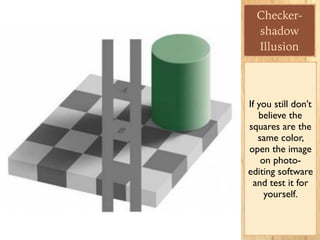
Are squares A
and B the same
color? Our
minds see
colors relative
to those around
them. Next to
lighter squares,
square A
appears dark,
and next to
darker squares,
square B
appears light.
Checker-
shadow
Illusion
If you still don’t
believe the
squares are the
same color,
open the image
on photo-
editing software
and test it for
yourself.

Mini Lesson 1

  • 1.
  • 2.
  • 3.
    Sensation & Perception Inpsychology, sensation and perception are stages of processing the sensory systems, such as vision, auditory, and pain sensory systems.
  • 4.
    Sensation & Perception + =Sensation + Perception = our interpretation of reality around us.
  • 5.
    Sensation & Perception Sensationis the impact of a stimulus on receptor cells in our sensory organs: the eyes, ears, nose, tongue, and fingertips (among other parts of the body that sense feeling/touch). Stimuli from the environment are transformed into neural signals. Perception is the mental process of understanding the sensory input received in our brains: it is awareness or understanding of the real-world cause of the sensory input. The neural signals we receive from our sensory organs are processed in the brain, and the brain creates useful information and meaning about the world around us. +
  • 6.
    Sensation & Perception + =Sensation + Perception = our interpretation of reality around us.
  • 7.
    Transduction Transduction is theprocess of turning environmental information into neural impulses. • In the eyes, light waves create neural impulses • In the nose, chemical reactions from gaseous molecules create neural impulses • On the tongue, chemical reactions create neural impulses • In the ear, sound waves create neural impulses • Within the skin, pressure, pain, and temperature create neural impulses
  • 8.
    Transduction Information gathered from yoursensory organs is converted into neural impulses that are carried through the peripheral nervous system to your brain. After this process of “transduction” has occurred, the brain can convert the impulses into information.
  • 9.
    Fraser’s Spiral Is itactually a spiral? The Fraser’s Spiral is an example of how our perception does not always match reality. If you trace the rings of the spiral, your finger will end where you started - forming a perfect circle.
  • 10.
    Checker- shadow Illusion Are squares A andB the same color? Our minds see colors relative to those around them. Next to lighter squares, square A appears dark, and next to darker squares, square B appears light.
  • 11.
    Checker- shadow Illusion If you stilldon’t believe the squares are the same color, open the image on photo- editing software and test it for yourself.