Observation Learning:
Learning from the Behavior and Outcomes of Others
While at a formal dinner party, you notice five different forks placed next to your plate, including two ofa
hape you've never seen betore. Which ones do you use for which dishes? You have no idea. In order to avoid
making a complete fool of yourself, as the first course arrives, you watch the other guests. When several reach
NGhesitatingly for one of the unfamiliar forks, you do the same. Now, thank goodness, you can concentrate on
the food.
You have probably encountered similar situations, in which you have acquired new information, forms of
behavior, or even abstract rules and concepts from watching the actions of other people and the consequences
they experience. Such observational learning is a third major way we learn, and it is a common part ofeveryday
life (Bandura, 1977, 1986). Indeed, a large body of research findings suggest it can play a role in almost every
aspect of behavior.
More formal evidence for the existence ofobservational learning has been provided by hundreds ofstudies,
many of them performed with children. Perhaps the most famous of these studies are the well-known "Bobo
doll experiments conducted by Bandura and his colleagues (e.g., Bandura, Ross, & Ross, 1963). In these
studies one group of nursery-school children saw an adult engage in aggressive actions against a large intlated
Bobo doll. The adult who was serving as a model knocked the doll down, sat on it, insulted it verbally, and
repeatedly punched it in the nose. Another group ofchildren were exposed to a model who behaved in a quiet,
nonaggressive manner. Later, both groups of youngsters were placed in a room with several toys, including a
Bobo doll. Careful observation of their behavior revealed that those who had seen the aggressive adult model
often imitated this person's behavior: They too punched the toy, sat on it, and even uttered verbal comments
similar to those of the model. In contrast, children in the control group rarely if ever demonstrated such ac
tions. While you may not find these results surprising, they may be significant in relation to the enduring
controversy over whether children acquire new ways of aggressing through exposure to violent television pro-
grams and movies. Well return to this issue shortly. For the moment, let's consider the nature ofobservational
learning itself.
Given that observational learning exists, what factors and conditions determine whether a
we acquire behaviors, information, or concepts rom others? The following four factorsa
important (Bandura, 1986).
First, in order to learn through observation you must direct your attention to appropriate1
to other persons pertorming an activity. And, as you might expect, you dont choose such model.
but focus most attention on people who are attractive to you; on people who possess signs that thev .
theyre doing, such as status or success; and on pcople whose behavior seems relevant to your ounha
goals (Baron, 1970).
Second, you must be able to remember what the persons have said or done. Only if you can reta
representation of their actions in memory can you pertorm similar actions at later times or acquire
information from them.
Observational Learning: Some Basic Principles
and to
what extenn
ppear to be the
moy
elsthatis
s at random
know what
n
needs and
retain Some
usehul
Third, you need to be able to convert these memory representations into appropriate actions. Thisam.
ofobservational learning is termed production processes. Production processes depend on (1) your own nh
cal abilities-if you can't perform the behavior in question, having a clear representation of it in memo
of little use; and (2) your capacity to monitor your own performance and adjust it until it matches thatofth
the
Finally, motivation plays a role. We often acquire information through observational learning but don
put it into immediate use in our own behavior. You may have no need for the information, as when you watch
someone tie a bow tie but have no plans to wear one yourself. Or the observed behaviors may involve highri
ofpunishnment or be repugnant to you personally, as when you observe an ingenious way ofcheating during an
exam but don't want to tury it yourself. Only if the information or behaviors acquired are useful will obsenes
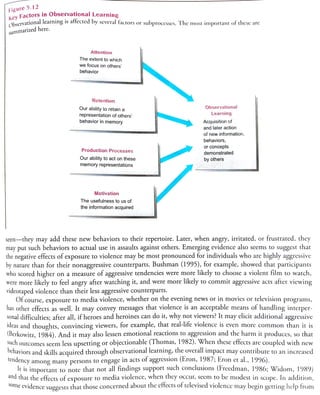
put them to acrual use. Figure 5.12 summarizes factors affecting observational learning.
As you can sec, observational learning is a complex process-far more complex than mere imitation-and
plays an important role in many aspects of behavior. This point is perhaps most forcefully illustrated by a
controversy that has persisted in psychology, and in society as a whole, since the early 1960s: the controversy
over whether children, and perhaps even adults, are made more aggressive by long-term exposure to violence
model.
on television shows or in movies.
VBasic Principles of Social Learning
According to Bandura and Walters, the most fundamcntal and
significant principle of social learning is the principle of rcinforce-
Most ot our beiaviour in social situations is acquircd through
the principle of reinoicement. The scopc of responses acquired
through reinloreemeni is unlimited. We will deseribe how aggressive
ment.
behavinur can be acquired through reinforcement by children. An
experiment to thus etfect was conducted by C'owar. and Waltcrs
Walters
(1963).
(1963). Tie experiment was conducted on small children who were
given 'B«bo clown with a sign saying 'Hit me painted on the clown.
it was observed by the experimenters that the rate of responding
(hitting) were inereased as a result of reinforcement. This experiment
further established the fact that partial reinforcement leads to greater
Tesistance to extinction than continuous reinforcement.
Bandura and Walters en1phasize the importance of reinforcement
in situations where a person observes the actions of another person
(Model) who is reinforced or punished for these actions. They in-
troduced an
important type of reinforc.ment that is known as
reinforcement which refcrs tu the modification of an
IcaTious
erver's behaviour by reinforcement administered to a model which
i heing observed. An illustration from the experimental studies con-
ducted by Bandura and Walters will make the concept of vicarious
Teintorcement more clear. Nursery school children were exposed to
ms of iults or live adults behaving aggressively to a large plastic
doll. They found that children who were exposed to aggressive
They
nodels tendel i bchave toward the doll in the same way and exhi-
Diled a
l1rge number of precisely matehing responses. Such responses
SNCAOUA
SYCHOLO
rarely occurred for children who were not
exposed to
models hbeh
novel responses through vicarious reinforcementChildren
observing the
s beha
ing aggressively. This experiment indicates that
children a
behaviour of the model. This process of learnine th
is infuenced by the nature of the reinforcement given to
through imitati
the model
escents and
behaviour is
imitated to mar
If we minutely analyse the behaviour of children, adole
even adults, we find that most of the
the behaviour of the model. Models may be categorized
into two
broad categories:
(a) Real life models. Under this category we can include
teachers, friends, heroes of films, sports stars, most successful.
in the society or in the immediate environment.
de parents,
persons
(6) Symbolic models.
They include verbal material, pictorial and
representation (Film and TV) written materials, books, magazines
and works of art. Both types of models are equally effectiven
learning.
It is a common experience that what children view and listen on
TV and in films they try to imitate in their real life. Hairstyle, dres,
delinquency and conversational styles have been imitated by our
adolescents in recent years from films and TV.
Bandura and Walters use, another term, self-reinforcement which
operates in observational learning. In many situations the individual
sets a standard for self-reinforcement, children and adolescents tend
to adopt standards of self-reinforcement which matches the standards
of the models to which they have been exposed.
Positive reinforcement and reward playan important role in
SOCial learning.They strengthen our responses and develop a
tenuru
o repeat the same
responses in future. Bandura studied a
nu
of factors which operate in social learning (observational learning'
Few of the variables are given below:
A. Stimulus properties of the model. (1) The models
id
The model's age, Se,
ried
social and economic slatus relative to that of the subject ai
High status models are more
imita.cd.
(2) The model's
similarity to the subject. The more si
between the model and the
subject, the more
imitationoc skils
B. Type of behaviour
exemplified by the model. (1) NO Sel*
Similarityis
irs.
skils
del. (1) Novel
(3) Standards of
self
(2) Hostile or
aggressive responses and (3) Stanaa
reward.
and
C.
Consequences of model's behaviour. Rewarded Dou
the model are more
likely to be
imitated.
o f
Rewarded behaviourso
PERS
Motivational set given to the subject:
structions given to the subject before he observes the model
model
provide
him with high or low motivation to pay attention to and
(2) Motiv
)Motivating instructions may be given after the subject views
themode
model and before he is tested. This aids in distinguishing learning
from performance of imitative responses.
l e a r n
the model's behaviour.
Mechanisms of Observational ILearning
Bandura and his associates extensively studied observational learn-
ing and made an analysis of the whole process of learning. They
emphasize four interrelated sub-processes in observational learni.g as
listed below:
(8) Attentional processes. Attention to the model is the first process
in observational learning. The subject must attend the model in order
to learn from the model. Attention is influenceed by a number of
variables including the past functional value of attention to the
model.
(2) Retention processes. The subject, in order to integrate the beha-
viour cf the model, must retain the learning.
(3) Motoric reproduction of skills. A child or adult may know
"cognitively" and roughly what is to be done but nonetheless be
relatively unskilled at the perfórmance itself. A considerable motor
practice with feed-back of results /s needed to shape the motor skills.
It is known that with some motor skills such as basket ball, shooting,
driving and dart throwing, covert cognitive rehcarsal or imaginary
practice can often produce significant improvement in actual perfor-
mance.
(4) The role of reinforcement. Bandura treats the anticipation of
reinforcement as a motivational factor determining expression of
cognition and behaviours learned earlier.
of
a s follo topredict human behavior to control it,
10studysimple animals. Since the assumption is that learn-
The doctrine of early behaviorists can be summa-
104). The
conditioning, which would involve randomly trying out many
possible behaviors and repeating only those that were
rewarded with a good grade. Rather, you learned througn
taton and observational learning: you copied the behav-
or of others, whose behavior you observed to be successful.
Important research on observational learning was carried
Out by Albert Bandura. Early on, Bandura emphasized that
observational learning occurs through the principles of operant
Condlitionirng (Bandura & Walters, 1963): models inform
us about the consequences of our behaviors. Models often
are actual persons whose behaviors we observe, but they can
also be more abstract (for example, the written instructions
TOund in a book). Reinforcemernt in many cases is 'vicarious'
the imitator expects to be reinforced just like the model wasS.
One of Bandura's early studies concerned the observa-
tIonal learning of aggressive behavior in young children
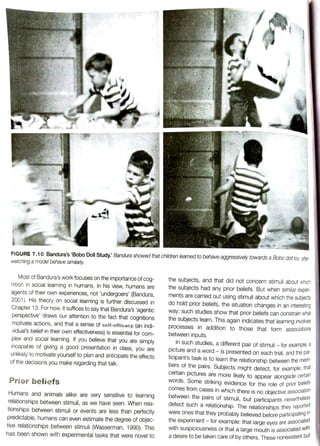
(Bandura et al., 1961), the 'Bobo doll study.' A Bobo doll is
an inflatable toy with a heavy base that ensures that the dol
springs back up when it is pushed over. One grOup of chil-
dren was shown adult models behaving aggressively
towards a Bobo doll (see Figure 7.10). Another group of
children was exposed to adult models behaving non-
aggressively. Afterwards, the children were led into a room
in which they could play with many different toys. The first
group of children was shown to display more aggressive
behavior towards the Bobo doll than the second group of
children. Bandura later showed that the effects are very
similar if the children are exposed to aggressive behavior
by models presented in film sequences on a TV screen
(Bandura et al, 1963). For this reason, Bandura's work is
often cited in discussions concerning the effects of
televi
sion violence on aggressive behavior in children. Increased
aggressive tendenoy after exposure to violent media con-
tent has been reported - both in the short term in laboratory
studies (see, for example, Anderson et al., 2003a) as well
as over the lifetime, in longitudinal studies (Huesman
et al., 2003). More recently, studies focusing on the aggres-
sive content in video games have shown similar effects
(Anderson, 2004).
In his later work, Bandura emphasized the cognitive abili-
ties that are necessary for observational learning to
occur (Bandura, 1977, 2001). The learner must be able to
(1) pay attention to the model's behavior and observe itscon
sequences, (2) remember what was observed, (3) be able to
reproduce the behavior, and (4) be motivated to do so. In
other words: obsenvational learning involves the ability to
imagine and anticipate - thoughts and intentions are essen-
tial. Recent evidence suggests that mirror neurons play a role
in observational learning. Mirror neurons are active when a
subject observes someone elseperforma behavior, but even
more active when that behavior is carried out with a certain
we need to know only the situation that the human
even-
And to study the mechanics of
learning, it suffices
eactsto.
only from experience (with
stimulus-response
i n g r e s u
ips, and with
reason to study or assume 'higher mental
the consequence of
responses),
r e l a t i o
there is no
processes.'
have seen that the empirical approach to the study
We
had a considerable impact on the history of
N. especially in the USA. We have also seen
o f
b e h a v i o r
psych
thatmany
of the
haviorists later in tne century revealed the importance of
experiments that were carried out by
nition.Recall the experiments by Rescorla, showing
nat
not all stimulus-response relationships are learned
8Qually easily (contingency matters), as well as the experi-
ments by Seligman, showing that reinforcers can lose their
nMer if the organism perceives no control over them.
These results highlight the importance of cognitions held
by the animals.
But the basic behaviorist doctrine actually never went
unchallenged. Already in the 1930s, Edward C. Tolman, an
American psychologist, described findings showing latent
learning in simple animals: he was able to show that animals
were learning, while their behavior did not change in a cor-
responding way (Tolman & Honzik, 1930). In a typical study,
rats would learn to run a complicated maze. One group of
rats was rewarded with food for finding their way through the
maze: these rats improved gradually in soving the maze,
over the course of a number of days. A second group
was not rewarded initially, and consequently showed little
improvement in solving the maze. However, when a reward
Was introduced for this second group of rats, their perfor-
mance almost instantly caught up with the performance
of the first group. This showed that the second group of
rats had "latent knowledge' of the maze, which was only
expressed behaviorally once the food was introduced.
Iolman concluded that a rat running through a complex
aZe was not learning a sequence of right- and left-turning
Eponses, but rather was developing a cognitive map
-
a
al representation of the layout of the maze (Tolman,
D. And more importantly: that this learning occurs even
When the animal is not reinforced.
Observational learning
nforced for thebehavior. Consider how you learned to give
nans, too, learn any things without immediately being
Human
ntation in class: when you prepared for it, you prob-
picked up a book for some advice
ar Structure your presentation. Clearly, you did not
sidered how others go about giving a lecture, and
yOu
might have even
purpose or in a meaningful context (Catteano & Rizzolatti,
2009). In other words: mirror neurons are involved in under
standing others' actions and intentions.
On ho
how to give a Successful presentation through simple
FIGURE 7.10 Bandura's 'Bobo Doll Study: Bandura showed that children learned to behave aggressively towards a Bobo doll toy, after
watching a model behave similarly
the subjects, and that did not concern stimuli about which
the subjects had any prior beliefs. But when similar expen
ments are carried out using stimuli about which the subjects
do hold prior beliefs, the situation changes in an interesting
way: such studies show that prior beliefs can constrain what
the subjects learn. This again indicates that learning invoves
processes in addition to those that form assOciations
between inputs.
Most of Bandura's work focuses on the importance of cog-
nition in social learning in humans. In his view, humans are
agents of their own experiences, not 'undergoers' (Bandura,
2001). His theory on social learning is further discussed in
Chapter 13. For now, it suffices to say that Bandura's 'agentic
perspective' draws our attention to the fact that cognitions
motivate actions, and that a sense of seif-efficacy (an indi-
vidual's belief in their own effectiveness) is essential for com-
plex and social learning. If you believe that you are simply
incapable of giving a good presentation in class, you are
unlikely to motivate yourself to plan and anticipate the effects
of the decisions you make regarding that talk.
In such studies, a different pair of stimuli -
for example, a
picture and a word -is presented on each trial, and the
pal
ticipant's task is to learn the relationship between the men
bers of the pairs. Subjects might detect, for example, tn
certain pictures are more likely to appear alongside certadi
Words. Some striking evidence for the role of prior beiei
Comes from cases in which there is no objective associano
between the pairs of stimuli, but participants neverthele
detect such a
relationship. The relationships they repor
were ones that they probably believed before participating
the
experiment-for example: that large eyes are assOciai
with suspiciousness or that a large mouth is associatedwu
a desire to be taken care of by others. These nonexistent but
Prior beliefs
Humans and animals alike are very sensitive to learning
relationships between stimuli, as we have seen. When rela-
tionships between stimuli or events are less than perfectly
predictable, humans can even estimate the degree of objec-
tive relationships between stimuli (Wasserman, 1990). This
has been shown with experimental tasks that were novel to
lausible relationships detected by the subjects are referred
to 8s spurious associations (Chapman & Chapman, 1969).
Tne fact that humans are prone to detect associations or
:en causal relationships between events when in fact there
are none, can also be explained from an evolutionary per-
Soective. Statistical analyses show that in circumstances
where the probability that two events are really associated is
.eak, it can sometimes be advantageous to assume that a
one measure might have been how often a young boy copied
another student's homework in school, and the seCond an
indication of how often that same boy was dishonest at
home. Most people beilieve (erroneously) that two measures
of the same trait (such as honesty) will always be highly cor
related. This is the critical prior belief. In fact, the objective
relationship between the two measures of honesty varied
across different conditions of the experiment, sometimes
being quite low. The participants' task was to estimate the
strength of this relationship by choosing a number between 0
(which indicated no relation) and 100 (a perfect relation). The
results showed that participants consistently overestimated
the strength of the relationship. Their prior belief that an honest
person is honest in all situations led them to see more than
was there
The results of these studies are reminiscent of what we
reiationship does exist (Foster & Kokko, 2009). Superstitious
behavior might be adaptive! Some authors even argue that
ris insight holds the key to explaining the evolution of reli-
gjous behavior in humans (Hood, 2009).
Even when there is an objective association to be learned,
prior beliefs affect what subjects actually learn. This was
shown in studies similar to the one described above
Jennings et al, 1982). On each of a set of trials, participants
were presented with two measures of an individual's honesty called top-down processing in perception (see Chapter 5), in
which perceivers combine their expectations of what they are
aken from two completely different situations. For example,
likely to see with the actual input to yield a final percept. In
top-down processing in learning, the learner combines prior
belief about an associative relationship with the objective
input about that relationship to yield a inal estimate of the
strength of that relationship.
The importance of prior beliefs in human learning strength-
ens the case for a cognitive approach to learning. The research
also has a connection to the ethological approach to learning.
Just as rats and pigeons may be constrained to learning only
associations that evolution has prepared them for, so we
humans seem to be constrained to learn associations that our
prior beliefs have prepared us for. Without prior constraints of
Some sort, perhaps there would simply be too many potential
associations to consider, and associative learning would be
chaotic, if not impossible.
Observational Learning and Aggression
Can young people learn aggression through watching the actions of others? This issue was recently brought
sharply into focus when President Bill Clinton ordered a government study of how the entertainment indus.
try markets violence to children. The president's order followed a series of school shootings, among them the
one that ocured in April 1999 at Columbine High School in Littleton, Colorado (CNN Interactive, 19).
In that incident two student gunmen killed a dozen classmates and a teacher and wounded rwenty-three other
students before they committed suicide. Some experts attribute such incidents to the proliferation of violence
depicted on television and in film. The National Television Violence Study (1996, 1997) analyzed nearly
4,500 hours of programming on cable and broadcast television and found that approximately 60 percent of
these programs contained some form of violence. But does merely watching violence on television lead people
to commit similar acts?
A large body of research indicates that aggression may indeed be learned through observation (Baron &
Richardson, 1994; Centerwall, 1989; Snyder, 1991; Wood, Wong, & Chachere, 1991). Apparently, when
children and adults are exposed to new ways of aggressing against others-techniques they have not previously
Figure 5.12
Factors in ervational Learning
Obser
Observational learning is aftected by several factors or subprocesses. The most important of these are
summarized here.
Attention
The extent to which
we focus on others'
behavior
Retention
Observational
Our ability to retaina
representation of others'
behavior in memory
Learning
Acquisition of
and later action
of new information,
behaviors,
or concepts
Production Processes demonstrated
Our ability to act on these by others
memory representations
Motivation
The usefulness to us of
the information acquired
en-they may add these new behaviors to their repertoire. Later, when angry, irritated, or frustrated, they
may put such behaviors to actual use in assaults against others. Emerging evidence also seems to suggest that
the negative effects of exposure to violence may be most pronounced for individuals who are highly aggressive
by nature than for their nonaggressive counterparts. Bushman (1995), for example, showed that participants
who scored higher on a measure of aggressive tendencies were more likely to choose a violent film to watch
were more likely to feel angry after watching it, and were more likely to commit aggressive acts after viewing
videotaped violence than their less aggressive counterparts.
Of course, exposure to media violence, whether on the evening nevws or in movies or television programs,
has other effects as well. It may convey messages that violence is an acceptable means of handling interper-
sonal difficulties; after all, if heroes and heroines can do it, why not viewers? It may elicit additional aggressive
ideas and thoughts, convincing viewers, for example, that real-life violence is even more common than it is
Berkowitz, 1984). And it may also lessen emotional reactions to aggression and the harm it produces, so that
such outcomes seem less upsetting or objectionable (Thomas, 1982). When these effects are coupled with new
behaviors and skills acquired through observational learning, the overall impact may contribute to an increased
Cnaency among many persons to engage in acts of aggression (Eron, 1987; Eron et al., 1996).
It is important to note that not all findings support such conclusions (Frecedman, 1986; Widom, 1989)
and that the effects of exposure to media violence, when they occur, seem to be modest in scope. In addition,
SOme evidence suggests that those concerned about the eftects of televised violence may begin getting help from
companies that sponsor the shows. Arecet study conducted by Bushman (1998) showed that i
programs on television may not be profitable for advertiscrs; awarcness
of this could slow the proliferan
the pres
ation of
Viewers memories of brand names and commercial messages.
1
nus, Sponsoring e
ofviolence decreased
game
intluence
GIven the fact that many children spend more time watching
television, playing violent vidco
these types of shows.
the topic of
o r e recently, surting the Web than they do in any
other single activity, howevct,tne potentialinf.
or such experience on behavior seems worthy ofcareful attention. In Chapter
10 we Il return to the.
9gression and discuss additional factors that seem to motivate aggressive
behavior.
Observational Learning and Culture
uch o
As wevealrcady noted, observational learning plays an important
role in many aspects of behavior,. Mi
erva-
our understanding ofthe world around us-including
our language
and
c u s t o m s - c o m e s
to us throuoh
observation of the behaviors of others around us. Recently, psychologists
have applicd principles ofohs
As the United States and other countries move toward a global economy, companies throughout the
are faced with a difticult task. They must prepare
their employees for the business
environment of the twenre.
rsons
century-an
environment that will require a broad range ofskillsand the ability to interact etfectively with ner
nguage
world
tional learning to help meet a challenge ofgrowing
concern: preparing people to handle "culture shock"
-first
from other cultures (Adler & Bartholomew, 1992; Feldman & Tompson, 1993). Dramatic differences in lano
customs, and lifestyle often lead to unintended misunderstandings
between persons
from different cultural bacl
grounds. Behaviors that are acceptable and in one country may be quite offensive to persons
from anothercount
To soften the effects ofculture shock, experts in the area of cross-cultural training have advocated ane
periential approach based on behavioral modeling (Black & Mendenhall, 1990). Trainees first watch films in
which models exhibit the correct behaviors in a problem situation. Then the trainees participate in a role-play
ing exercise to test their knowledge. Finally, they receive constructive feedback regarding their performance
Some evidence suggests that this approach can be quite effective. In one study, Harrison (1992) compared
the effectiveness of several approaches to cross-cultural training. One group of participants received culture.
relevant information only; another received behavioral modeling training only; a third received both compo-
nents; and a control group received no training. The results showed that participants who received both forms
of training-information and behavioral modeling-performed best on measures of culture-specific knowl-
These findings illustrate the important role that observational learning plays in alleviating the eftects of
culture shock. Observation initially enables us to perform behaviors appropriate to our own cultures, but later
edge and on a behavioral measure.
can help us adapt to the demands of a rapidly changing world.
Observational Learning: Some Practical Applications
As you can see from the previous discussions, the effects of observational learning on our behavior can indeed bc
powerful-and not always for the good. For example, observational learning may contribute to the development
of unhealthy behaviors, including smoking, especially among adolescents (Hahn et al., 1990). Becauseace
tance by peers is so important to persons in this age group, it is possible that observing peers who smoke contr
utes to teenagers' own decisions to start smoking (Hawkins, Catalano, & Miller, 1992). Some evidenceseen
to indicare this is true. In one study, Aloise-Young, Graham, and Hansen (1994) surveyed several thous
and
tici-
seventh graders to assess their smoking habits and the smoking habits of their peers. They also asked part
her
pants it they cared how their friends would react if they used drugs or alcohol. Finally, they assessedwn
each student was already a member ofa social group ("group members) or not ("outsiders"). Then, durng
wing school year, they surveyed the students as
eighth graders to determine their smoking status. Which
of
G
hesestudents were most likely to have started smoking? Because peer acceptance is so important to twelve-
d thirteen-year-olds,Aloise.Young and
her colleagues predicted that the outsiders, teens who had not yet
and hirteen-y
been.
a c
han would teens
already in a friendship group. These predictions were confirmed. The results showed that the
en accepted into a triendship group, would be influenced to a greater extent by the behavior of their peers
t h a n w o u
siders were much more likely to emulate the behavior of others-and hence to begin smoking-than partici-
O u
pants
who were group members. In fact, outsiders whose best friend smoked in the seventh grade were twice as
kely to begin smoking than outsiders whose friends did not smoke. In contrast, this pattern of peer influence
not evident among teens who were
already part ofa group.
Although the results of this study highlight the potential negative effects of observational learning, there is
a large body of evidence showing that peer influence can also be used to promote more productive behaviors.
la one interesting study, Werts, Caldwell, and Wolery (1996) examined whether mildly retarded children
enrolled in a regular classroom could acquire skills by having their nonhandicapped peers model the skills for
them. The skills included spelling their name, using a calculator to perform simple arithmetic, and sharpening
a pencil. Each of the skills was broken down into simpler sets of tasks that the peer tutors learned to perform
and describe accurately. The students were required to master performance on one set oftasks before moving on
to the next step in the chain. Through this procedure, each participant acquired useful skills in a relatively short
period of time (less than a month). It is noteworthy that the time the peers spent modeling the behaviors aver
aged about five minutes per day--suggesting that observational learning can be an efficient tool in the learning
process. To summarize, then, observational learning plays an important role in many aspects of behavior.
REVIEN QUESTIONS
What is observational learning?
What factors determine the extent to which we
In whatforms of behavior does observational learn-
ing play a role?
In what ways can observational learning be used to
solve problems of everyday life?
acquire new information through observational
learning?

observation.pdf

  • 1.
    Observation Learning: Learning fromthe Behavior and Outcomes of Others While at a formal dinner party, you notice five different forks placed next to your plate, including two ofa hape you've never seen betore. Which ones do you use for which dishes? You have no idea. In order to avoid making a complete fool of yourself, as the first course arrives, you watch the other guests. When several reach NGhesitatingly for one of the unfamiliar forks, you do the same. Now, thank goodness, you can concentrate on the food. You have probably encountered similar situations, in which you have acquired new information, forms of behavior, or even abstract rules and concepts from watching the actions of other people and the consequences they experience. Such observational learning is a third major way we learn, and it is a common part ofeveryday life (Bandura, 1977, 1986). Indeed, a large body of research findings suggest it can play a role in almost every aspect of behavior. More formal evidence for the existence ofobservational learning has been provided by hundreds ofstudies, many of them performed with children. Perhaps the most famous of these studies are the well-known "Bobo doll experiments conducted by Bandura and his colleagues (e.g., Bandura, Ross, & Ross, 1963). In these studies one group of nursery-school children saw an adult engage in aggressive actions against a large intlated Bobo doll. The adult who was serving as a model knocked the doll down, sat on it, insulted it verbally, and repeatedly punched it in the nose. Another group ofchildren were exposed to a model who behaved in a quiet, nonaggressive manner. Later, both groups of youngsters were placed in a room with several toys, including a Bobo doll. Careful observation of their behavior revealed that those who had seen the aggressive adult model often imitated this person's behavior: They too punched the toy, sat on it, and even uttered verbal comments similar to those of the model. In contrast, children in the control group rarely if ever demonstrated such ac tions. While you may not find these results surprising, they may be significant in relation to the enduring controversy over whether children acquire new ways of aggressing through exposure to violent television pro- grams and movies. Well return to this issue shortly. For the moment, let's consider the nature ofobservational learning itself.
  • 2.
    Given that observationallearning exists, what factors and conditions determine whether a we acquire behaviors, information, or concepts rom others? The following four factorsa important (Bandura, 1986). First, in order to learn through observation you must direct your attention to appropriate1 to other persons pertorming an activity. And, as you might expect, you dont choose such model. but focus most attention on people who are attractive to you; on people who possess signs that thev . theyre doing, such as status or success; and on pcople whose behavior seems relevant to your ounha goals (Baron, 1970). Second, you must be able to remember what the persons have said or done. Only if you can reta representation of their actions in memory can you pertorm similar actions at later times or acquire information from them. Observational Learning: Some Basic Principles and to what extenn ppear to be the moy elsthatis s at random know what n needs and retain Some usehul Third, you need to be able to convert these memory representations into appropriate actions. Thisam. ofobservational learning is termed production processes. Production processes depend on (1) your own nh cal abilities-if you can't perform the behavior in question, having a clear representation of it in memo of little use; and (2) your capacity to monitor your own performance and adjust it until it matches thatofth the Finally, motivation plays a role. We often acquire information through observational learning but don put it into immediate use in our own behavior. You may have no need for the information, as when you watch someone tie a bow tie but have no plans to wear one yourself. Or the observed behaviors may involve highri ofpunishnment or be repugnant to you personally, as when you observe an ingenious way ofcheating during an exam but don't want to tury it yourself. Only if the information or behaviors acquired are useful will obsenes put them to acrual use. Figure 5.12 summarizes factors affecting observational learning. As you can sec, observational learning is a complex process-far more complex than mere imitation-and plays an important role in many aspects of behavior. This point is perhaps most forcefully illustrated by a controversy that has persisted in psychology, and in society as a whole, since the early 1960s: the controversy over whether children, and perhaps even adults, are made more aggressive by long-term exposure to violence model. on television shows or in movies.
  • 3.
    VBasic Principles ofSocial Learning According to Bandura and Walters, the most fundamcntal and significant principle of social learning is the principle of rcinforce- Most ot our beiaviour in social situations is acquircd through the principle of reinoicement. The scopc of responses acquired through reinloreemeni is unlimited. We will deseribe how aggressive ment. behavinur can be acquired through reinforcement by children. An experiment to thus etfect was conducted by C'owar. and Waltcrs Walters (1963). (1963). Tie experiment was conducted on small children who were given 'B«bo clown with a sign saying 'Hit me painted on the clown. it was observed by the experimenters that the rate of responding (hitting) were inereased as a result of reinforcement. This experiment further established the fact that partial reinforcement leads to greater Tesistance to extinction than continuous reinforcement. Bandura and Walters en1phasize the importance of reinforcement in situations where a person observes the actions of another person (Model) who is reinforced or punished for these actions. They in- troduced an important type of reinforc.ment that is known as reinforcement which refcrs tu the modification of an IcaTious erver's behaviour by reinforcement administered to a model which i heing observed. An illustration from the experimental studies con- ducted by Bandura and Walters will make the concept of vicarious Teintorcement more clear. Nursery school children were exposed to ms of iults or live adults behaving aggressively to a large plastic doll. They found that children who were exposed to aggressive They nodels tendel i bchave toward the doll in the same way and exhi- Diled a l1rge number of precisely matehing responses. Such responses
  • 4.
    SNCAOUA SYCHOLO rarely occurred forchildren who were not exposed to models hbeh novel responses through vicarious reinforcementChildren observing the s beha ing aggressively. This experiment indicates that children a behaviour of the model. This process of learnine th is infuenced by the nature of the reinforcement given to through imitati the model escents and behaviour is imitated to mar If we minutely analyse the behaviour of children, adole even adults, we find that most of the the behaviour of the model. Models may be categorized into two broad categories: (a) Real life models. Under this category we can include teachers, friends, heroes of films, sports stars, most successful. in the society or in the immediate environment. de parents, persons (6) Symbolic models. They include verbal material, pictorial and representation (Film and TV) written materials, books, magazines and works of art. Both types of models are equally effectiven learning. It is a common experience that what children view and listen on TV and in films they try to imitate in their real life. Hairstyle, dres, delinquency and conversational styles have been imitated by our adolescents in recent years from films and TV. Bandura and Walters use, another term, self-reinforcement which operates in observational learning. In many situations the individual sets a standard for self-reinforcement, children and adolescents tend to adopt standards of self-reinforcement which matches the standards of the models to which they have been exposed. Positive reinforcement and reward playan important role in SOCial learning.They strengthen our responses and develop a tenuru o repeat the same responses in future. Bandura studied a nu of factors which operate in social learning (observational learning' Few of the variables are given below: A. Stimulus properties of the model. (1) The models id The model's age, Se, ried social and economic slatus relative to that of the subject ai High status models are more imita.cd. (2) The model's similarity to the subject. The more si between the model and the subject, the more imitationoc skils B. Type of behaviour exemplified by the model. (1) NO Sel* Similarityis irs. skils del. (1) Novel (3) Standards of self (2) Hostile or aggressive responses and (3) Stanaa reward. and C. Consequences of model's behaviour. Rewarded Dou the model are more likely to be imitated. o f Rewarded behaviourso
  • 5.
    PERS Motivational set givento the subject: structions given to the subject before he observes the model model provide him with high or low motivation to pay attention to and (2) Motiv )Motivating instructions may be given after the subject views themode model and before he is tested. This aids in distinguishing learning from performance of imitative responses. l e a r n the model's behaviour. Mechanisms of Observational ILearning Bandura and his associates extensively studied observational learn- ing and made an analysis of the whole process of learning. They emphasize four interrelated sub-processes in observational learni.g as listed below: (8) Attentional processes. Attention to the model is the first process in observational learning. The subject must attend the model in order to learn from the model. Attention is influenceed by a number of variables including the past functional value of attention to the model. (2) Retention processes. The subject, in order to integrate the beha- viour cf the model, must retain the learning. (3) Motoric reproduction of skills. A child or adult may know "cognitively" and roughly what is to be done but nonetheless be relatively unskilled at the perfórmance itself. A considerable motor practice with feed-back of results /s needed to shape the motor skills. It is known that with some motor skills such as basket ball, shooting, driving and dart throwing, covert cognitive rehcarsal or imaginary practice can often produce significant improvement in actual perfor- mance. (4) The role of reinforcement. Bandura treats the anticipation of reinforcement as a motivational factor determining expression of cognition and behaviours learned earlier. of
  • 6.
    a s follotopredict human behavior to control it, 10studysimple animals. Since the assumption is that learn- The doctrine of early behaviorists can be summa- 104). The conditioning, which would involve randomly trying out many possible behaviors and repeating only those that were rewarded with a good grade. Rather, you learned througn taton and observational learning: you copied the behav- or of others, whose behavior you observed to be successful. Important research on observational learning was carried Out by Albert Bandura. Early on, Bandura emphasized that observational learning occurs through the principles of operant Condlitionirng (Bandura & Walters, 1963): models inform us about the consequences of our behaviors. Models often are actual persons whose behaviors we observe, but they can also be more abstract (for example, the written instructions TOund in a book). Reinforcemernt in many cases is 'vicarious' the imitator expects to be reinforced just like the model wasS. One of Bandura's early studies concerned the observa- tIonal learning of aggressive behavior in young children (Bandura et al., 1961), the 'Bobo doll study.' A Bobo doll is an inflatable toy with a heavy base that ensures that the dol springs back up when it is pushed over. One grOup of chil- dren was shown adult models behaving aggressively towards a Bobo doll (see Figure 7.10). Another group of children was exposed to adult models behaving non- aggressively. Afterwards, the children were led into a room in which they could play with many different toys. The first group of children was shown to display more aggressive behavior towards the Bobo doll than the second group of children. Bandura later showed that the effects are very similar if the children are exposed to aggressive behavior by models presented in film sequences on a TV screen (Bandura et al, 1963). For this reason, Bandura's work is often cited in discussions concerning the effects of televi sion violence on aggressive behavior in children. Increased aggressive tendenoy after exposure to violent media con- tent has been reported - both in the short term in laboratory studies (see, for example, Anderson et al., 2003a) as well as over the lifetime, in longitudinal studies (Huesman et al., 2003). More recently, studies focusing on the aggres- sive content in video games have shown similar effects (Anderson, 2004). In his later work, Bandura emphasized the cognitive abili- ties that are necessary for observational learning to occur (Bandura, 1977, 2001). The learner must be able to (1) pay attention to the model's behavior and observe itscon sequences, (2) remember what was observed, (3) be able to reproduce the behavior, and (4) be motivated to do so. In other words: obsenvational learning involves the ability to imagine and anticipate - thoughts and intentions are essen- tial. Recent evidence suggests that mirror neurons play a role in observational learning. Mirror neurons are active when a subject observes someone elseperforma behavior, but even more active when that behavior is carried out with a certain we need to know only the situation that the human even- And to study the mechanics of learning, it suffices eactsto. only from experience (with stimulus-response i n g r e s u ips, and with reason to study or assume 'higher mental the consequence of responses), r e l a t i o there is no processes.' have seen that the empirical approach to the study We had a considerable impact on the history of N. especially in the USA. We have also seen o f b e h a v i o r psych thatmany of the haviorists later in tne century revealed the importance of experiments that were carried out by nition.Recall the experiments by Rescorla, showing nat not all stimulus-response relationships are learned 8Qually easily (contingency matters), as well as the experi- ments by Seligman, showing that reinforcers can lose their nMer if the organism perceives no control over them. These results highlight the importance of cognitions held by the animals. But the basic behaviorist doctrine actually never went unchallenged. Already in the 1930s, Edward C. Tolman, an American psychologist, described findings showing latent learning in simple animals: he was able to show that animals were learning, while their behavior did not change in a cor- responding way (Tolman & Honzik, 1930). In a typical study, rats would learn to run a complicated maze. One group of rats was rewarded with food for finding their way through the maze: these rats improved gradually in soving the maze, over the course of a number of days. A second group was not rewarded initially, and consequently showed little improvement in solving the maze. However, when a reward Was introduced for this second group of rats, their perfor- mance almost instantly caught up with the performance of the first group. This showed that the second group of rats had "latent knowledge' of the maze, which was only expressed behaviorally once the food was introduced. Iolman concluded that a rat running through a complex aZe was not learning a sequence of right- and left-turning Eponses, but rather was developing a cognitive map - a al representation of the layout of the maze (Tolman, D. And more importantly: that this learning occurs even When the animal is not reinforced. Observational learning nforced for thebehavior. Consider how you learned to give nans, too, learn any things without immediately being Human ntation in class: when you prepared for it, you prob- picked up a book for some advice ar Structure your presentation. Clearly, you did not sidered how others go about giving a lecture, and yOu might have even purpose or in a meaningful context (Catteano & Rizzolatti, 2009). In other words: mirror neurons are involved in under standing others' actions and intentions. On ho how to give a Successful presentation through simple
  • 7.
    FIGURE 7.10 Bandura's'Bobo Doll Study: Bandura showed that children learned to behave aggressively towards a Bobo doll toy, after watching a model behave similarly the subjects, and that did not concern stimuli about which the subjects had any prior beliefs. But when similar expen ments are carried out using stimuli about which the subjects do hold prior beliefs, the situation changes in an interesting way: such studies show that prior beliefs can constrain what the subjects learn. This again indicates that learning invoves processes in addition to those that form assOciations between inputs. Most of Bandura's work focuses on the importance of cog- nition in social learning in humans. In his view, humans are agents of their own experiences, not 'undergoers' (Bandura, 2001). His theory on social learning is further discussed in Chapter 13. For now, it suffices to say that Bandura's 'agentic perspective' draws our attention to the fact that cognitions motivate actions, and that a sense of seif-efficacy (an indi- vidual's belief in their own effectiveness) is essential for com- plex and social learning. If you believe that you are simply incapable of giving a good presentation in class, you are unlikely to motivate yourself to plan and anticipate the effects of the decisions you make regarding that talk. In such studies, a different pair of stimuli - for example, a picture and a word -is presented on each trial, and the pal ticipant's task is to learn the relationship between the men bers of the pairs. Subjects might detect, for example, tn certain pictures are more likely to appear alongside certadi Words. Some striking evidence for the role of prior beiei Comes from cases in which there is no objective associano between the pairs of stimuli, but participants neverthele detect such a relationship. The relationships they repor were ones that they probably believed before participating the experiment-for example: that large eyes are assOciai with suspiciousness or that a large mouth is associatedwu a desire to be taken care of by others. These nonexistent but Prior beliefs Humans and animals alike are very sensitive to learning relationships between stimuli, as we have seen. When rela- tionships between stimuli or events are less than perfectly predictable, humans can even estimate the degree of objec- tive relationships between stimuli (Wasserman, 1990). This has been shown with experimental tasks that were novel to
  • 8.
    lausible relationships detectedby the subjects are referred to 8s spurious associations (Chapman & Chapman, 1969). Tne fact that humans are prone to detect associations or :en causal relationships between events when in fact there are none, can also be explained from an evolutionary per- Soective. Statistical analyses show that in circumstances where the probability that two events are really associated is .eak, it can sometimes be advantageous to assume that a one measure might have been how often a young boy copied another student's homework in school, and the seCond an indication of how often that same boy was dishonest at home. Most people beilieve (erroneously) that two measures of the same trait (such as honesty) will always be highly cor related. This is the critical prior belief. In fact, the objective relationship between the two measures of honesty varied across different conditions of the experiment, sometimes being quite low. The participants' task was to estimate the strength of this relationship by choosing a number between 0 (which indicated no relation) and 100 (a perfect relation). The results showed that participants consistently overestimated the strength of the relationship. Their prior belief that an honest person is honest in all situations led them to see more than was there The results of these studies are reminiscent of what we reiationship does exist (Foster & Kokko, 2009). Superstitious behavior might be adaptive! Some authors even argue that ris insight holds the key to explaining the evolution of reli- gjous behavior in humans (Hood, 2009). Even when there is an objective association to be learned, prior beliefs affect what subjects actually learn. This was shown in studies similar to the one described above Jennings et al, 1982). On each of a set of trials, participants were presented with two measures of an individual's honesty called top-down processing in perception (see Chapter 5), in which perceivers combine their expectations of what they are aken from two completely different situations. For example,
  • 9.
    likely to seewith the actual input to yield a final percept. In top-down processing in learning, the learner combines prior belief about an associative relationship with the objective input about that relationship to yield a inal estimate of the strength of that relationship. The importance of prior beliefs in human learning strength- ens the case for a cognitive approach to learning. The research also has a connection to the ethological approach to learning. Just as rats and pigeons may be constrained to learning only associations that evolution has prepared them for, so we humans seem to be constrained to learn associations that our prior beliefs have prepared us for. Without prior constraints of Some sort, perhaps there would simply be too many potential associations to consider, and associative learning would be chaotic, if not impossible.
  • 10.
    Observational Learning andAggression Can young people learn aggression through watching the actions of others? This issue was recently brought sharply into focus when President Bill Clinton ordered a government study of how the entertainment indus. try markets violence to children. The president's order followed a series of school shootings, among them the one that ocured in April 1999 at Columbine High School in Littleton, Colorado (CNN Interactive, 19). In that incident two student gunmen killed a dozen classmates and a teacher and wounded rwenty-three other students before they committed suicide. Some experts attribute such incidents to the proliferation of violence depicted on television and in film. The National Television Violence Study (1996, 1997) analyzed nearly 4,500 hours of programming on cable and broadcast television and found that approximately 60 percent of these programs contained some form of violence. But does merely watching violence on television lead people to commit similar acts? A large body of research indicates that aggression may indeed be learned through observation (Baron & Richardson, 1994; Centerwall, 1989; Snyder, 1991; Wood, Wong, & Chachere, 1991). Apparently, when children and adults are exposed to new ways of aggressing against others-techniques they have not previously
  • 11.
    Figure 5.12 Factors inervational Learning Obser Observational learning is aftected by several factors or subprocesses. The most important of these are summarized here. Attention The extent to which we focus on others' behavior Retention Observational Our ability to retaina representation of others' behavior in memory Learning Acquisition of and later action of new information, behaviors, or concepts Production Processes demonstrated Our ability to act on these by others memory representations Motivation The usefulness to us of the information acquired en-they may add these new behaviors to their repertoire. Later, when angry, irritated, or frustrated, they may put such behaviors to actual use in assaults against others. Emerging evidence also seems to suggest that the negative effects of exposure to violence may be most pronounced for individuals who are highly aggressive by nature than for their nonaggressive counterparts. Bushman (1995), for example, showed that participants who scored higher on a measure of aggressive tendencies were more likely to choose a violent film to watch were more likely to feel angry after watching it, and were more likely to commit aggressive acts after viewing videotaped violence than their less aggressive counterparts. Of course, exposure to media violence, whether on the evening nevws or in movies or television programs, has other effects as well. It may convey messages that violence is an acceptable means of handling interper- sonal difficulties; after all, if heroes and heroines can do it, why not viewers? It may elicit additional aggressive ideas and thoughts, convincing viewers, for example, that real-life violence is even more common than it is Berkowitz, 1984). And it may also lessen emotional reactions to aggression and the harm it produces, so that such outcomes seem less upsetting or objectionable (Thomas, 1982). When these effects are coupled with new behaviors and skills acquired through observational learning, the overall impact may contribute to an increased Cnaency among many persons to engage in acts of aggression (Eron, 1987; Eron et al., 1996). It is important to note that not all findings support such conclusions (Frecedman, 1986; Widom, 1989) and that the effects of exposure to media violence, when they occur, seem to be modest in scope. In addition, SOme evidence suggests that those concerned about the eftects of televised violence may begin getting help from
  • 12.
    companies that sponsorthe shows. Arecet study conducted by Bushman (1998) showed that i programs on television may not be profitable for advertiscrs; awarcness of this could slow the proliferan the pres ation of Viewers memories of brand names and commercial messages. 1 nus, Sponsoring e ofviolence decreased game intluence GIven the fact that many children spend more time watching television, playing violent vidco these types of shows. the topic of o r e recently, surting the Web than they do in any other single activity, howevct,tne potentialinf. or such experience on behavior seems worthy ofcareful attention. In Chapter 10 we Il return to the. 9gression and discuss additional factors that seem to motivate aggressive behavior. Observational Learning and Culture uch o As wevealrcady noted, observational learning plays an important role in many aspects of behavior,. Mi erva- our understanding ofthe world around us-including our language and c u s t o m s - c o m e s to us throuoh observation of the behaviors of others around us. Recently, psychologists have applicd principles ofohs As the United States and other countries move toward a global economy, companies throughout the are faced with a difticult task. They must prepare their employees for the business environment of the twenre. rsons century-an environment that will require a broad range ofskillsand the ability to interact etfectively with ner nguage world tional learning to help meet a challenge ofgrowing concern: preparing people to handle "culture shock" -first from other cultures (Adler & Bartholomew, 1992; Feldman & Tompson, 1993). Dramatic differences in lano customs, and lifestyle often lead to unintended misunderstandings between persons from different cultural bacl grounds. Behaviors that are acceptable and in one country may be quite offensive to persons from anothercount To soften the effects ofculture shock, experts in the area of cross-cultural training have advocated ane periential approach based on behavioral modeling (Black & Mendenhall, 1990). Trainees first watch films in which models exhibit the correct behaviors in a problem situation. Then the trainees participate in a role-play ing exercise to test their knowledge. Finally, they receive constructive feedback regarding their performance Some evidence suggests that this approach can be quite effective. In one study, Harrison (1992) compared the effectiveness of several approaches to cross-cultural training. One group of participants received culture. relevant information only; another received behavioral modeling training only; a third received both compo- nents; and a control group received no training. The results showed that participants who received both forms of training-information and behavioral modeling-performed best on measures of culture-specific knowl- These findings illustrate the important role that observational learning plays in alleviating the eftects of culture shock. Observation initially enables us to perform behaviors appropriate to our own cultures, but later edge and on a behavioral measure. can help us adapt to the demands of a rapidly changing world. Observational Learning: Some Practical Applications As you can see from the previous discussions, the effects of observational learning on our behavior can indeed bc powerful-and not always for the good. For example, observational learning may contribute to the development of unhealthy behaviors, including smoking, especially among adolescents (Hahn et al., 1990). Becauseace tance by peers is so important to persons in this age group, it is possible that observing peers who smoke contr utes to teenagers' own decisions to start smoking (Hawkins, Catalano, & Miller, 1992). Some evidenceseen to indicare this is true. In one study, Aloise-Young, Graham, and Hansen (1994) surveyed several thous and tici- seventh graders to assess their smoking habits and the smoking habits of their peers. They also asked part her pants it they cared how their friends would react if they used drugs or alcohol. Finally, they assessedwn each student was already a member ofa social group ("group members) or not ("outsiders"). Then, durng
  • 13.
    wing school year,they surveyed the students as eighth graders to determine their smoking status. Which of G hesestudents were most likely to have started smoking? Because peer acceptance is so important to twelve- d thirteen-year-olds,Aloise.Young and her colleagues predicted that the outsiders, teens who had not yet and hirteen-y been. a c han would teens already in a friendship group. These predictions were confirmed. The results showed that the en accepted into a triendship group, would be influenced to a greater extent by the behavior of their peers t h a n w o u siders were much more likely to emulate the behavior of others-and hence to begin smoking-than partici- O u pants who were group members. In fact, outsiders whose best friend smoked in the seventh grade were twice as kely to begin smoking than outsiders whose friends did not smoke. In contrast, this pattern of peer influence not evident among teens who were already part ofa group. Although the results of this study highlight the potential negative effects of observational learning, there is a large body of evidence showing that peer influence can also be used to promote more productive behaviors. la one interesting study, Werts, Caldwell, and Wolery (1996) examined whether mildly retarded children enrolled in a regular classroom could acquire skills by having their nonhandicapped peers model the skills for them. The skills included spelling their name, using a calculator to perform simple arithmetic, and sharpening a pencil. Each of the skills was broken down into simpler sets of tasks that the peer tutors learned to perform and describe accurately. The students were required to master performance on one set oftasks before moving on to the next step in the chain. Through this procedure, each participant acquired useful skills in a relatively short period of time (less than a month). It is noteworthy that the time the peers spent modeling the behaviors aver aged about five minutes per day--suggesting that observational learning can be an efficient tool in the learning process. To summarize, then, observational learning plays an important role in many aspects of behavior. REVIEN QUESTIONS What is observational learning? What factors determine the extent to which we In whatforms of behavior does observational learn- ing play a role? In what ways can observational learning be used to solve problems of everyday life? acquire new information through observational learning?