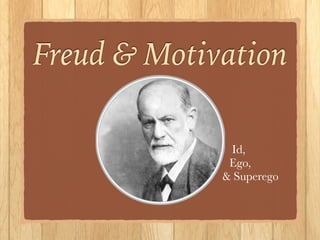
Freud & Motivation
Id,
Ego,
& Superego
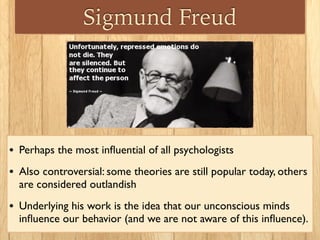
Sigmund Freud
• Perhaps the most influential of all psychologists
• Also controversial: some theories are still popular today, others
are considered outlandish
• Underlying his work is the idea that our unconscious minds
influence our behavior (and we are not aware of this influence).
Freud’s View of Motivation
Freud believed that human behavior is
motivated by the id, ego, and superego.
Id = Pleasure:
All animals instinctively
seek things that bring them
pleasure (food, water,
freedom, sex) and avoid
things that bring them pain.
The “Id”
The instinctual part of the mind that responds immediately
to wants and desires. It operates on the pleasure principle,
and does not follow logic or reason.The id is chaotic and
animal-like, simply seeking pleasure and avoiding pain.
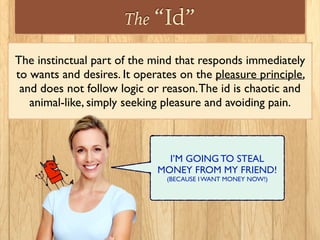
I’M GOING TO STEAL
MONEY FROM MY FRIEND!
(BECAUSE I WANT MONEY NOW!)
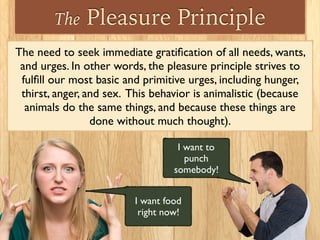
The Pleasure Principle
The need to seek immediate gratification of all needs, wants,
and urges. In other words, the pleasure principle strives to
fulfill our most basic and primitive urges, including hunger,
thirst, anger, and sex. This behavior is animalistic (because
animals do the same things, and because these things are
done without much thought).
I want to
punch
somebody!
I want food
right now!
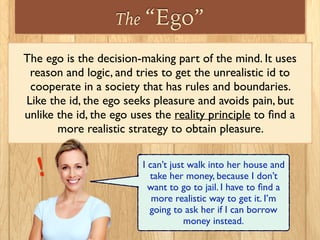
The “Ego”
The ego is the decision-making part of the mind. It uses
reason and logic, and tries to get the unrealistic id to
cooperate in a society that has rules and boundaries.
Like the id, the ego seeks pleasure and avoids pain, but
unlike the id, the ego uses the reality principle to find a
more realistic strategy to obtain pleasure.
I can’t just walk into her house and
take her money, because I don’t
want to go to jail. I have to find a
more realistic way to get it. I’m
going to ask her if I can borrow
money instead.
!
The Reality Principle
The the reality principle strives to satisfy the id's desires in
realistic and socially appropriate ways.The reality principle
logically weighs the costs and benefits of an action before
deciding to act upon or abandon an impulse.
I’m hungry, but I
can’t grab the
food off of
someone else’s
plate: they will
yell at me. I
should ask
someone to
give me food
instead…
I have the urge
to cut people
up into tiny
pieces, but, I’ll
go to jail. I
should become
a surgeon
instead of being
a serial killer…
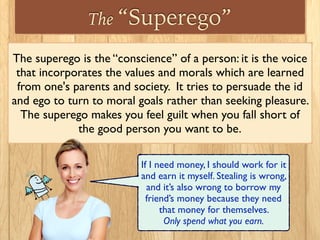
The “Superego”
The superego is the “conscience” of a person: it is the voice
that incorporates the values and morals which are learned
from one's parents and society. It tries to persuade the id
and ego to turn to moral goals rather than seeking pleasure.
The superego makes you feel guilt when you fall short of
the good person you want to be.
If I need money, I should work for it
and earn it myself. Stealing is wrong,
and it’s also wrong to borrow my
friend’s money because they need
that money for themselves.
Only spend what you earn.
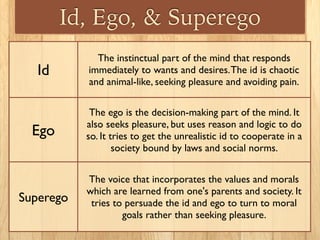
Id, Ego, & Superego
Id
The instinctual part of the mind that responds
immediately to wants and desires.The id is chaotic
and animal-like, seeking pleasure and avoiding pain.
Ego
The ego is the decision-making part of the mind. It
also seeks pleasure, but uses reason and logic to do
so. It tries to get the unrealistic id to cooperate in a
society bound by laws and social norms.
Superego
The voice that incorporates the values and morals
which are learned from one's parents and society. It
tries to persuade the id and ego to turn to moral
goals rather than seeking pleasure.
Childhood Experiences
Freud believed that when
children are born, their
minds are entirely “id.” As
they try and fail things,
learning what is acceptable in
society, they develop an
“ego.” The “superego” is the
last to develop, as children
learn the values of their
parents and gain a moral
understanding of the world.
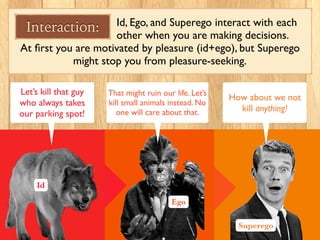
Id, Ego, and Superego interact with each
other when you are making decisions.
At first you are motivated by pleasure (id+ego), but Superego
might stop you from pleasure-seeking.
Let’s kill that guy
who always takes
our parking spot!
That might ruin our life. Let’s
kill small animals instead. No
one will care about that.
How about we not
kill anything!
Id
Ego
Superego
Interaction:
Assignment
Create an illustration in which id, ego, and superego are arguing
about how to behave. See specific instructions on the class website.
Let’s kill that guy
who always takes
our parking spot!
That might ruin our life. Let’s
kill small animals instead. No
one will care about that.
How about we not
kill anything!
Id
Ego
Superego
Assignment
Create an illustration in which id, ego, and superego are arguing
about how to behave. See specific instructions on the class website.
I want money!
power! fame!
Raaahhhhrrrr! I can
do whatever I want!
I want those things too, but I
need to avoid saying stupid
things that offend people. I
need to make people think I
am a good person.
I don’t really believe that
money, power, and fame
are things leaders should
care about. Leaders
should care about
citizens…
Id Ego Superego

Sigmund Freud Part 1

  • 1.
  • 2.
    Sigmund Freud • Perhapsthe most influential of all psychologists • Also controversial: some theories are still popular today, others are considered outlandish • Underlying his work is the idea that our unconscious minds influence our behavior (and we are not aware of this influence).
  • 3.
    Freud’s View ofMotivation Freud believed that human behavior is motivated by the id, ego, and superego. Id = Pleasure: All animals instinctively seek things that bring them pleasure (food, water, freedom, sex) and avoid things that bring them pain.
  • 4.
    The “Id” The instinctualpart of the mind that responds immediately to wants and desires. It operates on the pleasure principle, and does not follow logic or reason.The id is chaotic and animal-like, simply seeking pleasure and avoiding pain. I’M GOING TO STEAL MONEY FROM MY FRIEND! (BECAUSE I WANT MONEY NOW!)
  • 5.
    The Pleasure Principle Theneed to seek immediate gratification of all needs, wants, and urges. In other words, the pleasure principle strives to fulfill our most basic and primitive urges, including hunger, thirst, anger, and sex. This behavior is animalistic (because animals do the same things, and because these things are done without much thought). I want to punch somebody! I want food right now!
  • 6.
    The “Ego” The egois the decision-making part of the mind. It uses reason and logic, and tries to get the unrealistic id to cooperate in a society that has rules and boundaries. Like the id, the ego seeks pleasure and avoids pain, but unlike the id, the ego uses the reality principle to find a more realistic strategy to obtain pleasure. I can’t just walk into her house and take her money, because I don’t want to go to jail. I have to find a more realistic way to get it. I’m going to ask her if I can borrow money instead. !
  • 7.
    The Reality Principle Thethe reality principle strives to satisfy the id's desires in realistic and socially appropriate ways.The reality principle logically weighs the costs and benefits of an action before deciding to act upon or abandon an impulse. I’m hungry, but I can’t grab the food off of someone else’s plate: they will yell at me. I should ask someone to give me food instead… I have the urge to cut people up into tiny pieces, but, I’ll go to jail. I should become a surgeon instead of being a serial killer…
  • 8.
    The “Superego” The superegois the “conscience” of a person: it is the voice that incorporates the values and morals which are learned from one's parents and society. It tries to persuade the id and ego to turn to moral goals rather than seeking pleasure. The superego makes you feel guilt when you fall short of the good person you want to be. If I need money, I should work for it and earn it myself. Stealing is wrong, and it’s also wrong to borrow my friend’s money because they need that money for themselves. Only spend what you earn.
  • 9.
    Id, Ego, &Superego Id The instinctual part of the mind that responds immediately to wants and desires.The id is chaotic and animal-like, seeking pleasure and avoiding pain. Ego The ego is the decision-making part of the mind. It also seeks pleasure, but uses reason and logic to do so. It tries to get the unrealistic id to cooperate in a society bound by laws and social norms. Superego The voice that incorporates the values and morals which are learned from one's parents and society. It tries to persuade the id and ego to turn to moral goals rather than seeking pleasure.
  • 10.
    Childhood Experiences Freud believedthat when children are born, their minds are entirely “id.” As they try and fail things, learning what is acceptable in society, they develop an “ego.” The “superego” is the last to develop, as children learn the values of their parents and gain a moral understanding of the world.
  • 11.
    Id, Ego, andSuperego interact with each other when you are making decisions. At first you are motivated by pleasure (id+ego), but Superego might stop you from pleasure-seeking. Let’s kill that guy who always takes our parking spot! That might ruin our life. Let’s kill small animals instead. No one will care about that. How about we not kill anything! Id Ego Superego Interaction:
  • 12.
    Assignment Create an illustrationin which id, ego, and superego are arguing about how to behave. See specific instructions on the class website. Let’s kill that guy who always takes our parking spot! That might ruin our life. Let’s kill small animals instead. No one will care about that. How about we not kill anything! Id Ego Superego
  • 13.
    Assignment Create an illustrationin which id, ego, and superego are arguing about how to behave. See specific instructions on the class website. I want money! power! fame! Raaahhhhrrrr! I can do whatever I want! I want those things too, but I need to avoid saying stupid things that offend people. I need to make people think I am a good person. I don’t really believe that money, power, and fame are things leaders should care about. Leaders should care about citizens… Id Ego Superego