FLUID AND CRYSTALLIZED
INTELLIGENCE
By:
Raymond Cattell and John Horn
What is the “fluid and crystallized
intelligence”?


In the 1960s American psychologists
Raymond Cattell and John Horn
applied new methods of factor analysis
and concluded there are two kinds of
general intelligence: fluid intelligence (gf)
and crystallized intelligence (gc).
What is the “fluid and crystallized
intelligence”?


Raymond Cattell first proposed the
concepts of fluid and crystallized
intelligence and further developed the
theory with John Horn. The Cattell-Horn
theory of
fluid and crystallized
intelligence suggests that intelligence is
composed of a number of different
abilities that interact and work together
to produce overall individual intelligence.
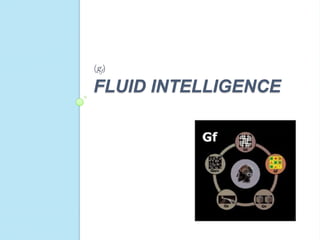
(gf)

FLUID INTELLIGENCE
Fluid intelligence
 represents the biological basis of intelligence.
Measures of fluid intelligence, such as speed
of reasoning and memory, increase into
adulthood and then decline due to the aging
process.
Fluid intelligence
 involves being able to think and reason
abstractly and solve problems

 considered

independent
of
learning,
experience, and education.
Examples of the use of fluid intelligence:
solving puzzles and coming up with problem
solving strategies.
Fluid intelligence
Examples of the use of fluid intelligence:

solving puzzles
coming up with problem solving strategies.
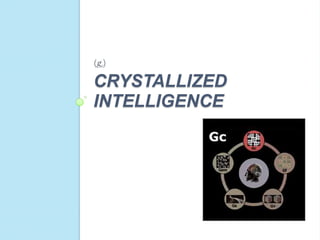
(gc)

CRYSTALLIZED
INTELLIGENCE
Crystallized intelligence
 the

knowledge and skills
obtained through learning
and experience.
Crystallized intelligence
As long as opportunities for
learning are available, crystallized
intelligence
can
increase
indefinitely during a person’s life.
For example, vocabulary knowledge is
known to increase in college professors
throughout their life span.
Crystallized intelligence
involves

knowledge that comes
from prior learning and past
experiences
Crystallized intelligence
Situations that require crystallized
intelligence include reading comprehension
and vocabulary exams.
Crystallized intelligence
 This

type of intelligence is based upon
facts and rooted in experiences.

As we age and accumulate new
knowledge
and
understanding,
crystallized intelligence becomes
stronger.

Fluid and crystallized intelligence

  • 1.
  • 2.
    What is the“fluid and crystallized intelligence”?  In the 1960s American psychologists Raymond Cattell and John Horn applied new methods of factor analysis and concluded there are two kinds of general intelligence: fluid intelligence (gf) and crystallized intelligence (gc).
  • 3.
    What is the“fluid and crystallized intelligence”?  Raymond Cattell first proposed the concepts of fluid and crystallized intelligence and further developed the theory with John Horn. The Cattell-Horn theory of fluid and crystallized intelligence suggests that intelligence is composed of a number of different abilities that interact and work together to produce overall individual intelligence.
  • 4.
  • 5.
    Fluid intelligence  representsthe biological basis of intelligence. Measures of fluid intelligence, such as speed of reasoning and memory, increase into adulthood and then decline due to the aging process.
  • 6.
    Fluid intelligence  involvesbeing able to think and reason abstractly and solve problems  considered independent of learning, experience, and education. Examples of the use of fluid intelligence: solving puzzles and coming up with problem solving strategies.
  • 7.
    Fluid intelligence Examples ofthe use of fluid intelligence: solving puzzles coming up with problem solving strategies.
  • 8.
  • 9.
    Crystallized intelligence  the knowledgeand skills obtained through learning and experience.
  • 10.
    Crystallized intelligence As longas opportunities for learning are available, crystallized intelligence can increase indefinitely during a person’s life. For example, vocabulary knowledge is known to increase in college professors throughout their life span.
  • 11.
    Crystallized intelligence involves knowledge thatcomes from prior learning and past experiences
  • 12.
    Crystallized intelligence Situations thatrequire crystallized intelligence include reading comprehension and vocabulary exams.
  • 13.
    Crystallized intelligence  This typeof intelligence is based upon facts and rooted in experiences. As we age and accumulate new knowledge and understanding, crystallized intelligence becomes stronger.