BEHAVIORISM
(JOHN B. WATSON THEORY)
BY:
MS. CHANDA SAH
LECTURER
UCNS, Bhairahwa, Nepal
BEHAVIORISM
Behaviorism, also known as behavioral
psychology, is a theory of learning based upon
the idea that all behaviors are acquired
through conditioning.
Conditioning occurs through interaction with the
environment.
 Behaviorists believe that our responses to
environmental stimuli shape our actions.
Contd..
Behaviorism refers to the school of psychology
founded by John B. Watson based on the belief
that behaviors can be measured, trained, and
changed.
Behaviorism was established with the publication
of Watson's classic paper "Psychology as the
Behaviorist Views It" (1913).
Assumptions of behaviorism:
1. The primary means of investigating learning is
by observation.
2. Principles of learning apply equally to different
behaviors and to different species of animals.
3. Learning processes can be studied objectively.
Typically learning is described as a stimulus and
response relationship(S = R).
4. Internal cognitive processes are largely excluded
from scientific study.
Contd…
5. Learning involves a behavior change.
6. Organisms are born as blank sheets. Since each
organism has a different experience with the
environment, each will have a different set of
behaviors.
7. Learning is largely the result of environmental
events. Behaviorists tend to use the term
conditioning instead of learning to reflect this.
Principles of learning from
behaviorist theory
Principle of frequency/exercise:
 It states that the more frequently a given
response is made to a given stimulus, the more
likely the response to that stimulus will be
repeated.
Contd…
Principle of Recency:
It states that the more recently a given response to
a particular stimulus is made, the more likely it
will be repeated.
Whatever we did last under a given set of
circumstances will be what we will tend to do
again if those circumstances are reencountered.
Things most recently learned are best
remembered. Frequent review and summarization
help fix in the mind the material covered.
Contd…
Principles of effect:
Positive and negative reinforcement
Consistency in the use of reinforcers
during the teaching learning process
Contd…
Father of American Behaviorist theory or
father of Behaviorism.
His work based on Pavlov experiments on
dogs digestive system.
He researched on classical conditioning.
Watson believed that all individual
differences in behavior were due to different
experiences of learning.
Contd..
John Watson proposed that the process of
classical conditioning was able to explain all
aspects of human psychology.
Everything from speech to emotional
responses were simply patterns of stimulus
and response.
Watson denied completely the existence of
the mind or consciousness.
Contd..
John Watson's Academic Life:
John B. Watson grew up in South Carolina.
He entered Furman University at the age of
16.
After graduating with a master's degree, he
began studying psychology at the University
of Chicago.
Watson earned his Ph.D. in psychology in
1903 ( youngest person to receive a PhD at
the age of 25).
Contd…
John Watson's Career:
In 1908, Watson joined as the faculty at John
Hopkins University.
In 1913, he gave a seminar lecture at Columbia
University titled ’Psychology as the Behaviorist
Views It ‘ in which he “reviewed failings of
introspective study, and offered a different definition
of psychology, calling it the ‘science of behavior’.
Contd…
He was also elected president of the American
Psychological Association.
Watson’s work was based on the experiments of
Ivan Pavlov, who had studied animals’ responses to
conditioning.
 He became interested in the work of Ivan Pavlov
and included a brief summary of Pavlov’s works in
his major works.
Pavlov believed, as Watson was later to emphasize,
that humans react to stimuli in the same way.
Famous quotation by Watson
Give me a dozen healthy infants, well-formed,
and my own specified world to bring them up in
and I’ll guarantee to take any one at random and
train him to become any type of specialist I might
select – doctor, lawyer, artist, merchant chief and
yes, even beggar-man and thief, regardless of his
talents, penchants, tendencies, abilities, vocations
and the race of his ancestors”.
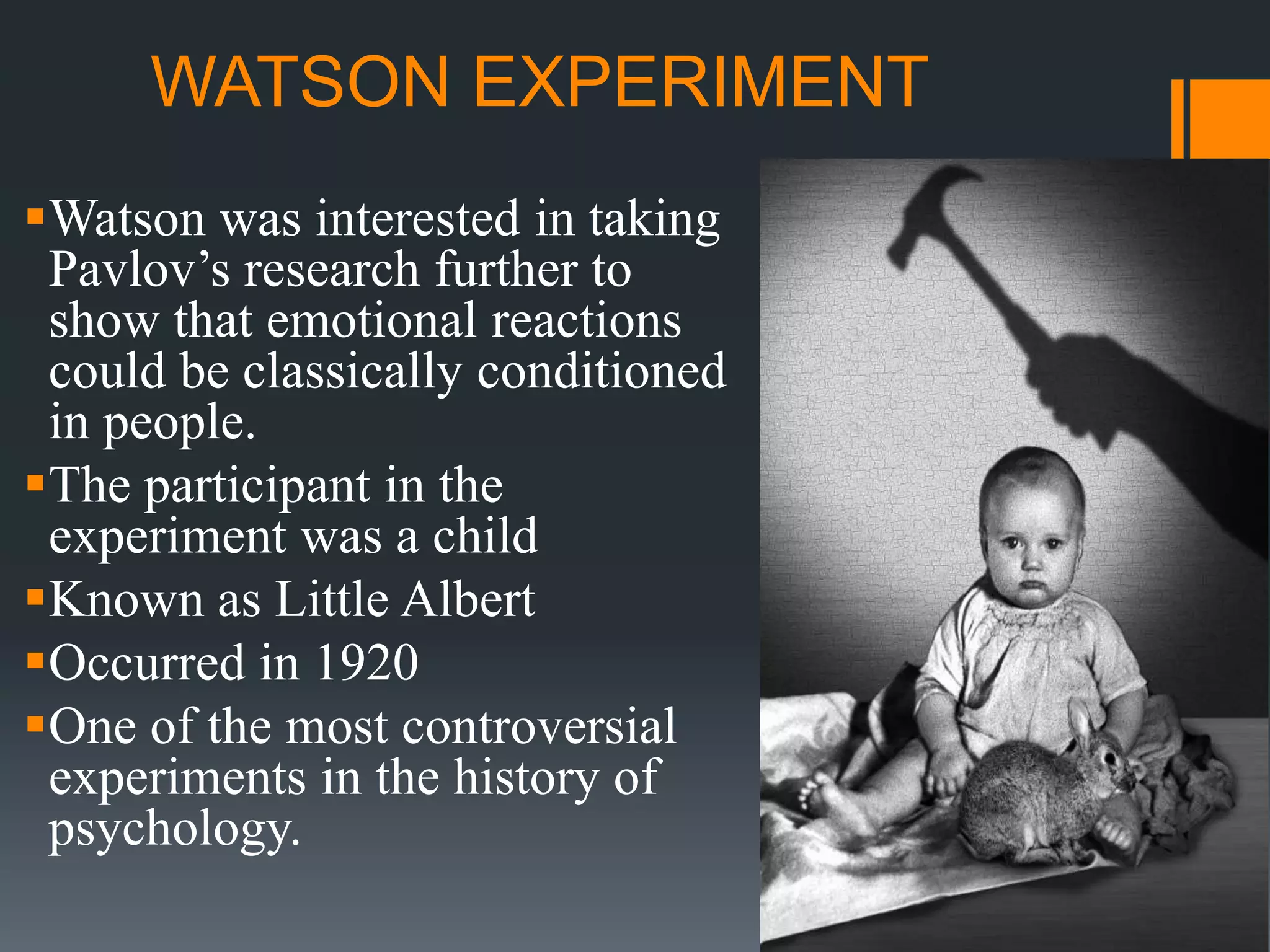
WATSON EXPERIMENT
Watson was interested in taking
Pavlov’s research further to
show that emotional reactions
could be classically conditioned
in people.
The participant in the
experiment was a child
Known as Little Albert
Occurred in 1920
One of the most controversial
experiments in the history of
psychology.
Contd…
A 9 months old infant, Albert, was selected
He was tested and was judged to show no fear
when successively observing a number of live
animals (e.g. a rat, a rabbit, a dog, and a
monkey) and various inanimate objects (e.g.
cotton, human masks, a burning newspaper).
Little Albert Experiment
Watson’s Experiment contd…
During the baseline, Albert showed no fear
toward any of these items.
Albert was placed on a mattress on a table
in the middle of room. A white rat was placed
near Albert and he was allowed to play with
it.
At this point, the child showed no fear of rat.
He began to reach out to the rat, as it
roamed around him.
Contd…
In later trails, Watson made a loud sound behind
Albert’s back by striking a suspended steel bar with
a hammer when the baby touched the rat.
Not surprisingly in these occasions, Albert cried and
showed fear as he heard the noise.
After several such pairings of the two stimuli, Albert
was again presented with only the rat.
Contd…
Now however, he became very distressed as the
rat appeared in the room.
He cried, turned away from rat, and tried to move
away.
The experiment showed that Little Albert seemed
to generalize his response to furry objects so that
when Watson sent a nonwhite rabbit into the
room seventeen days after the original
experiment, Albert also became distressed.
Contd…
He showed similar reactions when presented
with a furry dog, and even when Watson
appeared in front of him wearing a Santa
Claus mask with white cotton balls as his
beard.
Contd..
Later, another child, three year old Peter, was
experimented.
Once the fear was well established, he brought
the rabbit into the same room with the child
while the child was eating, keeping enough
distance between the rabbit and child so that
the child was not alarmed.
Contd..
He then moved the rabbit closer and closer to
the child, allowing him to grow accustomed to it
in gradual steps.
Eventually the child was able to touch and hold
the formerly fear inducing animal.
According to Watson, this procedure had
eliminated fear by conditioning a positive
emotional response, produced by eating, to the
rabbit.
Contd…
Stage 1- Before Conditioning:
The boy initially showed no fear of any of the objects
he was shown.
Contd…
Stage 2 During Conditioning:
The next time Albert was exposed the rat,
Watson made a loud noise by hitting a metal
pipe with a hammer.
Contd…
Stage 3 After Conditioning:
Naturally, the child began to cry after hearing
the loud noise.
After repeatedly pairing the white rat with the
loud noise, Albert began to cry simply after
seeing the rat.
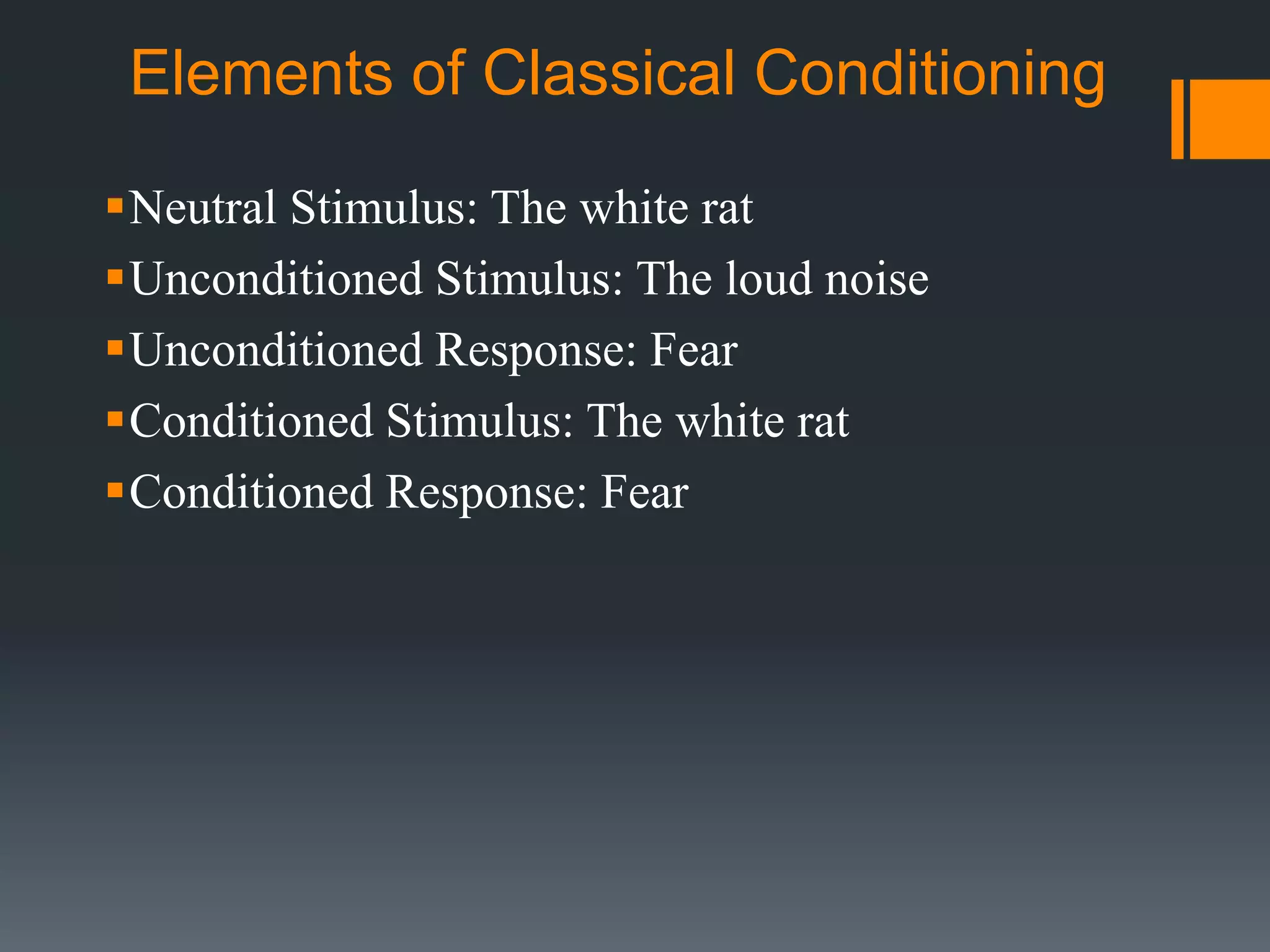
Elements of Classical Conditioning
Neutral Stimulus: The white rat
Unconditioned Stimulus: The loud noise
Unconditioned Response: Fear
Conditioned Stimulus: The white rat
Conditioned Response: Fear
Progression results of
experiment
Introduction of a loud sound (unconditioned
stimulus) resulted in fear (unconditioned response)
, a natural response.
Introduction of a rat (neutral stimulus) paired with
the loud sound (unconditioned stimulus) resulted in
fear (unconditioned response)
Successive introductions of a rat (conditioned
response). Here, learning is demonstrated.
Aspects of Watson’s theory
He opposed mentalistic concepts.
He used contiguity to explain learning.
He considered emotion to be just another example
of classical conditioning.
He rejected the notion of individual differences.
Aspects of Watson theory contd..
He thought complex behaviors came about through
combinations of identifiable reflexes.
He was a chief proponent of “nurture” and believed that
all human differences were the result of learning.
He believed that practice strengthens learning.
Implications of Watson's theory:
Animal trainers, parents, teachers, and many others
make use of basic behavioral principles to help
teach new behaviors and discourage unwanted
ones.
To find out whether the students have better
understanding through observing their behavior
changes.
Sequencing of learning lead to mastery in learning,
Use of reinforcement to improve : positive verbal
reinforcement take little time or effort and usually
bring about the desired behavior quickly.
Contd….
Treating various behavioral and psychological
problem like phobia and anxiety.
Immediate consistent and positive reinforcement
increases the speed of learning as well as
intermittent reinforcement promotes retention of
the learnt behavior.
Habits and other undesirable responses can be
broken by removing the positive reinforces
connected with them.
Critiques of John Watson
theory:
Thomson attaches more importance to the law of effect than
to the law of exercise and frequency.
He points out that there is no guarantee in favour of the
successful movement being most frequently repeated or
exercised.
Even an erroneous movement may go on being repeated.
so according to the law of frequency only; it stands a fair
chance of being stamped in. this however, does not occur if
the law of effect be emphasized.
Secondly, if recency alone be the cause of learning then
every prior unsuccessful or erroneous movement being
recent would go on being repeated.
Assignment
 Strength and criticism of behaviorism

Behaviorism (john b watson)

  • 1.
    BEHAVIORISM (JOHN B. WATSONTHEORY) BY: MS. CHANDA SAH LECTURER UCNS, Bhairahwa, Nepal
  • 2.
    BEHAVIORISM Behaviorism, also knownas behavioral psychology, is a theory of learning based upon the idea that all behaviors are acquired through conditioning. Conditioning occurs through interaction with the environment.  Behaviorists believe that our responses to environmental stimuli shape our actions.
  • 3.
    Contd.. Behaviorism refers tothe school of psychology founded by John B. Watson based on the belief that behaviors can be measured, trained, and changed. Behaviorism was established with the publication of Watson's classic paper "Psychology as the Behaviorist Views It" (1913).
  • 4.
    Assumptions of behaviorism: 1.The primary means of investigating learning is by observation. 2. Principles of learning apply equally to different behaviors and to different species of animals. 3. Learning processes can be studied objectively. Typically learning is described as a stimulus and response relationship(S = R). 4. Internal cognitive processes are largely excluded from scientific study.
  • 5.
    Contd… 5. Learning involvesa behavior change. 6. Organisms are born as blank sheets. Since each organism has a different experience with the environment, each will have a different set of behaviors. 7. Learning is largely the result of environmental events. Behaviorists tend to use the term conditioning instead of learning to reflect this.
  • 6.
    Principles of learningfrom behaviorist theory Principle of frequency/exercise:  It states that the more frequently a given response is made to a given stimulus, the more likely the response to that stimulus will be repeated.
  • 7.
    Contd… Principle of Recency: Itstates that the more recently a given response to a particular stimulus is made, the more likely it will be repeated. Whatever we did last under a given set of circumstances will be what we will tend to do again if those circumstances are reencountered. Things most recently learned are best remembered. Frequent review and summarization help fix in the mind the material covered.
  • 8.
    Contd… Principles of effect: Positiveand negative reinforcement Consistency in the use of reinforcers during the teaching learning process
  • 11.
    Contd… Father of AmericanBehaviorist theory or father of Behaviorism. His work based on Pavlov experiments on dogs digestive system. He researched on classical conditioning. Watson believed that all individual differences in behavior were due to different experiences of learning.
  • 12.
    Contd.. John Watson proposedthat the process of classical conditioning was able to explain all aspects of human psychology. Everything from speech to emotional responses were simply patterns of stimulus and response. Watson denied completely the existence of the mind or consciousness.
  • 13.
    Contd.. John Watson's AcademicLife: John B. Watson grew up in South Carolina. He entered Furman University at the age of 16. After graduating with a master's degree, he began studying psychology at the University of Chicago. Watson earned his Ph.D. in psychology in 1903 ( youngest person to receive a PhD at the age of 25).
  • 14.
    Contd… John Watson's Career: In1908, Watson joined as the faculty at John Hopkins University. In 1913, he gave a seminar lecture at Columbia University titled ’Psychology as the Behaviorist Views It ‘ in which he “reviewed failings of introspective study, and offered a different definition of psychology, calling it the ‘science of behavior’.
  • 15.
    Contd… He was alsoelected president of the American Psychological Association. Watson’s work was based on the experiments of Ivan Pavlov, who had studied animals’ responses to conditioning.  He became interested in the work of Ivan Pavlov and included a brief summary of Pavlov’s works in his major works. Pavlov believed, as Watson was later to emphasize, that humans react to stimuli in the same way.
  • 16.
    Famous quotation byWatson Give me a dozen healthy infants, well-formed, and my own specified world to bring them up in and I’ll guarantee to take any one at random and train him to become any type of specialist I might select – doctor, lawyer, artist, merchant chief and yes, even beggar-man and thief, regardless of his talents, penchants, tendencies, abilities, vocations and the race of his ancestors”.
  • 18.
    WATSON EXPERIMENT Watson wasinterested in taking Pavlov’s research further to show that emotional reactions could be classically conditioned in people. The participant in the experiment was a child Known as Little Albert Occurred in 1920 One of the most controversial experiments in the history of psychology.
  • 19.
    Contd… A 9 monthsold infant, Albert, was selected He was tested and was judged to show no fear when successively observing a number of live animals (e.g. a rat, a rabbit, a dog, and a monkey) and various inanimate objects (e.g. cotton, human masks, a burning newspaper).
  • 20.
  • 21.
    Watson’s Experiment contd… Duringthe baseline, Albert showed no fear toward any of these items. Albert was placed on a mattress on a table in the middle of room. A white rat was placed near Albert and he was allowed to play with it. At this point, the child showed no fear of rat. He began to reach out to the rat, as it roamed around him.
  • 22.
    Contd… In later trails,Watson made a loud sound behind Albert’s back by striking a suspended steel bar with a hammer when the baby touched the rat. Not surprisingly in these occasions, Albert cried and showed fear as he heard the noise. After several such pairings of the two stimuli, Albert was again presented with only the rat.
  • 23.
    Contd… Now however, hebecame very distressed as the rat appeared in the room. He cried, turned away from rat, and tried to move away. The experiment showed that Little Albert seemed to generalize his response to furry objects so that when Watson sent a nonwhite rabbit into the room seventeen days after the original experiment, Albert also became distressed.
  • 24.
    Contd… He showed similarreactions when presented with a furry dog, and even when Watson appeared in front of him wearing a Santa Claus mask with white cotton balls as his beard.
  • 25.
    Contd.. Later, another child,three year old Peter, was experimented. Once the fear was well established, he brought the rabbit into the same room with the child while the child was eating, keeping enough distance between the rabbit and child so that the child was not alarmed.
  • 26.
    Contd.. He then movedthe rabbit closer and closer to the child, allowing him to grow accustomed to it in gradual steps. Eventually the child was able to touch and hold the formerly fear inducing animal. According to Watson, this procedure had eliminated fear by conditioning a positive emotional response, produced by eating, to the rabbit.
  • 27.
    Contd… Stage 1- BeforeConditioning: The boy initially showed no fear of any of the objects he was shown.
  • 28.
    Contd… Stage 2 DuringConditioning: The next time Albert was exposed the rat, Watson made a loud noise by hitting a metal pipe with a hammer.
  • 29.
    Contd… Stage 3 AfterConditioning: Naturally, the child began to cry after hearing the loud noise. After repeatedly pairing the white rat with the loud noise, Albert began to cry simply after seeing the rat.
  • 30.
    Elements of ClassicalConditioning Neutral Stimulus: The white rat Unconditioned Stimulus: The loud noise Unconditioned Response: Fear Conditioned Stimulus: The white rat Conditioned Response: Fear
  • 31.
    Progression results of experiment Introductionof a loud sound (unconditioned stimulus) resulted in fear (unconditioned response) , a natural response. Introduction of a rat (neutral stimulus) paired with the loud sound (unconditioned stimulus) resulted in fear (unconditioned response) Successive introductions of a rat (conditioned response). Here, learning is demonstrated.
  • 32.
    Aspects of Watson’stheory He opposed mentalistic concepts. He used contiguity to explain learning. He considered emotion to be just another example of classical conditioning. He rejected the notion of individual differences.
  • 33.
    Aspects of Watsontheory contd.. He thought complex behaviors came about through combinations of identifiable reflexes. He was a chief proponent of “nurture” and believed that all human differences were the result of learning. He believed that practice strengthens learning.
  • 34.
    Implications of Watson'stheory: Animal trainers, parents, teachers, and many others make use of basic behavioral principles to help teach new behaviors and discourage unwanted ones. To find out whether the students have better understanding through observing their behavior changes. Sequencing of learning lead to mastery in learning, Use of reinforcement to improve : positive verbal reinforcement take little time or effort and usually bring about the desired behavior quickly.
  • 35.
    Contd…. Treating various behavioraland psychological problem like phobia and anxiety. Immediate consistent and positive reinforcement increases the speed of learning as well as intermittent reinforcement promotes retention of the learnt behavior. Habits and other undesirable responses can be broken by removing the positive reinforces connected with them.
  • 36.
    Critiques of JohnWatson theory: Thomson attaches more importance to the law of effect than to the law of exercise and frequency. He points out that there is no guarantee in favour of the successful movement being most frequently repeated or exercised. Even an erroneous movement may go on being repeated. so according to the law of frequency only; it stands a fair chance of being stamped in. this however, does not occur if the law of effect be emphasized. Secondly, if recency alone be the cause of learning then every prior unsuccessful or erroneous movement being recent would go on being repeated.
  • 37.
    Assignment  Strength andcriticism of behaviorism