SOCIAL
FORCES and
PHENOMENA
(quick reference)
Conformity (Normative)
Going along with the group,
agreeing with the group, or
adopting the behavioral norms of
the group because you want them
to like you, or because you are
worried they might dislike you.
We are most likely to conform
when people are watching us,
when we admire the group
members, when the group
members are unanimous, and
when we have low self-esteem.
I want to be
accepted as part
of the group!
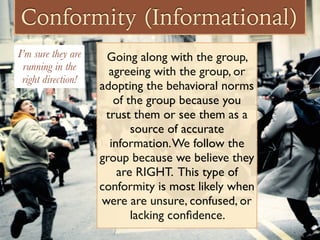
Conformity (Informational)
Going along with the group,
agreeing with the group, or
adopting the behavioral norms
of the group because you
trust them or see them as a
source of accurate
information.We follow the
group because we believe they
are RIGHT. This type of
conformity is most likely when
were are unsure, confused, or
lacking confidence.
I’m sure they are
running in the
right direction!
Obedience
Changing your behavior
or beliefs because an
authority figure told
you to do so. We
obviously follow the
orders of authority
figures because we fear
punishments, but we
are more likely to
follow authority figures
who we trust, respect,
or admire.
Yes, Coach!
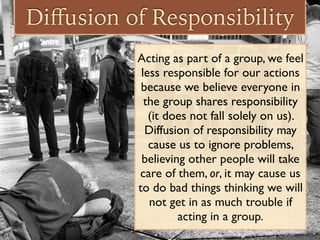
Diffusion of Responsibility
Acting as part of a group, we feel
less responsible for our actions
because we believe everyone in
the group shares responsibility
(it does not fall solely on us).
Diffusion of responsibility may
cause us to ignore problems,
believing other people will take
care of them, or, it may cause us
to do bad things thinking we will
not get in as much trouble if
acting in a group.
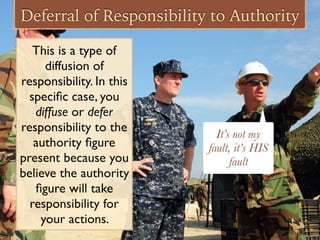
Deferral of Responsibility to Authority
This is a type of
diffusion of
responsibility. In this
specific case, you
diffuse or defer
responsibility to the
authority figure
present because you
believe the authority
figure will take
responsibility for
your actions.
It’s not my
fault, it’s HIS
fault
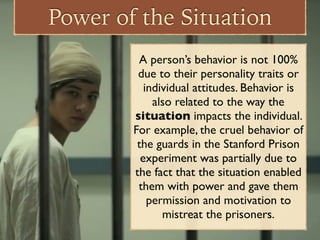
Power of the Situation
A person’s behavior is not 100%
due to their personality traits or
individual attitudes. Behavior is
also related to the way the
situation impacts the individual.
For example, the cruel behavior of
the guards in the Stanford Prison
experiment was partially due to
the fact that the situation enabled
them with power and gave them
permission and motivation to
mistreat the prisoners.
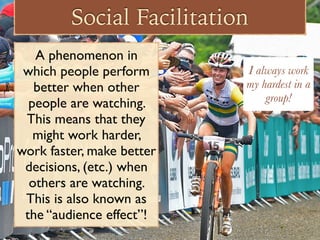
Social Facilitation
A phenomenon in
which people perform
better when other
people are watching.
This means that they
might work harder,
work faster, make better
decisions, (etc.) when
others are watching.
This is also known as
the “audience effect”!
I always work
my hardest in a
group!
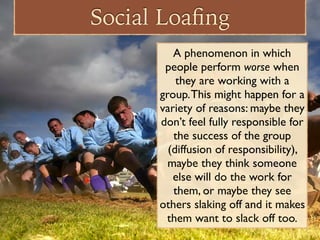
Social Loafing
A phenomenon in which
people perform worse when
they are working with a
group.This might happen for a
variety of reasons: maybe they
don’t feel fully responsible for
the success of the group
(diffusion of responsibility),
maybe they think someone
else will do the work for
them, or maybe they see
others slaking off and it makes
them want to slack off too.
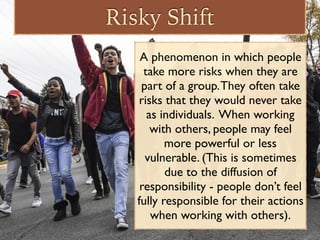
Risky Shift
A phenomenon in which people
take more risks when they are
part of a group.They often take
risks that they would never take
as individuals. When working
with others, people may feel
more powerful or less
vulnerable. (This is sometimes
due to the diffusion of
responsibility - people don’t feel
fully responsible for their actions
when working with others).
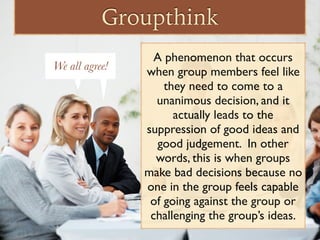
Groupthink
A phenomenon that occurs
when group members feel like
they need to come to a
unanimous decision, and it
actually leads to the
suppression of good ideas and
good judgement. In other
words, this is when groups
make bad decisions because no
one in the group feels capable
of going against the group or
challenging the group’s ideas.
We all agree!We all agree!

Terms Quick Reference

  • 1.
  • 2.
    Conformity (Normative) Going alongwith the group, agreeing with the group, or adopting the behavioral norms of the group because you want them to like you, or because you are worried they might dislike you. We are most likely to conform when people are watching us, when we admire the group members, when the group members are unanimous, and when we have low self-esteem. I want to be accepted as part of the group!
  • 3.
    Conformity (Informational) Going alongwith the group, agreeing with the group, or adopting the behavioral norms of the group because you trust them or see them as a source of accurate information.We follow the group because we believe they are RIGHT. This type of conformity is most likely when were are unsure, confused, or lacking confidence. I’m sure they are running in the right direction!
  • 4.
    Obedience Changing your behavior orbeliefs because an authority figure told you to do so. We obviously follow the orders of authority figures because we fear punishments, but we are more likely to follow authority figures who we trust, respect, or admire. Yes, Coach!
  • 5.
    Diffusion of Responsibility Actingas part of a group, we feel less responsible for our actions because we believe everyone in the group shares responsibility (it does not fall solely on us). Diffusion of responsibility may cause us to ignore problems, believing other people will take care of them, or, it may cause us to do bad things thinking we will not get in as much trouble if acting in a group.
  • 6.
    Deferral of Responsibilityto Authority This is a type of diffusion of responsibility. In this specific case, you diffuse or defer responsibility to the authority figure present because you believe the authority figure will take responsibility for your actions. It’s not my fault, it’s HIS fault
  • 7.
    Power of theSituation A person’s behavior is not 100% due to their personality traits or individual attitudes. Behavior is also related to the way the situation impacts the individual. For example, the cruel behavior of the guards in the Stanford Prison experiment was partially due to the fact that the situation enabled them with power and gave them permission and motivation to mistreat the prisoners.
  • 8.
    Social Facilitation A phenomenonin which people perform better when other people are watching. This means that they might work harder, work faster, make better decisions, (etc.) when others are watching. This is also known as the “audience effect”! I always work my hardest in a group!
  • 9.
    Social Loafing A phenomenonin which people perform worse when they are working with a group.This might happen for a variety of reasons: maybe they don’t feel fully responsible for the success of the group (diffusion of responsibility), maybe they think someone else will do the work for them, or maybe they see others slaking off and it makes them want to slack off too.
  • 10.
    Risky Shift A phenomenonin which people take more risks when they are part of a group.They often take risks that they would never take as individuals. When working with others, people may feel more powerful or less vulnerable. (This is sometimes due to the diffusion of responsibility - people don’t feel fully responsible for their actions when working with others).
  • 11.
    Groupthink A phenomenon thatoccurs when group members feel like they need to come to a unanimous decision, and it actually leads to the suppression of good ideas and good judgement. In other words, this is when groups make bad decisions because no one in the group feels capable of going against the group or challenging the group’s ideas. We all agree!We all agree!