Semiconductors 1
A SEMINAR REPORT ON
THE ZIGBEE TECHNOLOGY
BY
karthik nch
Semiconductors 2
Why ZigBee?
• Standard in a fragmented market
– Many proprietary solutions, interoperability issues
• Low Power consumption
– Users expect battery to last months to years!
• Low Cost
• High density of nodes per network
• Simple protocol, global implementation
Semiconductors 3
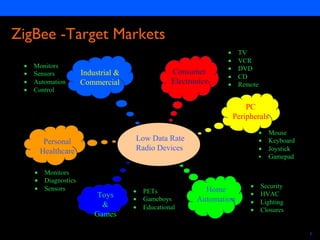
Low Data Rate
Radio Devices
• TV
• VCR
• DVD
• CD
• Remote
• Mouse
• Keyboard
• Joystick
• Gamepad
• Security
• HVAC
• Lighting
• Closures
• PETs
• Gameboys
• Educational
• Monitors
• Diagnostics
• Sensors
Industrial &
Commercial
Consumer
Electronics
Personal
Healthcare
• Monitors
• Sensors
• Automation
• Control
Toys
&
Games
Home
Automation
PC
Peripherals
ZigBee -Target Markets
Semiconductors 4
ZigBee - General Characteristics
• Data rates of 250 kbps and 20 kbps
• Star topology, peer to peer possible
• 255 devices per network
• CSMA-CA channel access
• Optional Guaranteed Time Slot
• Fully handshaked protocol for transfer reliability
• Low power (battery life multi-month to years)
• Dual PHY (2.4GHz and 868/915 MHz)
• Range: 10m nominal (1-100m based on settings)
• Location Aware:Yes, but optional
Semiconductors 5
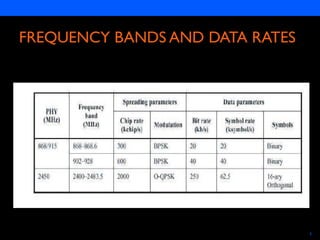
FREQUENCY BANDS AND DATA RATES
Semiconductors 6
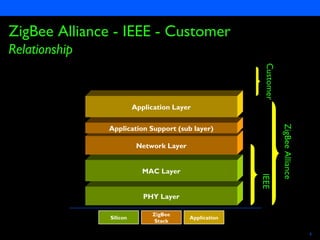
Silicon
PHY Layer
MAC Layer
Network Layer
ZigBee
Stack
Application
Application Support (sub layer)
Application Layer
Customer
ZigBeeAlliance
IEEE
ZigBee Alliance - IEEE - Customer
Relationship
Semiconductors 7
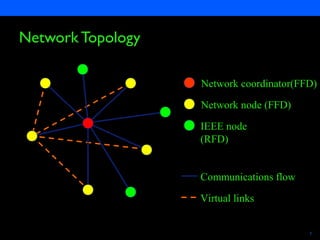
Virtual links
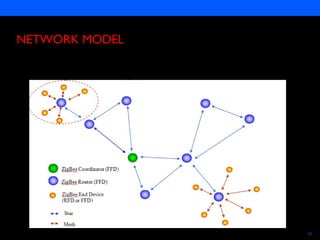
Network Topology
Network coordinator(FFD)
Network node (FFD)
Communications flow
IEEE node
(RFD)
Semiconductors 8
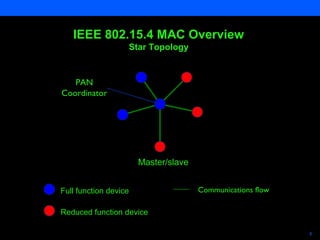
Full function device
Reduced function device
Communications flow
Master/slave
PAN
Coordinator
IEEE 802.15.4 MAC Overview
Star Topology
Semiconductors 9
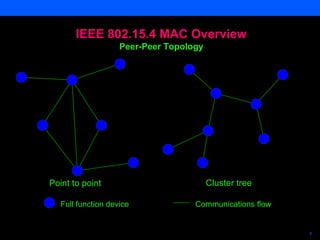
Full function device Communications flow
Point to point Cluster tree
IEEE 802.15.4 MAC Overview
Peer-Peer Topology
Semiconductors 10
NETWORK MODEL
Semiconductors 11
The Network Coordinator
• Transmits network beacons
• Sets up a network
• Manages network nodes
• Stores network node information
• Routes messages between paired nodes
• Receives constantly
Semiconductors 12
The Network Node
• Is generally battery powered
• Searches for available networks
• Transfers data from its application as necessary
• Determines whether data is pending
• Requests data from the network coordinator
• Can sleep for extended periods
Semiconductors 13
Supported Traffic Types
• Periodic data
– Application defined rate(e.g: sensors)
• Intermittent
– Basic communication(e.g: Light switch)
• Repetitive low latency data
– Allocation of guaranteed time slots
(e.g: mouse)
Semiconductors 14
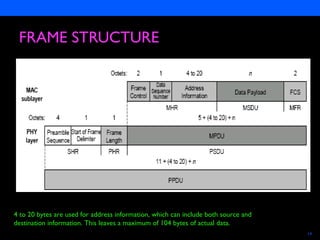
FRAME STRUCTURE
4 to 20 bytes are used for address information, which can include both source and
destination information. This leaves a maximum of 104 bytes of actual data.
Semiconductors 15
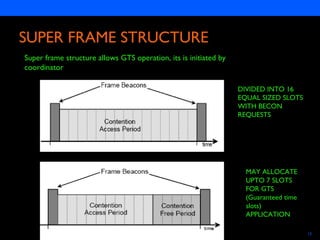
SUPER FRAME STRUCTURE
DIVIDED INTO 16
EQUAL SIZED SLOTS
WITH BECON
REQUESTS
MAY ALLOCATE
UPTO 7 SLOTS
FOR GTS
(Guaranteed time
slots)
APPLICATION
Super frame structure allows GTS operation, its is initiated by
coordinator
Semiconductors 16
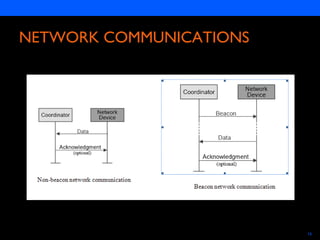
NETWORK COMMUNICATIONS
Semiconductors 17
THE ZIGBEE ALLIANCE
CompXs
Semiconductors 18
ZigBee vs Bluetooth
Competition or Complementary?
Semiconductors 19
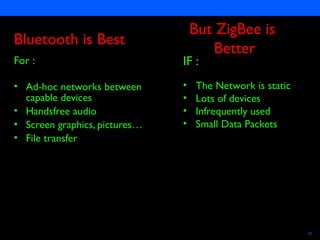
Bluetooth is Best
For :
• Ad-hoc networks between
capable devices
• Handsfree audio
• Screen graphics, pictures…
• File transfer
But ZigBee is
Better
IF :
• The Network is static
• Lots of devices
• Infrequently used
• Small Data Packets
Semiconductors 20
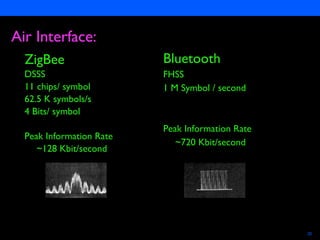
Air Interface:
ZigBee
DSSS
11 chips/ symbol
62.5 K symbols/s
4 Bits/ symbol
Peak Information Rate
~128 Kbit/second
Bluetooth
FHSS
1 M Symbol / second
Peak Information Rate
~720 Kbit/second
Semiconductors 21
Silicon
RF
Baseband
Link Controller
Voice
Link Manager
Host Control Interface
L2CAP
Telephony
Control
Protocol
Intercom
Headset
Cordless
GroupCall
RFCOMM
(Serial Port)
OBEX
HOST
MODULE
Bluetooth
Stack
Applications
vCard
vCal
vNote
vMessage
Dial-up
Networking
Fax Service
Discovery
Protocol
User Interface
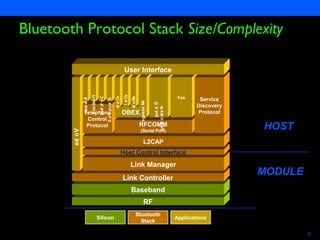
Bluetooth Protocol Stack Size/Complexity
Semiconductors 22
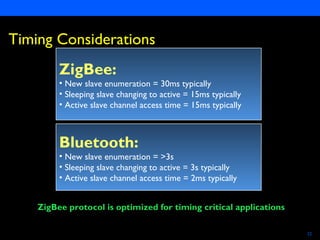
Bluetooth:
• New slave enumeration = >3s
• Sleeping slave changing to active = 3s typically
• Active slave channel access time = 2ms typically
ZigBee:
• New slave enumeration = 30ms typically
• Sleeping slave changing to active = 15ms typically
• Active slave channel access time = 15ms typically
Timing Considerations
ZigBee protocol is optimized for timing critical applications
Semiconductors 23
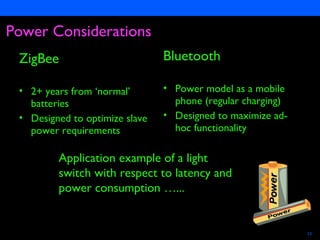
Power Considerations
ZigBee
• 2+ years from ‘normal’
batteries
• Designed to optimize slave
power requirements
Bluetooth
• Power model as a mobile
phone (regular charging)
• Designed to maximize ad-
hoc functionality
Application example of a light
switch with respect to latency and
power consumption …...
Semiconductors 25
ZigBee - Bluetooth - PLC Comparison
ZigBee Bluetooth PLC
Cost (BOM) $5 $10 $15-$40
Power years hours N/A
Data Rate 250Kbps 720Kbps 3/10 Mbps
Complexity Low Medium High
Density 255 + 7 20-250
Interop Yes Yes No
Ease of Use Simple Moderate Restrictive
Latency 15ms >3s <15ms
Interference Low High High
Security High High Low
Semiconductors 26
Conclusion
• ZigBee and Bluetooth are two solutions for two application
areas
Semiconductors 27

zigbee technology

  • 1.
    Semiconductors 1 A SEMINARREPORT ON THE ZIGBEE TECHNOLOGY BY karthik nch
  • 2.
    Semiconductors 2 Why ZigBee? •Standard in a fragmented market – Many proprietary solutions, interoperability issues • Low Power consumption – Users expect battery to last months to years! • Low Cost • High density of nodes per network • Simple protocol, global implementation
  • 3.
    Semiconductors 3 Low DataRate Radio Devices • TV • VCR • DVD • CD • Remote • Mouse • Keyboard • Joystick • Gamepad • Security • HVAC • Lighting • Closures • PETs • Gameboys • Educational • Monitors • Diagnostics • Sensors Industrial & Commercial Consumer Electronics Personal Healthcare • Monitors • Sensors • Automation • Control Toys & Games Home Automation PC Peripherals ZigBee -Target Markets
  • 4.
    Semiconductors 4 ZigBee -General Characteristics • Data rates of 250 kbps and 20 kbps • Star topology, peer to peer possible • 255 devices per network • CSMA-CA channel access • Optional Guaranteed Time Slot • Fully handshaked protocol for transfer reliability • Low power (battery life multi-month to years) • Dual PHY (2.4GHz and 868/915 MHz) • Range: 10m nominal (1-100m based on settings) • Location Aware:Yes, but optional
  • 5.
  • 6.
    Semiconductors 6 Silicon PHY Layer MACLayer Network Layer ZigBee Stack Application Application Support (sub layer) Application Layer Customer ZigBeeAlliance IEEE ZigBee Alliance - IEEE - Customer Relationship
  • 7.
    Semiconductors 7 Virtual links NetworkTopology Network coordinator(FFD) Network node (FFD) Communications flow IEEE node (RFD)
  • 8.
    Semiconductors 8 Full functiondevice Reduced function device Communications flow Master/slave PAN Coordinator IEEE 802.15.4 MAC Overview Star Topology
  • 9.
    Semiconductors 9 Full functiondevice Communications flow Point to point Cluster tree IEEE 802.15.4 MAC Overview Peer-Peer Topology
  • 10.
  • 11.
    Semiconductors 11 The NetworkCoordinator • Transmits network beacons • Sets up a network • Manages network nodes • Stores network node information • Routes messages between paired nodes • Receives constantly
  • 12.
    Semiconductors 12 The NetworkNode • Is generally battery powered • Searches for available networks • Transfers data from its application as necessary • Determines whether data is pending • Requests data from the network coordinator • Can sleep for extended periods
  • 13.
    Semiconductors 13 Supported TrafficTypes • Periodic data – Application defined rate(e.g: sensors) • Intermittent – Basic communication(e.g: Light switch) • Repetitive low latency data – Allocation of guaranteed time slots (e.g: mouse)
  • 14.
    Semiconductors 14 FRAME STRUCTURE 4to 20 bytes are used for address information, which can include both source and destination information. This leaves a maximum of 104 bytes of actual data.
  • 15.
    Semiconductors 15 SUPER FRAMESTRUCTURE DIVIDED INTO 16 EQUAL SIZED SLOTS WITH BECON REQUESTS MAY ALLOCATE UPTO 7 SLOTS FOR GTS (Guaranteed time slots) APPLICATION Super frame structure allows GTS operation, its is initiated by coordinator
  • 16.
  • 17.
  • 18.
    Semiconductors 18 ZigBee vsBluetooth Competition or Complementary?
  • 19.
    Semiconductors 19 Bluetooth isBest For : • Ad-hoc networks between capable devices • Handsfree audio • Screen graphics, pictures… • File transfer But ZigBee is Better IF : • The Network is static • Lots of devices • Infrequently used • Small Data Packets
  • 20.
    Semiconductors 20 Air Interface: ZigBee DSSS 11chips/ symbol 62.5 K symbols/s 4 Bits/ symbol Peak Information Rate ~128 Kbit/second Bluetooth FHSS 1 M Symbol / second Peak Information Rate ~720 Kbit/second
  • 21.
    Semiconductors 21 Silicon RF Baseband Link Controller Voice LinkManager Host Control Interface L2CAP Telephony Control Protocol Intercom Headset Cordless GroupCall RFCOMM (Serial Port) OBEX HOST MODULE Bluetooth Stack Applications vCard vCal vNote vMessage Dial-up Networking Fax Service Discovery Protocol User Interface Bluetooth Protocol Stack Size/Complexity
  • 22.
    Semiconductors 22 Bluetooth: • Newslave enumeration = >3s • Sleeping slave changing to active = 3s typically • Active slave channel access time = 2ms typically ZigBee: • New slave enumeration = 30ms typically • Sleeping slave changing to active = 15ms typically • Active slave channel access time = 15ms typically Timing Considerations ZigBee protocol is optimized for timing critical applications
  • 23.
    Semiconductors 23 Power Considerations ZigBee •2+ years from ‘normal’ batteries • Designed to optimize slave power requirements Bluetooth • Power model as a mobile phone (regular charging) • Designed to maximize ad- hoc functionality Application example of a light switch with respect to latency and power consumption …...
  • 24.
    Semiconductors 25 ZigBee -Bluetooth - PLC Comparison ZigBee Bluetooth PLC Cost (BOM) $5 $10 $15-$40 Power years hours N/A Data Rate 250Kbps 720Kbps 3/10 Mbps Complexity Low Medium High Density 255 + 7 20-250 Interop Yes Yes No Ease of Use Simple Moderate Restrictive Latency 15ms >3s <15ms Interference Low High High Security High High Low
  • 25.
    Semiconductors 26 Conclusion • ZigBeeand Bluetooth are two solutions for two application areas
  • 26.