ZigBee/IEEE 802.15.4
Sequence
• Background
• Gen Characteristics
• How it works
– Tech
– Bandwidth/ energy consumption
• Architecture
• Comparison with other WPAN Standards
• Applications
Why ZigBee ?
– Wireless communication standards:
• IEEE 802.11 a/b/g
• Bluetooth
• GSM
– What makes them unattractive for WSN:
• Power hungry (need big batteries)
• Complexity (need lots of clock cycles and memory)
– New protocol for WSN:
• 802.15.4 and Zigbee (ratified in Dec 14, 2004)
• Low Cost
• Low Power Consumption
• Scalability and Reliability
Origin Of Name ZigBee
• The technique that honey bees use to communicate
new-found food sources to other members of the
colony is referred to as the ZigBee Principle.
• Using this silent, but powerful communication
system, whereby the bee dances in a zig-zag pattern,
she is able to share information such as the location,
distance, and direction of a newly discovered food
source to her fellow colony members. Instinctively
implementing the ZigBee Principle.
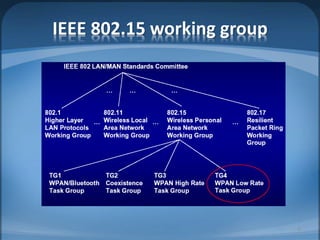
Within the broad organization of the Institute of Electrical and
Electronics Engineers (IEEE), the 802 group is the section that
deals with network operations and technologies. Group 15
works more specifically with wireless networking, and Task
Group 4 drafted the 802.15.4 standard for a low data rate
wireless personal area network (WPAN).
The ZigBee standard is currently an ‘open’ standard only to
those that are a part of the ZigBee Alliance. For this reason,
the ZigBee standard was not used to implement the
application layer.
802.15.4 Standard (WPAN)
IEEE 802.15 working group
6
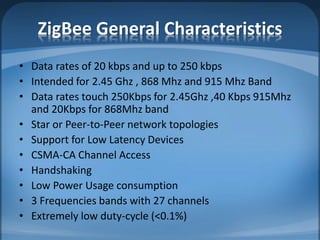
ZigBee General Characteristics
• Data rates of 20 kbps and up to 250 kbps
• Intended for 2.45 Ghz , 868 Mhz and 915 Mhz Band
• Data rates touch 250Kbps for 2.45Ghz ,40 Kbps 915Mhz
and 20Kbps for 868Mhz band
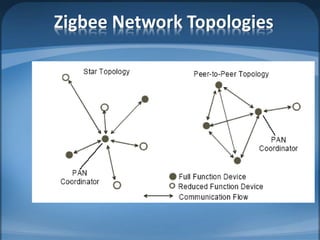
• Star or Peer-to-Peer network topologies
• Support for Low Latency Devices
• CSMA-CA Channel Access
• Handshaking
• Low Power Usage consumption
• 3 Frequencies bands with 27 channels
• Extremely low duty-cycle (<0.1%)
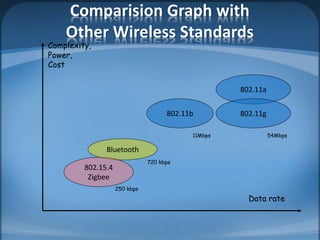
Comparision Graph with
Other Wireless Standards
Complexity,
Power,
Cost
Data rate
802.11a
802.11g802.11b
Bluetooth
802.15.4
Zigbee
54Mbps11Mbps
720 kbps
250 kbps
Why NOT 802.11 ?
The Cost of Throughput
• High data rates
– up to 11Mbps for b and
– up to 54Mbps for g and a)
• Distance up to 300 feet, or more with special
antennas
• High power consumption
– Sources about 1800mA when transceiver is
operational.
ZigBee Aims Low
• Low data rate
• Low power consumption
• Small packet devices
What Does ZigBee Do?
• Designed for wireless controls and sensors
• Operates in Personal Area Networks (PAN’s)
and device-to-device networks
• Connectivity between small packet devices
• Control of lights, switches, thermostats,
appliances, etc.
How ZigBee Works
• Devices
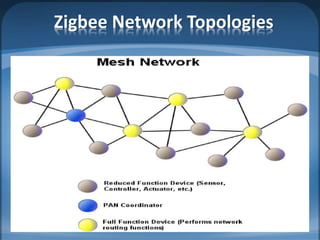
– Zigbee Coordinator Node
– Zigbee Full Function Node
– Zigbee Reduced Function Node
• Modes of operation
– Beacon
– Non-beacon
Device Types and Roles
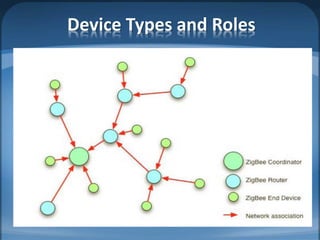
• Zigbee Coordinator Node (ZCN):
• It is the root of the network tree
• Acts as a bridge to other networks.
• Stores Information about the Network
• There is only one ZCN for the complete
Network
Device Types and Roles
• Zigbee Full Functional Device (FFD):
• An Intermediate router in the Network
• Transmitting and Receiving data from other
devices
• Needs less memory than Zigbee Coordinator
Node
• Lesser Manufacturing cost
• Can operate on all topologies
Device Types and Roles
• Zigbee Reduced Function Device (FFD):
• Also called the End Device
• Device capable of talking in the Network
• Can’t relay data from other devices
• Cheaper than FFD
• Lesser Manufacturing cost
• Talks only to the Network Coordinator
Device Types and Roles
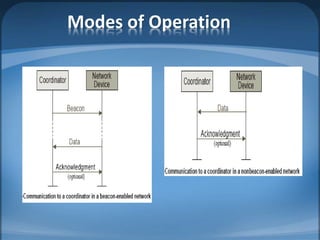
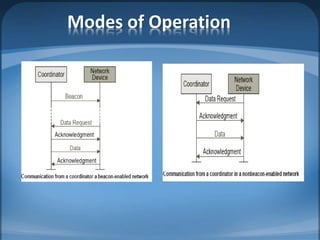
• Beacon Mode :
In beacon-enabled networks, the special network nodes called
ZigBee Routers transmit periodic beacons to confirm their
presence to other network nodes. Nodes may sleep between
beacons, thus lowering their duty cycle and extending their
battery life.
• Non Beacon Mode
In non-beacon-enabled networks, an unslotted CSMA/CA
channel access mechanism is used. In this type of network,
ZigBee Routers typically have their receivers continuously
active, requiring a more robust power supply.
Modes of Operation
Modes of Operation
Modes of Operation
Zigbee Network Topologies
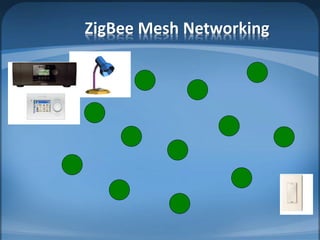
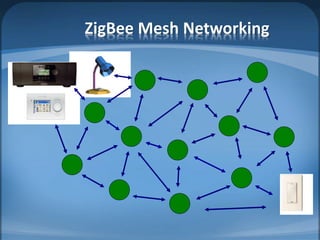
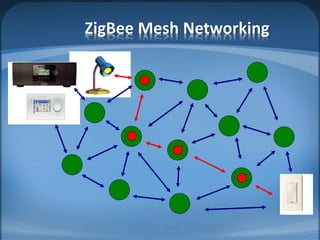
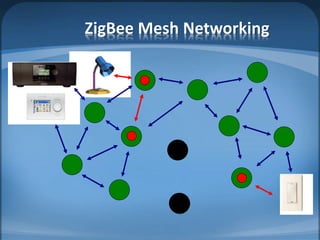
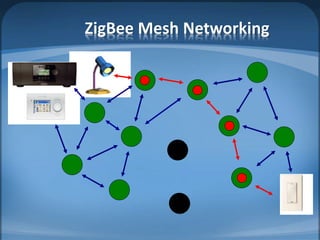
ZigBee Mesh Networking
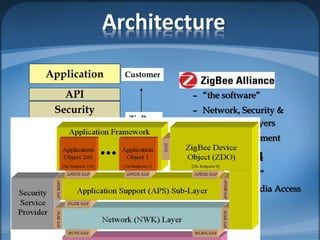
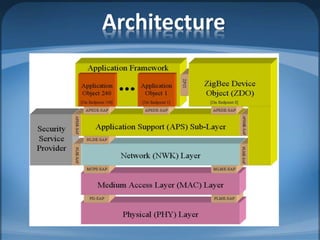
Architecture
– “the software”
– Network, Security &
Application layers
– Brand management
IEEE 802.15.4
– “the hardware”
– Physical & Media Access
Control layers
PHY
868MHz / 915MHz / 2.4GHz
MAC
Network
Star / Mesh / Cluster-Tree
Security
32- / 64- / 128-bit encryption
Application
API
ZigBee
Alliance
IEEE
802.15.4
Customer
Silicon Stack App
Architecture
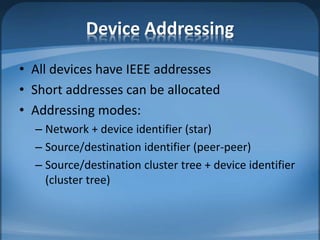
Device Addressing
• All devices have IEEE addresses
• Short addresses can be allocated
• Addressing modes:
– Network + device identifier (star)
– Source/destination identifier (peer-peer)
– Source/destination cluster tree + device identifier
(cluster tree)
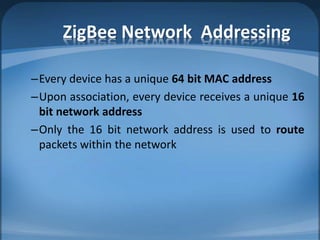
ZigBee Network Addressing
–Every device has a unique 64 bit MAC address
–Upon association, every device receives a unique 16
bit network address
–Only the 16 bit network address is used to route
packets within the network
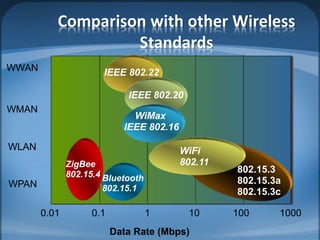
Comparison with other Wireless
Standards
Data Rate (Mbps)
ZigBee
802.15.4
802.15.3
802.15.3a
802.15.3c
WPAN
WLAN
WMAN
WWAN
WiFi
802.11
0.01 0.1 1 10 100 1000
Bluetooth
802.15.1
IEEE 802.22
WiMax
IEEE 802.16
IEEE 802.20
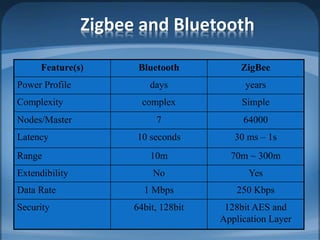
Zigbee and Bluetooth
Feature(s) Bluetooth ZigBee
Power Profile days years
Complexity complex Simple
Nodes/Master 7 64000
Latency 10 seconds 30 ms – 1s
Range 10m 70m ~ 300m
Extendibility No Yes
Data Rate 1 Mbps 250 Kbps
Security 64bit, 128bit 128bit AES and
Application Layer
ZigBee Alliance
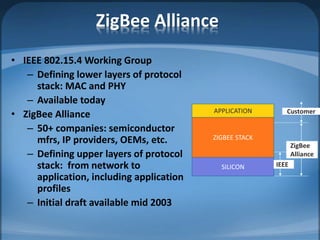
• IEEE 802.15.4 Working Group
– Defining lower layers of protocol
stack: MAC and PHY
– Available today
• ZigBee Alliance
– 50+ companies: semiconductor
mfrs, IP providers, OEMs, etc.
– Defining upper layers of protocol
stack: from network to
application, including application
profiles
– Initial draft available mid 2003
SILICON
ZIGBEE STACK
APPLICATION Customer
IEEE
ZigBee
Alliance
ZigBee Alliance
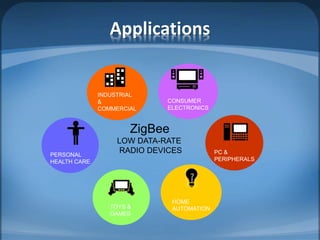
Applications
PERSONAL
HEALTH CARE
ZigBee
LOW DATA-RATE
RADIO DEVICES
HOME
AUTOMATION
CONSUMER
ELECTRONICS
PC &
PERIPHERALS
TOYS &
GAMES
INDUSTRIAL
&
COMMERCIAL
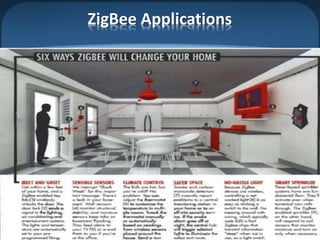
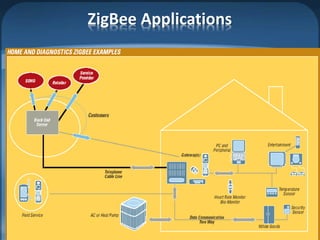
ZigBee Applications
• Wireless home security
• Remote thermostats for air conditioner
• Remote lighting, drape controller
• Call button for elderly and disabled
• Universal remote controller to TV and radio
• Wireless keyboard, mouse and game pads
• Wireless smoke, CO detectors
• Industrial and building automation and control
(lighting, etc.)
ZigBee Applications
ZigBee Applications
Queries!
. .
U
Thank you!

Zigbee

  • 1.
  • 2.
    Sequence • Background • GenCharacteristics • How it works – Tech – Bandwidth/ energy consumption • Architecture • Comparison with other WPAN Standards • Applications
  • 3.
    Why ZigBee ? –Wireless communication standards: • IEEE 802.11 a/b/g • Bluetooth • GSM – What makes them unattractive for WSN: • Power hungry (need big batteries) • Complexity (need lots of clock cycles and memory) – New protocol for WSN: • 802.15.4 and Zigbee (ratified in Dec 14, 2004) • Low Cost • Low Power Consumption • Scalability and Reliability
  • 4.
    Origin Of NameZigBee • The technique that honey bees use to communicate new-found food sources to other members of the colony is referred to as the ZigBee Principle. • Using this silent, but powerful communication system, whereby the bee dances in a zig-zag pattern, she is able to share information such as the location, distance, and direction of a newly discovered food source to her fellow colony members. Instinctively implementing the ZigBee Principle.
  • 5.
    Within the broadorganization of the Institute of Electrical and Electronics Engineers (IEEE), the 802 group is the section that deals with network operations and technologies. Group 15 works more specifically with wireless networking, and Task Group 4 drafted the 802.15.4 standard for a low data rate wireless personal area network (WPAN). The ZigBee standard is currently an ‘open’ standard only to those that are a part of the ZigBee Alliance. For this reason, the ZigBee standard was not used to implement the application layer. 802.15.4 Standard (WPAN)
  • 6.
  • 7.
    ZigBee General Characteristics •Data rates of 20 kbps and up to 250 kbps • Intended for 2.45 Ghz , 868 Mhz and 915 Mhz Band • Data rates touch 250Kbps for 2.45Ghz ,40 Kbps 915Mhz and 20Kbps for 868Mhz band • Star or Peer-to-Peer network topologies • Support for Low Latency Devices • CSMA-CA Channel Access • Handshaking • Low Power Usage consumption • 3 Frequencies bands with 27 channels • Extremely low duty-cycle (<0.1%)
  • 8.
    Comparision Graph with OtherWireless Standards Complexity, Power, Cost Data rate 802.11a 802.11g802.11b Bluetooth 802.15.4 Zigbee 54Mbps11Mbps 720 kbps 250 kbps
  • 9.
    Why NOT 802.11? The Cost of Throughput • High data rates – up to 11Mbps for b and – up to 54Mbps for g and a) • Distance up to 300 feet, or more with special antennas • High power consumption – Sources about 1800mA when transceiver is operational.
  • 10.
    ZigBee Aims Low •Low data rate • Low power consumption • Small packet devices
  • 11.
    What Does ZigBeeDo? • Designed for wireless controls and sensors • Operates in Personal Area Networks (PAN’s) and device-to-device networks • Connectivity between small packet devices • Control of lights, switches, thermostats, appliances, etc.
  • 12.
    How ZigBee Works •Devices – Zigbee Coordinator Node – Zigbee Full Function Node – Zigbee Reduced Function Node • Modes of operation – Beacon – Non-beacon
  • 13.
    Device Types andRoles • Zigbee Coordinator Node (ZCN): • It is the root of the network tree • Acts as a bridge to other networks. • Stores Information about the Network • There is only one ZCN for the complete Network
  • 14.
    Device Types andRoles • Zigbee Full Functional Device (FFD): • An Intermediate router in the Network • Transmitting and Receiving data from other devices • Needs less memory than Zigbee Coordinator Node • Lesser Manufacturing cost • Can operate on all topologies
  • 15.
    Device Types andRoles • Zigbee Reduced Function Device (FFD): • Also called the End Device • Device capable of talking in the Network • Can’t relay data from other devices • Cheaper than FFD • Lesser Manufacturing cost • Talks only to the Network Coordinator
  • 16.
  • 17.
    • Beacon Mode: In beacon-enabled networks, the special network nodes called ZigBee Routers transmit periodic beacons to confirm their presence to other network nodes. Nodes may sleep between beacons, thus lowering their duty cycle and extending their battery life. • Non Beacon Mode In non-beacon-enabled networks, an unslotted CSMA/CA channel access mechanism is used. In this type of network, ZigBee Routers typically have their receivers continuously active, requiring a more robust power supply. Modes of Operation
  • 18.
  • 19.
  • 20.
  • 21.
  • 22.
  • 23.
  • 24.
  • 25.
  • 26.
  • 27.
    Architecture – “the software” –Network, Security & Application layers – Brand management IEEE 802.15.4 – “the hardware” – Physical & Media Access Control layers PHY 868MHz / 915MHz / 2.4GHz MAC Network Star / Mesh / Cluster-Tree Security 32- / 64- / 128-bit encryption Application API ZigBee Alliance IEEE 802.15.4 Customer Silicon Stack App
  • 28.
  • 29.
    Device Addressing • Alldevices have IEEE addresses • Short addresses can be allocated • Addressing modes: – Network + device identifier (star) – Source/destination identifier (peer-peer) – Source/destination cluster tree + device identifier (cluster tree)
  • 30.
    ZigBee Network Addressing –Everydevice has a unique 64 bit MAC address –Upon association, every device receives a unique 16 bit network address –Only the 16 bit network address is used to route packets within the network
  • 31.
    Comparison with otherWireless Standards Data Rate (Mbps) ZigBee 802.15.4 802.15.3 802.15.3a 802.15.3c WPAN WLAN WMAN WWAN WiFi 802.11 0.01 0.1 1 10 100 1000 Bluetooth 802.15.1 IEEE 802.22 WiMax IEEE 802.16 IEEE 802.20
  • 32.
    Zigbee and Bluetooth Feature(s)Bluetooth ZigBee Power Profile days years Complexity complex Simple Nodes/Master 7 64000 Latency 10 seconds 30 ms – 1s Range 10m 70m ~ 300m Extendibility No Yes Data Rate 1 Mbps 250 Kbps Security 64bit, 128bit 128bit AES and Application Layer
  • 33.
  • 34.
    • IEEE 802.15.4Working Group – Defining lower layers of protocol stack: MAC and PHY – Available today • ZigBee Alliance – 50+ companies: semiconductor mfrs, IP providers, OEMs, etc. – Defining upper layers of protocol stack: from network to application, including application profiles – Initial draft available mid 2003 SILICON ZIGBEE STACK APPLICATION Customer IEEE ZigBee Alliance ZigBee Alliance
  • 35.
    Applications PERSONAL HEALTH CARE ZigBee LOW DATA-RATE RADIODEVICES HOME AUTOMATION CONSUMER ELECTRONICS PC & PERIPHERALS TOYS & GAMES INDUSTRIAL & COMMERCIAL
  • 36.
    ZigBee Applications • Wirelesshome security • Remote thermostats for air conditioner • Remote lighting, drape controller • Call button for elderly and disabled • Universal remote controller to TV and radio • Wireless keyboard, mouse and game pads • Wireless smoke, CO detectors • Industrial and building automation and control (lighting, etc.)
  • 37.
  • 38.
  • 39.
  • 40.