ZIGBEE TECHNOLOGY
WIRELESS CONTROL THAT SIMPLY WORKS
SHOAIB AHMED SIDDIQUI
THE ZIGBEE NAME
 Named for the “waggle” dance that honey
bees do to communicate with each other
 Erratic, zig-zagging patterns of bees
between flowers
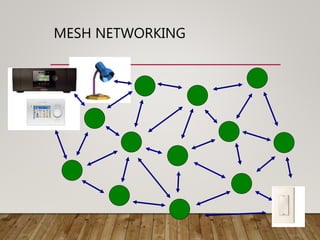
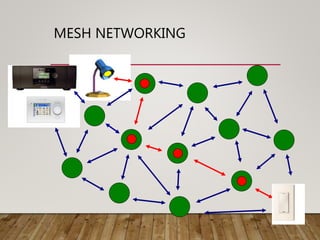
 Symbolizes communication between nodes
in a mesh network
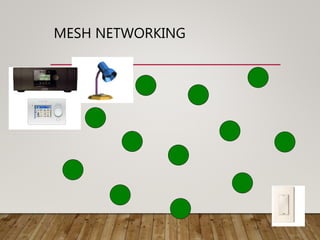
 Network components analogous to queen
bee, drones, worker bees
WHAT IS ZIGBEE ?
• ZigBee is a Ad-hoc networking technology for LR-
WPAN.
• Technological Standard Created for Control and
Sensor Networks
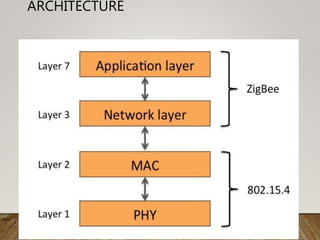
• Based On IEEE 802.15.4 standard that defines the PHY
and Mac Layers for ZigBee.
• Low in cost ,complexity & power consumption as
compared to competing technologies.
• Data rates touch 250Kbps for 2.45Ghz ,40 Kbps
915Mhz and 20Kbps for 868Mhz band.
• ZigBee is an established set of specifications for wireless personal
area networking (WPAN) i.e. digital radio connections between
computers and related devices.
• ZigBee is targeted at radio-frequency (RF) applications which require
a low data rate, long battery life, and secure networking.
• Created by the ZigBee Alliance
ZIGBEE ALLIANCE
and many more....
6
HISTORY
ZigBee-style networks began to be conceived
around 1998, when many installers realized
that both Wi-Fi and Bluetooth were going to
be unsuitable for many applications.
During the last quarter of 2007, ZigBee PRO,
the enhanced ZigBee specification was
finalized.
WHAT DOES ZIGBEE DO?
• It is used for embedded application for low data rates
and Low power consumption, In expensive
• Designed for wireless controls and sensors
• Operates in Personal Area Networks (PAN’s) and
device-to-device networks
• Connectivity between small packet devices
• Control of lights, switches, thermostats, appliances,
etc.
ZIGBEE GENERAL CHARACTERISTICS
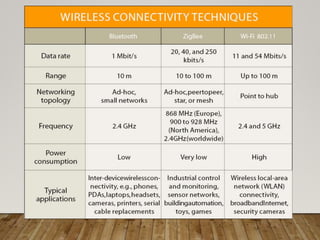
• Data rates of 20 kbps and up to 250 kbps
• Support for Low Latency Devices
• CSMA-CA Channel Access
• Low Power Usage consumption
• 3 Frequencies bands with 27 channels
• Extremely low duty-cycle (<0.1%)
• Supports large number of nodes
• Very long battery life
• ZigBee transmission range is approx. 1-100 meters.
WHY ZIGBEE IS NEEDED
• For Long Battery Lives
• It require low cost and very low current drain.
• It doesn't need much power
• It uses low data rates
9
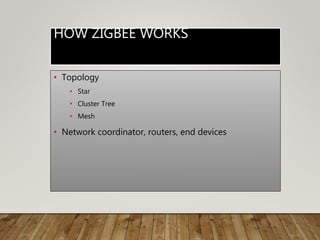
HOW ZIGBEE WORKS
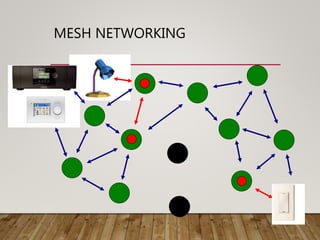
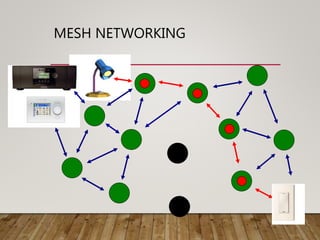
• Topology
• Star
• Cluster Tree
• Mesh
• Network coordinator, routers, end devices
MESH NETWORKING
MESH NETWORKING
MESH NETWORKING
MESH NETWORKING
MESH NETWORKING
ARCHITECTURE
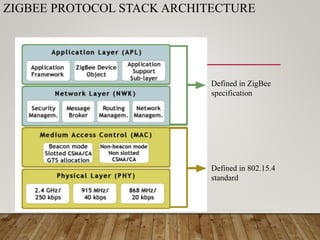
ZIGBEE PROTOCOL STACK ARCHITECTURE
•
Defined in ZigBee
specification
Defined in 802.15.4
standard
PHYSICAL LAYER
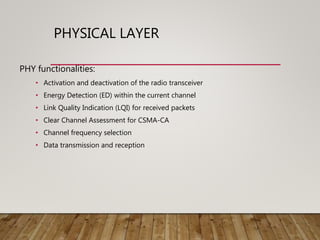
PHY functionalities:
• Activation and deactivation of the radio transceiver
• Energy Detection (ED) within the current channel
• Link Quality Indication (LQI) for received packets
• Clear Channel Assessment for CSMA-CA
• Channel frequency selection
• Data transmission and reception
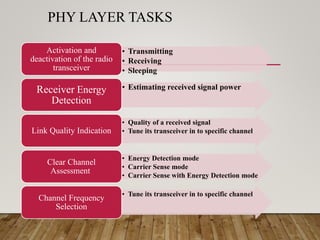
PHY LAYER TASKS
• Transmitting
• Receiving
• Sleeping
Activation and
deactivation of the radio
transceiver
• Estimating received signal powerReceiver Energy
Detection
• Quality of a received signal
• Tune its transceiver in to specific channelLink Quality Indication
• Energy Detection mode
• Carrier Sense mode
• Carrier Sense with Energy Detection mode
Clear Channel
Assessment
• Tune its transceiver in to specific channel
Channel Frequency
Selection
OPERATING FREQUENCIES
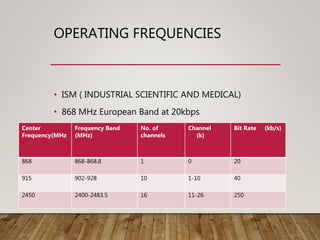
• ISM ( INDUSTRIAL SCIENTIFIC AND MEDICAL)
• 868 MHz European Band at 20kbps
• 915 MHz North American Band at 40kbps
• 2.4 GHz Global Band at 250kbps
Center
Frequency(MHz
Frequency Band
(MHz)
No. of
channels
Channel
(k)
Bit Rate (kb/s)
868 868-868.8 1 0 20
915 902-928 10 1-10 40
2450 2400-2483.5 16 11-26 250
MAC LAYER
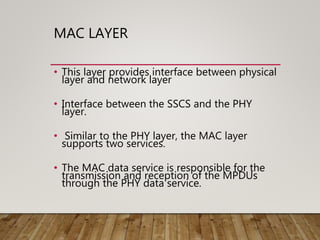
• This layer provides interface between physical
layer and network layer
• Interface between the SSCS and the PHY
layer.
• Similar to the PHY layer, the MAC layer
supports two services.
• The MAC data service is responsible for the
transmission and reception of the MPDUs
through the PHY data service.
MAC LAYER
• The MAC management service, if the device
is a coordinator, manages the network
beacons. It is also responsible for PAN
association and disassociation, frame
validation, and acknowledgment providing “a
reliable link between two peer MAC entities.”
• Uses the CSMA/CA for channel access and
handles and maintains the GTS mechanism.
• Supports device security.
MAC LAYER FRAME FORMATS
• The IEEE 802.15.4 standard defines four
different frame types: the beacon, data,
acknowledgment, and MAC command
frame.
• All frame types are based on the general
MAC frame format.
• The frame control field describes and
specifies the above different frame types.
MAC LAYER FRAME FORMATS
• The MAC frame format is
composed of a MHR, a MAC
payload, and a MFR.
• Different frame types have
different MAC payload fields.
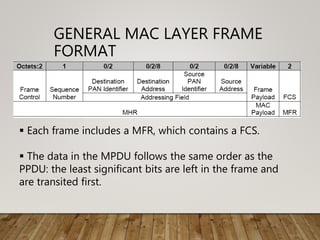
GENERAL MAC LAYER FRAME
FORMAT
 Each frame includes a MFR, which contains a FCS.
 The data in the MPDU follows the same order as the
PPDU: the least significant bits are left in the frame and
are transited first.
TRAFFIC MODES
ZigBee employs either of two modes, beacon or non-beacon to
enable the to-and-fro data traffic.
Beacon mode is used when the coordinator runs on batteries
and thus offers maximum power savings, whereas the Non-
Beacon mode finds favor when the coordinator is mains-
powered.
IEEE 802.15.4 MAC LAYER
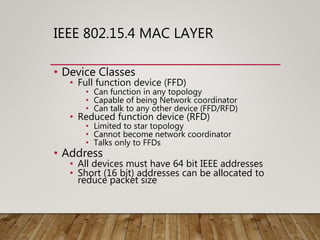
• Device Classes
• Full function device (FFD)
• Can function in any topology
• Capable of being Network coordinator
• Can talk to any other device (FFD/RFD)
• Reduced function device (RFD)
• Limited to star topology
• Cannot become network coordinator
• Talks only to FFDs
• Address
• All devices must have 64 bit IEEE addresses
• Short (16 bit) addresses can be allocated to
reduce packet size
IEEE 802.15.4 MAC LAYER
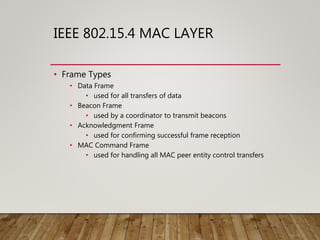
• Frame Types
• Data Frame
• used for all transfers of data
• Beacon Frame
• used by a coordinator to transmit beacons
• Acknowledgment Frame
• used for confirming successful frame reception
• MAC Command Frame
• used for handling all MAC peer entity control transfers
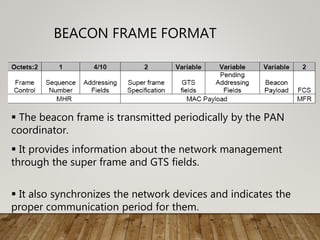
BEACON FRAME FORMAT
 The beacon frame is transmitted periodically by the PAN
coordinator.
 It provides information about the network management
through the super frame and GTS fields.
 It also synchronizes the network devices and indicates the
proper communication period for them.
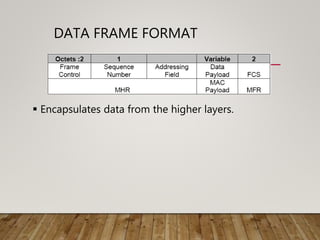
DATA FRAME FORMAT
 Encapsulates data from the higher layers.
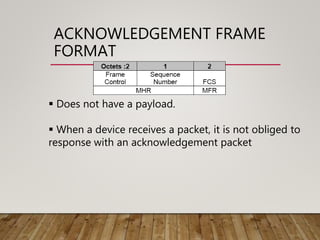
ACKNOWLEDGEMENT FRAME
FORMAT
 Does not have a payload.
 When a device receives a packet, it is not obliged to
response with an acknowledgement packet
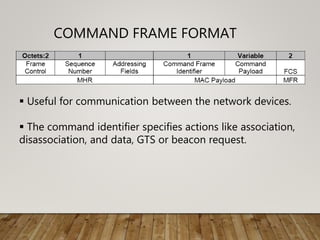
COMMAND FRAME FORMAT
 Useful for communication between the network devices.
 The command identifier specifies actions like association,
disassociation, and data, GTS or beacon request.
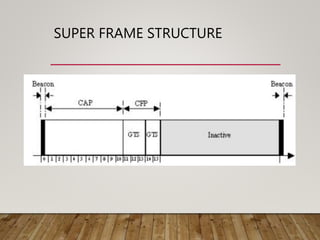
SUPER FRAME STRUCTURE
SUPER FRAME
• In the LR-WPAN, every PAN has its own
coordinator. The PAN coordinator manages
the communication in the local area; it has
two options, to use or not use the super
frame structure.
• The super frame uses network beacons.
• If the coordinator does not want to use a
super frame structure, it suspends the beacon
transmission.
SUPER FRAME
• The beacon is important for device association and
disassociation.
• If the coordinator wishes to maintain close
communication control in the PAN, and to support
low-latency devices it usually uses the super frame.
• A super frame determines a specific time period,
beacons bound it.
DATA TRANSFER TYPES
• Three different types of data transfer exist.
• Data transfer from a device to the PAN
coordinator.
• Data transfer from the PAN.
• Peer-to-peer Data Transfer
• The types differ if the coordinator uses or does
not beacons
IEEE 802.15.4 MAC LAYER
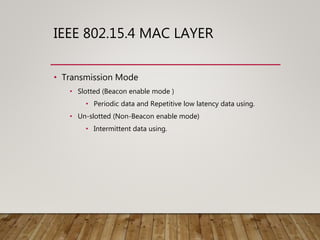
• Transmission Mode
• Slotted (Beacon enable mode )
• Periodic data and Repetitive low latency data using.
• Un-slotted (Non-Beacon enable mode)
• Intermittent data using.
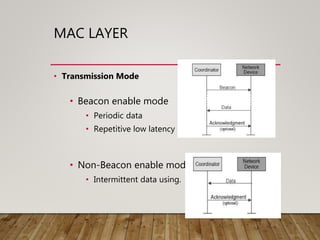
MAC LAYER
• Transmission Mode
• Beacon enable mode
• Periodic data
• Repetitive low latency data using.
• Non-Beacon enable mode
• Intermittent data using.
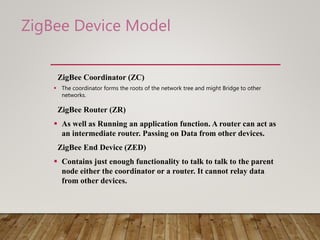
ZigBee Coordinator (ZC)
 The coordinator forms the roots of the network tree and might Bridge to other
networks.
ZigBee Router (ZR)
 As well as Running an application function. A router can act as
an intermediate router. Passing on Data from other devices.
ZigBee End Device (ZED)
 Contains just enough functionality to talk to talk to the parent
node either the coordinator or a router. It cannot relay data
from other devices.
ZigBee Device Model
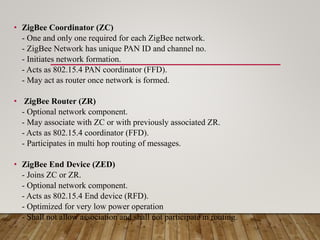
• ZigBee Coordinator (ZC)
- One and only one required for each ZigBee network.
- ZigBee Network has unique PAN ID and channel no.
- Initiates network formation.
- Acts as 802.15.4 PAN coordinator (FFD).
- May act as router once network is formed.
• ZigBee Router (ZR)
- Optional network component.
- May associate with ZC or with previously associated ZR.
- Acts as 802.15.4 coordinator (FFD).
- Participates in multi hop routing of messages.
• ZigBee End Device (ZED)
- Joins ZC or ZR.
- Optional network component.
- Acts as 802.15.4 End device (RFD).
- Optimized for very low power operation
- Shall not allow association and shall not participate in routing.
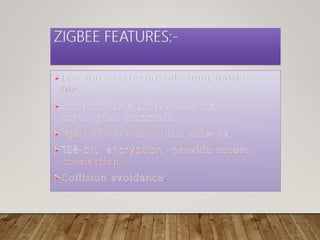
ZIGBEE FEATURES:-
.
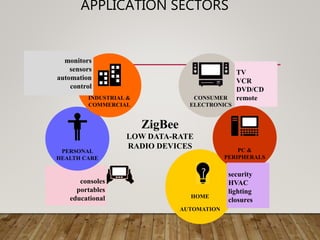
APPLICATION SECTORS
HOME
AUTOMATION
ZigBee
LOW DATA-RATE
RADIO DEVICES
CONSUMER
ELECTRONICS
TV
VCR
DVD/CD
remote
PC &
PERIPHERALS
consoles
portables
educational
PERSONAL
HEALTH CARE
INDUSTRIAL &
COMMERCIAL
monitors
sensors
automation
control
security
HVAC
lighting
closures
CONCLUSION
• ZigBee will play a vital role in the mass adoption
of cost effective, low power, mesh networking
technology for monitoring and control
applications, based on an open global standard.
• Near Future more flexibility and cost savings for
consumers and greater control over household
appliances.
• Used for campus-wide electrical and security
systems from a single computer
THANK YOU

Zigbee

  • 1.
    ZIGBEE TECHNOLOGY WIRELESS CONTROLTHAT SIMPLY WORKS SHOAIB AHMED SIDDIQUI
  • 2.
    THE ZIGBEE NAME Named for the “waggle” dance that honey bees do to communicate with each other  Erratic, zig-zagging patterns of bees between flowers  Symbolizes communication between nodes in a mesh network  Network components analogous to queen bee, drones, worker bees
  • 3.
    WHAT IS ZIGBEE? • ZigBee is a Ad-hoc networking technology for LR- WPAN. • Technological Standard Created for Control and Sensor Networks • Based On IEEE 802.15.4 standard that defines the PHY and Mac Layers for ZigBee. • Low in cost ,complexity & power consumption as compared to competing technologies. • Data rates touch 250Kbps for 2.45Ghz ,40 Kbps 915Mhz and 20Kbps for 868Mhz band.
  • 4.
    • ZigBee isan established set of specifications for wireless personal area networking (WPAN) i.e. digital radio connections between computers and related devices. • ZigBee is targeted at radio-frequency (RF) applications which require a low data rate, long battery life, and secure networking. • Created by the ZigBee Alliance
  • 5.
  • 6.
    6 HISTORY ZigBee-style networks beganto be conceived around 1998, when many installers realized that both Wi-Fi and Bluetooth were going to be unsuitable for many applications. During the last quarter of 2007, ZigBee PRO, the enhanced ZigBee specification was finalized.
  • 7.
    WHAT DOES ZIGBEEDO? • It is used for embedded application for low data rates and Low power consumption, In expensive • Designed for wireless controls and sensors • Operates in Personal Area Networks (PAN’s) and device-to-device networks • Connectivity between small packet devices • Control of lights, switches, thermostats, appliances, etc.
  • 8.
    ZIGBEE GENERAL CHARACTERISTICS •Data rates of 20 kbps and up to 250 kbps • Support for Low Latency Devices • CSMA-CA Channel Access • Low Power Usage consumption • 3 Frequencies bands with 27 channels • Extremely low duty-cycle (<0.1%) • Supports large number of nodes • Very long battery life • ZigBee transmission range is approx. 1-100 meters.
  • 9.
    WHY ZIGBEE ISNEEDED • For Long Battery Lives • It require low cost and very low current drain. • It doesn't need much power • It uses low data rates 9
  • 10.
    HOW ZIGBEE WORKS •Topology • Star • Cluster Tree • Mesh • Network coordinator, routers, end devices
  • 11.
  • 12.
  • 13.
  • 14.
  • 15.
  • 16.
  • 17.
    ZIGBEE PROTOCOL STACKARCHITECTURE • Defined in ZigBee specification Defined in 802.15.4 standard
  • 18.
    PHYSICAL LAYER PHY functionalities: •Activation and deactivation of the radio transceiver • Energy Detection (ED) within the current channel • Link Quality Indication (LQI) for received packets • Clear Channel Assessment for CSMA-CA • Channel frequency selection • Data transmission and reception
  • 19.
    PHY LAYER TASKS •Transmitting • Receiving • Sleeping Activation and deactivation of the radio transceiver • Estimating received signal powerReceiver Energy Detection • Quality of a received signal • Tune its transceiver in to specific channelLink Quality Indication • Energy Detection mode • Carrier Sense mode • Carrier Sense with Energy Detection mode Clear Channel Assessment • Tune its transceiver in to specific channel Channel Frequency Selection
  • 20.
    OPERATING FREQUENCIES • ISM( INDUSTRIAL SCIENTIFIC AND MEDICAL) • 868 MHz European Band at 20kbps • 915 MHz North American Band at 40kbps • 2.4 GHz Global Band at 250kbps Center Frequency(MHz Frequency Band (MHz) No. of channels Channel (k) Bit Rate (kb/s) 868 868-868.8 1 0 20 915 902-928 10 1-10 40 2450 2400-2483.5 16 11-26 250
  • 21.
    MAC LAYER • Thislayer provides interface between physical layer and network layer • Interface between the SSCS and the PHY layer. • Similar to the PHY layer, the MAC layer supports two services. • The MAC data service is responsible for the transmission and reception of the MPDUs through the PHY data service.
  • 22.
    MAC LAYER • TheMAC management service, if the device is a coordinator, manages the network beacons. It is also responsible for PAN association and disassociation, frame validation, and acknowledgment providing “a reliable link between two peer MAC entities.” • Uses the CSMA/CA for channel access and handles and maintains the GTS mechanism. • Supports device security.
  • 23.
    MAC LAYER FRAMEFORMATS • The IEEE 802.15.4 standard defines four different frame types: the beacon, data, acknowledgment, and MAC command frame. • All frame types are based on the general MAC frame format. • The frame control field describes and specifies the above different frame types.
  • 24.
    MAC LAYER FRAMEFORMATS • The MAC frame format is composed of a MHR, a MAC payload, and a MFR. • Different frame types have different MAC payload fields.
  • 25.
    GENERAL MAC LAYERFRAME FORMAT  Each frame includes a MFR, which contains a FCS.  The data in the MPDU follows the same order as the PPDU: the least significant bits are left in the frame and are transited first.
  • 26.
    TRAFFIC MODES ZigBee employseither of two modes, beacon or non-beacon to enable the to-and-fro data traffic. Beacon mode is used when the coordinator runs on batteries and thus offers maximum power savings, whereas the Non- Beacon mode finds favor when the coordinator is mains- powered.
  • 27.
    IEEE 802.15.4 MACLAYER • Device Classes • Full function device (FFD) • Can function in any topology • Capable of being Network coordinator • Can talk to any other device (FFD/RFD) • Reduced function device (RFD) • Limited to star topology • Cannot become network coordinator • Talks only to FFDs • Address • All devices must have 64 bit IEEE addresses • Short (16 bit) addresses can be allocated to reduce packet size
  • 28.
    IEEE 802.15.4 MACLAYER • Frame Types • Data Frame • used for all transfers of data • Beacon Frame • used by a coordinator to transmit beacons • Acknowledgment Frame • used for confirming successful frame reception • MAC Command Frame • used for handling all MAC peer entity control transfers
  • 29.
    BEACON FRAME FORMAT The beacon frame is transmitted periodically by the PAN coordinator.  It provides information about the network management through the super frame and GTS fields.  It also synchronizes the network devices and indicates the proper communication period for them.
  • 30.
    DATA FRAME FORMAT Encapsulates data from the higher layers.
  • 31.
    ACKNOWLEDGEMENT FRAME FORMAT  Doesnot have a payload.  When a device receives a packet, it is not obliged to response with an acknowledgement packet
  • 32.
    COMMAND FRAME FORMAT Useful for communication between the network devices.  The command identifier specifies actions like association, disassociation, and data, GTS or beacon request.
  • 33.
  • 34.
    SUPER FRAME • Inthe LR-WPAN, every PAN has its own coordinator. The PAN coordinator manages the communication in the local area; it has two options, to use or not use the super frame structure. • The super frame uses network beacons. • If the coordinator does not want to use a super frame structure, it suspends the beacon transmission.
  • 35.
    SUPER FRAME • Thebeacon is important for device association and disassociation. • If the coordinator wishes to maintain close communication control in the PAN, and to support low-latency devices it usually uses the super frame. • A super frame determines a specific time period, beacons bound it.
  • 36.
    DATA TRANSFER TYPES •Three different types of data transfer exist. • Data transfer from a device to the PAN coordinator. • Data transfer from the PAN. • Peer-to-peer Data Transfer • The types differ if the coordinator uses or does not beacons
  • 37.
    IEEE 802.15.4 MACLAYER • Transmission Mode • Slotted (Beacon enable mode ) • Periodic data and Repetitive low latency data using. • Un-slotted (Non-Beacon enable mode) • Intermittent data using.
  • 38.
    MAC LAYER • TransmissionMode • Beacon enable mode • Periodic data • Repetitive low latency data using. • Non-Beacon enable mode • Intermittent data using.
  • 39.
    ZigBee Coordinator (ZC) The coordinator forms the roots of the network tree and might Bridge to other networks. ZigBee Router (ZR)  As well as Running an application function. A router can act as an intermediate router. Passing on Data from other devices. ZigBee End Device (ZED)  Contains just enough functionality to talk to talk to the parent node either the coordinator or a router. It cannot relay data from other devices. ZigBee Device Model
  • 40.
    • ZigBee Coordinator(ZC) - One and only one required for each ZigBee network. - ZigBee Network has unique PAN ID and channel no. - Initiates network formation. - Acts as 802.15.4 PAN coordinator (FFD). - May act as router once network is formed. • ZigBee Router (ZR) - Optional network component. - May associate with ZC or with previously associated ZR. - Acts as 802.15.4 coordinator (FFD). - Participates in multi hop routing of messages. • ZigBee End Device (ZED) - Joins ZC or ZR. - Optional network component. - Acts as 802.15.4 End device (RFD). - Optimized for very low power operation - Shall not allow association and shall not participate in routing.
  • 41.
  • 43.
    APPLICATION SECTORS HOME AUTOMATION ZigBee LOW DATA-RATE RADIODEVICES CONSUMER ELECTRONICS TV VCR DVD/CD remote PC & PERIPHERALS consoles portables educational PERSONAL HEALTH CARE INDUSTRIAL & COMMERCIAL monitors sensors automation control security HVAC lighting closures
  • 44.
    CONCLUSION • ZigBee willplay a vital role in the mass adoption of cost effective, low power, mesh networking technology for monitoring and control applications, based on an open global standard. • Near Future more flexibility and cost savings for consumers and greater control over household appliances. • Used for campus-wide electrical and security systems from a single computer
  • 45.