etw orks
                s or N
       ess Sen
Wirel                     Zig bee
             c tio n to
      ntr odu
  I
Sensor Network
            Challenges
• Low computational power
  – Less than 10 MIPS
  – Low memory budget: 4-10 KB


• Limited energy budget
  – AA batteries provide ~2850 mAh
  – LiIon and NiMH batteries provide 800-2500 mAh
  – Solar cells: around 5 mA/cm2 in direct sunlight


• Communication?
Wireless Communication
– Wireless communication standards:
  • IEEE 802.11 a/b/g
  • Bluetooth
  • GSM
– What makes them unattractive for WSN:
  • Power hungry (need big batteries)
  • Complexity (need lots of clock cycles and
    memory)
– New protocol for WSN:
  • 802.15.4 and Zigbee (ratified in Dec 14, 2004)
Outline

•   Why not 802.11 ?
•   How about Bluetooth? X-10?
•   What is ZigBee?
•   ZigBee Protocol: PHY and above
•   Hardware: CC2420
•   Example and discussion
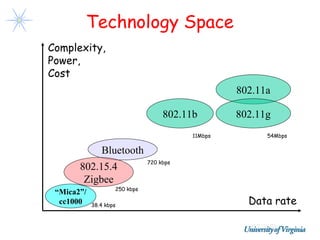
Technology Space
Complexity,
Power,
Cost
                                                   802.11a

                                    802.11b        802.11g
                                          11Mbps         54Mbps

               Bluetooth
                               720 kbps
       802.15.4
        Zigbee
                    250 kbps
 “Mica2”/
  cc1000    38.4 kbps                                Data rate
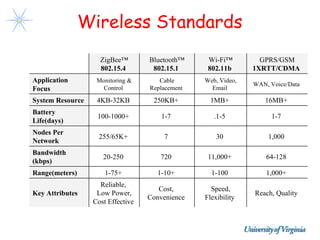
Wireless Standards
                    ZigBee™        Bluetooth™     Wi-Fi™         GPRS/GSM
                    802.15.4        802.15.1      802.11b      1XRTT/CDMA
Application        Monitoring &       Cable      Web, Video,
                                                               WAN, Voice/Data
Focus                Control       Replacement     Email

System Resource    4KB-32KB         250KB+         1MB+           16MB+
Battery
                   100-1000+           1-7          .1-5            1-7
Life(days)
Nodes Per
                    255/65K+           7             30            1,000
Network
Bandwidth
                     20-250           720         11,000+          64-128
(kbps)
Range(meters)         1-75+          1-10+         1-100           1,000+
                    Reliable,
                                      Cost,        Speed,
Key Attributes     Low Power,                                  Reach, Quality
                                   Convenience   Flexibility
                  Cost Effective
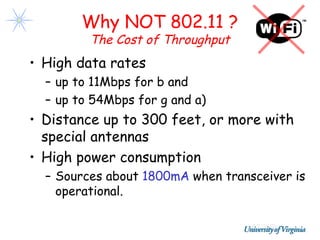
Why NOT 802.11 ?
         The Cost of Throughput
• High data rates
  – up to 11Mbps for b and
  – up to 54Mbps for g and a)
• Distance up to 300 feet, or more with
  special antennas
• High power consumption
  – Sources about 1800mA when transceiver is
    operational.
IEEE 802.11b example

• Consider running a mote with 802.11b on two
  AA batteries.
• Consumes 1800mA when transmitting
• Assume NiMH battery capacity 2400mA/h
• Assume transmitting 1/3 of the time

• How long will the batteries last?
• Is the given information sufficient for the
  question asked?
How About Bluetooth ?                          ?
             The Cost of Universalism
• Designed for communications
  between portable and
  peripheral devices

•   720 kbps, 10m range
•   One master and 7 slave devices in each “Piconet”
•   Time Division Multiple Access (TDMA)
•   Frequency hopping to avoid collisions between
    Piconets
    – Hop between channels 1600 times a second
    – 79 channels (1MHz each) to avoid collisions
Bluetooth (2)

• Protocol tailored to many different
  data types: Audio, Text, Raw data
  – Makes the protocol rather complex to
    accommodate for all data types
  – Needs more memory and clock cycles than
    we are willing to afford on the Motes


• Zigbee needs only about 10-50% of the
  software in comparison with Bluetooth
  and WiFi
How About X-10?                            ?

• Targeted for home automation
• Originally used power lines as transmission media.
  Later RF communication was added.
• Mainly used to transmit a few codes to turn on or
  off other devices, aka. Remote control.

• Very simple protocol
   – 4-bit house code (group address)
   – 4-bit unit code (device address)
   – 1-bit on/off command (data)
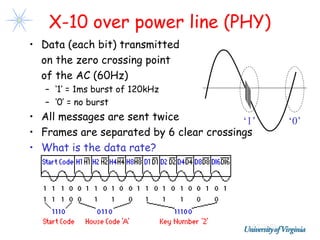
X-10 over power line (PHY)
• Data (each bit) transmitted
  on the zero crossing point
  of the AC (60Hz)
   – ‘1’ = 1ms burst of 120kHz
   – ‘0’ = no burst
• All messages are sent twice            ‘1’   ‘0’
• Frames are separated by 6 clear crossings
• What is the data rate?
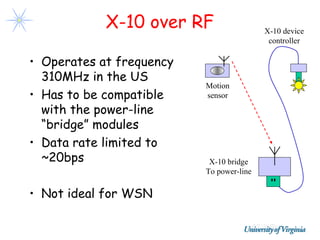
X-10 over RF                  X-10 device
                                           controller

• Operates at frequency
  310MHz in the US
                          Motion
• Has to be compatible    sensor
  with the power-line
  “bridge” modules
• Data rate limited to
  ~20bps                   X-10 bridge
                          To power-line

• Not ideal for WSN
X-10 video over RF

• X10 has a high data rate extension
  allowing to transmit video over RF at
  2.4GHz
  – Channel A: 2.411 GHz
  – Channel B: 2.434 GHz
  – Channel C: 2.453 GHz
  – Channel D: 2.473 GHz

• Proprietary protocol for NTSC video
  signal transmission
• NOT secure!
What is Zigbee
           Affordable Simplicity
• ZigBee is a published specification set
  of high level communication protocols
  for:
  – Low data rate, low power, low cost wireless
    systems operating in unlicensed RF domain
• Formely known as
  – PURLnet, RF-Lite, Firefly, and HomeRF Lite


• Based on IEEE 802.15.4
ZigBee Applications

•   Wireless home security
•   Remote thermostats for air conditioner
•   Remote lighting, drape controller
•   Call button for elderly and disabled
•   Universal remote controller to TV and radio
•   Wireless keyboard, mouse and game pads
•   Wireless smoke, CO detectors
•   Industrial and building automation and
    control (lighting, etc.)
Zigbee General

• Low power
  – battery life multi-month to years
• Multiple topologies
  – star, peer-to-peer, mesh
• Addressing space: 64 bits
  – Question: how many nodes?
• Fully hand-shake protocol (reliability)
• Range: 50m typical
  – 5-500m based on environment
Zigbee Intended Traffic

• Periodic data
• Intermittent data
• Application defined rate (e.g., sensors)
• External stimulus defined rate (e.g.,
  light switch)
• Low latency data (Q: Any examples?)
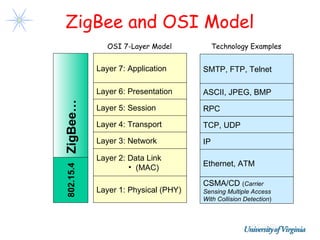
ZigBee and OSI Model
              OSI 7-Layer Model           Technology Examples


           Layer 7: Application      SMTP, FTP, Telnet

           Layer 6: Presentation     ASCII, JPEG, BMP
ZigBee…

           Layer 5: Session          RPC
           Layer 4: Transport        TCP, UDP
           Layer 3: Network          IP

           Layer 2: Data Link
                    • (MAC)          Ethernet, ATM
802.15.4


                                     CSMA/CD (Carrier
           Layer 1: Physical (PHY)   Sensing Multiple Access
                                     With Collision Detection)
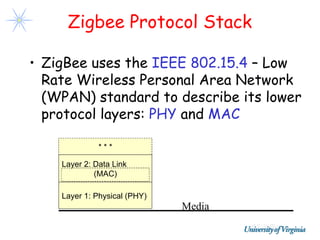
Zigbee Protocol Stack

• ZigBee uses the IEEE 802.15.4 – Low
  Rate Wireless Personal Area Network
  (WPAN) standard to describe its lower
  protocol layers: PHY and MAC

              ***

    Layer 2: Data Link
             (MAC)

    Layer 1: Physical (PHY)
                              Media
Zigbee/IEEE 802.15.4

• Dual PHY: 2.4GHz and 868/915 MHz
• Data rates:
  – 250 kbps @ 2.4GHz
  – 40 kbps @ 915MHz
  – 20 kbps @ 868MHz
     • Q: Why would anyone want this?
     • A: Better penetrates obstacles than @2.4GHz
• CSMA-CA channel access
  – Yields high throughput and low latency for low
    duty cycle devices
IEEE 802.15

• IEEE 802.15 is a working group of IEEE
  that specializes in Wireless PAN
  standards
  – 802.15.1: Bluetooth
  – 802.15.2: Coexistence of PAN and 802.11
  – 802.15.3a: UWB (Wireless USB)
          » High data rate
  – 802.15.4:    WPAN Low Rate
          » Low data rate but very long battery life (months/
            years)
ZigBee: PHY
• The radio uses Digital Spread Spectrum
  Signaling (DSSS)
  – Conventional DSSS for 868MHz and
    915MHz bands
  – Orthogonal Signaling (4 bits per symbol)
    for 2.4GHz band
• Number of channels
  – 16 channels in the 2.4GHz ISM band
  – 10 channels in the 915MHz
  – one channel in the 868MHz
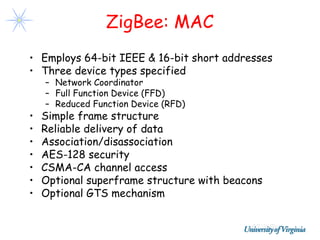
ZigBee: MAC
• Employs 64-bit IEEE & 16-bit short addresses
• Three device types specified
    – Network Coordinator
    – Full Function Device (FFD)
    – Reduced Function Device (RFD)
•   Simple frame structure
•   Reliable delivery of data
•   Association/disassociation
•   AES-128 security
•   CSMA-CA channel access
•   Optional superframe structure with beacons
•   Optional GTS mechanism
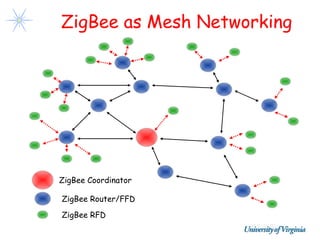
ZigBee as Mesh Networking


ZigBee Coordinator

ZigBee Router/FFD

ZigBee RFD
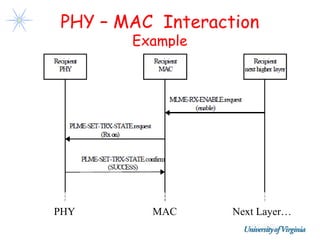
PHY – MAC Interaction
       Example


PHY      MAC      Next Layer…
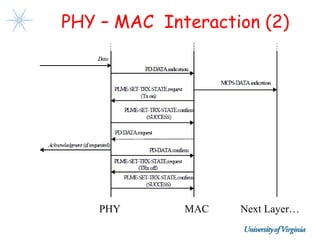
PHY – MAC Interaction (2)


    PHY      MAC   Next Layer…
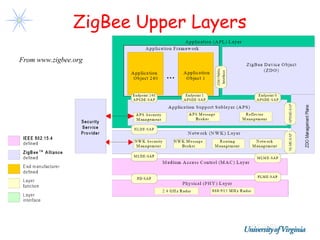
ZigBee Upper Layers
From www.zigbee.org
ZigBee Upper Layers
• Messaging
• Configurations that can be used
• Security:
   –   Key setup and maintenance:     Commercial, Residential
   –   Defines key types:             Master, Link, Network
   –   CCM (unified, simple mode of operation)
   –   More: Key freshness checks, message integrity,
       authentication (network and device level)
• Network layer (NWK) supports three topologies:
   – Star
   – Mesh
   – Cluster-Tree ( = Star + Mesh)
How A ZigBee Network Forms
• Devices are pre-programmed for their network
  function
  – Coordinator scans to find an unused channel to start a
    network
  – Router scans to find an active channel to join, then permits
    other devices to join
  – End Device will always try to join an existing network

• Devices discover other devices in the network
  providing complementary services
  – Service Discovery can be initiated from any device within the
    network

• Devices can be bound to other devices offering
  complementary services
  – Binding provides a command and control feature for specially
    identified sets of devices
ZigBee Stack Architecture:
             Addressing
– Every device has a unique 64 bit MAC address
– Upon association, every device receives a
  unique 16 bit network address
– Only the 16 bit network address is used to
  route packets within the network
– Devices retain their 16 bit address if they
  disconnect from the network, however, if they
  leave the network, the 16 bit address is re-
  assigned
ZigBee Stack Architecture:
          Addressing (2)
– NWK broadcast implemented above the MAC:
 • NWK address 0xFFFF is the broadcast address
 • Special algorithm in NWK to propagate the
   message
 • “Best Effort” or “Guaranteed Delivery” options
 • Radius Limited Broadcast feature
ZigBee Routing
•   Routing table entry:
     – Destination Address (2 bytes)
     – Route status (3 bits)
     – Next Hop (2 bytes)

•   Route request command frame:
     – FrameID, Options, RequestID, Destination Address, Path cost

•   Route reply command frame:
     – FrameID, Options, Req.ID, Originator Addr, Responder Addr, Path cost

•   A device wishing to discover or repair a route issues a route request
    command frame which is broadcast throughout the network

•   When the intended destination receives the route request command
    frame it responds with at least one route reply command frame

•   Potential routes are evaluated with respect to a routing cost metric at
    both source and destination
ZigBee NWK Parameters
•   nwkMaxDepth and nwkMaxChildren
•   nwkMaxRouters
•   Size of the routing table
•   Size of neighbor table
•   Size of route discovery table
•   Number of reserved routing table entries
•   How many packets to buffer pending route discovery
•   How many packets to buffer on behalf of end devices
•   Routing cost calculation
•   nwkSymLink
•   nwkUseTreeRouting
Hardware: CC2420
               How Stuff Works
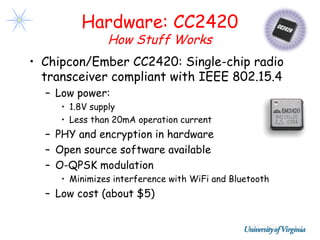
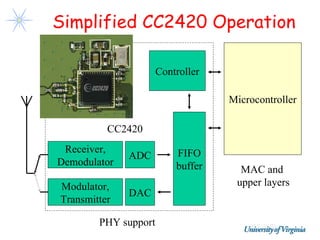
• Chipcon/Ember CC2420: Single-chip radio
  transceiver compliant with IEEE 802.15.4
  – Low power:
     • 1.8V supply
     • Less than 20mA operation current
  – PHY and encryption in hardware
  – Open source software available
  – O-QPSK modulation
     • Minimizes interference with WiFi and Bluetooth
  – Low cost (about $5)
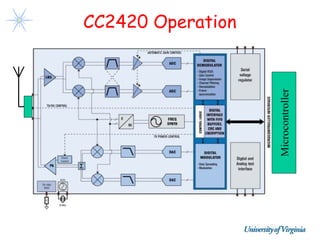
Simplified CC2420 Operation

                      Controller

                                   Microcontroller

          CC2420
 Receiver,                FIFO
              ADC
Demodulator               buffer     MAC and
Modulator,                          upper layers
              DAC
Transmitter

        PHY support
CC2420 Operation


                   Microcontroller
Example
                  Choose Wisely

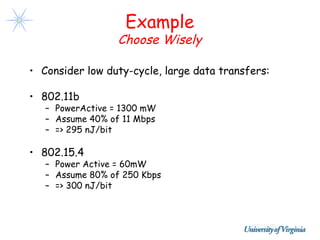
• Consider low duty-cycle, large data transfers:

• 802.11b
   – PowerActive = 1300 mW
   – Assume 40% of 11 Mbps
   – => 295 nJ/bit

• 802.15.4
   – Power Active = 60mW
   – Assume 80% of 250 Kbps
   – => 300 nJ/bit
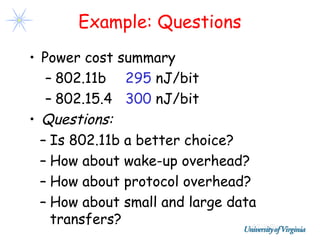
Example: Questions
• Power cost summary
   – 802.11b 295 nJ/bit
   – 802.15.4 300 nJ/bit
• Questions:
  – Is 802.11b a better choice?
  – How about wake-up overhead?
  – How about protocol overhead?
  – How about small and large data
    transfers?
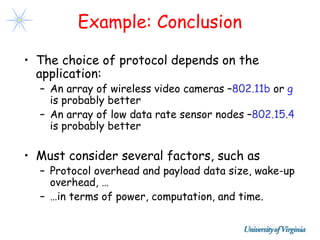
Example: Conclusion

• The choice of protocol depends on the
  application:
  – An array of wireless video cameras –802.11b or g
    is probably better
  – An array of low data rate sensor nodes –802.15.4
    is probably better

• Must consider several factors, such as
  – Protocol overhead and payload data size, wake-up
    overhead, …
  – …in terms of power, computation, and time.
More on Zigbee

• WEB
 – Zigbee Alliance http://www.zigbee.org
 – http://www.palowireless.com/zigbee/
 – 802.15.4 - Task Group 4
   http://ieee802.org/15/pub/TG4.html
 – More on the web
Summary
• Most wireless standards are too power
  hungry and complex for WSN

• Zigbee Alliance proposed Zigbee that targets
  low power WSN systems

• Zigbee is NOT equal to 802.15.4, but extends
  it

• When designing a WSN, one must consider
  various factors before choosing a
  communication’s protocol.
Summary (2):
• ZigBee is a set of protocols for:
  – Low data rate (up to 250kbps)
  – Low Power consumption (months to years
    on batteries)
  – Low cost solution
• ZigBee addressing: 64 bit and 16 bit.
• ZigBee has three types of nodes
  – Coordinator
  – Router
  – End Device

Zigbee intro v5

  • 1.
    etw orks s or N ess Sen Wirel Zig bee c tio n to ntr odu I
  • 2.
    Sensor Network Challenges • Low computational power – Less than 10 MIPS – Low memory budget: 4-10 KB • Limited energy budget – AA batteries provide ~2850 mAh – LiIon and NiMH batteries provide 800-2500 mAh – Solar cells: around 5 mA/cm2 in direct sunlight • Communication?
  • 3.
    Wireless Communication – Wirelesscommunication standards: • IEEE 802.11 a/b/g • Bluetooth • GSM – What makes them unattractive for WSN: • Power hungry (need big batteries) • Complexity (need lots of clock cycles and memory) – New protocol for WSN: • 802.15.4 and Zigbee (ratified in Dec 14, 2004)
  • 4.
    Outline • Why not 802.11 ? • How about Bluetooth? X-10? • What is ZigBee? • ZigBee Protocol: PHY and above • Hardware: CC2420 • Example and discussion
  • 5.
    Technology Space Complexity, Power, Cost 802.11a 802.11b 802.11g 11Mbps 54Mbps Bluetooth 720 kbps 802.15.4 Zigbee 250 kbps “Mica2”/ cc1000 38.4 kbps Data rate
  • 6.
    Wireless Standards ZigBee™ Bluetooth™ Wi-Fi™ GPRS/GSM 802.15.4 802.15.1 802.11b 1XRTT/CDMA Application Monitoring & Cable Web, Video, WAN, Voice/Data Focus Control Replacement Email System Resource 4KB-32KB 250KB+ 1MB+ 16MB+ Battery 100-1000+ 1-7 .1-5 1-7 Life(days) Nodes Per 255/65K+ 7 30 1,000 Network Bandwidth 20-250 720 11,000+ 64-128 (kbps) Range(meters) 1-75+ 1-10+ 1-100 1,000+ Reliable, Cost, Speed, Key Attributes Low Power, Reach, Quality Convenience Flexibility Cost Effective
  • 7.
    Why NOT 802.11? The Cost of Throughput • High data rates – up to 11Mbps for b and – up to 54Mbps for g and a) • Distance up to 300 feet, or more with special antennas • High power consumption – Sources about 1800mA when transceiver is operational.
  • 8.
    IEEE 802.11b example •Consider running a mote with 802.11b on two AA batteries. • Consumes 1800mA when transmitting • Assume NiMH battery capacity 2400mA/h • Assume transmitting 1/3 of the time • How long will the batteries last? • Is the given information sufficient for the question asked?
  • 9.
    How About Bluetooth? ? The Cost of Universalism • Designed for communications between portable and peripheral devices • 720 kbps, 10m range • One master and 7 slave devices in each “Piconet” • Time Division Multiple Access (TDMA) • Frequency hopping to avoid collisions between Piconets – Hop between channels 1600 times a second – 79 channels (1MHz each) to avoid collisions
  • 10.
    Bluetooth (2) • Protocoltailored to many different data types: Audio, Text, Raw data – Makes the protocol rather complex to accommodate for all data types – Needs more memory and clock cycles than we are willing to afford on the Motes • Zigbee needs only about 10-50% of the software in comparison with Bluetooth and WiFi
  • 11.
    How About X-10? ? • Targeted for home automation • Originally used power lines as transmission media. Later RF communication was added. • Mainly used to transmit a few codes to turn on or off other devices, aka. Remote control. • Very simple protocol – 4-bit house code (group address) – 4-bit unit code (device address) – 1-bit on/off command (data)
  • 12.
    X-10 over powerline (PHY) • Data (each bit) transmitted on the zero crossing point of the AC (60Hz) – ‘1’ = 1ms burst of 120kHz – ‘0’ = no burst • All messages are sent twice ‘1’ ‘0’ • Frames are separated by 6 clear crossings • What is the data rate?
  • 13.
    X-10 over RF X-10 device controller • Operates at frequency 310MHz in the US Motion • Has to be compatible sensor with the power-line “bridge” modules • Data rate limited to ~20bps X-10 bridge To power-line • Not ideal for WSN
  • 14.
    X-10 video overRF • X10 has a high data rate extension allowing to transmit video over RF at 2.4GHz – Channel A: 2.411 GHz – Channel B: 2.434 GHz – Channel C: 2.453 GHz – Channel D: 2.473 GHz • Proprietary protocol for NTSC video signal transmission • NOT secure!
  • 15.
    What is Zigbee Affordable Simplicity • ZigBee is a published specification set of high level communication protocols for: – Low data rate, low power, low cost wireless systems operating in unlicensed RF domain • Formely known as – PURLnet, RF-Lite, Firefly, and HomeRF Lite • Based on IEEE 802.15.4
  • 16.
    ZigBee Applications • Wireless home security • Remote thermostats for air conditioner • Remote lighting, drape controller • Call button for elderly and disabled • Universal remote controller to TV and radio • Wireless keyboard, mouse and game pads • Wireless smoke, CO detectors • Industrial and building automation and control (lighting, etc.)
  • 17.
    Zigbee General • Lowpower – battery life multi-month to years • Multiple topologies – star, peer-to-peer, mesh • Addressing space: 64 bits – Question: how many nodes? • Fully hand-shake protocol (reliability) • Range: 50m typical – 5-500m based on environment
  • 18.
    Zigbee Intended Traffic •Periodic data • Intermittent data • Application defined rate (e.g., sensors) • External stimulus defined rate (e.g., light switch) • Low latency data (Q: Any examples?)
  • 19.
    ZigBee and OSIModel OSI 7-Layer Model Technology Examples Layer 7: Application SMTP, FTP, Telnet Layer 6: Presentation ASCII, JPEG, BMP ZigBee… Layer 5: Session RPC Layer 4: Transport TCP, UDP Layer 3: Network IP Layer 2: Data Link • (MAC) Ethernet, ATM 802.15.4 CSMA/CD (Carrier Layer 1: Physical (PHY) Sensing Multiple Access With Collision Detection)
  • 20.
    Zigbee Protocol Stack •ZigBee uses the IEEE 802.15.4 – Low Rate Wireless Personal Area Network (WPAN) standard to describe its lower protocol layers: PHY and MAC *** Layer 2: Data Link (MAC) Layer 1: Physical (PHY) Media
  • 21.
    Zigbee/IEEE 802.15.4 • DualPHY: 2.4GHz and 868/915 MHz • Data rates: – 250 kbps @ 2.4GHz – 40 kbps @ 915MHz – 20 kbps @ 868MHz • Q: Why would anyone want this? • A: Better penetrates obstacles than @2.4GHz • CSMA-CA channel access – Yields high throughput and low latency for low duty cycle devices
  • 22.
    IEEE 802.15 • IEEE802.15 is a working group of IEEE that specializes in Wireless PAN standards – 802.15.1: Bluetooth – 802.15.2: Coexistence of PAN and 802.11 – 802.15.3a: UWB (Wireless USB) » High data rate – 802.15.4: WPAN Low Rate » Low data rate but very long battery life (months/ years)
  • 23.
    ZigBee: PHY • Theradio uses Digital Spread Spectrum Signaling (DSSS) – Conventional DSSS for 868MHz and 915MHz bands – Orthogonal Signaling (4 bits per symbol) for 2.4GHz band • Number of channels – 16 channels in the 2.4GHz ISM band – 10 channels in the 915MHz – one channel in the 868MHz
  • 24.
    ZigBee: MAC • Employs64-bit IEEE & 16-bit short addresses • Three device types specified – Network Coordinator – Full Function Device (FFD) – Reduced Function Device (RFD) • Simple frame structure • Reliable delivery of data • Association/disassociation • AES-128 security • CSMA-CA channel access • Optional superframe structure with beacons • Optional GTS mechanism
  • 25.
    ZigBee as MeshNetworking ZigBee Coordinator ZigBee Router/FFD ZigBee RFD
  • 26.
    PHY – MACInteraction Example PHY MAC Next Layer…
  • 27.
    PHY – MACInteraction (2) PHY MAC Next Layer…
  • 28.
  • 29.
    ZigBee Upper Layers •Messaging • Configurations that can be used • Security: – Key setup and maintenance: Commercial, Residential – Defines key types: Master, Link, Network – CCM (unified, simple mode of operation) – More: Key freshness checks, message integrity, authentication (network and device level) • Network layer (NWK) supports three topologies: – Star – Mesh – Cluster-Tree ( = Star + Mesh)
  • 30.
    How A ZigBeeNetwork Forms • Devices are pre-programmed for their network function – Coordinator scans to find an unused channel to start a network – Router scans to find an active channel to join, then permits other devices to join – End Device will always try to join an existing network • Devices discover other devices in the network providing complementary services – Service Discovery can be initiated from any device within the network • Devices can be bound to other devices offering complementary services – Binding provides a command and control feature for specially identified sets of devices
  • 31.
    ZigBee Stack Architecture: Addressing – Every device has a unique 64 bit MAC address – Upon association, every device receives a unique 16 bit network address – Only the 16 bit network address is used to route packets within the network – Devices retain their 16 bit address if they disconnect from the network, however, if they leave the network, the 16 bit address is re- assigned
  • 32.
    ZigBee Stack Architecture: Addressing (2) – NWK broadcast implemented above the MAC: • NWK address 0xFFFF is the broadcast address • Special algorithm in NWK to propagate the message • “Best Effort” or “Guaranteed Delivery” options • Radius Limited Broadcast feature
  • 33.
    ZigBee Routing • Routing table entry: – Destination Address (2 bytes) – Route status (3 bits) – Next Hop (2 bytes) • Route request command frame: – FrameID, Options, RequestID, Destination Address, Path cost • Route reply command frame: – FrameID, Options, Req.ID, Originator Addr, Responder Addr, Path cost • A device wishing to discover or repair a route issues a route request command frame which is broadcast throughout the network • When the intended destination receives the route request command frame it responds with at least one route reply command frame • Potential routes are evaluated with respect to a routing cost metric at both source and destination
  • 34.
    ZigBee NWK Parameters • nwkMaxDepth and nwkMaxChildren • nwkMaxRouters • Size of the routing table • Size of neighbor table • Size of route discovery table • Number of reserved routing table entries • How many packets to buffer pending route discovery • How many packets to buffer on behalf of end devices • Routing cost calculation • nwkSymLink • nwkUseTreeRouting
  • 35.
    Hardware: CC2420 How Stuff Works • Chipcon/Ember CC2420: Single-chip radio transceiver compliant with IEEE 802.15.4 – Low power: • 1.8V supply • Less than 20mA operation current – PHY and encryption in hardware – Open source software available – O-QPSK modulation • Minimizes interference with WiFi and Bluetooth – Low cost (about $5)
  • 36.
    Simplified CC2420 Operation Controller Microcontroller CC2420 Receiver, FIFO ADC Demodulator buffer MAC and Modulator, upper layers DAC Transmitter PHY support
  • 37.
    CC2420 Operation Microcontroller
  • 38.
    Example Choose Wisely • Consider low duty-cycle, large data transfers: • 802.11b – PowerActive = 1300 mW – Assume 40% of 11 Mbps – => 295 nJ/bit • 802.15.4 – Power Active = 60mW – Assume 80% of 250 Kbps – => 300 nJ/bit
  • 39.
    Example: Questions • Powercost summary – 802.11b 295 nJ/bit – 802.15.4 300 nJ/bit • Questions: – Is 802.11b a better choice? – How about wake-up overhead? – How about protocol overhead? – How about small and large data transfers?
  • 40.
    Example: Conclusion • Thechoice of protocol depends on the application: – An array of wireless video cameras –802.11b or g is probably better – An array of low data rate sensor nodes –802.15.4 is probably better • Must consider several factors, such as – Protocol overhead and payload data size, wake-up overhead, … – …in terms of power, computation, and time.
  • 41.
    More on Zigbee •WEB – Zigbee Alliance http://www.zigbee.org – http://www.palowireless.com/zigbee/ – 802.15.4 - Task Group 4 http://ieee802.org/15/pub/TG4.html – More on the web
  • 42.
    Summary • Most wirelessstandards are too power hungry and complex for WSN • Zigbee Alliance proposed Zigbee that targets low power WSN systems • Zigbee is NOT equal to 802.15.4, but extends it • When designing a WSN, one must consider various factors before choosing a communication’s protocol.
  • 43.
    Summary (2): • ZigBeeis a set of protocols for: – Low data rate (up to 250kbps) – Low Power consumption (months to years on batteries) – Low cost solution • ZigBee addressing: 64 bit and 16 bit. • ZigBee has three types of nodes – Coordinator – Router – End Device