Zigbee
technology
 Submitted By:-PRANJUL MANI RASTOGI
 Branch:-EC-2
 Roll No.:-1214331105
CONTENTS
 What is ZigBee
 ZigBee Technical Goals
 IEEE 802.15.4
 WPANs
 Network Architecture
 ZigBee Device Model
 Operating Modes
 Simulation of ZigBee Networks
 ZigBee Vs other Network Protocols
 ZigBee Applications
 Conclusion
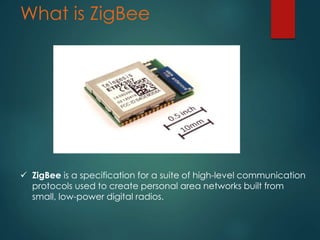
What is ZigBee
 ZigBee is a specification for a suite of high-level communication
protocols used to create personal area networks built from
small, low-power digital radios.
Introduction
 Emerging standardized protocol for Ultra low power Wireless
Personal Area Networks (WPANs)
 ZigBee is an established set of specifications for Wireless
Personal Area Networking (WPAN) i.e, digital radio
connections between computers and related devices.
 ZigBee is targeted at Radio-frequency (RF) applications which
require a low data rate, long battery life, and secure
networking.
 ZigBee networks are secured by 128 bit symmetric
encryption keys
CONTD.
 ZigBee devices can transmit data over long
distances by passing data through a mesh
network of intermediate devices to reach more
distant ones.
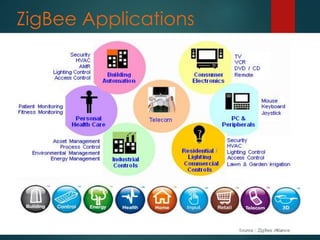
 ZigBee is often used in industrial automation and
physical plant operation.
 ZigBee is based on the Institute of Electrical and
Electronics Engineers Standards
Association's 802.15 specification.
ZigBee Technical Goals
 Maximum data rates allowed for each of these frequency
bands are fixed as 250 kbps @2.4 GHz, 40 kbps @ 915 MHz, and
20 kbps @868 MHz .
 10 to 100 m coverage range.
 Up to 100 collocated networks.
 Up to 2 years of battery life on standard alkaline
Batteries.
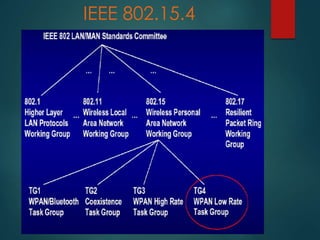
IEEE 802.15.4
IEEE 802.15.4
 IEEE 802.15 is a working group of the Institute of Electrical and
Electronics Engineers (IEEE) IEEE 802 standards committee which
specifies wireless personal area network (WPAN) standards.
 Low-Rate wireless PAN(e.g., ZigBee, WirelessHART, MiWi, etc.)
 Zigbee is set of high level communication protocols based upon the
specification produced by 802.15.4 - standard for wireless personal
area networks (WPANs)
Wireless Personal Area
Network(WPAN)
 A Personal Area Network (PAN) is a computer network used for data
transmission among devices such
as computers,telephones and personal digital assistants.
 Connections are wireless.
 Wireless PAN is based on the standard IEEE 802.15
 Technologies for WPAN:
o Wireless USB
o Bluetooth
o Wifi
o Infrared Data Association
o ZigBee, etc.
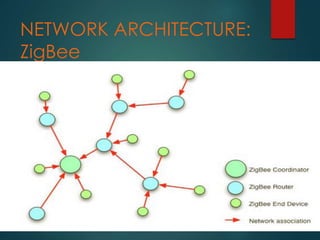
NETWORK ARCHITECTURE:
ZigBee
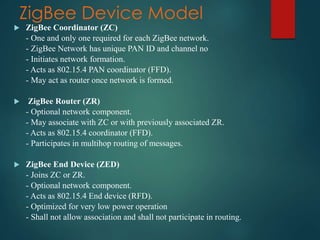
ZigBee Device Model
 ZigBee Coordinator (ZC)
- One and only one required for each ZigBee network.
- ZigBee Network has unique PAN ID and channel no
- Initiates network formation.
- Acts as 802.15.4 PAN coordinator (FFD).
- May act as router once network is formed.
 ZigBee Router (ZR)
- Optional network component.
- May associate with ZC or with previously associated ZR.
- Acts as 802.15.4 coordinator (FFD).
- Participates in multihop routing of messages.
 ZigBee End Device (ZED)
- Joins ZC or ZR.
- Optional network component.
- Acts as 802.15.4 End device (RFD).
- Optimized for very low power operation
- Shall not allow association and shall not participate in routing.
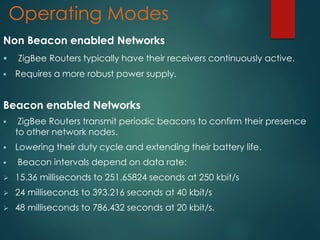
Operating Modes
Non Beacon enabled Networks
 ZigBee Routers typically have their receivers continuously active.
 Requires a more robust power supply.
Beacon enabled Networks
 ZigBee Routers transmit periodic beacons to confirm their presence
to other network nodes.
 Lowering their duty cycle and extending their battery life.
 Beacon intervals depend on data rate:
 15.36 milliseconds to 251.65824 seconds at 250 kbit/s
 24 milliseconds to 393.216 seconds at 40 kbit/s
 48 milliseconds to 786.432 seconds at 20 kbit/s.
Simulation of ZigBee
Networks
 Network simulators, like NS2, OPNET,
and NetSim can be used to simulate IEEE 802.15.4
ZigBee networks.
 These simulators come with open source C or C++
libraries for users to modify. This way users can
determine the validity of new algorithms prior to
hardware implementation.
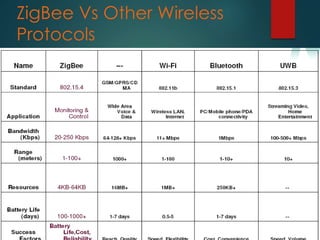
ZigBee Vs Other Wireless
Protocols
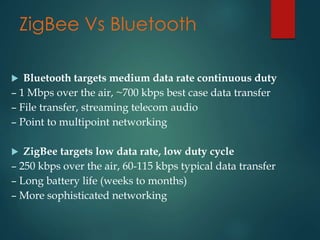
ZigBee Vs Bluetooth
 Bluetooth targets medium data rate continuous duty
– 1 Mbps over the air, ~700 kbps best case data transfer
– File transfer, streaming telecom audio
– Point to multipoint networking
 ZigBee targets low data rate, low duty cycle
– 250 kbps over the air, 60-115 kbps typical data transfer
– Long battery life (weeks to months)
– More sophisticated networking
ZigBee Applications
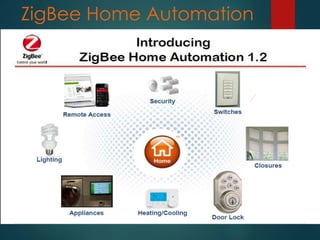
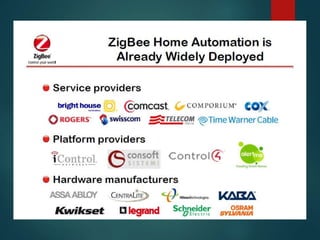
ZigBee Home Automation
CONTD.
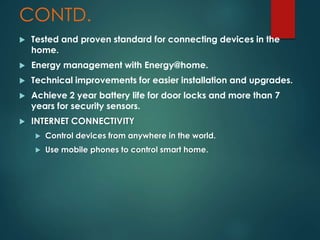
 Tested and proven standard for connecting devices in the
home.
 Energy management with Energy@home.
 Technical improvements for easier installation and upgrades.
 Achieve 2 year battery life for door locks and more than 7
years for security sensors.

 INTERNET CONNECTIVITY
 Control devices from anywhere in the world.
 Use mobile phones to control smart home.
Conclusion
 ZigBee will play a vital role in the mass adoption
of cost effective, low power, mesh networking
technology for monitoring and control
applications, based on an open global standard.
 Near Future more flexibility and cost savings for
consumers and greater control over household
appliances.
 Used for campus-wide electrical and security
systems from a single computer
THANK YOU

Zigbee ppt

  • 1.
    Zigbee technology  Submitted By:-PRANJULMANI RASTOGI  Branch:-EC-2  Roll No.:-1214331105
  • 2.
    CONTENTS  What isZigBee  ZigBee Technical Goals  IEEE 802.15.4  WPANs  Network Architecture  ZigBee Device Model  Operating Modes  Simulation of ZigBee Networks  ZigBee Vs other Network Protocols  ZigBee Applications  Conclusion
  • 3.
    What is ZigBee ZigBee is a specification for a suite of high-level communication protocols used to create personal area networks built from small, low-power digital radios.
  • 4.
    Introduction  Emerging standardizedprotocol for Ultra low power Wireless Personal Area Networks (WPANs)  ZigBee is an established set of specifications for Wireless Personal Area Networking (WPAN) i.e, digital radio connections between computers and related devices.  ZigBee is targeted at Radio-frequency (RF) applications which require a low data rate, long battery life, and secure networking.  ZigBee networks are secured by 128 bit symmetric encryption keys
  • 5.
    CONTD.  ZigBee devicescan transmit data over long distances by passing data through a mesh network of intermediate devices to reach more distant ones.  ZigBee is often used in industrial automation and physical plant operation.  ZigBee is based on the Institute of Electrical and Electronics Engineers Standards Association's 802.15 specification.
  • 6.
    ZigBee Technical Goals Maximum data rates allowed for each of these frequency bands are fixed as 250 kbps @2.4 GHz, 40 kbps @ 915 MHz, and 20 kbps @868 MHz .  10 to 100 m coverage range.  Up to 100 collocated networks.  Up to 2 years of battery life on standard alkaline Batteries.
  • 7.
  • 8.
    IEEE 802.15.4  IEEE802.15 is a working group of the Institute of Electrical and Electronics Engineers (IEEE) IEEE 802 standards committee which specifies wireless personal area network (WPAN) standards.  Low-Rate wireless PAN(e.g., ZigBee, WirelessHART, MiWi, etc.)  Zigbee is set of high level communication protocols based upon the specification produced by 802.15.4 - standard for wireless personal area networks (WPANs)
  • 9.
    Wireless Personal Area Network(WPAN) A Personal Area Network (PAN) is a computer network used for data transmission among devices such as computers,telephones and personal digital assistants.  Connections are wireless.  Wireless PAN is based on the standard IEEE 802.15  Technologies for WPAN: o Wireless USB o Bluetooth o Wifi o Infrared Data Association o ZigBee, etc.
  • 10.
  • 11.
    ZigBee Device Model ZigBee Coordinator (ZC) - One and only one required for each ZigBee network. - ZigBee Network has unique PAN ID and channel no - Initiates network formation. - Acts as 802.15.4 PAN coordinator (FFD). - May act as router once network is formed.  ZigBee Router (ZR) - Optional network component. - May associate with ZC or with previously associated ZR. - Acts as 802.15.4 coordinator (FFD). - Participates in multihop routing of messages.  ZigBee End Device (ZED) - Joins ZC or ZR. - Optional network component. - Acts as 802.15.4 End device (RFD). - Optimized for very low power operation - Shall not allow association and shall not participate in routing.
  • 12.
    Operating Modes Non Beaconenabled Networks  ZigBee Routers typically have their receivers continuously active.  Requires a more robust power supply. Beacon enabled Networks  ZigBee Routers transmit periodic beacons to confirm their presence to other network nodes.  Lowering their duty cycle and extending their battery life.  Beacon intervals depend on data rate:  15.36 milliseconds to 251.65824 seconds at 250 kbit/s  24 milliseconds to 393.216 seconds at 40 kbit/s  48 milliseconds to 786.432 seconds at 20 kbit/s.
  • 13.
    Simulation of ZigBee Networks Network simulators, like NS2, OPNET, and NetSim can be used to simulate IEEE 802.15.4 ZigBee networks.  These simulators come with open source C or C++ libraries for users to modify. This way users can determine the validity of new algorithms prior to hardware implementation.
  • 14.
    ZigBee Vs OtherWireless Protocols
  • 15.
    ZigBee Vs Bluetooth Bluetooth targets medium data rate continuous duty – 1 Mbps over the air, ~700 kbps best case data transfer – File transfer, streaming telecom audio – Point to multipoint networking  ZigBee targets low data rate, low duty cycle – 250 kbps over the air, 60-115 kbps typical data transfer – Long battery life (weeks to months) – More sophisticated networking
  • 16.
  • 17.
  • 18.
    CONTD.  Tested andproven standard for connecting devices in the home.  Energy management with Energy@home.  Technical improvements for easier installation and upgrades.  Achieve 2 year battery life for door locks and more than 7 years for security sensors.  INTERNET CONNECTIVITY  Control devices from anywhere in the world.  Use mobile phones to control smart home.
  • 21.
    Conclusion  ZigBee willplay a vital role in the mass adoption of cost effective, low power, mesh networking technology for monitoring and control applications, based on an open global standard.  Near Future more flexibility and cost savings for consumers and greater control over household appliances.  Used for campus-wide electrical and security systems from a single computer
  • 22.