Seminar Report
On
Presented By
Jadhav Vinayak Alias Nikhil Dadaso
Class:-B.E. ETRX Roll no:-29
Group no.:-10
Under the Guidance of
Prof. Mrs. M. U. Phutane
Outline
 Origin of name ZigBee
 Introduction :-What is ZigBee?
 General characteristics of ZigBee
 Research on ZigBee
 Market Requirements
 How ZigBee Works?
 Basic block diagram
 What is ZigBee Alliance?
 ZigBee Protocol Overview
i. Different Node Types in a ZigBee Network
ii. Different Network Topology in a ZigBee Network
iii. ZigBee / IEEE 802.15.4 Protocol Stack Architecture
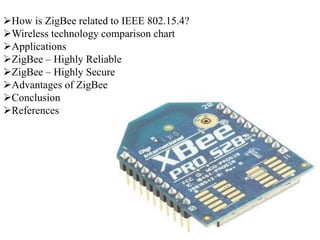
How is ZigBee related to IEEE 802.15.4?
Wireless technology comparison chart
Applications
ZigBee – Highly Reliable
ZigBee – Highly Secure
Advantages of ZigBee
Conclusion
References
Origin Of Name ZigBee
 The domestic honeybee, a colonial insect, lives in a hive that
contains a queen, a few male drones, and thousands of worker bees.
 The survival, success, and future of the colony is dependent upon
continuous communication of vital information between every
member of the colony.
 The technique that honey bees use to communicate new-found
food sources to other members of the colony is referred to as the
ZigBee principle.
 Using this silent, but powerful communication system, whereby
the bee dances in a zig-zag pattern, she is able to share information
such as the location, distance, and direction of a newly discovered
food source to her fellow colony members.
 Instinctively implementing the ZigBee Principle, bees around the
world industriously sustain productive hives and foster future
generations of colony members.
Introduction
What is ZigBee ?
 ZigBee is a Ad-hoc networking technology for Low Rate –Wireless
Personal Area Networks(LR-WPAN).
 Based On IEEE 802.15.4 standard that defines the Physical(PHY)
and Medium Access Control(Mac) Layers for ZigBee.
 The wireless mesh networking standard for monitoring & control
system.
 Intended for 2.45 Ghz , 868 Mhz and 915 Mhz Band.
 Low in cost & power consumption as compared to competing
technologies.
 Simple (self-configuring), Reliable & robust (self-healing) & Flexible
(mesh topology) with high Security (built-in cryptography).
 Intended to network inexpensive devices .
 Data rates touch 250Kbps for 2.45Ghz Global Band ,40 Kbps for
915Mhz North American band and 20Kbps for 868Mhz European
band.
General Characteristics Of ZigBee
 Data rates of 20 kbps and up to 250 kbps
 Star or Peer-to-Peer network topologies
 255 devices per network
 Support for Low Latency Devices
 Carriers Sense Multiple Access/Collision Avoidance(CSMA-CA )
Channel Access
 Fully handshake protocol for transfer reliability
 Low Power Usage consumption
 3 Frequencies bands with 27 channels
 Extremely low duty-cycle (<0.1%)
Research on Zigbee
 The IEEE standard 802.15.4 was completed in May 2003.
 The zigbee specifications were ratified on 14 December 2004.
 The zigbee alliance announced public availability on 13 June
2005.
Papers:
 Time Synchronization for ZigBee Networks
 ZigBee: “Wireless Control That Simply Works”
 Journal of Neuroengineering and Rehabilitation
 Development of Ubiquitous Sensor Network
 Wireless Technologies for Data Acquisition Systems
Much research is still going on with zigbee in various
fields……….
Market Requirements
 Global licence free Industrial, Scientific and Medical(ISM) band
operation
 Unrestricted geographic use
 Automatic/semi-automatic installation
 Ability to add or remove devices
 Possible voice support
 10k-115.2kbps data throughput
 10-75m coverage range (home/garden)
 Support for 32-255 nodes
 Support for 4 critical devices
 4-100 co-located networks
 0.5-2 year battery life
 Up to 5m/sec. (18kmph) permitted mobility
How ZigBee Works?
1.It works on digital radio networks via direct-sequence spread spectrum
coding.
2.Operate on ISM band.
3.ZigBee-compliant radios may operate on one of three different radio
bands: the 868 MHz,2.4GHz or 5.8 GHz frequencies.
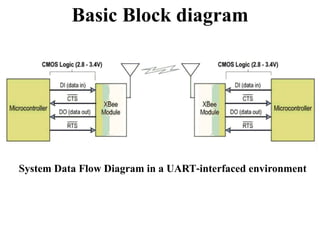
Basic Block diagram
UART Data Flow
System Data Flow Diagram in a UART‐interfaced environment
What is ZigBee Alliance?
 An organization with a mission to define reliable, cost
effective, low-power, wirelessly networked, monitoring and
control products based on an open global standard.
 Alliance provides interoperability, certification testing, and
branding.
ZigBee Protocol Overview
Node Types
Network Topology
Protocol Stack Architecture
ZigBee Protocol Overview
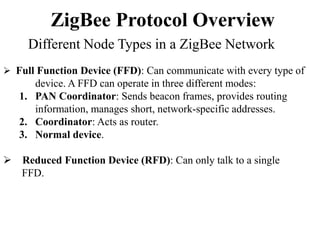
Different Node Types in a ZigBee Network
 Full Function Device (FFD): Can communicate with every type of
device. A FFD can operate in three different modes:
1. PAN Coordinator: Sends beacon frames, provides routing
information, manages short, network-specific addresses.
2. Coordinator: Acts as router.
3. Normal device.
 Reduced Function Device (RFD): Can only talk to a single
FFD.
ZigBee Protocol Overview
Different Network Topology in a ZigBee Network
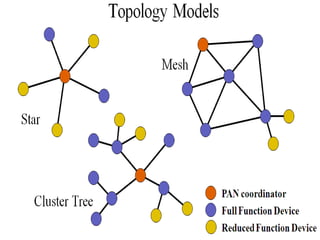
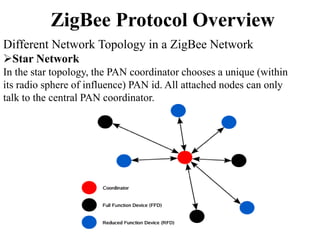
Star Network
In the star topology, the PAN coordinator chooses a unique (within
its radio sphere of influence) PAN id. All attached nodes can only
talk to the central PAN coordinator.
ZigBee Protocol Overview
Different Network Topology in a ZigBee Network
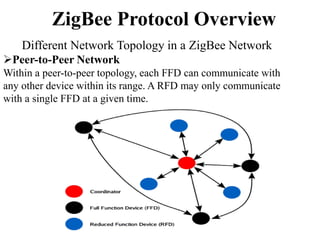
Peer-to-Peer Network
Within a peer-to-peer topology, each FFD can communicate with
any other device within its range. A RFD may only communicate
with a single FFD at a given time.
ZigBee Protocol Overview
Different Network Topology in a ZigBee Network
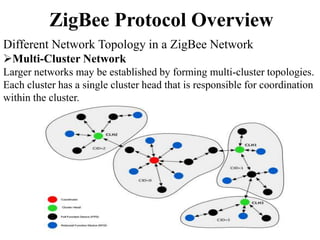
Multi-Cluster Network
Larger networks may be established by forming multi-cluster topologies.
Each cluster has a single cluster head that is responsible for coordination
within the cluster.
ZigBee Protocol Overview
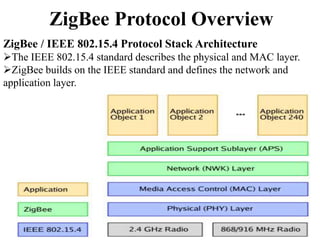
ZigBee / IEEE 802.15.4 Protocol Stack Architecture
The IEEE 802.15.4 standard describes the physical and MAC layer.
ZigBee builds on the IEEE standard and defines the network and
application layer.
ZigBee Protocol Overview
Physical(PHY) Layer
The physical layer is responsible for:
a) Activation/Deactivation of transceiver.
b) Channel selection, assessment.
c) Transmission and reception of packets.
d) Frequency bands: 2.4 GHz (worldwide), 868 MHz (EU),
916MHz(US)
Medium Access Control(MAC) Layer
The following services are provided by the MAC layer:
a) Beacon management
b) Channel access
c) Guaranteed Time Slot (GTS) management
d) Frame validation
e) Acknowledgment
f) Association, disassociation
ZigBee Protocol Overview
Network(NWK) Layer
The lower level of the ZigBee protocol builds on the MAC layer of
IEEE 802.15.4.
 Topology specific routing
 Security
 New device configuration
 Network startup
 Joining/leaving a network
 Addressing
 Neighbour discovery
 Route discovery
 Reception control
ZigBee Protocol Overview
Application Layer
The application layer provides the following services:
 Maintain tables for binding
 Fragmentation, reassembly and reliable data transport
 Provide communication endpoints for the application
 Discovering devices and application services.
 Initiating/responding to binding requests between
endpoints
Addressing
 Each ZigBee node has a unique 64 bit MAC address
 Additionally the Coordinator maintains a table to map the
64 bit addresses to network-specific 16 bit addresses
 Within each node, the application can define up to 240
Application endpoints.
How is ZigBee related to IEEE
802.15.4?
 ZigBee takes full advantage of a powerful physical radio
specified by IEEE 802.15.4
 ZigBee adds logical network, security and application
software
 ZigBee continues to work closely with the IEEE to ensure an
integrated and complete solution for the market
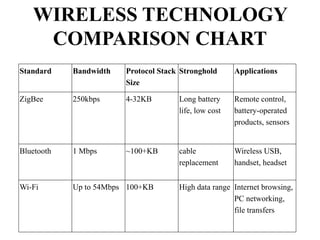
Standard Bandwidth Protocol Stack
Size
Stronghold Applications
ZigBee 250kbps 4-32KB Long battery
life, low cost
Remote control,
battery-operated
products, sensors
Bluetooth 1 Mbps ~100+KB cable
replacement
Wireless USB,
handset, headset
Wi-Fi Up to 54Mbps 100+KB High data range Internet browsing,
PC networking,
file transfers
WIRELESS TECHNOLOGY
COMPARISON CHART
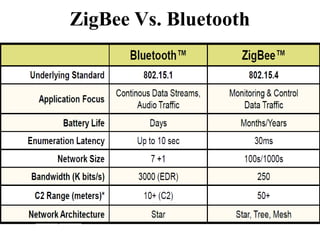
ZigBee Vs. Bluetooth
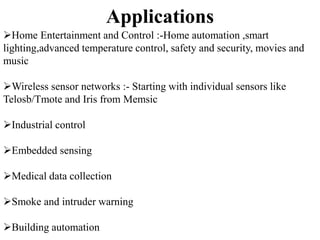
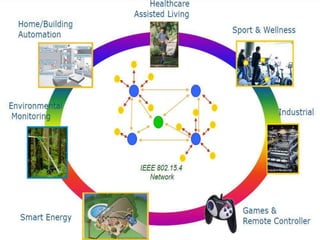
Applications
Home Entertainment and Control :-Home automation ,smart
lighting,advanced temperature control, safety and security, movies and
music
Wireless sensor networks :- Starting with individual sensors like
Telosb/Tmote and Iris from Memsic
Industrial control
Embedded sensing
Medical data collection
Smoke and intruder warning
Building automation
ZigBee – Highly Reliable
 Mesh and tree networking protocol provides
redundant paths
 Automatic retries and acknowledgements
 Broadcast delivery scheme ensures reliable
broadcasts across the network
 Parents keep track of messages for sleeping
Children
 High intrinsic interference tolerance
 Multiple channels
 Frequency agility
 Robust modulation
ZigBee – Highly Secure
Utilizes Advanced Encryption Standard(AES) 128-bit
encryption
Concept of a “trust center”
Link and network keys
Authentication and encryption
Security can be customized for the application
Keys can be “hard-wired” into application
Advantages of ZigBee
 Reliable and self healing
 Supports large number of nodes
 Easy to deploy
 Very long battery life
 Secure
 Low cost
 Can be used globally
Conclusion
 ZigBee will play a vital role in the mass adoption of cost
effective, low power, mesh networking technology for monitoring
and control applications, based on an open global standard.
 Near Future more flexibility and cost savings for consumers
and greater control over household appliances.
 Used for campus-wide electrical and security systems from a
single computer.
 In future all devices and their controls will be based
on this standard.Since Wireless personal Area Networking
applies not only to household devices, but also to individualized
office automation applications, ZigBee is here to stay. It is more
than likely the basis of future home networking solutions………
• IEEE® 802.15.4 OEM RF Modules by MaxStream, Inc.
• http://www.ember.com
• SPZB32W SeriesofIEEE 802.15.4 RF Modules ,by Gabriel Uribe 28 September
2011
• http://www.zigbee.org/en/about/faq.asp
• http://www.zigbee.org/en/resources/#SlidePresentations
• [ZigBee / IEEE 802.15.4 draft 18]
• http://www.technologyreview.com/articles/04/08/wo_brown081904.asp
• file://Seminar%20Zigbee/PowerPoint%20Presentations%20Of%20Electronics
%20And%20Communication%20Engineering%20_%20PowerPoint%20Prese
ntations.htm
• http://www.wisegeek.com/what-is-
zigbee.htm?referrer=adwords_campaign=zigbee_ad=013761&_content_kw=wh
at%20is%20zigbee
• http://www.zigbee.org/resources/documents/IWAS_presentation_Mar04_Desig
ning_with_802154_and_zigbee.ppt
• http://en.wikipedia.org/wiki/ZigBee
• http://www.zigbee.org/imwp/idms/popups/pop_download.asp?ContentID=7092
• http://www.zigbee.org/en/spec_download/download_request.asp
References
Zigbee technology [autosaved]

Zigbee technology [autosaved]

  • 1.
    Seminar Report On Presented By JadhavVinayak Alias Nikhil Dadaso Class:-B.E. ETRX Roll no:-29 Group no.:-10 Under the Guidance of Prof. Mrs. M. U. Phutane
  • 2.
    Outline  Origin ofname ZigBee  Introduction :-What is ZigBee?  General characteristics of ZigBee  Research on ZigBee  Market Requirements  How ZigBee Works?  Basic block diagram  What is ZigBee Alliance?  ZigBee Protocol Overview i. Different Node Types in a ZigBee Network ii. Different Network Topology in a ZigBee Network iii. ZigBee / IEEE 802.15.4 Protocol Stack Architecture
  • 3.
    How is ZigBeerelated to IEEE 802.15.4? Wireless technology comparison chart Applications ZigBee – Highly Reliable ZigBee – Highly Secure Advantages of ZigBee Conclusion References
  • 4.
    Origin Of NameZigBee  The domestic honeybee, a colonial insect, lives in a hive that contains a queen, a few male drones, and thousands of worker bees.  The survival, success, and future of the colony is dependent upon continuous communication of vital information between every member of the colony.  The technique that honey bees use to communicate new-found food sources to other members of the colony is referred to as the ZigBee principle.  Using this silent, but powerful communication system, whereby the bee dances in a zig-zag pattern, she is able to share information such as the location, distance, and direction of a newly discovered food source to her fellow colony members.  Instinctively implementing the ZigBee Principle, bees around the world industriously sustain productive hives and foster future generations of colony members.
  • 5.
    Introduction What is ZigBee?  ZigBee is a Ad-hoc networking technology for Low Rate –Wireless Personal Area Networks(LR-WPAN).  Based On IEEE 802.15.4 standard that defines the Physical(PHY) and Medium Access Control(Mac) Layers for ZigBee.  The wireless mesh networking standard for monitoring & control system.  Intended for 2.45 Ghz , 868 Mhz and 915 Mhz Band.
  • 6.
     Low incost & power consumption as compared to competing technologies.  Simple (self-configuring), Reliable & robust (self-healing) & Flexible (mesh topology) with high Security (built-in cryptography).  Intended to network inexpensive devices .  Data rates touch 250Kbps for 2.45Ghz Global Band ,40 Kbps for 915Mhz North American band and 20Kbps for 868Mhz European band.
  • 7.
    General Characteristics OfZigBee  Data rates of 20 kbps and up to 250 kbps  Star or Peer-to-Peer network topologies  255 devices per network  Support for Low Latency Devices  Carriers Sense Multiple Access/Collision Avoidance(CSMA-CA ) Channel Access  Fully handshake protocol for transfer reliability  Low Power Usage consumption  3 Frequencies bands with 27 channels  Extremely low duty-cycle (<0.1%)
  • 8.
    Research on Zigbee The IEEE standard 802.15.4 was completed in May 2003.  The zigbee specifications were ratified on 14 December 2004.  The zigbee alliance announced public availability on 13 June 2005. Papers:  Time Synchronization for ZigBee Networks  ZigBee: “Wireless Control That Simply Works”  Journal of Neuroengineering and Rehabilitation  Development of Ubiquitous Sensor Network  Wireless Technologies for Data Acquisition Systems Much research is still going on with zigbee in various fields……….
  • 9.
    Market Requirements  Globallicence free Industrial, Scientific and Medical(ISM) band operation  Unrestricted geographic use  Automatic/semi-automatic installation  Ability to add or remove devices  Possible voice support  10k-115.2kbps data throughput  10-75m coverage range (home/garden)  Support for 32-255 nodes  Support for 4 critical devices  4-100 co-located networks  0.5-2 year battery life  Up to 5m/sec. (18kmph) permitted mobility
  • 10.
    How ZigBee Works? 1.Itworks on digital radio networks via direct-sequence spread spectrum coding. 2.Operate on ISM band. 3.ZigBee-compliant radios may operate on one of three different radio bands: the 868 MHz,2.4GHz or 5.8 GHz frequencies.
  • 11.
    Basic Block diagram UARTData Flow System Data Flow Diagram in a UART‐interfaced environment
  • 13.
    What is ZigBeeAlliance?  An organization with a mission to define reliable, cost effective, low-power, wirelessly networked, monitoring and control products based on an open global standard.  Alliance provides interoperability, certification testing, and branding.
  • 14.
    ZigBee Protocol Overview NodeTypes Network Topology Protocol Stack Architecture
  • 15.
    ZigBee Protocol Overview DifferentNode Types in a ZigBee Network  Full Function Device (FFD): Can communicate with every type of device. A FFD can operate in three different modes: 1. PAN Coordinator: Sends beacon frames, provides routing information, manages short, network-specific addresses. 2. Coordinator: Acts as router. 3. Normal device.  Reduced Function Device (RFD): Can only talk to a single FFD.
  • 17.
    ZigBee Protocol Overview DifferentNetwork Topology in a ZigBee Network Star Network In the star topology, the PAN coordinator chooses a unique (within its radio sphere of influence) PAN id. All attached nodes can only talk to the central PAN coordinator.
  • 18.
    ZigBee Protocol Overview DifferentNetwork Topology in a ZigBee Network Peer-to-Peer Network Within a peer-to-peer topology, each FFD can communicate with any other device within its range. A RFD may only communicate with a single FFD at a given time.
  • 19.
    ZigBee Protocol Overview DifferentNetwork Topology in a ZigBee Network Multi-Cluster Network Larger networks may be established by forming multi-cluster topologies. Each cluster has a single cluster head that is responsible for coordination within the cluster.
  • 20.
    ZigBee Protocol Overview ZigBee/ IEEE 802.15.4 Protocol Stack Architecture The IEEE 802.15.4 standard describes the physical and MAC layer. ZigBee builds on the IEEE standard and defines the network and application layer.
  • 21.
    ZigBee Protocol Overview Physical(PHY)Layer The physical layer is responsible for: a) Activation/Deactivation of transceiver. b) Channel selection, assessment. c) Transmission and reception of packets. d) Frequency bands: 2.4 GHz (worldwide), 868 MHz (EU), 916MHz(US) Medium Access Control(MAC) Layer The following services are provided by the MAC layer: a) Beacon management b) Channel access c) Guaranteed Time Slot (GTS) management d) Frame validation e) Acknowledgment f) Association, disassociation
  • 22.
    ZigBee Protocol Overview Network(NWK)Layer The lower level of the ZigBee protocol builds on the MAC layer of IEEE 802.15.4.  Topology specific routing  Security  New device configuration  Network startup  Joining/leaving a network  Addressing  Neighbour discovery  Route discovery  Reception control
  • 23.
    ZigBee Protocol Overview ApplicationLayer The application layer provides the following services:  Maintain tables for binding  Fragmentation, reassembly and reliable data transport  Provide communication endpoints for the application  Discovering devices and application services.  Initiating/responding to binding requests between endpoints Addressing  Each ZigBee node has a unique 64 bit MAC address  Additionally the Coordinator maintains a table to map the 64 bit addresses to network-specific 16 bit addresses  Within each node, the application can define up to 240 Application endpoints.
  • 24.
    How is ZigBeerelated to IEEE 802.15.4?  ZigBee takes full advantage of a powerful physical radio specified by IEEE 802.15.4  ZigBee adds logical network, security and application software  ZigBee continues to work closely with the IEEE to ensure an integrated and complete solution for the market
  • 25.
    Standard Bandwidth ProtocolStack Size Stronghold Applications ZigBee 250kbps 4-32KB Long battery life, low cost Remote control, battery-operated products, sensors Bluetooth 1 Mbps ~100+KB cable replacement Wireless USB, handset, headset Wi-Fi Up to 54Mbps 100+KB High data range Internet browsing, PC networking, file transfers WIRELESS TECHNOLOGY COMPARISON CHART
  • 26.
  • 27.
    Applications Home Entertainment andControl :-Home automation ,smart lighting,advanced temperature control, safety and security, movies and music Wireless sensor networks :- Starting with individual sensors like Telosb/Tmote and Iris from Memsic Industrial control Embedded sensing Medical data collection Smoke and intruder warning Building automation
  • 29.
    ZigBee – HighlyReliable  Mesh and tree networking protocol provides redundant paths  Automatic retries and acknowledgements  Broadcast delivery scheme ensures reliable broadcasts across the network  Parents keep track of messages for sleeping Children  High intrinsic interference tolerance  Multiple channels  Frequency agility  Robust modulation
  • 30.
    ZigBee – HighlySecure Utilizes Advanced Encryption Standard(AES) 128-bit encryption Concept of a “trust center” Link and network keys Authentication and encryption Security can be customized for the application Keys can be “hard-wired” into application
  • 31.
    Advantages of ZigBee Reliable and self healing  Supports large number of nodes  Easy to deploy  Very long battery life  Secure  Low cost  Can be used globally
  • 32.
    Conclusion  ZigBee willplay a vital role in the mass adoption of cost effective, low power, mesh networking technology for monitoring and control applications, based on an open global standard.  Near Future more flexibility and cost savings for consumers and greater control over household appliances.  Used for campus-wide electrical and security systems from a single computer.  In future all devices and their controls will be based on this standard.Since Wireless personal Area Networking applies not only to household devices, but also to individualized office automation applications, ZigBee is here to stay. It is more than likely the basis of future home networking solutions………
  • 33.
    • IEEE® 802.15.4OEM RF Modules by MaxStream, Inc. • http://www.ember.com • SPZB32W SeriesofIEEE 802.15.4 RF Modules ,by Gabriel Uribe 28 September 2011 • http://www.zigbee.org/en/about/faq.asp • http://www.zigbee.org/en/resources/#SlidePresentations • [ZigBee / IEEE 802.15.4 draft 18] • http://www.technologyreview.com/articles/04/08/wo_brown081904.asp • file://Seminar%20Zigbee/PowerPoint%20Presentations%20Of%20Electronics %20And%20Communication%20Engineering%20_%20PowerPoint%20Prese ntations.htm • http://www.wisegeek.com/what-is- zigbee.htm?referrer=adwords_campaign=zigbee_ad=013761&_content_kw=wh at%20is%20zigbee • http://www.zigbee.org/resources/documents/IWAS_presentation_Mar04_Desig ning_with_802154_and_zigbee.ppt • http://en.wikipedia.org/wiki/ZigBee • http://www.zigbee.org/imwp/idms/popups/pop_download.asp?ContentID=7092 • http://www.zigbee.org/en/spec_download/download_request.asp References